NOTE: This week’s update is a transcription of a live interview done as part of the Tilly’s Trans Tuesdays podcast. Special thanks to Duna Mae Cat for the transcription!
Welcome to Trans Tuesday! This week, we’re gonna talk about an amazing trans theater festival here in Los Angeles, and the good news is the entire thing will be livestreamed, so you can watch it from anywhere. Let’s talk about THE JOY WHO LIVED.
Tilly Bridges: Hi, I’m Tilly Bridges, your host, and I’m joined by my writing partner, my best friend, my wife, our token cis representation, the biggest joy in my life, Susan Bridges.
Susan Bridges: Hello!
TB: Our guest this week is Aurora Zenith, a trans producer, performer, and musician with over a decade of experience producing live events. She is a producer and co-founder of podcast network Dragon Wagon Radio, and most recently was production coordinator for the narrative short Out for Delivery, which premiered at the 2025 Sundance Film Festival. Welcome, Aurora!
Aurora Zenith: Hi! Thanks for having me, I’m so excited to be here!
TB: Of course, and… Working on a film that got into Sundance, that’s pretty cool.
SB: Yeah, right?
AZ: It is very cool, thank you. Humble brag a little bit, but I mostly am just the beneficiary of my incredibly talented best friend, who is the director and writer of that short. She is a force to be reckoned with, and I was fortunate enough to, like, get to lend a hand, and follow along to Sundance, which was such an incredible experience.
TB: That’s amazing. Like, we know, because we just made a short last year, and it’s still going through the festival circuit, and it is brutal trying to get into festivals, so… Sundance is huge.
AZ: Yeah it’s tough, and I think, you know, I can’t talk from a lot of experience here, but I know Chelsea has had many films that have gone through the festival circuit, and it’s always a grind. But until this one, which for whatever reason really struck a chord with folks, and we got into Sundance, we also got into South by Southwest and, I think we’re closing the run this month, with 31 festivals under our belt, which is really cool.
TB: That’s amazing. We should be so lucky.
AZ: You will be! It’ll happen!
TB: Oh, well, thank you.
AZ: I’m putting it out there.
TB: All right, before we get started, we usually have a few questions we like to ask our guests so the listeners can get to know you better. So, for you, what has been the best thing about transitioning?
AZ: Oh my god. Where do I begin?
TB: There’s a lot, right? There’s a lot of really good stuff.
AZ: There is a lot. I… have… Wow. I mean, my life is, like, completely different than it was before I transitioned, and everything is better. I think if I had to pick one singular, like, very concrete thing that I could point to, it’s that I… and this is, I know, not everyone’s experience, so I feel very, very fortunate that this is my experience: I had chronic anxiety and depression as long as I was alive, and always believed that that was just something I was going to have to manage forever.
I don’t have that anymore, and that is crazy to me. So, my day-to-day baseline enjoyment of life is so much higher, and, I mean, I think it just really comes from getting to finally be myself, you know?
TB: Yeah, I mean, I don’t… I didn’t have depression and anxiety in the same way, but I was really badly affected by dysphoria and life was awful, and I felt awful all the time, and, like, the wildest thing to me is finding out once that went away from transition, and I started to feel better and alive, like, I’m an extrovert? What? What?
AZ: Oh my god, Tilly, me too!
TB: Really?
AZ: I was always like, I’m an introvert! Meh.
TB: Yeah.
AZ: And, like, in the last couple years, I’m like, “actually, I think I’m an extrovert.” Like, it’s crazy to go from “social situations drain me” to, like, “social situations fill my cup.” Like…
TB: Yes! Yes!
AZ: It’s a wild thing.
TB: It’s bananas. I did not think anything like that was possible. It turned out I just didn’t want to be perceived as the wrong person, and suddenly…
AZ: Yeah! It turns out that performing to everyone all the time is exhausting.
TB: Right? Who would have thought?
TB: Okay, well then, on the flip side of that, what has been one of the most difficult parts of transition for you?
AZ: Oh, that’s a good question. It has been overwhelmingly positive. So it’s, like, hard to… but of course there’s hard things. I think, like, maybe one of the hardest things, and this feels like a little embarrassing to say in, like, a strange way, but, like transitioning from being perceived as a cis man to being perceived as a trans woman, and losing all of that privilege that comes with being a cis man is a hard. Like, I knew, but I didn’t know. You know what I mean? I have so many friends who were cis women and trans women and… and, like, I knew… but experiencing it firsthand is very, very different. And oh my god, and then this last couple of years has made it even crazier. And so there was really, like, a learning curve of just, like, how do I feel okay when suddenly I have to worry about things like my safety? And people taking me seriously at work, and, men saying creepy things to me, and all of these other things that come with it. So, I think that was the hardest thing.
TB: Yeah, that’s fair. I mean, I don’t think trans women pre-transition experience male privilege the way cis men do, because, you know, we never conform to exactly what they expect, and they will punish us for it. But we were conferred a bit of that, like, if we walked into a room and nobody had interacted with us and didn’t know us, we were given that male privilege, and it just changes everything. Like, I remember it changed so much for [Susan] when I transitioned, because you were like, at being cis, you’re like… now you’re the one with more power in society, or more… people will listen to you more than they will listen to me. Whereas before, as I was a very tall, perceived cis white man, everybody would listen to me, until I started not conforming, and then I was punished, but…
SB: Yeah, yeah, and you were like… if it was a public transit situation, I would feel much more secure with you, and now all that’s gone. Don’t get that anymore.
TB: I’m still very tall and buff.
SB: True.
TB: But I am perceived as a very transy woman, so…
SB: So, yeah.
AZ: Yeah, you’re powerful, Tilly. You’re powerful, for sure.
TB: Thank you!
AZ: Yeah. No, that’s so true. I read something somewhere that I thought was really astute, which is, male privilege when you’re cis comes free. But when you’re trans, male privilege when you’re cis-presenting comes at a cost, right? And so it’s like… it isn’t exactly the same, for sure. I would never, like… I was the victim of so much patriarchy, as many cis men are as well, actually. But yeah, the way people perceive you does make a difference in your experience moving through the world.
TB: Yeah, my favorite story about that is, the week that I came out, a man that I was often in meetings with suddenly repeated the thing that I said back like it was his, and I’m like, at least he sees me as a woman, so…
AZ: I call that ewwphoria.
TB: Ewwphoria, yes exactly! Like, thanks for seeing me as a lady, but that’s gross. Okay.
AZ: Yep. Yep.
TB: Well, all right, let’s get into talking about The Joy Who Lived. This is a trans theater and comedy festival in its second year here in LA, and I only found out about it when it was all planned, and I first heard about it and went to see some of the shows in the first year. And it was such a moving experience for me, to see all this beautiful trans art that was made completely without cis gatekeepers. And these were our stories told by us, and we need so much more of that. And I’m so happy that I get to be part of it this year, but I’m not gonna go too much into detail about that, because everybody listening has heard me pitch that, and the festival itself, at the beginning of all the last few episodes, and this episode. So, did you want to let folks know how the festival came about, and how you first got involved with it?
AZ: Yeah, so… my getting involved with the festival, Tilly, is really similar to yours. I, like, was not involved the first year, and I was actually, like, you know, something I think about all the time is how grateful I am to be living in LA, how fortunate I am. Because, like, you know… I go to, like, all my favorite places in LA, like Vidiots, and Geeky Teas, and I’m surrounded by trans people. And then I’m like, “hmm, I’d like to take a writing class. I bet there’s a trans writing class.” And I google “trans writing class,” and sure enough, Maddox’s writing class, The Joy Who Lived, pops up, and I’m like, of course, I’m in LA, of course there’s a trans writing class.
And so that was my introduction to Joy Who Lived, is I was really searching for… I was honestly searching for two things. I was searching for more trans community, and I was searching for more opportunity to be creative and reconnect with my creative roots. And Joy Who Lived kind of fit both those criteria. And so, going to that class, I got to perform in a showcase at the festival, and then I also went to a ton of shows at the festival, went to some of the parties, met the folks working on Joy Who Lived, and basically was like, “I love this!”
It was so meaningful to me, to see trans people coming together and being creative and bringing so much joy into everything they were doing. And yeah, it was just… it, like, came along at, like, kind of the perfect moment for me. And so, I basically just started saying, “hey, I really want… next year, let me know, because I would love to help.” And, back over the summer, Laser, who is the founder and artistic director for Joy Who Lived, was like, “hey, we’d love you to come help be part of the steering committee this year.” So now this year, I am operations coordinator, and also part of the programming committee, and it’s been really fun working on it this year. It’s been honestly, like, so rewarding, especially, frankly, with every… I mean, this is like, of course, everything has its caveat right now, especially with everything going on in the world. Like, it has felt very, very good to sink my time into something that feels like it’s helping other trans people. And is empowering for other trans people. So that’s a little bit of my story. I know, like, Joy Who Lived when it first started, I think the story that Laser and the other two founders, Maddox and Petey, like to talk about is that this was originally counter-programming to the [transphobic wizard play] play coming to town, which I love.
TB: And then that makes sense where the name came from, if you are familiar with those books, so yeah. Because I remember the first… the festival last year, it was… about the same time as it is this year, like, March… late March, early April. And that was not long after… I mean, that was, like, what, a couple months after the inauguration, after that horrible election, and so I was just… I felt so bad, and then going to see that, and see all this trans art was just… it, like, healed me somewhat, you know? It was just this beautiful thing, like, “we can still do this”. They can’t stop us, and we’re gonna make all this great trans stuff, and I’m so glad that we get to be part of it. Like, I wouldn’t have even found out about it if we didn’t make our short film, because our short film starred Griffin Kelly. And she was like, hey, I have a show this week. I would love for all of you to come see it. She’s amazing. And we’re like, what is this show? And it was part of the festival, it was her show in the festival last year, and we got the program, I was like, “look at all of this! It’s amazing!” And then we went to a whole bunch more, so… yeah, it was great. And she stars in our show this year, because we love working with her, she’s… disgustingly talented.
SB: Yes.
AZ: Yeah, she’s incredibly talented. I think she’s in, like, every show this year, maybe? She’s so good.
SB: I would believe that!
TB: It was wild watching the reels of actors who applied to be in our show, and she was, like, in a bunch of their reels. Just incidentally, like, she works in so many things, and she was at all of their stuff. So what does the steering committee do? What is it that you do, like, to help the festival exactly?
AZ: Yeah, I mean, we’re… it’s basically a group of volunteers, that just come together to, like, plan and execute the festival. And so, last year, I know this was… it was really, like, Laser, Petey, and Maddox just on their own, seat of their pants, like, throwing it all together. And this year, there’s about, oh gosh, I think there’s, like 15 of us that are helping out in different ways. So, that’s huge. It means that Laser doesn’t have to do everything, and Petey and Maddox don’t have to do everything, which is great. But it also means we get to do a lot more, which is really cool. The thing that I am really focused on is the operations piece, so, like basically the website design, how we ingest… like, setting up all the forms and doing all the backend… all the backend tomfoolery to make sure that we’re, like, able to ingest everything and make sure it’s all working. I’m sure you’ve used the producer portal and things like this. These are all things I’ve built.
TB: It’s so organized and helpful, it’s amazing!
AZ: Thank you!
TB: Very professional.
AZ: Yeah, and then the other piece is I was part of the programming committee, so that means literally, as you know, going through and interviewing folks who had submitted shows, reviewing show submissions, and deciding what we’re gonna program in this year’s festival. It was a huge undertaking. We had, like, I think 86 or something show submissions, and then we had, I think 150 actors submit as talent. It was a lot to go through, and… you know, so heartbreaking that we can’t program everything. It’s only a two-week festival. There were so many incredible submissions.
It was really hard to sort of finalize, but I feel really proud of the lineup we have this year, including your show, that I’m so excited for. And I think it’s gonna be a really fun festival.
TB: Thanks, I’m very excited for it, yeah, it’s… like, there was the schedule that was posted, and, like, it only had the titles of shows, but I was very intrigued by a lot of them.
AZ: Yeah, more is coming, more is coming.
TB: And before we get too far and I forget, I did want to mention that Laser has been a guest on this show, and I meant to look up the episodes ahead of time, and I forgot, but they were back in the single digits. He was one of the first guests we ever had, I think, or, like, in maybe 10, 11, 12. So, way back when.
SB: It would have been a while ago.
TB: It was a while ago, yes. Go back and look, you’ll find them, he’s great.
SB: Find Laser! That’s your homework.
[Laser was guest on episodes 5 and 6 of the podcast, on WHAT REAL CIS ACCEPTANCE LOOKS LIKE and THE SIGNS WERE ALWAYS THERE.]
AZ: Find laser, it’s good advice, good advice. Laser knows what he’s doing.
TB: At the very least, you’ll have an amazing conversation. What has the festival meant to you, personally, like, compared to other projects that you’ve worked on? Like, you’re a creative, you know, you’ve worked on a lot of other things. So, like, is it… different, this, for you, like, emotionally? Or do you feel more attached to it, or…
AZ: I mean, you know, something I said to my best friend after the first steering committee meeting we had was, “I feel like I found my people.” Like… it just felt like, “oh, like this feeling I have of being on the outside all the time, I, like, suddenly don’t have working with the folks that are putting on The Joy Who Lived.” Because it really is this perfect Venn diagram of my interests, which are being trans and doing live shows. So, yeah, I mean, it really, for me… working on this has brought such a sense of belonging, which is huge. The piece I already mentioned, which is just, like, the impact. Like, one of my favorite things about the festival and the way that especially Laser and Maddox think about the festival (Maddox is the Director of Education, for those of you that don’t know) is that it’s a… the way Laser puts it is, it’s a learning festival. So you don’t have to have a perfectly polished show to necessarily get programmed in the festival. You could be someone who needs help putting on a show, and we will help you, and we will connect you with other trans talent.
TB: Can verify!
AZ: Yeah, and there’s all these workshops we’re doing during the festival, too, so if you, like, aren’t even ready to put on a show, but you just want to dip your toes in, you can. And I think the ethos is very much like… so many of us have this experience as trans people of, like, totally starting our life over from scratch at, like, 30. And sometimes you don’t have 20 years of acting experience to fall back on, and you’re starting new, and you need a little help. And so I think a lot of the way that we approach the festival is, how can we give folks that help? And that feels so meaningful to me, rather than it being sort of a gatekeepy, like, you know… let’s try to be really, really inclusive. And I think the fact that it’s online and remote, as well as, you know… all of that. We try to do as much as we can to make it accessible to folks. And that’s really, really important to me.
TB: Yeah, that meant a lot to us last year, because a lot of shows we haven’t been able to go to, because there’s, like, no masking policy, you know? And it would be kind of dangerous. And I could not believe that the festival last year required masks in the audience for everybody, for every show. And they’re doing it again this year, and that’s just wild to me. It’s so amazing! And like, we have never done a live show before, and so I can definitely confirm that you are very encouraging and helpful to people who have no idea what the hell we’re doing, so… thank you!
AZ: That’s great! We’re all in it together, because I don’t know what I’m doing either, so we’re gonna… we’re gonna figure it out.
TB: Yeah, I mean, that feels very trans in the best way, right? Like, we help each other through, even if we don’t know everything, we’re not gonna gatekeep each other, we’re all just gonna work together and make something cool. And I love that so much.
AZ: Yep, exactly.
SB: Oh, and also [American sign language] will be for some shows. And some are on request. If someone wants to request ASL, they can.
AZ: Yeah, and in fact, if anyone has any accessibility needs, we are going to be putting accessibility information on the website soon. And if there’s anything that’s not there that would enable you to be at a show, reach out to us, and we will try to figure it out.
TB: They will, because they’re really good people, it’s amazing. And there’s sliding scale tickets, I think, for almost every show, or all shows? I’m not sure if every show has it, but I think so? Most of them?
AZ: It’s a little bit show-dependent, but yeah, as much as possible, we try to offer a sliding scale. And the great thing, too, is that between last year and this year, Joy Who Lived is now part of a non-profit. Laser started a nonprofit called Trans Stories, and so the other really nice part is a lot of our money for, like, the venue and the tech comes from funding that we do, rather than ticket sales, which means all the ticket sales… well, 90% of the ticket sales, get to go towards the artists. So the other… the other part of this is, like, we want to be able to pay people. So, that also feels really important to me.
TB: Yeah, like, we did a profit split with our whole cast, so that we told them exactly how much percentage of whatever the ticket sales are that they’re gonna get. And I love that we get to pay them for that, because you’re paying us for that, and it’s all just so wonderful. And you mentioned those classes… I’m also going to be holding one of those classes! I forgot the date and time. Stay tuned to future episodes, I will mention it. But it’s a class on writing television pilots and pitching, and I’m very excited to do that with a bunch of trans people who want to learn how to write those things. So, it’s just… The vibes are so good.
AZ: The vibes are good!
TB: They’re so good! If people listening would like to get involved with the festival beyond buying tickets, or attending or watching the streaming shows, how can they do that?
AZ: joywholived.com is where you’re gonna go for all the information. We are… right now, we have volunteer submissions that are open. So if you’re interested in, like, being involved more directly, and wanting to help out at the festival itself, we need people to handle cash, we need people to run merch booths, we need people to help set up parties, we need people to design sets and help construct sets. So, literally, looking for everything. You can submit to volunteer for the festival through the website. And then tickets are gonna be going on sale really soon [They are on sale now!], and we’ll be we’ll have tickets for the in-person shows here in Los Angeles, but also streaming shows. So, almost every show is streaming, and so, even if you’re not based out of LA, you can still, enjoy the incredible talent. And we’re bringing in folks from outside LA, too, which I’m really excited about. I don’t think we had this last year. This year is the first time we have some folks from outside LA who are coming, I’m putting on a show as part of Joy Who Lived, so that’s really fun.
TB: It is really cool, and I remember in one of the producer meetings, they were saying it’s not even just, like, one static camera with a wide shot of the stage. There’s gonna be multiple cameras, and you’re gonna be able to see facial expressions. So it’s gonna be, like, a really good livestream.
AZ: The livestreams look good! I watched a couple of livestreamed shows for Joy Who Lived last year, and I’m always like… LA is just so good at this, honestly. Like, every venue has a legit setup for livestream, yeah, and it always looks amazing, so…
SB: I know we’ve all had that livestream experience where it just wasn’t very good, and you’re just like…
TB: You can’t see anything, the sound is echoey, you can barely understand it, and that is not what this is. I wanna tell you…
SB: This is a quality experience.
TB: Alright, well, are there any last thoughts that you wanted to share with folks, or one last pitch to get them to see the festival, or anything like that?
AZ: I’m just gonna say… we would love to have you there. Cis allies are welcome. Like, obviously, come support your trans community and your trans friends, and, trans people: I love you, I want to meet… I have, like, my, like, toxic trait is I want to meet every single trans person I see, so please come hang out. And, yeah, it’s just gonna be such a good time. joywholived.com. I guess one little plug I will make for myself is that I am gonna be part of one of the shows. I’m in a show called Genderchella, which is, like, mini-Coachella for queers.
TB: I love it!
AZ: And I’m gonna be playing a couple of original songs as part of that,on April 4th. I’m a singer-songwriter and a musician in a past life, and I’m trying to get… trying to get back out there. So, that’s gonna be really fun, and yeah, there’s just a ton of great shows. All the information on all the shows is on joywholived.com, and we’ll be, making tickets available very soon.
TB: Excellent. Thank you for being here, Aurora!
AZ: Thank you, Susan. Thank you, Tilly. This was so nice, I’m so grateful to you for having me.
TB: We were delighted to have you on, and I am so excited to get the whole world excited for these shows. I may be overestimating the reach of this podcast, but I can dream.
Friends, the Joy Who Lived is such an important celebration of trans art, trans culture, and trans people. Please, check out joywholived.com and support all this great trans art. Our world needs it so, so badly right now.
Tilly Bridges, end transmission.
tillysbridges@gmail.com
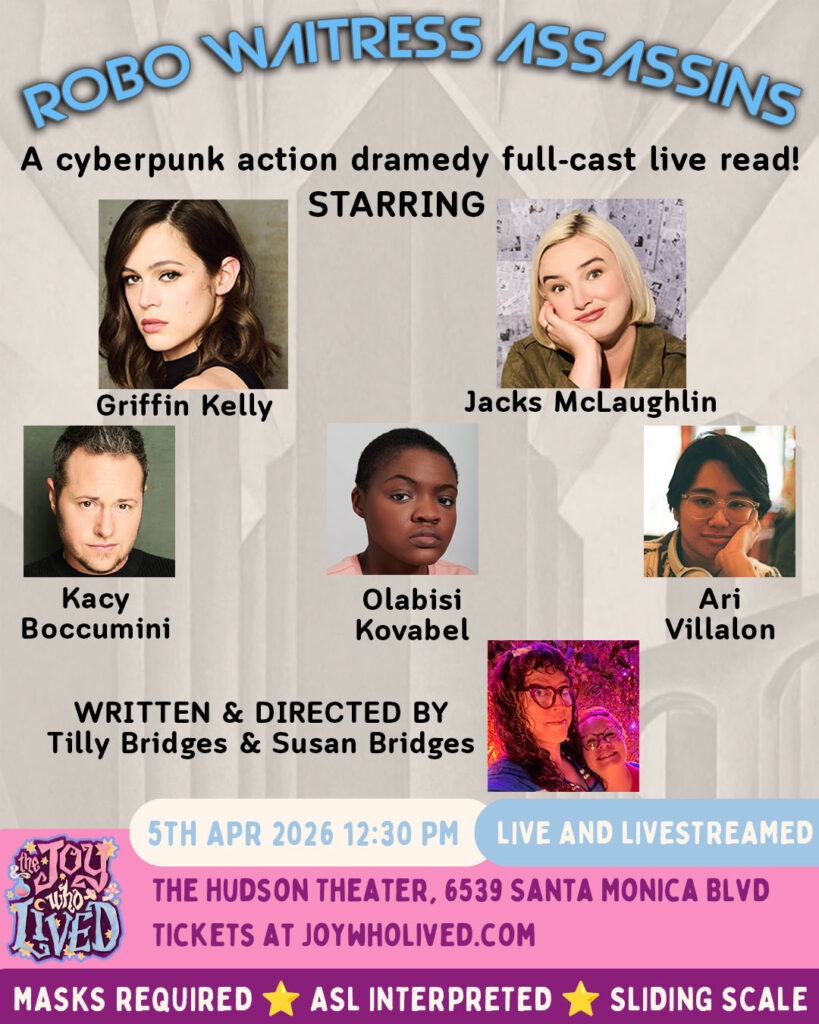
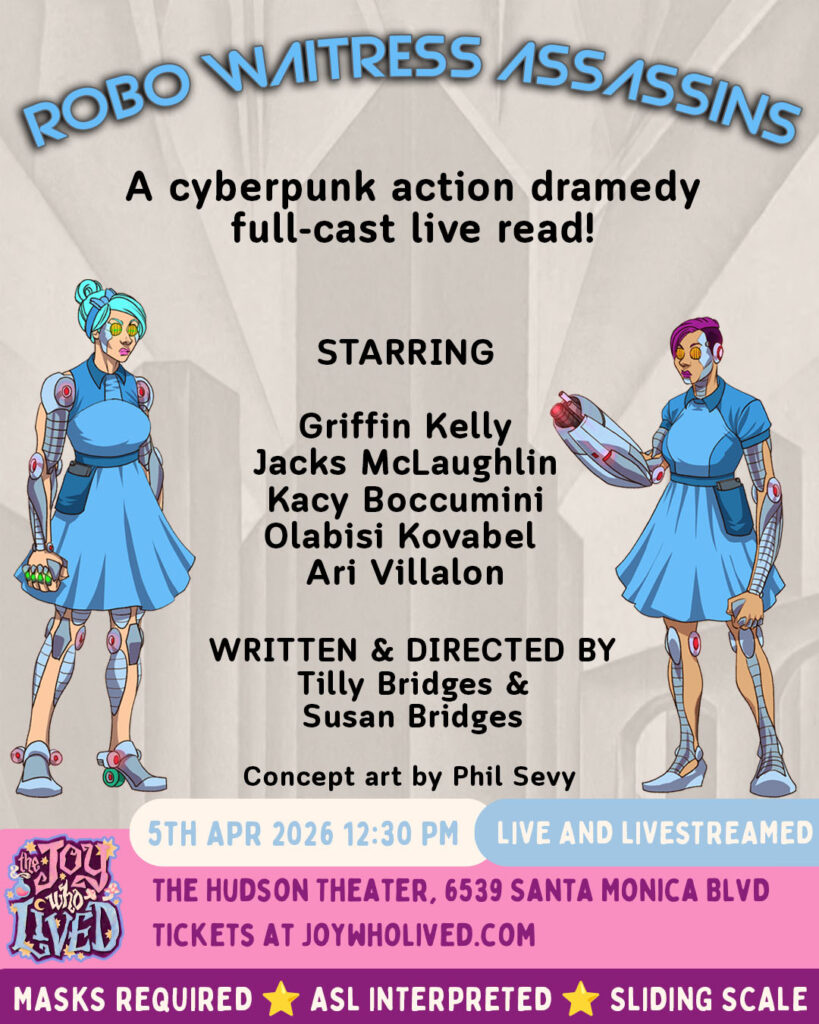
Here’s the show Susan and I are writing and directing… a full-cast live read/performance of our original queer trans cyberpunk action dramedy pilot, ROBO WAITRESS ASSASSINS!
April 5, 2026, 12:30-1:30 pm pacific. In-person in Los Angeles, and livestream, tickets on sale now!