NOTE: This week’s update is a transcription of a live interview done as part of the Tilly’s Trans Tuesdays podcast. Special thanks to Nicole Lynn Ó Catháin for the transcription! (Look for her at Seattle Reign women’s soccer matches – she’s the one waving the trans pride flag with the Valkyrie crown!)
Tilly Bridges: Welcome to Tilly’s Trans Tuesdays. This week, we interview Jadzia Axelrod, a fellow comic writer who’s authored some graphic novels that have become easy favorites of mine, and they’ll be favorites of yours, too, if you know what’s good for you.
TB: Hi, I’m Tilly Bridges, your host, and I’m joined by my writing partner, my best friend, my wife, our token cis representation, the only fellow graphic novel author I live with, Susan Bridges.
Susan Bridges: Hello!
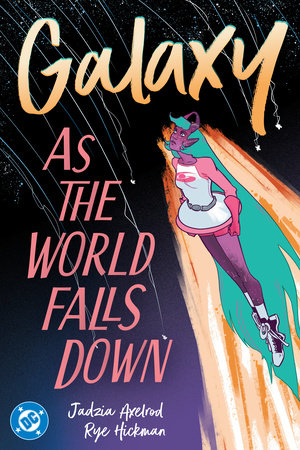
TB: Our guest this week, as you likely surmised from the intro, because you’re very smart, is Jadzia Axelrod, author of Galaxy: The Prettiest Star, Galaxy As The World Falls Down, Hawk Girl: Once Upon a Galaxy, and Justice League Intergalactic for DC Comics, the DC Book of Pride for DK, stories in the Sharp Wit and the Company of Women and When We Were Young anthologies, as well as comics for Tor, Quirk Books, and Epic! Books. She lives in Philadelphia, where she cooks needlessly elaborate meals for her wonderful wife and delightful child. Welcome, Jadzia!
Jadzia Axelrod: Oh, thank you for having me! It’s great to be here!
TB: Okay, so before we get into talking about your fabulous writing, I wanted to ask you about your fabulous cooking, because not only are those meals elaborate, they are tremendously well photographed.
JA: Thank you!
TB: They look like shots from a cookbook, and they always make me starve. So, how did you get into cooking, and how do you photograph them so well? What’s the appeal to all that for you?
JA: Well, let me answer the second one first. My wife is a professional photographer. Years ago, when we both worked at a newspaper, she would take pictures for the food reviewer and so she would go to restaurants after the reviewer had been there in secret, and go there and tell them that she was there to take photos of very specific dishes. So they would do it up real nice and fancy like they would never do if you were just ordering it, and then she would take pictures. So I learned all the tricks watching her, because of course I went ’cause then I got to eat the food.
TB: Of course!
JA: Right? And it was win-win. So I learned all the tricks on how to shoot food really nice just by watching her do it for months and months, years.
SB: Wow.
JA: So, I’ve been taking my own pictures, got all those secrets. As far as interest in cooking, it’s been something I’ve always done. I’ve had a love of it since as a child that continues to this day. I’m really into eating and that –
TB: Same! (laughs)
JA: – goes hand in hand with like, well, if you want to eat really good food, you should learn how to cook really good food, and then you will always have really good food on hand. As a result, we are raising our child in an ingredient house, which I didn’t realize I was doing until someone pointed it out. Which is fine but it means that now they have to also learn how to cook, which they’re learning and had a passion for fora while. We did a thing where they made dinner on Mondays, which was amazing.
TB: That’s great!
JA: Yeah! We have some kids’ cookbooks for them. It’s really wonderful.
TB: I remember one of the first times our kid cooked for us and I ate it, told him it was good and the look on his face was the most beautiful thing.
JA: Aww.
TB: Yeah! Does it scratch the same creative itch for you as writing?
JA: No, it’s completely different.
TB: Okay.
JA: (laughs)
TB: That’s fine.
JA: Which is why I like it. Cooking is very restorative. This is how I decompress at the end of the day – by cooking something. Which is not how cooking is for everyone and I recognize that. For some people, it’s just another chore. But for me, it is almost a meditative act of restoration.
TB: That’s really cool.
JA: Which is not writing. Writing is something else.
TB: It sure is. I know there are a lot of professional chefs who approach it from a creative standpoint, sort of the same way we do writing. It’s wild that it can be so very different for everyone who does it. I don’t know. You cook a lot, how do you feel? Is it creative in the same way to you or is it….
SB: No!
TB: No.
SB: It’s definitely different and it depends on what you’re making cause cooking and baking are completely different.
TB: Sure.
SB: I find….I just feel like I’m letting our child down because trying to teach him, it’s impossible for me to keep everything in my head at the same time. So, actually, this Thanksgiving, I have him help on these occasions, but I definitely put the pumpkin pie in the oven and then realized I had not added sweetener to it, of any kind. Then I had to pull it out and dump it in and be like I’m gonna do this, and it’s gonna probably be ok.
TB: That’s kinda like writing. I’m just saying.
SB: I guess it is. It was fine.
JA: But when you’re teaching someone, you do have to follow the rules. And something that I’ve been having problems with… I can eyeball now a teaspoon, a tablespoon, all of that. I don’t need to measure. But they can’t. They just started. I have to bring out the measuring spoons so that they can learn to eyeball it later.
SB: It changes your process and then it throws you off
JA: It does!
SB: Cause you’re like, wait, this isn’t how I normally do it. And then because brains are like this – like, you changed one thing-
TB: And now I’m gonna forget everything you did. Yes. Thanks, brain.
SB: Thanks, brains.
TB: All right, well, for you, what has been the best thing about transitioning?
JA: Oh! I used so much brainpower trying to deny being trans.
TB: Yeah.
JA: There was so much of my brain that was spent self-policing and self-editing, and constantly being outside of myself in the fear that anyone would realize or recognize what was going on. So to be free from that, and to be able to use all of my brain, all of the time, for everything that I do, from writing to parenting to cooking, to all of that, just to be constantly present in a way that I never was before has been magical.
TB: I feel like it made me a better writer, a better spouse, a better parent. It opened up the whole world to me in new ways. I discovered I’m kinda extroverted when I thought I was introverted – no, I just didn’t want to be perceived as that person. And it’s so wild, like now, I love trying new foods and before, I never could because it was too much. I couldn’t process it because I was dealing with so much at the time. I was like, “I can’t handle anything else. No. Same stuff all the time.” It’s an absolutely wild thing discovering what the world really is when you can be in it. What? You have a look.
SB: I’m just thinking of how your family could not cook at all.
TB: Well, that’s a different story.
SB: Like, 4 or 5 recipes that I’ve never heard of in my life.
TB: Yes, if it didn’t come from a box or a can, my mother didn’t cook it.
SB: I would tell you that’s not a recipe, that’s a list of pantry ingredients. That is not, y’know, okay.
TB: Well, on the flip side of that, what has been the worst, or maybe most difficult part for you?
JA: I mean, it’s all… a lot of it’s been very great, I want to preface. So this is… this is a difficult question. I think in, like, the first handful of years, like that first five or six6 or four years, it was really difficult because the hormones hadn’t quite kicked in yet.
TB: Yeah.
JA: Right? And, like, I’m… I’m a large person, I have broad shoulders…
TB: Same.
JA: And especially when I was starting out and there was no curves to speak of, like, it was definitely a male body. It was a male body that was trying very hard to present in a feminine way, and that, I think, led to a lot of confusion on the parts of people I interacted with, as far as to what box to put this person in, “Do I relate to them as a man, or do I relate to them as a woman? I don’t have a middle one.” And now that I am more clearly a woman, I don’t get that as much, but there was a long time of just not being interacted with at all. People avoiding me, or interacting with me as little as possible, because the social roles that they were used to no longer applied in that scenario. And this was really difficult, at that time in my transition. It was really difficult to be early on, and my kid, as a new mom, and wanting to connect with other moms, and them not knowing how to relate to me.
Not to say that no one did. I did… I do have some very wonderful friends that I met who are mothers, are still friends to this day, and I cherish them so much. But, like, it was really hard, and very difficult, and very isolating, in a way that I didn’t clock until it started to not be. And then I was like, whoa, things were bad, and I didn’t even realize, because so much else was going on.
TB: Yeah, right.
JA: But it’s good now. So, when my presentation caught up to my identity, things got a lot better. And now, I was just at the beach, just hanging out in a bikini. And, like, another woman came up and just talked to me like, yeah, we’re just two women on the beach, just having a chit-chat, talking about her vacation. And it was just a really nice moment of her, like, deciding what box I was in, and then treating me as such, which was correct and wonderful. And, like, and that’s what happens now, but it took… it took a while to get there, and that’s part of why those early transition years are so difficult.
TB: Yeah, I think it’s extra hard, because, like, for all of us who transition as adults, we feel like we’ve been waiting so long. And then you start, and it’s still not what you want it to be, and it takes so long to get there. It’s just such a slow process, so…
JA: Yeah, we all want to skip to the end.
TB: We do! We want to jump right through. Okay, well, let’s get into what you’re here to talk about, your comic writing, and very specifically, your Galaxy graphic novels. And I don’t want to be too spoilery for folks who haven’t read them yet, but Galaxy is an alien with her own mythos and culture that comes to Earth and sort of integrates into the larger DC Comics universe. And so I wanted you to sort of tell us a little bit about how you created her, and where she came from as a concept.
JA: Well, that kind of story is something that’s been kicking around in my head for a long time. And then I got the opportunity to pitch some stuff to DC at the start of their YA line.
Because this was… the original pitch was so long ago. They were just starting the YA line and, I talked to the editors of DC, and sent them like 4 pitches. And then right at the bottom, I put what would become Galaxy, even though they specifically told me not to pitch original characters. Because that was not what they were doing, but it was like, I have to put this in, or…
TB: It doesn’t hurt if you just put one in there, right?
JA: Right, it’s at the bottom, it doesn’t count.
SB: You probably didn’t read that anyway, right? I mean…..
JA: Yeah, it’s 2 sentences. Like, it’s fine, there’s other stuff with Superman in it, you’ll be fine. So when I put that in, it was just something that I wanted to do and I’ve kind of been poking at for a while. And so, to get this opportunity was something that I couldn’t waste.
So I did that, and then that was the one they picked. So then I had to develop it more than just an idea of trans alien on Earth and like… actually pull it together. Thankfully, I had a really good guide in that with the editors, especially Sarah Miller, who edited the book, and, like, really kind of bringing that whole thing into focus. But it was really just, like, something that coalesced with the pitch. But beyond that, it was something that I had been poking and prodding for a while because, like, I’d always felt like an alien because of being trans.
TB: Relatable.
JA: Yeah, right. And, like, so that seemed like a natural metaphor to put in there, and having recently transitioned when I pitched, which is, like… I think I’d only been trans, like, a year, if even. The life of Galaxy and the life of my transition, very similar. So to have those emotions, they were still very raw, and still very real, and it was still very easy to tap into that.
TB: Yeah, I feel that really shows in the first book, because I read it not too long after I had come out, I think it was, like, a couple years, and so it was all very fresh for me, too. And it felt like it was my story, almost, you know? And so I love that.
JA: I love that too.
TB: Yeah, well, is this what you always hoped for her? I mean, I know it was just sort of a nebulous concept, but, like, did you always want her to be part of a larger, like, existing superhero world, rather than off on her own?
JA: I never thought she would be. I mean, I wanted to, sure.
TB: It’s something that rarely ever happens anymore, yeah.
JA: I was 100% certain that the book was gonna flop, that I had somehow conned them into letting me tell this story, and then no one was gonna buy it. But it was okay, because I had had my shot, I had done the story I wanted to do, that was my DC Comics experience, and I was better for it. And it would never happen again, and that character certainly would never be used ever, ever again. So the fact that the book became a hit, and that they wanted to move her into the main DCU, was a surprise. One I was ready for, absolutely excited to do it, but it was not something that I even allowed myself to imagine. I was 100% certain that nothing was going to happen with that book after it was published.
TB: Yeah, it feels….
JA: And I was wrong.
TB: You sure were. It feels like such a rare gem. Like, new characters in, like, the DC and Marvel Universe, they’re so rare. And when they come up, they’re usually directed by editorial, perhaps, or part of a larger thing. So to have an original creation of yours become part of that universe is just, like, so cool. That’s, like, the dream! You’re living it. It’s so good.
JA: Yeah, and it’s… it is really unusual. Like, I was talking to a marketing person not long after it was published, and she’s like, “I’ve never seen an audience come around a new character like this before. That never happens.” So, like, right off the bat, like, she had fans and people who were loving the book and loving the character, which is amazing. Superhero comics in particular are kind of a backwards-looking medium. We want the stuff that we read when we were kids, but for adults now. And that’s still… that’s very much the thing that goes on now. And so to have a new character who is not connected to an existing character in any way, beyond some feints at Superman… it’s really astounding to have her, one, exist, and be so embraced by the fan community, and also editorial, and to have her be in Hawkgirl, and then in Justice League, and it’s really wonderful, and I’m really fortunate to have it all happen.
TB: It’s the coolest thing.
JA: It’s pretty great.
TB: Did you have to change any of the things that you intended to do with her to make her fit in the larger DC universe?
JA: No.
TB: No?
JA: No.
TB: That’s amazing.
JA: Yeah, we’re in a in a particularly writer-focused era of DC, which is really nice. A lot of the writers, not just me, but other people working at DC, are given the space to do the stories that they want to tell, which has been really amazing. So hopefully that continues, and I get to tell all the Galaxy stories I want to tell. But yeah, I haven’t had to change anything about it, and I think there’s a lot of resistance to… in general, and we saw this with Tim Drake coming out, there’s a lot of resistance to these characters, even if their sexuality’s been hinted at for decades, to have it be explicit creates some backlash, because that’s not how people imagine it. They miss the hints, they miss stuff, because that’s not what they were reading.
And so to have a character like Galaxy, who was very trans and very queer right off- right from jump, that’s the whole point of the book. It’s no big deal to have her then make out with her girlfriend in Hawkgirl, because she already did that in the YA book. Why shouldn’t she do that in the regular one?
TB: And more!
JA: And more! Yeah, we did a lot in that YA book, so, like, anything we do in the superhero thing, we’ve already covered that ground, so…
TB: Yeah!
JA: And that’s been really great.
TB: It’s great that you were able to do that, though, like, from the start. Because, you know, we have experience writing in larger universes with things, and whenever you try to take an established character and reveal something new about them, that maybe you didn’t know ahead of time, you get accused of changing the characters, right? You know, like… we would approach editors and be like, what if this character has actually been a trans woman all along, and you didn’t know, because nothing in her story that was ever revealed said that she was cis? You just assumed she was. You know, the presumption of cisness. And they’re like, “no, you can’t change the character.” We’re like, technically, that’s not a change. It’s just a fact you didn’t know. Maybe she also hates pizza. You didn’t know that either. Now you do. It’s just another fact that you didn’t know. But they don’t always see it that way.
SB: But we digress.
TB: All right, for anyone listening, maybe who has not read Galaxy: The Prettiest Star, or maybe doesn’t even usually read comics or graphic novels, do you want to give them the sort of soft pitch for the book?
JA: Oh, sure! Yeah, so Galaxy: The Prettiest Star is about Taylor Barzelay, who is a sparkly space princess…
TB: Yes she is!
JA: ….whose planet was overrun, and she is hiding out on Earth. In Galaxy: The Prettiest Star, she is disguised as a human. She’s also disguised as a boy, because she was assigned male at birth. And as the story goes on, she meets the new girl in town, Kat Silverberg. They have a relationship, and that disguise becomes harder and harder to keep up. And eventually, she reveals herself as her cool, sparkly space princess alien self, with the superpowers that come along with it, because it’s a DC Comics story, and all aliens have superpowers. And… and that’s pretty much the… what happens in Galaxy: The Prettiest Star. What’s fun is that in Galaxy: As the World Falls Down, we get to move beyond the coming out story.
TB: Yeah!
JA: And talk about, like, what do you do after you come out, and how do you find your community once you come out? Which is a story that we don’t often get. We always… we’ve gotten a lot… I don’t want to say we’ve gotten a lot, because there’s still not that many queer stories…
TB: Yeah, sadly.
JA: Especially trans coming out stories, right? So, like, of the trans stories we get, most of them are focused on the coming out. So it was nice to tell a story that was not about that, but about what happens after.
TB: Yeah, and she’s got a really unique… both visual design, but, like, power set, too. Like, I’ve not seen a character like that before, and it’s hard to come up with brand new powers you haven’t seen before.
JA: Boy is it ever! That was one of the things I had to do, in addition to create her own alien world and make it be different than anything else that DC already had going on, but also give her a power set that was not just copying someone else. So to have her be someone who can, like, perceive and manipulate the energies around her was neat, and a very powerful power to do. But also a nice kind of metaphor as far as, like, being a trans person and being very aware of, like, the way the energy changes when you’re in a room. Being aware of the microaggressions that someone else might not see or sense.
And so to have that metaphor be locked into her powers in that way, and to make her sensitive in that way, but in a way that then allowed her to take control of that sensitivity. And it’s like, yes, she’s aware of the things that are around her, and also she can change that, and make that to suit her, was a really fun power fantasy. So it made for a really fun power set.
TB: Yeah. Well, I want to add that in addition to your pitch for Galaxy there, that when I first read the first book, I loved it so much that I posted about it, way back on the bad site, Twitter, and I went and found my post, because I have my old archive. And I wrote: “it touched my heart in specific trans ways that so little does, and that people should hire more of us trans creators, and if I’d had this book as a kid, it would have been life-changing to be so seen and understood for the first time,” so…
JA: Oh my gosh!
TB: It meant so much to me, and I wanted to… relatedly, like, what has the response been? Like, I know people love it, but, like, have you heard from kids, or teens, or adults, that it meant a lot to?
JA: So many. It’s been so amazing. My heart is full to bursting with all the messages that people have sent me about this book and how much it meant to them. I got a message from a mom of a trans kid who, she carries the book with her in her backpack to school every day as, like, a kind of… Yeah, as, like, a little talisman or, like, some sort of sympathetic armor to get through the day. And I keep getting messages. I got two this week of people who, parents who had these… who had given their trans kids this book, and that they loved it and identified with it, and it meant so much. So it’s really wonderful that it’s… it’s reaching those people, but it’s also reaching people who, like myself, transitioned later in life, and like, the dedication of the first book is, like, to the girl who needed this book ages ago and couldn’t find it.
TB: Yeah, that was me, thank you.
JA: (laughs) No problem. It was a lot of people, and it’s continued to touch a lot of people, because I… I did want to write the book that I needed as a kid. And it’s so wonderful that the kids who need it now are getting it, and are able to be inspired, and to be… confident in their lives because of that book. We talk about superheroes as what they’re supposed to do is inspire. And, like, sometimes that happens, and sometimes it doesn’t, for certain. But it’s really nice to see it happen, and to see it happen with Galaxy, and it’s really wonderful.
TB: Yeah, it’s the best feeling. Because as a creator, you know, you put these stories out there, and you hope that it’s going to connect with people, that the people who need it will find it. And when it does, oh, it is the most magical thing in the entire world. But I just want to say that I was lucky enough to not only read an early copy of the follow-up, Galaxy: As the World Falls Down, but I was also asked to blurb it, that’s very exciting for me.
JA: And a very nice blurb you provided, too!
TB: Oh, well, thank you. But I found it even better than the first book, which I would not have thought was possible, because I love the first book so, so much. And I think, like, you totally outdid yourself. And Rye Hickman’s art, oh my god, is so gorgeous. So perfect.
JA: Rye’s amazing. I love working with Rye. I will work with Rye as long as they’ll have me.
TB: Yes, yes, they’re so good. So, do you feel… I mean, I think I have my own answer for this, but do you feel that people who have not read the first Galaxy graphic novel can pick up As The World Falls Down and start there, if they’re intrigued by this? Or do you feel like they should get the first one?
JA: Oh, you should definitely start with one, you should always start with one. Right? Like, that’s the truth of any series. Could you pick it up cold? For sure. I like to think that we catch everybody up pretty quickly in the first handful of pages.
TB: You do, yeah.
JA: If they were coming in without having read number one, but, like, I mean… because of the way it works to be part of an interconnected series of stories, like you said, the ideal reading order is, of course, Galaxy: The Prettiest Star, and then Nicole Maines’ Bad Dream: A Dreamer Story, in which Galaxy appears, and then Galaxy: As The World Falls Down. So that’s, like, the ideal reading order, if you were looking for it. Which is, like simultaneously the second book and also the third book, depending on how you look at it. But, you could come into it cold. You can do anything you like, there’s no rules.
TB: No rules. Read it whichever way you want.
JA: Yeah, yeah, I think it works as its own, number one, but, like, it is better if you read it having read Galaxy: The Prettiest Star, and even better if you’ve read it and read Bad Dream.
TB: Yeah, there are so many references and little callbacks to The Prettiest Star, but also Bad Dream, which I really love. And I love their friendship, like, they’re the two trans lady superheroes in DC, and they’re, like, best friends, and it’s so great.
JA: Yeah, there’s a bunch of trans characters in DC, which is wonderful, but I… I love that Dreamer and Galaxy get to be friends, I love that. Because so often the trans characters are siloed, and like, here is the one because…
TB: The one, the token.
JA: Right? Like, here’s the trans character in the Wonder Woman section, here’s the Bat trans character, here’s that. And so, to have these two who not only are in the same, like, area, but also get to be friends, and to have that friendship has been so meaningful. And it’s meant that I have a friendship now with Nicole, which has been wonderful, and something that I cherish. So, it’s really great that also our characters get to be friends.
TB: Yeah, she’s wonderful. We’ve gotten to hang with her a few times and she’s amazing.
JA: She’s the best.
TB: Well, I have been a DC fangirl for my entire life, and I would have loved to introduce a new trans woman who was a superhero to that universe, and you actually did it! You did the thing, and I’m so glad you did, and Galaxy is so important to me, so…
JA: Yeah, it’s… it’s funny, too, because, like, when I pitched it, which, again, years ago, because it takes so long to make a book, as you know.
TB: Yeah.
JA: Nicole hadn’t been cast as Dreamer yet.
TB: Oh, it was before she was even on the Supergirl show?
JA: It was before she was… so there wasn’t anyone. Yeah. It takes so long to get a book done. And then the pandemic happened, so it took even longer.
TB: Yeah, yeah.
JA: But it’s, like. it’s before she’d been cast, and, like, there wasn’t, there wasn’t really a trans… like, Alysia Yeoh was there, but she’s not a superhero.
TB: Yeah.
JA: So…when I was doing it, I don’t think I thought about how… I don’t want to use the word “groundbreaking,” but I guess that’s the only word… groundbreaking it was.
TB: Sure.
JA: Because, like, the closest we had to that was Kate Godwin, right, who’s, like, a Vertigo character. And, like, she’s been embraced by the main line now, but at the time, like she was both a Vertigo character and dead, so, like, that didn’t count. But I didn’t even think about that at the time. I was just telling the story I wanted to tell, and it wasn’t until after it came out and people started talking about it in that context. I was like, oh, that… that is…yeah, she’s kind of exceptional in that way. Like, it’s… she’s the only character in DC or Marvel who’s trans who has her name in the title. Or the first, because, like, we have Bad Dream now. But, like she was the first to do that, and, like, the only one to have a series now, with two books. But I’m glad that I didn’t think about that when I was writing it, and it wasn’t about that.
TB: No pressure, right. Yeah.
JA: Right, because, like, again, at the time, I was like, “they’re never gonna do anything to this character again.” This is not… this is gonna be a one-off that’s gonna be weird, and someone’s gonna find it in a back issue bin, and like, “huh, I didn’t know they published this.” But it’s… it’s wonderful that it’s been more than that and… that it’s touched so many people, and I’m really proud of that first book with Jess. I’m also proud of the second book with Rye. It’s just they’re the books that I’ve always wanted to write, and so it’s great to finally be able to write them.
TB: Well, it shows. I think your heart is all over them, and it’s… they’re beautiful, and I love them both so, so much, so thank you for sharing her with the world.
JA: You’re very welcome.
TB: And thank you for being here!
JA: Oh, well, I mean, talking about Galaxy is my favorite thing to do, and you were delightful to talk with, so it was very nice.
TB: Aw, well, thank you. Galaxy: As the World Falls Down releases on May 5th from DC Comics, and you can pre-order it right now. And do it, because you need to read this book.
It will make you believe in love again.
Tilly Bridges, end transmission.
tillysbridges@gmail.com
PS – For the full and correct reading order: