NOTE: This week’s update is a transcription of a live interview done as part of the Tilly’s Trans Tuesdays podcast. Special thanks to Nomi-Be for the transcription!
Tilly Bridges: Welcome to Tilly’s Trans Tuesdays. This week, we interview writer Alex Ritany about their upcoming book, Maybe Tomorrow I’ll Know. And trust me when I say you’re going to want to hear all about it.
Hi, I’m Tilly Bridges, your host, and I’m joined by my writing partner, my best friend, my wife, our token, cis representation, the one and only person I’d want to be stuck in a time loop with, Susan Bridges.
Susan Bridges: Oh! A time loop sounds really relaxing right now. No more bad things could happen for a while.
TB: Right?
SB: We just put a pause on reality. That’d be great.
TB: Our guest this week is Alex Ritany, a Canadian artist, musician, and YA author of Dead Girls Don’t Say Sorry from Knopp BFYR, I Wish You Wouldn’t, and Maybe Tomorrow I’ll Know, upcoming April 7th, 2026, from Norton BFYR. When they’re not at the keyboard, you can find them hosting tabletop game night, working on illustrations, or at their other keyboard, composing music. Alex’s love of art, music, and the Western Canadian landscape regularly spills into their writing, which tends to feature complex friendships, twisty romances, and explorations of queerness. They live in Calgary with their roommate, cat, and dice collection. Welcome, Alex!
Alex Ritany: Thanks for having me, it’s good to be with you guys today!
TB: So, given that you write prose, and compose music, and do illustrations, it feels like you’ve got this drive to just sort of create and make things, and so do I. But where did that come from for you?
AR: Oh, it’s definitely cultivated in our house growing up. Like, my parents are both musicians. They met in grad school for music, so, like…
TB: Oh wow.
AR: …both were immediately very passionate about that and passed that on to us. So music was actually the big thing in our house, but I’ve been telling stories and have been supported in doing that since I was very small. Like, some of my earliest memories are putting together a little, like, illustrative story that I wrote and illustrated that my parents helped, you know, put together…
TB: That’s amazing.
AR: …in the actual physical form.
TB: I love that so much.
AR: Yeah, it’s… I’m very grateful to have been raised in that environment. Like, my dad’s a very talented artist as well, so I got to see that growing up, and kind of chased that a little bit myself, and writing.
SB: That’s really cool.
AR: Yeah, writing… writing’s always been a bit of a, kind of, escape thing.
TB: Sure.
TB: For a lot of us.
SB: Yeah.
TB: I wish I’d had a childhood like that. Like, all of my creativity is sort of in spite of the way I was raised, so… but, you know, however we get there, that’s all that matters, right?
AR: Yeah. I find those of us who are kind of prolific in terms of making stuff usually come from kind of one extreme or the other.
TB: Yeah, but I feel also… like, we work in so many mediums, Susan and I, and we are always writing or making something. And I feel like if I’m not, I don’t feel alive. It’s, like, the best thing.
AR: Yeah, if I… if everything gets too busy to the point that I can’t be making stuff, I start going into what I call the death spiral tar pit. I’m like, “what is the point of me?” And it’s not even a, like, “here’s where my worth comes from.” It’s just like, I’m not having fun. Come on. I want to be making something.
TB: Yeah, yeah, it’s…
SB: Creating aligns your atoms.
AR: Yeah.
SB: Yeah, like an MRI machine.
TB: I love that. No, it does, because if I’m not, I’ll just be cranky and upset and miserable all the time, and it’s just… there’s something so beautiful about just making things to connect thoughts and feelings with other humans. It’s just… it’s just the best thing.
AR: Yeah, totally. Totally gotta keep doing it, or I get bad to be around.
TB: Yeah, exactly. Well, okay, so for you, what has been the best thing about transitioning?
AR: Oh… all of it?
TB: Yeah!
AR: I think there have been so many beautiful, good, individual moments. The big collective good has been releasing the weight that I hadn’t realized dysphoria was putting on me for so long, even before I had words for that. I’m now getting to the place where I pass in public, for the most part. And to be gendered the way I prefer to be gendered, just… it makes the gears of every day move smoother.
TB: Ooh! Yeah, I love that.
AR: There’s so many little frictions and upsets that I just don’t have to deal with anymore, that are just gone. Because I feel more at home in my skin, I feel correctly seen and validated by people who don’t even know they’re correctly seeing and validating me, in a way they might not have previously,
TB: Yeah.
AR: And it is so much easier to just be. I kind of have had a revelation I know a lot of us have of the, “oh, so this is what it’s like for cis people all the time?”
TB: “All the time, for their whole lives, without even trying?” Yeah, yeah.
AR: But that’s just been such a blessing to step into that. You know, I had my top surgery in the fall, and it was just as affirming as I thought it would be. I know some people have had, you know, really emotional experiences around their surgery. Or, you know, having some kinds of, like, hormonal depressive episodes afterwards. And I was, like, really prepared for that, but it was just so good, rich. I’m so grateful for, but… it has made every aspect of my life more fun, more interesting, and more me.
TB: Yeah. Did you find it also made you, like, better at, I guess… just being a human? Because, like, transitioning made me a better writer, but it made me a better mom, it made me a better wife, it made me a better friend. Because I could I could give more of myself, because I wasn’t buried by dysphoria.
AR: Yes, yeah, for sure. I feel way more able to be present.
TB: Yeah.
AR: And I have… I mean, I’ve always been a fairly introspective person, where I have never had trouble being on my own. Or just sitting with myself. But it’s easier to do that without immediately going into the, “well, I’m gonna think about something else, something creative, something fun.” I can just kind of be, and be in social settings without having that kind of ticking timer of, “the spring is tightening, and tightening, and tightening, and something’s gonna give,” and I’m just always aware of that at some point when I’m in social situations. I don’t have that as much anymore, which I think makes me more attentive to the people around me.
TB: Yes, exactly, yeah.
AR: Yeah. Yeah, for sure.
TB: That’s beautiful. So on the flip side of that then, what has been the worst or maybe most difficult part of transition for you?
AR: Oh, it’s… there’s… some social stuff is hard.
TB: Yeah.
AR: I know. It’s… I mean, I did not have a particularly easy experience with my initial transition. It was kind of… there was some big roadblocks, and then after that, the people who were left were really good. But I did, like… When I came out, it cost me my marriage, because I was married at the time.
TB: Oh, I’m so sorry.
AR: Yeah, me too. It was… it was too bad, because we were… we were very good partners to each other. But you know, if someone’s not queer, you can’t make them queer. That’s… that’s what it came down to. I have complicated feelings about that, but.
TB: Yeah.
AR: When I came out, I lost that relationship. So that relationship ended and that extended family… and then I also was estranged from my own parents for three years after the fact.
TB: Oh my goodness.
AR: So that was very turbulent And it made for, what I call that period of my life, a period of extremes.
TB: Sure.
AR: Because there was the extreme joy in coming out and, you know, being validated and recognized by the people that I had around me, and feeling so fulfilled in my own skin. And then also just dealing with the actual divorce was way less turbulent than trying to deal with my parents, which is like… how do you break up with your parents?
TB: Yeah. Yeah, I, like… my father died when I was really young, and so he never got to know the real me. And my mother died, like, ten years before I realized and came out. But I know that she would have never… never… it would have… I mean, she and I barely talked beforehand, because we disagreed on so many fundamental things that are important to me about life. And so, it’s so… it’s such a hard thing. Like, did it impact you in coming out and choosing to transition? Were you… like, the fear of losing so many people, was that really hard to get over?
AR: Yes. I think in a lot of ways, I stayed closeted to myself for a lot longer than I would have otherwise.
TB: Sure.
AR: Because it just felt like that… this cupboard door that kept kind of coming open, and I would just slam it shut, like, “I don’t want to see what’s in there!”
TB: Relatable!
AR: There’s gonna be… there’s gonna be consequences if I open the cupboard.
TB: Yeah.
AR: So I’m just gonna leave the cupboard closed. And it was actually starting to write, and realizing… it was basically right when I realized I was gonna be published, when my debut was gonna come out. It’s like, all of a sudden, I’m going to go from potentially never really being perceived in public by a bunch of people, and kind of living my own private life, to all of a sudden, I will exist to other people in some way.
TB: You will be perceived.
AR: I will be perceived, whether I like it or not, and the idea of doing that and going into a writing career and being perceived as a woman made me so ill that I… like, it was… that was a breaking point. I couldn’t, and I, you know, I came out about… it was just about six months before the divorce and the eventual, kind of, estrangement from my parents. I came out as non-binary, in that very, kind of, you know, one foot in the door. Like, nothing’s gonna change, but…
TB: Right.
AR: Because at that point, I wasn’t sure about, like, going on hormones. I knew probably down the road I’d want top surgery, but I was like, “you can still call me my deadname. That’s fine.” It doesn’t, like… you know, basically groveling for, like, “don’t hate me for this.”
TB: Yeah, we do so much to try to appease the cis people in our life, yeah.
AR: Yeah, yeah. So, the… that first conversation went pretty okay in that, I didn’t get the, “well… doom to you.” It was… a kind of like, “as long as nothing has to change for us, then, you know, we love you for who you are.” In that very strange, “we love you for who you are, as long as you are the thing we think you are, then it’s fine.”
TB: Yeah, exactly. That conditional “love,” yeah.
AR: Yeah, where then we had six… about six months of not ever talking about it. It was like, “we’re not discussing it.” Nothing changed on that front, and I didn’t expect it to. And as tragic and upsetting at the time as the divorce was, it really was like a catapult into, “okay, I’m fully doing it.” Like, if I’m gonna lose my marriage over this, like, surely by then, people will figure out, “oh, it is a big deal.”
TB: Yeah.
AR: It’s not something to just scoff at, and the potential consequences of that are not going to be nothing. So… even if I hadn’t been emotionally ready, and I probably would have delayed that, those serious conversations with my family for quite some time. Were it not for that… that just sent me straight into it. I was like, “well, if my whole life is changing, my whole life is changing, we’re starting over.” And I did.
TB: I’m sorry it was so rough for you, but I’m so glad that you made it through.
AR: Thank you, thank you.
TB: And you’r’re here as yourself, and that’s beautiful.
AR: I’m here! And my parents and I have started talking again in the last year.
TB: That’s great!
AR: And it’s, you know, turbulent, and as fraught as you’d expect it to be, but… like, progress is being made, I think, on both sides. So… I never would have said… you know, when I was writing Maybe Tomorrow I’ll Know, I never would have thought, ever, ever in a million years, that there would be any kind of reconciliation. But we’re inching towards it, so, you know, there’s always hope.
TB: There’s always hope, yes, absolutely. Well, I want to get into talking about that book, but before we do, where can people find you online after listening?
AR: Oh, yes. I am occasionally on Instagram, just at my name, @AlexRitany. I have a Tumblr blog…
TB: Ooooh.
AR: Which is where the real… the real goofy stuff happens. ARitany is my username there. Other than that, I have a couple other accounts, but I am rarely there. So Instagram, Tumblr… those are the places.
TB: Excellent. Alright, so let’s get into talking about Maybe Tomorrow I’ll Know and get listeners excited for it. And I thought to start off, maybe you could just tell people sort of what it’s about, give them the little pitch for it.
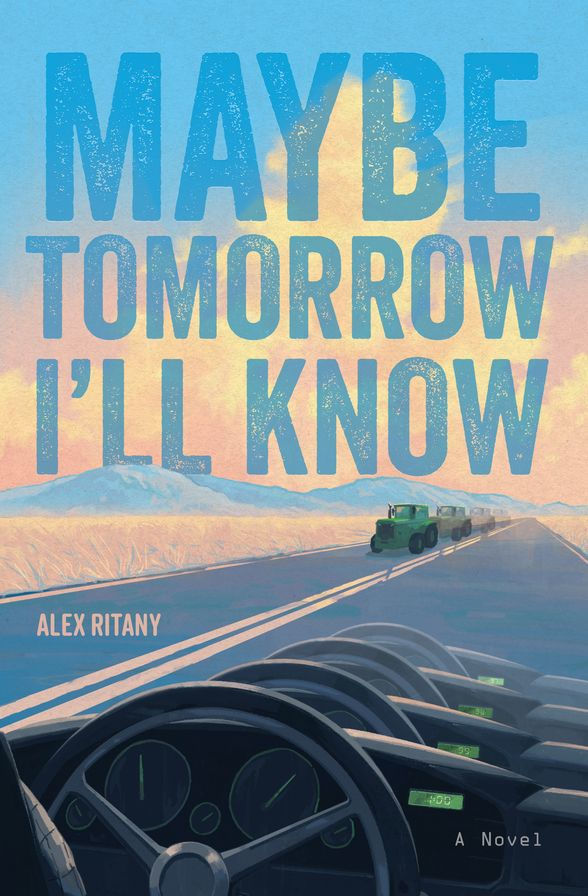
AR: Yeah, so Maybe Tomorrow I’ll Know is about a boy waking up in a girl’s body, with no memories. And having one hundred days to figure out, like, where his real life is, like, figure out who he’s stuck inside of. And what is going on is the day that he’s stuck in repeats. So he has one hundred repeats of the same day, in this time loop, to figure out, you know, where is his real life? Like, who… where is he? Who has he been? Who will he be? And he, you know, eventually gets help from a handsome stranger who helps him. First outside the time loop, and then, spoiler, inside the time loop as well.
TB: Spoilers!
AR: Spoilers!
AR: That’s as far as I’ll get with spoilers, but yeah, that’s my pitch for it.
TB: Well, Susan and I were lucky enough to get an early copy to read, and I want to be careful of the way I word questions, because I don’t want to spoil anything. So, I want… let me start with something overly general in, sort of… where did the idea for this book come from?
AR: It came from… I’ve loved time loop stories forever. I wanted to… I think there’s… there’s no real way to talk about Maybe Tomorrow I’ll Know without getting a little bit into spoiler territory. Aand I think, like… I will get a little bit into spoiler territory, because I think people who are tuning in here, who… any person, any trans person who’s read the book, has gone, “I know what’s going on here!” fairly quickly. And I honestly thought everyone was gonna… like, the whole point of this book is not the big plot twist of, like, “oh my goodness.” It’s like, it’s the journey. How did we get here?
TB: Yeah.
AR: And so I’ve been surprised. Some of my cis readers who have gotten advance copies have been like, “I didn’t see that coming.” I’m like, “How? How did you not get…” you know…
TB: They don’t have that perspective, yeah.
AR: Yeah. The draw to me was about, like, finding a different lens with which to talk about dysphoria and the experience of, you know, what some… some trans people have the experience of, kind of, “wrong body”.
TB: Yeah.
AR: And I put that in quotations. I didn’t necessarily actually have that experience myself of, you know, feeling like I was born wrong. It’s been more of a journey of building something that’s more right.
TB: Sure.
AR: But there is, I know, that experience of… especially once you realize you’re trans, you’re like, “Okay., the meat suit that I’m in is not feeling correct anymore.”
TB: Yeah.
AR: And I… I was struggling to describe that to some of my cis friends. Like, I don’t… literally don’t know how to explain. How do I explain to you what this is like? And that was when the kind of amnesia and when we get a “wrong body” came in. It’s like, what happens if you wake up and kind of, like, the first thing you know about yourself is, “I’m a dude!” And then you’re… as you’re moving through this space in the world, you’re realizing the body you’re in is not a dude’s body and people are addressing you as a girl. That is, to me… that’s a horror concept. And this book is not horror. I would describe it as contemporary, because of the kind of levity that I… I was like, “If I’m gonna get as distressing as this book can be, I’m gonna pack in some of the other light stuff as well. But putting that concept into a time loop, and adding the mystery, it was kind of all of those things… coming together all at once in, like, January 2024, where I was like, “I have to get this down. I have to get this down on paper right now.”
TB: Yeah.
AR: Or… or else!
TB: I’m glad that you are the one giving out those little spoilers, because then I will not get in trouble for it, so…
AR: (laughs) Exactly.
TB: But yeah, I feel like… when I was reading it, I identified so hard with the feeling, like, “every day is the same, and you don’t know how to get out of it, and you don’t know how to change it.” And… and you don’t even sometimes notice the passing of the time. Like, I had… when I was mired in my dysphoria before transition, I did a lot of dissociating that I didn’t even know I was doing.
AR: Yeah.
TB: And so I’ve lost so many memories, and I’ve lost so much time, and I feel like this book captures that really, really well.
AR: Thank you, thank you. Yeah, I think there is that kind of… pre-social, pre-medical, transition space where you’ve clocked that something’s not right
TB: Yeah.
AR: But you’re just wheel spinning. Because for whatever reason, you can’t… either you’ve literally, for safety reasons, can’t, or for other social reasons, can’t take that first step and actually… or… or even haven’t yet decided that it’s worth it.
TB: Yeah, or even gotten to the point where you can accept that about yourself, you know? It took me so long to get there, because I didn’t have a frame of reference. I didn’t know trans people were something that existed, that someone could be, for so long.
AR: Yes.
TB: And so, yeah, you end up getting stuck there. But I also really love what you said about your cis friends reading it. Because a thought that occurred to me when I was… as I was going through it. Over and over again, I was like, “this is a great book to give to cis people who don’t know what it’s like to be trans.” And I feel like it could open their minds in such… good ways.
AR: That’s the hope. That’s the hope. I wanted to write something that is… that resonates for trans people, but is really accessible to cis people who haven’t ever had to think about it. Because, yeah, I know there are some… there are some books that I’ve read that have been, you know, trans fiction, where I get into it. I’m like, “I am so here. I am right here.” And then I think about, like, trying to explain it to somebody else. Like, okay, you have to put aside… and I know so many people struggle when they’re reading to put aside their own experiences, to just be open. Come in open-mindedly. So, yeah, it’s… I feel as though I am always on a journey of trying to explain myself in the most clearly articulated way, and this book is definitely a part of that.
TB: Yeah, yeah. What was your reaction to it, as our token cis person? To the… to the way, like, the sort of awakening to dysphoria and everything happened in the book? Like, I mean, you’ve gone through all of this with me, so you’re very familiar with what I’ve been through, so was it… how did it impact you?
SB: I mean, it was obvious for me.
AR: Yeah. Yeah.
TB: Okay.
TB: You caught onto it right away, because you have the experience of going through my whole transition with me.
SB: Yeah, yeah, I could definitely see the… the sameness of going through the days and not really wanting to push on the edges of anything.
TB: Yeah.
SB: Like, that definitely makes sense.
TB: You could relate to what I’ve been through in there, is what you’re saying?
SB: I guess, yeah. I mean, I didn’t know at the time.
TB: Sure, I didn’t either.
SB: Which is a hard thing. Yeah. That’s always the hard thing, is not knowing…
TB: Yeah.
SB: …at the time that you were struggling so much…
TB: Sure.
SB: …with this thing that I didn’t know.
TB: Yeah. But it’s like, because I didn’t know what it was at the time.
SB: I know! And there’s no way I could have known.
TB: Right, yeah. Yeah. So… but you were… you were great, you were… you… well, I… okay, I’m gonna get into spoilers, I’m gonna shut up. So, like, as you mentioned, this book features a teen boy trapped in a teen girl’s body, and I just want to ask if you were mysteriously drawn to body swap stories for your entire life before realizing you weren’t cis? Because I sure was, “there were no signs.”
AR: What? What? No, I… one of the books… I guess I was a voracious reader as a kid. So I read so much. I was obsessed with one magical wizard book series, which shall not be named…
TB: Mmm.
AR: …as a child, before the author came out as terrible.
TB: Yes.
AR: I was so obsessed with those books that I had to read ten other books… it was, like, a law in my house. I had to read ten other books in between each book from that series that I was reading, because I was so obsessed with them. So as a result, I was, like, a voracious, prolific reader. And there are very few books, as a result, that stick out that I remember being like, whoa. And one of them was… I was a very young adult reading Every Day by David Levithan, which is that book where the person wakes up in a different body every day.
SB: Oh!
AR: Which I think we actually used as a comp for Maybe Tomorrow I’ll know, when we were trying to sell it, because it was that thing that intrigued me. It’s like, what is… what would… what would it be like to be you?
TB: Yeah, right?
AR: Yeah, in somebody else’s body.
AR: So, yeah, for sure.
TB: It’s… well, it’s wild, too, when I look back at my writing that I did before knowing and coming out. There were so many instances of dudes suddenly appearing in a woman’s body, being like, “what is this? What happened?” I’m like, come on, wake up to what you’re doing! Like, subconsciously, you know, I was going through it, and I couldn’t even see that’s what I was doing, so…
AR: Yeah.
TB: Yeah.
AR: I still find myself doing that, where I’m like, this is a cool, unrelated concept, I’m gonna… I’m gonna think about that. I started writing about a doppelganger in an adult fantasy project that I’m working on, and it took someone else being like, “so… and that’s interesting for you?” And I was like, oh, yeah, it is interesting to me for the gender reasons.
TB: Yeah.
AR: I thought it was interesting for the cool fantasy reasons, but it’s always the gender.
TB: It always comes back to that, it seems, yeah.
AR: Yeah.
TB: Well, there were so many moments in this book that I identified with as a queer and trans person, and it feels so much like we never get enough of that kind of authentic representation in our stories. And so, like… I’ve experienced this a lot, but I wanted to get your perspective on it. Have you had any difficulties in getting repped or finding a publisher to pick up a book like this, in these horrible political times that we’re in?
AR: Well, it’s interesting because with this book, I had… I will be transparent, a fairly unpleasant time with my debut novel. It was a really tricky situation for, like, a perfect storm of bad experiences. And my… my debut is not queer. I mean, those are bi-for-bi characters, but it’s an M-F romance.
TB: Sure.
AR: And… so it’s not specifically in the queer space, but… I was, with my representation at the time, trying to get any traction with the stuff that I was starting to write, which by that point was all queer.
TB: Yeah.
AR: And spinning wheels, getting absolutely nowhere, and… you know, we… we were just not a compatible, creative match, which I eventually figured out, and we parted ways right after my debut came out. But it was on a very discouraging note. Like, I had just worked so hard to get my name legally changed, and… because I wanted that in the copyright.
TB: Sure.
AR: I was like, if my copyright… if my deadname is in the copyright of this book, I’m gonna freak out. I’m going to freak out, like… I didn’t have the resources at the time to, like, open an LLC, get that done.
TB: Yeah yeah.
AR: So I was just like, I have to… I have to get this done, and the timeline was so crazy tight. It happened, like, right before we were at the printers. I was like, I could finally provide the documentation. And I kept my agent updated on, like, all of that stuff. And right after the book came out, it had such soft sales that she said, “You know, if you are ever gonna write again, you probably should consider writing under a pen name.”
TB: Ugh.
AR: Are you kidding me? This is the name I, like… I worked really hard for this name.
TB: Yeah.
AR: That’s my only way forward. And I had… I went into the process of writing this book with such a dismal, like, “No one’s ever gonna publish any of… anything I write again at all, let alone the weird queer stuff that I really want to get into.” Like, I want to write weird trans books…
TB: Yeah!
AR: …it’s just not going to happen. Which, I think, contributed to it being such a raw book, where I was, like, unflinchingly just writing whatever. I went, “Absolutely nobody on planet Earth is ever gonna read this book, because it’s so niche, I’m never gonna get published again, blah, blah, blah.” I was, like, really throwing myself a legendary pity party, right? And I parted ways with my agent, and I was just like, “Well, I guess I’ll just see what happens if I just really go for it.” And I did, and wrote this book. I finished it and was like, “Well, that’s another manuscript. Cool. I guess I’ll see what happens.” And went into trying to get literary representation with such a laissez-faire attitude. And… have such a miraculously positive story from that, because I got representation within two months of starting to query, and we sold this book at auction three weeks after I signed with my agent.
SB: Wow!
AR: So, it was… it was such a refreshing, validating, exciting journey. And, like, I ended up with Norton Young Readers, who have been such a fantastic home for this and for my upcoming books, because they are so adamantly supportive of, like, the heart of what the books are about. You know, my editor is fantastic.
TB: I love that.
AR: Amazing. So it was… it completely defied all of my expectations and, you know, flew in the face of the anti-trans legislation we’ve been seeing.
TB: Yeah.
AR: So I was like, oh my goodness. I hear all the time about publishers, you know, rolling back their support…
SB: Yup.
AR: …of marginalized stories, generally speaking, across the board. So I really was nervous going in, and… they really… my agent went to bat for me, my editor went to bat for me, and the team has been so supportive. It has been… like, I don’t think about it too often, or I get extremely emotional. It’s like…
TB: Wow.
AR: Never thought that would happen, and it is such a blessing. Such a blessing.
TB: Yeah, we’ve, like, had struggles in our TV writing and our comic writing with getting trans representation out there, you know, and it’s always so hard to get it past the cis gatekeepers. But one of our graphic novels was just announced. It’s a YA rom-com called Just Another Summer.
AR: Yeah, I saw that! Congratulations!
TB: Thank you! But when we got the gig, we asked for two things, and we thought we would get one. We said, “Can we make one character queer? and can we make the lead, the romantic lead, a trans man?” And we’re like, “If we’re lucky, we’ll get one.” Right? And they gave us both. They said we could do both. And that happened in the book, and then there was reshuffling as the book was just about complete, and we lost our editor. And I was like, oh no. What’s the first thing that always gets axed? It’s the queer and trans stuff, right? And it still went through, they just…
SB: There was a lot of anxiety.
TB: There was a lot of anxiety, and they just announced it, and that company, Maverick and Mad Cave, has been so supportive of the transness and the queerness in this story. And they have are other books that are like that, and I love it so much, and it means so much to me. But it shouldn’t feel like it’s rare, you know?
AR: Yeah.
TB: Like it’s… we’ve had so many struggles with so many places.
SB: Even in places that say they want queer content, they don’t want trans content.
TB: Oh, yeah. Yeah, yeah.
AR: Yeah, or, you know, they want queer content, but not the main characters.
TB: Ah, yep.
AR: Yeah, no, it’s really been amazing seeing, you know…now we have two examples of publishing professionals who are… what I hope for is, trailblazing the way.
SB: Yeah.
TB: Yeah.
AR: Showing what’s possible. You know, we see… people do want to read trans stories. And, you know, seeing fellow trans authors make bestseller lists makes me so, so happy.
TB: Yeah!
AR: In a way… sometimes I see other people on the bestseller list, and I get a little salty. We all have been there, where we’re like, “Oh, you’re succeeding?” But I just have this, complete joy for trans people making the bestseller list, because I’m like, “Yes! Yes! This is great!” Like, Petra Lord, who just published Queen of Faces, which is a YA fantasy, has been on the New York Times bestseller list three weeks in a row now. Which is so amazing, it’s like a trans femme YA fantasy. It’s like… you don’t see those on the bestseller lists, usually.
TB: Yeah.
SB: I’m writing that down right now.
AR: Yeah, I have my copy, it’s gorgeous. I haven’t started it yet, but I’m so excited, because it’s so cool to see all of us out there thriving.
TB: Yeah, yeah, yeah!
AR: We’re not all thriving, but…
TB: Each one of us that gets any kind of a win, it lifts all the rest of us up and makes the chances of others having their projects made, rise, so…
AR: Yeah, exactly.
TB: I love that. Well, did you have any last thoughts you wanted to share about the book before we wrap up?
AR: No, I think… I hope it is… validating for any trans kids who find it. I hope they realize that there are… that their transness does not make them too complicated for their own romance, their own life. There’s certainly complicatedness happening in Laurie’s life as he is navigating this romance with somebody who keeps forgetting him and is falling in love with him in the wrong body. That’s complicated.
TB: It is. Relatable.
AR: Yeah! And so I just… I hope that it resonates for queer kids, and I hope that the cis people who read it, you know, really sit with it. I got a review just recently, from someone saying that the book prompted a conversation between her and her husband about what what… how they would respond if their children ever came out as trans, which was so… gratifying, and exciting to me to see, because I had not even been thinking about the parents that might read the book.
TB: Yeah, yeah! That’s one of the best things about my book that I wrote about The Matrix films, and their inherent transness… is that I’ve heard from a lot of trans people that were touched and impacted by it, but the cis parents of trans kids that have written me and said, “I understand my trans kids better because of this.” I’m just like… that is…
AR: Oh!
TB: Right? Like, then that kid is gonna get better support from a parent who understands them better. That is the best thing in the world, so I’m so glad that you’re getting that, too.
AR: Yes. Yeah, it’s been a beautiful experience, and I can’t wait to see how it lands with readers once it’s out.
TB: And that is very soon.
AR: Yeah, yeah, April 7th, so…
TB: April 7th! Thank you for being here, Alex.
AR: Thank you guys so much for having me, it’s been an absolute pleasure.
TB: Friends, I really loved Maybe Tomorrow I’ll Know, and I think both trans and cis folks will get a whole lot from it. As we said, it releases April 7th, 2026, and you can pre-order it now. It is a sweet, grounded sci-fi story, with some fabulous and authentic representation, and we need so much more of that.
Especially now.
Tilly Bridges, end transmission.
tillysbridges@gmail.com