Welcome to Trans Tuesday! Tillyvision is back again to talk about the first explicitly transmasc allegory I’ve seen! Let’s dive into the delightful, the weird, the wonderful UNINTENTIONALLY INTENTIONAL TRANS ALLEGORY OF LISA FRANKENSTEIN, part 1! This week: context, color, names, and more!
I’ve done a lot of trans allegory in media writeups, and they’ve kind of become what I’m most known for, thanks to the series on The Matrix films that became my book, Begin Transmission: The Trans Allegories of The Matrix. If you’d like to check out alllll the others I’ve done, head to the TRANS MEDIA section of this site and have a browse!
These are easily the most popular essays and podcast episodes I do, you all seem to love experiencing them as much as I truly love doing them. But as a reminder, they’re exponentially more work than my usual essays.
Between watching the film and taking notes, turning those notes into this write up, sourcing screenshots, research, editing and revising, and recording the podcast version, I’ve put approximately thirty hours of work into this. And this is why I can only do them every so often. But hey, the next one’s here! Hooray.
When I first saw Lisa Frankenstein, I not only loved its heart and its humor and its delightful weirdness, but so much transness leapt out at me that it immediately went on my list of films to do a trans allegory deep dive on.
Especially since it’s the first transmasc allegory I’ve found! Some, like SILO (which as far as I know is entirely unintentional) and STAR TREK: STRANGE NEW WORLDS’ “AD ASTRA PER ASPERA,” speak generally about transness, others like THE MATRIX and BARBIE and I SAW THE TV GLOW speak even more specifically to transfems. So I was really excited to dive into one for all the trans men and nonbinary masc folks out there. Especially given THE ERASURE OF TRANS MEN is a real thing that happens.
But I do want to say Lisa Frankenstein, like The Matrix and Barbie and I Saw the TV Glow, still speaks to the entire trans community in so many ways.
So what the hell is an unintentionally intentional trans allegory, Tilly? Well I’m so glad you asked, this is perfect timing because I was just about to tell you.
As far as I’m aware, no out trans people worked on this film. But in an interview with intomore.com, Lisa Frankenstein writer and producer Diablo Cody had this to say about the film’s queerness:
…the object of Lisa’s affection is literally in a closet for a lot of the film. …I grew up not just in the 80s, but Catholic in the 80s, at a time when people around me were encouraged to repress any queer feelings that they had. And this relationship in this movie is hidden, so I think you can read some subtext into that. And, you know, even though it is somewhat of a heterosexual love story… they’re definitely an offbeat pair… it’s not a relationship that would be fully accepted by society in any era…
From that alone, you know that there’s an inherent queerness to the film, in spite of its seeming cishet romance.
But here’s something super interesting, if slightly problematic:
The film’s director, Zelda Williams… played a trans man in a television show, Dead of Summer, in 2016. Here’s some quotes from her in an interview with etonline.com:
The thing I’m most terrified about is the transgender community being insulted by [Drew]. It’s great that [the public] will get to learn about a male-identifying transgender character as a lead in an ensemble show, but really, more than anything, he is for the transgender community, because they don’t ever get to see him. I hope that they’re happy with him, because I’m proud of him.
Although she was a bit nervous to take on her first-ever leading role, Williams reveals that in a lot of ways, she felt like she could connect with Drew. “Drew isn’t necessarily a far stretch from who I am,” she explains. “I’m not a girly girl. I never have been. I had a shaved head for six years.”
While a seeming cis woman playing a trans man isn’t great (see TRANS ROLES AND STORIES for more on why that is), she clearly got to experience some of what trans men go through in her prep and performance of a role. And that’s not to say playing a trans man and being a trans man are equivocal, but actors get inside the heads and hearts of their characters. That’s the job. They think about them and explore them in deep and intimate ways.
So while portraying a trans man is not living as a trans man, it does give her a perspective that most cis people don’t have. Especially when she was so concerned about not doing harm and getting it right. A cis person playing a trans character does do harm (again see TRANS ROLES AND STORIES for why), but I doubt anyone involved even realized that. It’s part of a long trend of cis actors playing trans characters, even though there are many out trans actors available, especially now in 2025.
And from those quotes, she’s maybe somewhat gender nonconforming, or at least lived that way for a while. And that also gives her some personal experience with the way society treats you when you don’t fit into the very narrow boxes they like to categorize us into (see THE FALSE DICHOTOMY for more).
So I think, when you combine a writer who’s trying to speak to queerness subtextually, and a director who’s intimately familiar with some of what trans people, especially trans men, go through… when you mix those things together, you get them intentionally making a very trans movie even if they might not have realized it.
I’ve mentioned in many of these allegory writeups how that’s absolutely a thing that happens. Writers (and directors, and musicians, and and and…) can often be exploring something subtextually in their work and not even realize that’s what they’re doing.
For years before I understood, could name, and accepted my transness, I was exploring gender themes in my own writing. There were always perceived men becoming or turning into women. Why would that happen? Nobody knows, it’s a mystery!
In fact, Jane Shoenbrun, who wrote and directed I SAW THE TV GLOW which I did one of these deep-dives on, said it was the process of making their first film, We’re All Going to the World’s Fair that cracked their egg (made them realize they were trans).
We’re All Going to the World’s Fair is also a deep trans allegory, which Jane admits was intentional, because they were unpacking all their complicated gender feelings in exploring the theme of the film. But they didn’t know that’s what they were actually exploring through most of the process, even though they were intentionally exploring it. (I was on the Progressively Horrified podcast, with other fabulous guests, to talk about this film and all the ways it speaks to dealing with gender dysphoria, if that’s a thing you’re interested in).
This is what creating art is, we tell stories about people exploring feelings and themes that we want to talk about, sometimes without even being able to name or identify what those feelings and themes are.
And thus we arrive at Lisa Frankenstein, an unintentionally intentional trans allegory.
However… there’s some compelling evidence that it might not have been unintentionally intentional at all. Once we get to the end, and you have all the evidence, that’s something you can ponder. 😊
Just remember everything in a movie is a choice made by the filmmakers. Even when coincidences or happy accidents happen, it’s a choice whether to include those in the final cut of the movie or not. There is artistic intent behind it.
So let’s get to talking about the film itself! On the surface, it’s a Frankenstein retelling about a teen girl who’s a bit of an outcast bringing a dead body to life, making him whole with pieces from other humans, and falling in love with him.
But just like with The Matrix and Barbie, Lisa and the creature (this is how he’s referred to in the film’s subtitles, and is how the monster is referred to in the original Frankenstein) represent the same person at two different points of transition.
Before we go any further, I don’t like referring to someone who is, in effect, a trans man as “the creature,” so for the rest of these deep dives, I’ll call him Frank.
Lisa is a trans man who has denied their truth, like society instructs us to do in so many ways (see GENDERED CHILDHOODS and TRANS TRAUMA 2: SOCIETAL GASLIGHTING). Over the course of the film, she self-actualizes and becomes who she truly is, Frank the trans man.
It’s important to note this movie is not about her egg cracking (realizing she’s trans), this is about someone who did realize, but the world reacted so poorly that she suppressed and denied her own truth. And then coming to realize they cannot deny that truth no matter how hard they try, and finally accepting it.
So Frank represents her self-actualization, exactly the way Trinity represented that for Neo in The Matrix. And just like in the Matrix films, the “romance” between the two apparently cishet lead characters is actually about someone loving themself enough to do what they need to do in order to be happy… transition, even in spite of society working so hard to stop that.
“Lisa” derives from “Elizabeth,” which is the Greek form of the Hebrew name “Elisheva” which means, “my god is an oath.” An oath is a promise, and though I’m not Jewish, if “god is love” holds true then Lisa becomes “love is a promise.” A promise to yourself, to love yourself. To be your true self.
Lisa’s last name is “Swallows.” Those birds are symbolic of homecoming (very supertexty for someone who rejected their truth but then comes back around to accepting it), but also of the protection and blessing of the divine (and if god is love, the love she has for herself is protected and blessed here in her heart). Swallows can also represent those who know the truth but refuse to accept it! So now it’s just SUPERsupertext.
“Supertext” is a term I coined to mean the opposite of subtext, basically yelling the truth right in your face.
Lisa’s step-sister is “Taffy,” which in terms of names is the Anglicized form of “Dafydd,” which itself is the Welsh form of “David”… which comes from the Hebrew name “Dawid,” which means “beloved” or “uncle.”
So what the heck’s going on here?! Is the seeming gender-swap of the name important? I submit to you that no, it is not, and in fact I think the Taffy in Lisa Frankenstein has nothing to do with the origins of the name, and is instead there because of the candy. Because what is taffy? Soft, stretchy. Malleable. It can take whatever shape you mold it into.
And Taffy, the character, is everything society tells you girls should be. Pretty, overly concerned with her appearance, kind of obsessed with boys, ultra-fem. She’s everything Lisa doesn’t want to be. Though the fact that she’s someone who should, and seemingly does, actually care about Lisa (well, until she doesn’t) is also important.
Lisa’s dad is “Dale,” which literally just means a dale or valley. But what’s a valley? A low point that prevents you from seeing what’s around you. Dale is perpetually unaware of his surroundings, what’s going on, or even how to describe his own wife’s appearance. He’s kind of clueless, in the way so many cis people are about anything related to transness.
“Janet” comes from “Jane” which comes from “John,” which… okay, here we go… it’s the English form of Iohannes, which is the Latin form of the Greek name Ioannes, which comes from the Hebrew name Yohanan. And that means “god is gracious.”
But if god is love, why was this name given to Janet, the most cruel and evil person in the entire movie? Because Janet is a hypocrite in every way, which makes her name deeply ironic.
“Michael” is from the Hebrew name Miḵaʾel, meaning “who is like god?” or “like god.” Again, if god is love, then Michael is like love, but maybe actually isn’t love, which is important. Not just in what happens with him in the movie, but in what he represents for Lisa. We’ll talk more about that when he first appears.
As with The Matrix, and Barbie, and I Saw the TV Glow, all linked above, colors are used metaphorically to help tell the story.
The single most important color in the entire film is the very specific green-blue in the lightning bolt in the opening credits animation.
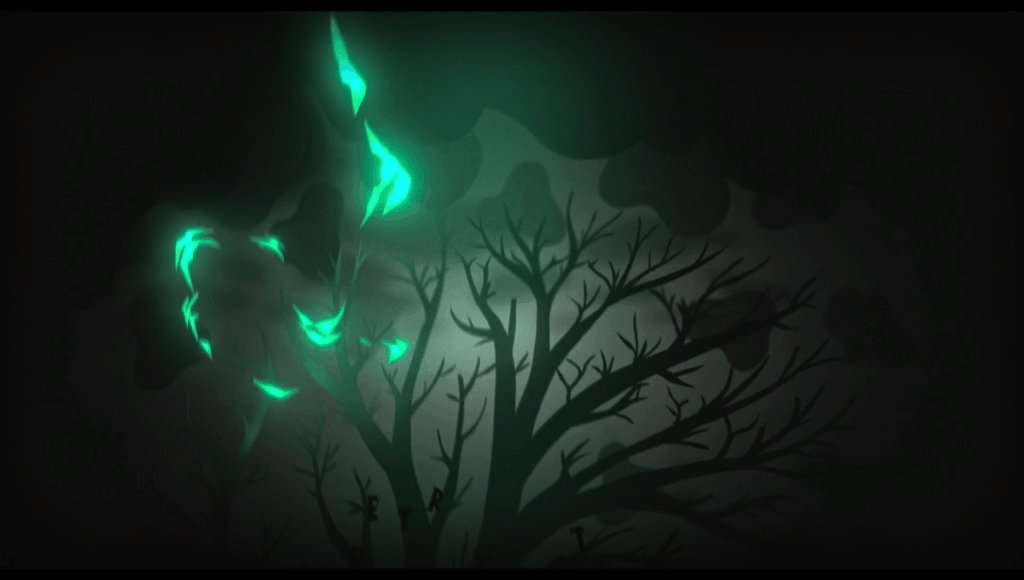
It’s the first color you see, it’s horribly destructive, and it shows up everywhere in the movie in very specific ways (which I think has to be very intentional for such a wildly specific color). This color is representative of GENDER DYSPHORIA, of everything wrong with the world when you’re not the gender you’re assigned at birth.
I tried to find a name for this color, and there are several that get close, but also because things like lighting and paints and fabrics are all colored in different ways, the color doesn’t always exactly match. So you’re looking for anything close to what you see in the screencap above. Trust it will be very obvious most of the time, and difficult to miss.
Pink is the color of gender conformity, which makes a lot of sense in a transmasc allegory. It’s the color the world forces on girls. And of course you can be nonbinary and like pink, you can be a girl and like pink just because you like it (like me), and you can be a boy who likes pink. But society says “pink is for girls” (see that GENDERED CHILDHOODS essay), and so in Lisa Frankenstein it’s representative of everything society forces on girls, and everything that transmasc folks may want to get away from.
Yellow is fear and caution.
Blue is sadness, despair, and depression.
Except for when you see pink and blue together, which is, you guessed it, indicative of transness.
Red is more complex, and has a double meaning. In the world, it’s a sign of danger.
But when Lisa is wearing red, it’s a metaphor for love. The colors Lisa wears conveys a lot about what’s going on with her.
When Lisa’s in black and going all gothy, well that kind of garb usually signifies death, or honoring death, respecting those we’ve lost. But as in tarot, many cultural beliefs, and many allegories, death is symbolic of change. The more black she wears, the closer she gets to the change of transition. And conversely, the more human Frank looks, the closer he is to being the fully realized man Lisa has always been inside.
I believe Lisa’s bedroom is indicative of her subconscious, and Bachelor’s Grove is a metaphor for her heart (which, yes, has a dude in it).
It’s important to note that all of the murders in this movie happen at the hands of Frank, and not Lisa, but more important is that each kill is a metaphoric rejection of what that person represents.
And just to be clear, though Lisa is a trans man, for clarity I will use she/her pronouns for her, and he/him for her true self, Frank.
Time for timestamps! Let’s. Gooooooooooooooooo!
0:58 – In our opening animation, we see Frank wake with a sigh, and the photo on the wall shows he’s alone. His parents disappeared from the photo after he looked at it. Maybe they died… or maybe they’re dead to him, and he to them, because they couldn’t accept his truth. It’s actually that second one, when you remember that Frank is Lisa’s final form, and what happened with Lisa’s mom.
1:04 – The food falls from the spoon, there’s no joy. Frank is reading, always reading or playing the piano. He’s artistic, inquisitive, soft. Not the stereotype of the manly-man, devoid of emotions except lust and anger, that the world tries to tell men they have to be.
1:18 – The woman blows a kiss at him, giving up her femininity and accepting him. This was Lisa’s egg cracking, realizing the soft, artistic guy that she really was.
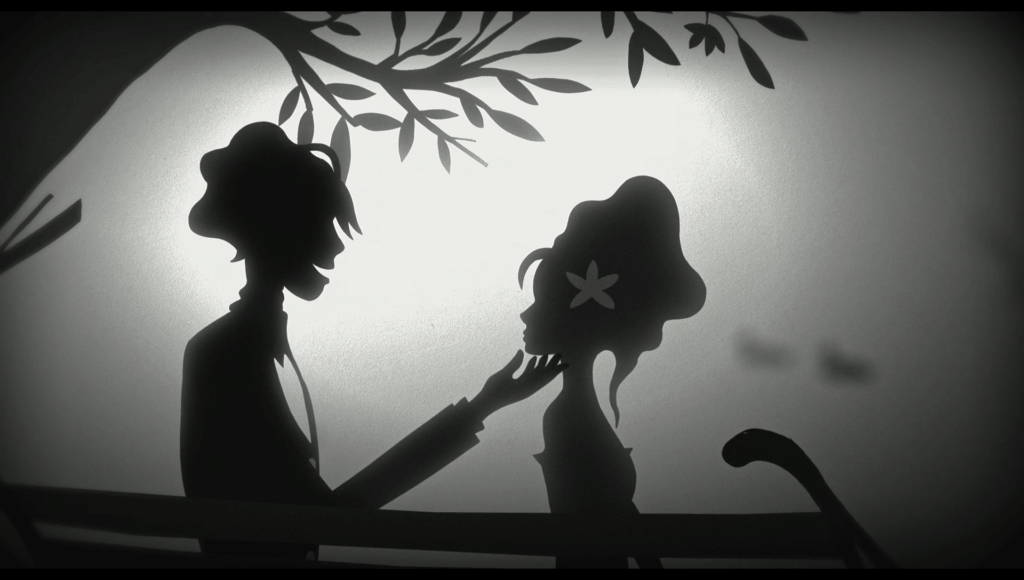
1:27 – The pair are together on the bench in black and white, him on the left, her on the right, happy. Frank puts a flower in her hair, and she accepts it. This is her accepting his gift (his existence). And look how similar the silhouette of their hair is. Is that because they’re the same person? Yeah you betcha.
1:36 – The woman leaves Frank, when society still treats her like a woman, and you see the flower in her hair has been lost. She’s given Frank up, and it devastates her true self inside.
1:49 – The horse kicks a man off the balcony, and metal beams fall and crush a man (with a gun) on a boat. Masculinity is rejected and cannot fight for itself.
Note that Frank here is always walking from left to right. He was on the left of the bench, the woman on the right. He is moving from his true self back to the woman society said he was and had to be.
2:00 – He sits on the bench alone, forgotten, not whole, as a man and woman pair (representative of a trans person who’s accepted and reconciled who they really are) are blown away. Gone.
2:05 – And here our green-blue lightning of dysphoria strikes and kills him, the true man inside is dead (for now).
2:12 – On his gravestone it says “unmarried.” If the metaphor for a self-accepted trans person in this film is a man and woman being together (just like in The Matrix, and opposite of Barbie), then being unmarried means unactualized.
2:15 – The dirt falls into the grave, and the man inside is covered up and hidden from the world. Her true inner man has been buried deep in her heart… Bachelor’s Grove.
2:19 – The woman places the flower on his grave, she is sad to lose him, even though she gave him up to pretend to be who society said she had to be.
2:33 – Much later in the future, in the same graveyard, we’re in Bachelor’s Grove (it’s for the dudes!). And there’s Lisa, the woman, at his gravestone. In red. She still loves her true self, even if she rejected him.
2:39 – A closeup shows a gravestone reads “Frances Owens.” “Frances” means French. How are French men seen culturally in the United States? As “weak” or “effeminate,” artistic, not “real” men. Owen traces back to two different names in English and Irish, and both mean “born of.”
Here in her heart, where she has love for the man she truly is, her true self will be born! This is foreshadowing her entire arc, and the entire movie, right in front of you. Supertext!
We’ll wrap it there for this week, even though we’ve only just begun. Come back next week as we discuss what we’ve buried deep inside our hearts, and the horror of being perceived!
Tilly Bridges, end transmission.
tillysbridges@gmail.com