NOTE: This week’s update is a transcription of a live interview done as part of the Tilly’s Trans Tuesdays podcast. Special thanks to Kestrel Clayton for the transcription!
Tilly Bridges: Welcome to Tilly’s Trans Tuesdays! This week, we interview author Mia V. Moss on their upcoming novel The Heresy of Thieves.
TB: Hi, I’m Tilly Bridges, your host, and I’m joined by my writing partner, my best friend, my wife, our token cis representation, the lady who may be a heretic, but the only thing she’s ever thieved is my heart, Susan Bridges.
Susan Bridges: Hello! Wow, you worked hard for that one.
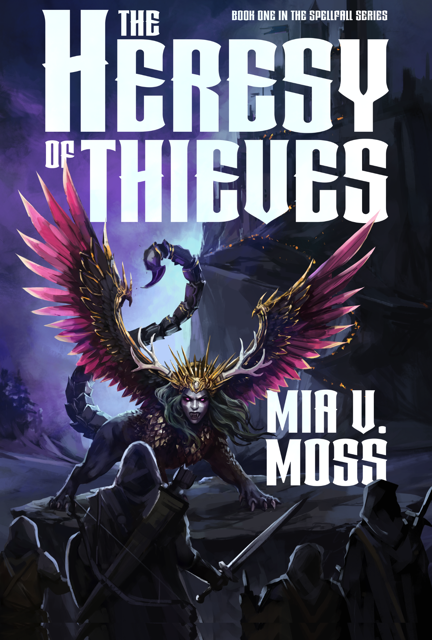
TB: Thank you, I tried. Our guest this week, as you might have expected from the spoilers in the episode introduction, is Mia V. Moss, a science fiction and fantasy author from the East San Francisco Bay Area. They are the author of the cli-fi noir novella My Ties for the Lost, and the creator of The Breakfast Serial, a food blog written from the perspective of a human settling on a new planet far from Earth. Their debut novel, the epic fantasy The Heresy of Thieves, comes out October 6th from Dark Matter Ink. Welcome, Mia!
Mia Moss: Hello! Thank you so much for having me.
TB: Yeah! Okay, so I need to ask you a little bit about this Breakfast Serial blog, because I went and read some of them, and they’re these little short posts, and it is such a fun idea! Where did you get that from?
MM: Thank you! Well, yeah, so it’s mostly just from reading a bunch of food blogs, and they always get really conversational about their day to day lives, and I was just thinking “What would that be like for someone on a completely different planet, and they had to move there, but they wanted to keep doing their food blog?” And so that’s where– I just went with it.
TB: It’s so fun! And it’s just got this great whimsy to it, so I think it’s really really cool.
MM: Thank you! Thank you very much. It started in the during the hardest times in 2020, and back then I had more time on my hands to do recipes. So it was weekly, and now it has gone to monthly, but maybe someday I’ll get to go back to weekly again.
TB: Yeah, we all had a lot of time on our hands back then, so… relatable. I find this answer varies a lot for non-binary folks, so I want to get your thoughts: Do you feel like you had a transition?
MM: I think I did, and it was a gradual one, though.
TB: Sure.
MM: And I actually didn’t even really consider it in those terms, until last summer… I was out at Burning Man; I lead a camp — we’re called Space Goats — and we had nonbinary and trans campers, and a lot of them are from the San Francisco Bay Area too. And we were just getting to know each other, and one of them asked me, when I said I was nonbinary, and they were like “Oh, do you go to the trans nerd meetup that Charlie Jane Anders does in San Francisco?”
And my default was “Well, that’s not my space. I don’t want to take up space for other people.” And that’s the moment I was like “Wait!” So, after that, I did give it a lot of thought, and I realized that I kind of… in general, with how I perceive myself, and in public, I do tend to kind of try to… not intentionally, but I think as a residual form of masking… I’m pretty stealth about it. People will know me, have known me for years, and not realize my orientation, for instance, and then I show up with a female-presenting person as my date to something. (Not anymore, I’m married now, but in the past…) And they’d be like, “I had no idea!” And so I’m just generally very stealth, and so with the nonbinary thing… I started out “My pronouns are she / her,” and then it was… “Actually, on Zoom, I’m just gonna change that to she / they.” And then later on… okay, “I’m just gonna flip those, and now it’s they / she,” and so it just kind of gradually goes into non-binary land. So that was… that was my thing.
TB: Yeah. It’s a journey for all of us.
MM: Yeah.
TB: And I think what you said is really important, because I think so many of us do this sort of self-gatekeeping. Like “That trans meetup is not for me. I’m obviously not one.” And that’s… it’s… I don’t know. Society trains us to do that to ourselves. But you’re trans if you say you are, and you are trans enough. Everyone is. So have you gone to those meetups with Charlie Jane?
MM: I haven’t yet, but I want to. I don’t go… and that’s… not because I no longer feel like, “oh, I shouldn’t,” but just because I tend not to go to a lot of meetups. I need to force myself out of the house more, so… I do. I want to go.
TB: Yeah, I see her posting about those all the time, and I’m always upset that we’re in LA, so I’m like “I can’t drive up there just for a 3-hour afternoon trans meetup!” But that would be so fun. I really want to go sometime.
MM: Yeah, they sound like a lot of fun.
SB: I feel that, though, what you were saying about, like… it’s just kind of easier to be stealth, because, like, I feel like that stood in the way of me exploring my queerness for a long time. Because I looked like I was in a hetero marriage for a long time —
TB: Before I transitioned, yeah.
SB: — I mean, “I know I’m queer, and that’s all that’s important,” and… it did kind of stand in the way.
TB: I feel like you felt at the time that it was keeping you from being– feeling part of the queer community. It certainly felt that way for me before I came out.
SB: It definitely did. I felt like… not accepted. I remember one time we went to a queer restaurant, and I felt like someone looked at us like we didn’t belong there, and I was just like… “Oh. Yeah.”
TB: People like to make a lot of judgments.
SB: So I felt like “Okay, this isn’t my space, I shouldn’t be here.”
TB: Yeah.
SB: And that was hard, for a long time.
MM: Yeah, I’ve had exactly the same kind of experience, I went to high school in the late 90s, and terminology and stuff was… I mean, it was there, but it was kind of understood a little differently, and my first partner in high school — I dated a girl and kissed a girl before I ever dated and kissed a boy, or anything like that. In those times I went, fortunately, to an amazing arts magnet academy thing. It was still a public school, but you had to apply to go there, and it was a bunch of weirdos who did art and wore capes, and it was so much fun! But, like, the minute I… I identified as pansexual at the time, and I also… I oftentimes use bisexual and pansexual interchangeably, because it’s just… it’s stuck in my head as, like, bi, but, like… at the time, you know, I was attracted to both, and it’s high school and confusing. But, like, the people way more comfortable with their sexuality at that time than I ever was, were like “Oh, you date girls, so you’re a lesbian, then.” And then I started dating a boy, and they’re like “Well, you can’t call yourself that because you’re dating a guy, so you’re straight, actually.” And there’s a lot of little boxes.
TB: Bi erasure.
MM: Yeah, the bi erasure and the boxes, and I did… you know, I’ve… I felt a lot of times, like I didn’t want to take up space, because I wasn’t obviously queer, or queer enough, I felt a lot of the times, so I just… kept out of those spaces.
TB: Yeah, it’s sad.
SB: I’ve definitely heard “Bi is just gay in training.”
TB: Oh, yeah, yeah.
MM: Yes!
TB: We have to stop policing ourselves, and each other! It’s bad, actually.
SB: It is.
MM: It’s really bad. Yeah.
TB: Okay, well then: For you, what has been the best thing about transitioning?
MM: Being able to just, like, really more openly be honest about myself to myself.
TB: Yeah!
MM: It’s a huge part, yeah. I felt for a long time, I didn’t realize how much I was masking, in social situations until I just… it took a lot, and even when I started realizing that’s what I was doing… as soon as I started hanging out with someone I didn’t know, or wasn’t very comfortable with because we didn’t know each other, the mask would come right back on, and I wouldn’t even realize it. And so now, openly stating “I’m “they.” I’m nonbinary.” It just feels like that’s internally setting that level for myself. The mask has been off, so don’t worry about it anymore! And that’s been, honestly, the greatest part, I think. Just being able to be openly myself with other people.
TB: Yeah, I love that, because I feel the same way! I always hated to be perceived as the person that I wasn’t, but then especially because I would have to put on that mask, and that costume, and perform. “Oh, you’re expecting a dude here, now I’ve got to be all dude-like so that you don’t suspect, and I don’t suspect to myself, that I’m not a dude.” And it took so much mental energy and effort… it was exhausting.
MM: Yeah, yeah, I can only imagine, and it did for me too. Just, like, “I have to be a very certain type of way. A very certain type of…”
TB: Yeah.
MM: Going back to early memories, too, there was a little seed of that. Back in teenage years, I loved putting on glitter everywhere on my face. That was just my love, and it was kind of, like… squished out. Like, “That’s not how you do makeup! It needs to be austere, and not… not wild.” And I remember going to a party once, and I had just gone all out with how I truly wanted to be! And some guy, a student, he… he looked at me, and he was like, “Well, Boy George looked like a woman too, so you’re fine.” And he meant it as an insult, and there was this weird… [laugh] mix of feeling embarrassed and scandalized that I had failed to perform femininity enough, and then, also… “Okay, well, that also was a little validating, actually.” [laughter]
TB: That feels kind of similar to the thing I got a lot when I was a kid, that other boys would be like “Oh, you’re so gaaay,” and I was always exclusively attracted to women, so that didn’t make sense to me. But now the joke’s on them! Because I am very gay, just not in the way they thought, so…
SB: It’s true, though. I feel like I’m still figuring out my personal style and way I want to express myself, and…
TB: Sure!
SB: I’m buying feminine things, but having, a more masculine haircut… the juxtaposition of things, which I’ve always enjoyed in many contexts, and figuring it out as I go, and it just… it never ends, I guess.
TB: No, it never ends. It’s a lifelong journey.
MM: Absolutely.
SB: And some glitter. I like glitter.
TB: Okay, well then, on the flip side of that, what has been the worst, or maybe the most difficult part, of transitioning for you?
MM: The worst, probably, was having an internal expectation, like “Oh, some people are gonna take this the wrong way, and not approve,” and then having that actually be true. And when your internal little guardian tells you those things, it’s trying to protect you, of course, but then for that to actually happen, it’s like, “Okay, well, ha… great.” And so you’re really just learning who is safe to be open around, and who isn’t. It might not always be the people you think.
TB: Yeah, that is tough. I feel like, especially early on for me, I felt like… especially if I was meeting new people, I had to overperform femininity, and…
MM: Yeah.
TB: I was at the time when I was still trying to figure out how femme I wanted to be, you know? And I wasn’t really sure, and so it’s really rough to deal with those expectations that, again… it feels like it’s just more gatekeeping. “People expect this, so you’d better do it, or it’s gonna be weird, and they might be mean to you.” Nobody should have to think like that, you know? It’s terrible.
MM: A hundred percent.
TB: Alright, before we get into talking about your book, do you want to let folks know where they can find you online after listening?
MM: So my website is magicrobotcarnival.com —
TB: So good!
MM: — and that is also my Bluesky handle. [laugh] Thank you. Those are pretty much the only places. I don’t really do social media. In fact, part of my experiment this year with the book: after Meta went full mask-off fashy, I was like “That’s it for Instagram!” and so I deleted that. I don’t have TikTok, I don’t have any of those. I don’t have Facebook, definitely. And so I’m keeping a journal of what it’s like to debut a novel with basically no social media presence whatsoever. And we’ll see how that goes!
TB: All right, so let’s talk about that upcoming fantasy novel, The Heresy of Thieves. Do you want to give listeners a pitch for it, tell them what it’s about?
MM: So The Heresy of Thieves is the first book in the Spellfall trilogy, and, it is a queer epic fantasy featuring multi point-of-view characters, messes, really, wielding sacred power accessories, on a road trip through three kingdoms, which are in shambles after all magic stops working. And, just for representation, I would say this book has everything. [laugh] It’s got bisexuals! Asexuals! Royal lesbians! Evil gay hot priests! Pansexual Hermione, but if university got canceled, so she applied herself to being the best mercenary captain she could be. Sentient monsters, sentient armor. Extended family drama and nonbinary gods.
TB: Wow! I love this! You’re really selling it.
MM: [laughter] Good. Yeah, this book is really a book of my heart. I started it, actually, 20 years ago, and…
TB: Wow!
MM: Yeah, actually, it might be longer than that, because I started it in the year 2000, so… which is not 20 years ago, unfortunately. So yeah, I started it in the year 2000, and I kept putting it down, for years at a time, and I’d come back to it, because I started it when I was just coming out into the world as an adult, and a lot of older adults kept telling me that writing wasn’t really a lucrative or real career, and that I should do other things.
TB: Sure.
MM: I kept putting this novel aside, and it just kept coming back to me. Like, the characters… I would dream about. I would doodle little maps of the world. And eventually, I just realized I’m miserable every time I put this book aside, and I really, really want to get this story out. And I really want to do these characters — who have lived inside of me for so long — justice, and so then I really started working seriously on it around 2018, and then got it out in the world.
TB: That’s amazing, to have sat with a project for that long. What made you want to write this one specifically? What was it that grabbed you, that got into your heart so much about it?
MM: So it started out, one of the characters, the royal lesbian I mentioned, her name is Thealis Vareen, and, she’s the king of this nation called Dinestra, and I had recurring dreams about this character in particular. She was the first one I thought of, and I initially just kept picturing her just, alone in this really opulent tower, just looking down over this insanely gorgeous, sprawling, ancient city. And then the city had some kind of deep secret beneath it, and that’s really where it all started from, was me just trying to figure out who is this person, in this castle by herself? Why is everything so gray for her? And then also, what is this deep secret underneath this huge amazing city. The city’s called Silver Bastion, and it was really the second character I developed for the book: The City of Silver Bastion. And yeah, I just had to tell both of their stories.
TB: I love it! I love that you dream about them; that’s so cool. I don’t know if I’ve ever dreamed a story up.
SB: Yeah, I don’t… I mean, probably? And then I wake up and be like, well… that doesn’t seem like anything. [laughter]
MM: I’ve definitely had story dreams. I tried for a long time to write them down as soon as I woke up, with a dream journal, and there’s definitely been ones where I’d go back and read my dream journal and be okay, yeah, that was… that was just brain goo. No one needs to see that!
TB: Yeah, I feel like I mostly have brain goo dreams — although I did have one last year that I was so captivated by… I did take notes on it to maybe do something with sometime, so… we’ll see, I don’t know! But, what themes are you exploring in this book? What is it that’s underneath the surface that we’re getting at?
MM: The biggest thing, I think, that comes through the whole book is “Who gets to decide who is suffering for the greater good?” And “Who gets to decide what the greater good is?”
TB: I love that.
MM: Thank you! And then also, “Who gets to decide who you are, as a person?” And there’s a lot of characters in here going through a lot of things, and a lot of them are trying to either live up to the expectations of what other people have told them they should be… or are actively trying to figure out some way to get out of that trap.
TB: I love that, that’s… it’s in our work, that we do so much of the time.
SB: It’s a bit… yeah, it’s similar.
TB: Yeah! That’s right up my alley. Ooh, I’m so excited.
MM: Thank you!
TB: So what drew you to, like, fantasy and genre writing?
MM: Oh, I have just… fantasy really was my biggest avenue of escape as a kid.
TB: Sure.
MM: I did not have a great childhood.
TB: Same.
SB: Relatable!
MM: But I was… my parents, though, they didn’t really care. They just wanted me to read. They wanted all of us to read. I have two siblings; they just wanted all of us to read. And even though they were weirdly really controlling about what we saw on television, or movies, or listened to for music… for books, they just didn’t really seem to care! It was like “Just go to a library and get books.” And so…
TB: Aha! Loophole!
MM: Yes! [laugh] That was my way. They never checked what books I was reading, and so I voraciously read as much fantasy as I could.
TB: Have you written in other genres? Is there a difference for you between fantasy or sci-fi, or horror, or even something that’s not genre? Because I find I can write non-genre stuff, and we have a graphic novel that’s non-genre that’s coming out, but if you’re asking me, the first thing I’m going to do is dive into sci-fi. I just feel like that’s where my heart is, so…
MM: Yeah, I don’t know! Especially when I was in college and it seemed that everybody was writing non-genre, I tried my best to write literary only, and my mind just couldn’t really wrap to it or adhere to it. But I do like writing sci-fi a lot, too. My novella’s sci-fi, and I really, really enjoy writing in that world. But I do think the story itself just sort of takes it in one direction or another when I start kind of thinking of it. Mai Tais for the Lost, when that book started… I was just browsing some fashion stuff online — I love fashion — and I had come across an image of a very high concept underwater breathing mask for diving, but it was all crazy. The shape of it was very futuristic, and I think it had crystals or something on it. And the first thing I thought was “Futuristic high-tech mermaids wearing these… haute couture… mermaid tails and face masks and everything.” And then that kind of blossomed out into a society of very wealthy people living out these crazy, post-apocalyptic Bioshock lives under the water, in the location where their ancestors had sunk their yachts, kind of ritualistically. And then that blossomed out into a huge discussion about social inequity and economy and climate and everything. And so just that one mask, though, when I saw the image, my brain was just like, “This is sci-fi.” And then in other stories, I’ll come up with a… a concept will stick in my brain, and it will just automatically go straight towards fantasy. So, yeah, I guess it depends.
TB: Yeah, I love that, though! That’s the same thing, I think, that happens with me. I get an idea, or I see something that sparks an idea, but my brain will immediately take it to sci-fi. Like, “What’s the sci-fi version of this?” And “Oh, what if it was like this? We could get a whole story out of it!” I don’t know, I feel like my brain just wants to go genre all the time.
MM: Yes!
TB: I have to pull myself back to make it not genre.
MM: [laugh]
SB: Do you listen to the Articles of Interest podcast?
MM: No… but I’m writing that down!
SB: You should write that down. You are going to love it.
TB: A live recommendation from my co-host!
SB: Yes, it’s all about the history of fashion, and there’s all sorts of weird, weird stuff, and there’s so many episodes. Enjoy.
MM: Excellent, thank you, thank you, thank you. I’m very excited.
TB: So did you always want to be a writer? Like, how did you get into it?
MM: Yes, I always wanted to be a writer, but I wanted to be a lot of things, too — but writing did always kind of come back around as number one. And I got a little bit ofa taste of it, very early on, in fifth grade. I had written a short story about my cat, whose name was Trillian, and the neighbor’s cat, whose name was Stinky. I wrote a whole portal adventure about these two cats going into another world and exploring. And my teacher at the time loved it so much, she had me do a reading in front of the class — which at the time was very embarrassing, because I was being singled out, like, in a positive way, but my brain didn’t think that way
TB: Yeah.
SB: Right.
MM: But that felt really good, to have a story that I had written from start to finish, and actually lauded and pointed out as “This is good, you should keep doing this.” So yes, always. And like I said earlier, I think every time I kind of dropped that goal and looked to other things as a more, “serious occupation,” I just always felt like a part of myself was missing.
TB: Yeah, yeah, I had such a similar experience. It was, I think, sophomore year of high school for me. In my English class, we had to write short stories, and my teacher liked mine so much that she read it out in front of the class. And I was like, “oh, there’s something here! This is…” That’s where I think I really got bit by it. But then when I look back, even to my childhood, I was always making up stories for my toys and action figures, and what is that if it’s not writing, you know? Here’s these characters, here’s a story for them, and I’m going to play it out! So I think it’s always been with me too, and when I’m not writing, if I’m not writing or creating something, I just feel a little bit dead inside, so it’s like…
MM: Yes.
SB: Yeah, I have to, I have to do it!
MM: It’s in your DNA. It’s gotta get done.
SB: It is! Yeah, yeah!
TB: Did you have trouble finding a home for this book, especially as part one of a trilogy?
MM: I did. I kept track of all the rejections. I was rejected 124 times, I think? I’ll have to look, it was definitely —
TB: Wow!
MM: It was in the three digits, mostly from agents, and then I kind of… once I gave up on agents, then I started checking the small presses, and a lot of them, unfortunately… the small press world– it’s a little matter of timing, too. There were some that I think I might have tried, but they were closed indefinitely, or closed for the next 6 months, or something like that, so…
It was kind of tricky to navigate through that world of just even finding a place that would accept submissions. But the story itself was pretty hard to find a home. It took me a while. But I learned a lot from that whole process, too, about submitting your work, especially fantasy work. I had a spreadsheet, and I ended up making a tab just to make myself feel a little better, called “Ew, Not That Kind of Fantasy.” Because what I noticed was when I’m going through all these agent lists, there would be some that would say, like “Oh, and yes, and I want fantasy!” and then you would pull them up, and then look at what they were actually looking for… and it was basically anything but epic fantasy. They really just wanted “literary with a tinge of whimsy to it,” or more increasingly, as I was going through the process, a lot of the agents I found were like “Fantasy, but only if it’s also romance!” This has a little bit of that flavor to it, but not as much as I think they were looking for, so…
TB: Yeah, it’s tough out there. I’ve looked for representation and stuff too, and even finding ones who want LGBTQ stuff, they usually have very specific, narrow things beneath that that they actually want. So finding the actual right publisher or right representative can be so tough, and it’s so draining. All those rejections, I mean, that’s writing, right? It’s more rejections than acceptances in every type of writing field, but it’s so hard to keep up the morale as the rejections flood in.
MM: It really, really is, yeah. And I don’t think I could have done it without… I’m in a writing group, where we tried to kind of flip that around, and so we have a thing we do every year called “Race to Rejections.” And every time we get a rejection… we have a Slack. We go into the Slack channel, and we’re, like, “Rejected from so-and-so!” or “This publication,” and everybody puts a little confetti emoji on. And whoever has the most rejections — we break it up by category, like poetry, fiction, nonfiction, that kind of thing — whoever has the most rejections in their category gets a prize at the end. Like an e-book.
TB: I love that, though, that’s so good!
MM: Yeah, it changed a lot of how I looked at it, and it felt so much better, I think, and less isolating. Because when you’re just by yourself with all those rejections, it’s so easy, I think, to feel, like, “Well, I am trash and my book is trash.” [laugh] But then if you know… I think it’s kind of reinforcing… you know that the people in your writing group are really good writers, and they also are getting all of these rejections, and then you’re also all just celebrating each other, just doing the act of putting something out there to be rejected, and that’s what we’re really celebrating, is “You’re still in the game. You’re still putting it out there.” So.
TB: Yeah. I love that. It feels so similar to the trans community, and none of us can do any of this alone, and having other people to help us through, to be there through the low points, to lift us up…
MM: Yes!
TB: … in both terms of queerness and transness, and in writing, it’s all so important. Community is everything. So I love that so much.
MM: Yeah.
TB: Well, did you have any last thoughts or things about your book that you wanted to discuss that we didn’t cover?
MM: It comes out October 6th!
TB: October 6!
MM: From Dark Matter Ink, it will be available in bookstores. It’s coming out actually in hardback, paperback, ebook, and audiobooks…
TB: Amazing!
MM: …so pick your format. And, yeah, thank you so much.
TB: Of course! Thank you for being on the show!
MM: Thank you for having me.
TB: And folks, be sure to get yourself a copy of The Heresy of Thieves, out October 6th — that’s my birthday! — from Dark Matter Ink, and support trans art.
Tilly Bridges, end transmission.