Welcome to Trans Tuesday! So many people love my trans allegory deep-dives, and so many people loved a certain huge animated movie, so let’s marry the two! Only… this might not go the way you think. Here’s THE IMPERFECT TRANS ALLEGORY OF KPOP DEMON HUNTERS, part 1!
So let me just get this out right upfront: I love this movie a lot. It’s joyous and original and kinetic and gorgeously animated with nearly every song a total banger. And it’s steeped in Korean culture and has a Korean cast, and anything that gives a spotlight to communities that are marginalized in the US, is wonderful and badly needed.
When I first watched it, there were parts of me going… oh? OH?! My trans allegory radar was pinging all over! Until a part of me went… oh. And the radar shut off.
Is Kpop Demon Hunters a trans allegory? I had to watch it again and again, and I couldn’t quite figure it out. I pondered it for days, turning the details over and over in my head. And obviously I’m doing this writeup, so you’d think that I determined that it was, in fact, a trans allegory.
But is it a trans allegory? I think… yes and no, with some bright spots of… kinda. But it’s absolutely worth talking about, not just in terms of its possible allegory, but also because of the ways I think it might not be. I love talking about art and media (you may have noticed, since I won’t ever shut up about it), and there’s a great discussion to be had here. If you’ve missed all my other allegory writeups, the TRANS MEDIA category of essays is full of goodies just waiting for you.
This also gets to something that I think it’s important for all of us to understand, when talking about these kinds of things, which I’ll cover at the end.
I think there’s a lot for trans people to identify with in this movie, and I absolutely understand why so many of us, myself included, saw ourselves in Rumi’s story. I also think the movie’s color scheme of blue representing the Honmoon and pink being the color of demons, and the intermingling of the two, certainly helped trans people see transness within it.
I’ve said so many times in these trans allegory writeups that everything in a movie is a choice, and that’s absolutely true. And trans people are always gonna perk up when anything seems to be trans pride flag-coded. We’ve had to look for these subtle nods to us in everything we watch, because so often that’s literally all there is. See my 2022, 2023, 2024, and 2025 TRANS REP IN MEDIA reports if you’re not aware of the state of actual trans representation in movies and television. And sometimes they’re glaringly obvious, like it is in one of the opening shots of STAR TREK STRANGE NEW WORLDS’ AD ASTRA PER ASPERA.
I believe, though, that the use of pink and blue together in Kpop Demon Hunters, while intentional, is not intentionally a nod to trans people, or hints at a trans allegory underneath. I’ll explain why as we go.
I’ll also explain, when we get to the end, what I mean by the film being an “imperfect” trans allegory, but I need to show you everything the movie’s saying first.
So I do believe the allegory within Kpop Demon Hunters, such as it is, is unintentional. Don’t take that as me saying you can’t identify with it or that it can’t mean a lot to you!
I’ve covered other unintentional trans allegories, like I believe SILO to be. In that one specifically, you can see that the allegory doesn’t always work on some minor details, but overall it absolutely does.
I’m not sure the character names in this film are in any way linked to its potential trans allegory, but let’s take a look and see what we can learn.
“Rumi” could mean, literally, lapis lazuli, which is… a vibrant blue rock. Which is maybe something, given that the normal Honmoon is blue. But it could also mean “stop” or “beautiful.” You could combine those into “stop being beautiful,” or “don’t pretend you’re a girl when you’re not,” but that might be a stretch.
“Mira” could mean sea or ocean, which is another blue connection. But it could also mean “peace.” Given her personality, that’d be pretty delightfully ironic.
“Zoey” means “life,” which works for how exuberant and energetic she is. But it also traces to Eve, which also (for biblical reasons) can mean “to live,” or “to breathe.” Eve being the “first woman” in some religions may also play a part, though as I’m not religious in any way I can’t really parse the meaning of that in relation to the character.
“Celine,” though a minor character, is an important one, and her name… either traces from the masculine Caelius, which means “heaven,” or is short for Marceline, which traces to the masculine Marcellinus, which is derived from Marcellus, which comes from Marcus, which it’s believed came from Mars, the Roman god of war, which may be related to mas in Latin, which means “male”.
There cerrrrrtainly could be some gender stuff going on there.
“Jinu” could come from jin, which could mean “town or marketplace” or “precious or rare,” combined with u, which could mean “house or universe” or “friend or companion”. There are also other Korean hanja that the name could be derived from. If you take all of that together though, he’s about a gathering of friendly people, or a place where friendly people are, and how rare and important that is. In other words, community. This actually works remarkably well, given what he comes to represent to Rumi.
“Gwi-ma” translates from Korean to mean “evil spirit.” Which is quite literal, but it’s the spirit of evil that society works into us, also known as INTERNALIZED TRANSPHOBIA (or bigotries and evils of other flavors, like IMPLICIT QUEERPHOBIA). He’s portrayed as fire, which is one of the most destructive forces in the world. But it can also be live-giving, or in this allegorical sense, is fueling the hate of bigotry.
So let’s get into the timestamps!
During the opening scene, note that everyone loves Huntrix. But also remember, as you’ve seen this film before, that everyone who loves Huntrix also believes they’re all human.
1:03 – Celine, narrating: “Demons have always haunted our world, stealing our souls and channeling strength back to their king, Gwi-Ma. Until heroes rose to defend us. Born with voices that could drive back the darkness. Singing songs of courage and hope, but hunters are more than warriors. Our music ignites the soul and brings people together. With this connection, the first hunters created a shield to protect our world, the Honmoon. Every generation, a new trio of Hunters is chosen to fulfill our ultimate duty. A barrier so strong it is impenetrable, that will keep demons and Gwi-Ma from our world forever, the Golden Honmoon. And now, that duty falls to you. That victory is within your reach. It is your voices, your song, that will create the Golden Honmoon.”
It’s important to note that the Honmoon is created with the power from the souls of people saved or protected. Souls, and the Honmoon, are blue, showing their connection.
And through the montage of all the past hunters, there are trans colors everywhere, especially on the group of hunters that Rumi’s mother was part of. From this you might think that trans people, or at least one trans member of each trio of hunters, was vital to stopping the demons.
That kind of works with where the allegory is going, but also maybe not in the way you think. Read on!
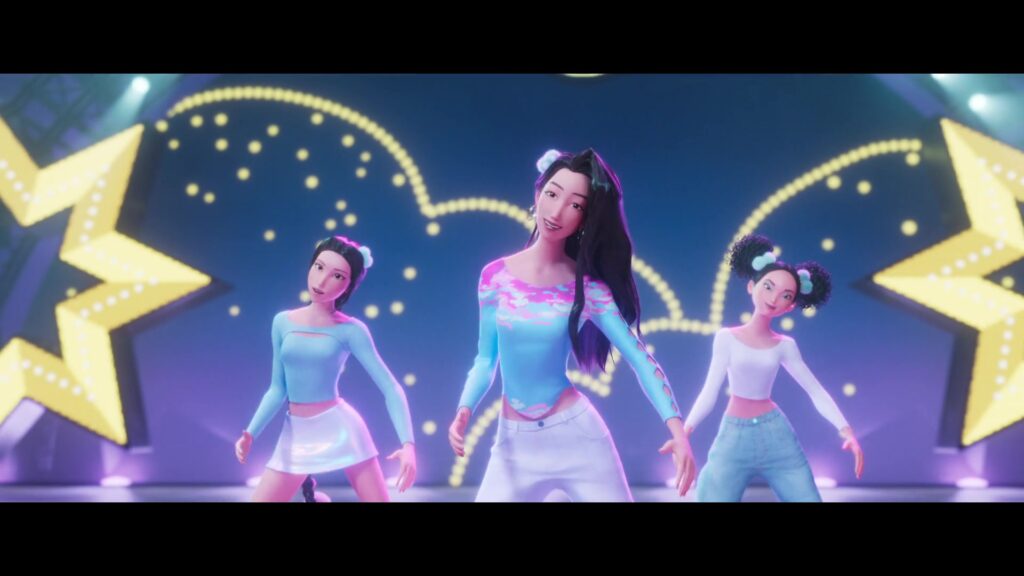
3:00 – Rumi is “pop star royalty.” Her mom was also a demon hunter as part of the Sunlight Sisters, and Celine raised her and built Huntrix around her.
In here, note that everybody loves Mira and Zoey for who they are, but loves Rumi because of who her mom was, and (seemingly secondarily) her voice. While appreciating her art is nice, none of these fans appreciate her for who she is, unlike with her fellow hunters. They only appreciate her because of her art, or because of who she is related to.
There’s hints at a bit of trans connection there, right? For trans creatives (oh hi that’s me), people might love our art, or love the “family” we come from or the people we work for, but that love may not extend to us personally, if they know we’re trans.
5:00 – Rumi, to the flight attendant: “You’re a demon, right? You’re smiling all weird, watering plants with coffee, and those guys?” She gestures to another flight attendant and the pilot, both of whom don’t know what they’re doing.
Very important to note here that demons are shapeshifters. They can change their form.
What do you think that means? Especially having already seen the film?
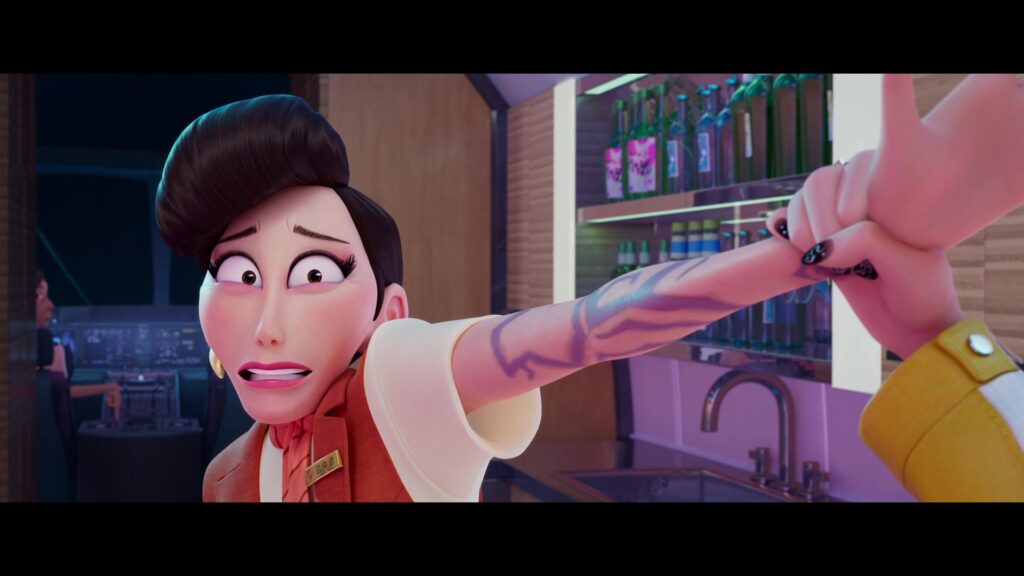
5:11 – Rumi: “Oh look, patterns.” Demons have jagged lines on their skin, that kind of look like tattoos, but they’re not anything they intentionally added to their bodies.
There are physical features that make them different from “normal” humans, that they have no control over. They have a lack of BODILY AUTONOMY.
Do you see the link already being made? In this film’s allegory, demons are the metaphor for trans people (this will get confirmed a few more times).
When asked what superpower we’d most like to have, a large portion of trans people will answer “shapeshifting.” The reason should be obvious, as it would help us escape GENDER DYSPHORIA.
We also have to deal with SOCIETAL GASLIGHTING about our very existence, and the general public in Kpop Demon Hunters kind of ties in to that. Growing up as a kid, through a GENDERED CHILDHOOD, I had no idea trans people existed, or it was a thing some people could be.
This is by design. See TRANS HISTORY 1: HOW AND WHY WE NAME TRANS PEOPLE IN HISTORY for more on the intentional erasure of trans people from history. It’s why Republicans in the US (and right wing politicians worldwide) are working so hard to try to force us all back in the closet. If trans people don’t know trans is a thing we can be, how can we come out as trans (and then be a threat to the entire system of white supremacist patriarchal lies our society is founded on)?
If the metaphor for trans people is demons (and it has to be to make the allegory work as much as it does), the metaphor for cis people are humans. And right here, you can maybe see some of where this is going. Trans people being monsters and cis people being normal humans is a pretty othering setup, in a movie that is, as far as i know, entirely written and directed by cis people.

5:20 – The demons reveal their true forms, as fanged monsters. Mira: “Oh, you got the patterns. Now you gotta die.” The demons threaten to eat Huntrix’s fans, and then a fight ensues, and the demons are killed by Rumi, Mira, and Zoey.
Despite Mira saying the demons have to “die,” the movie doesn’t show them actually dying. They’re just sent back to the underworld. If this is allegory, this isn’t really death. So what is it?
This scene is showing you that society has trained these three, who are aware of trans people, that the response to us should be violence. This includes legislative violence, this includes gaslighting us about our existence, this includes not believing we are who we say we are, and so much more than actual physical violence (which is also a very real problem). See THE CONSTANT FIGHT (of existing while trans).
I do want to stress, at this point, the film’s allegory isn’t saying this is how it should be, but this is how it is now. Rumi, a trans person, has been trained to visit all this violence upon trans people.
This is the implicit transphobia society works into every single cis person (see IMPLICIT QUEERPHOBIA), and the INTERNALIZED TRANSPHOBIA society works into every trans person.
In the lead up to the concert, the colors get super transy again. And during their performance, we see the (non-Golden) Honmoon spreading to protect the world, and demons trapped underneath it.
By upholding the implicit transphobia of society, they’re keeping trans people trapped away from society, away from cis people.
In the closet. That’s what the underworld is, trans people trapped and isolated from the rest of the world.
9:10 – In the underworld, the flight attendant demon that failed to stop Huntrix is confronted by Gwi-Ma. She’s destroyed for it (this appears to be an actual death in the surface-level story), as Gwi-Ma berates all the other demons for being useless.
Note that Gwi-ma, king of the demons, is also blue and pink, tying in to my read of him as societal hate, bigotry, and transphobia.
10:29 – Jinu has a plan, for he and some fellow demons to impersonate humans and try to steal Huntrix’s fans, to rob the Honmoon of its power.
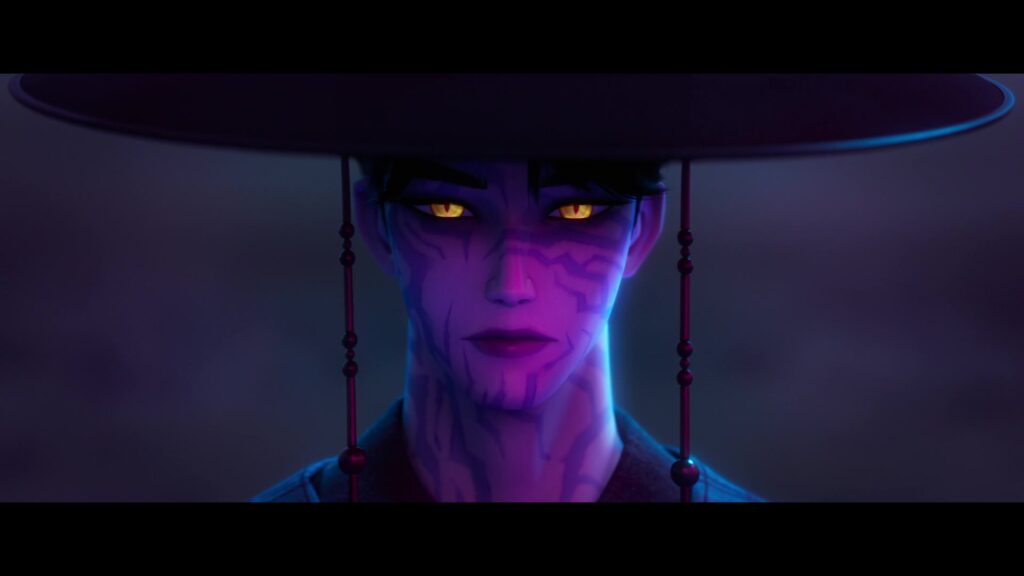
11:11 – Gwi-Ma: “I know you, Jinu. In four hundred years, you’ve never done a single thing that didn’t serve yourself.” Jinu is selfish, or at least believes himself to be, and Gwi-ma is feeding into that. Society wants us to feel that way.
So much of society will tell trans people we are selfish for wanting to live authentic lives free of pain, due to the cis people around us not being able to handle it. And it’s those very cis people who are being selfish, and asking us to live a painful waking nightmare for their own comfort. See CIS GRIEF and CIS SPOUSAL AND PARTNER SUPPORT for more on that.
11:40 – Huntrix saw some gold in the Honmoon, which means it’s time to release the song that will truly turn it gold. Rumi coughs. She knows, inside, that sealing the Honmoon means she’d be trapping everyone else like her, everyone trans, in the closet forever. Even if only subconsciously, here… she knows it’s not right, and her body reacts.
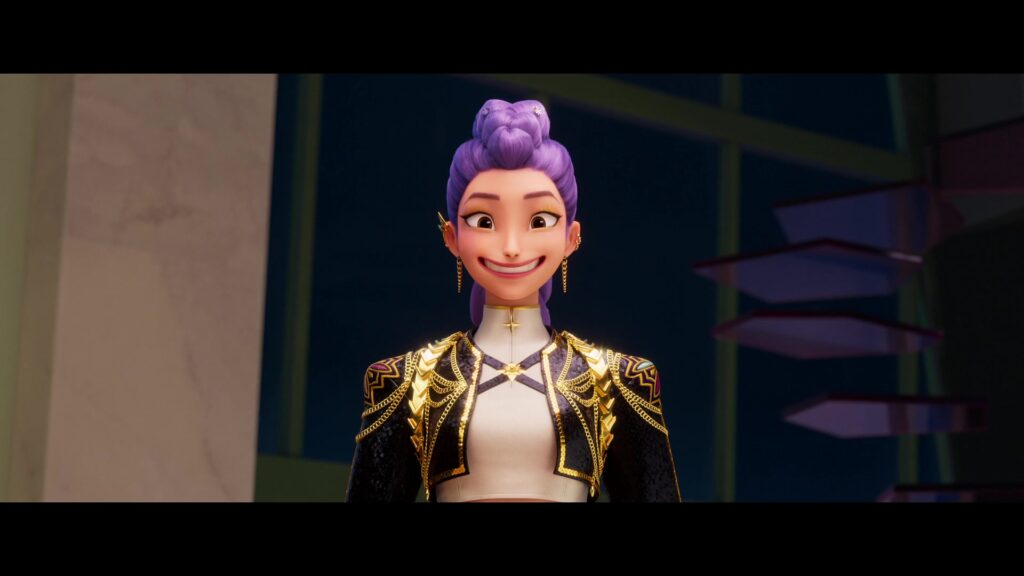
13:31 – Rumi immediately launches the new single and puts on her new outfit. She has to wear a costume. Like, there are a lot of costume changes in this film, but the one for Golden is special. It’s the costume of the cis person she has to wear to pretend that she, too, isn’t trans… especially if she’s going to lock that closet door on every other trans person, like she’s expected to.
“Golden” plays for the first time, and this is the first hint we get that Rumi is living some kind of “double life,” or has a “secret” she doesn’t want to get out, both of which are just super trans. Let’s look at the lyrics.
I was a ghost, I was alone
어두워진 앞길 속에 [In the darkened path ahead]
Given the throne, I didn’t know how to believe
I was the queen that I’m meant to be
This song is about trying to deny who she really is and live up to who she’s been told she is, and is “meant to” be. If you take the “queen” part of that literally, in terms of gender, that would make Rumi nonbinary or trans masc, and she’s trying to live up to the false expectations that have been put upon her – that she is a woman.
I lived two lives, tried to play both sides
But I couldn’t find my own place
Called a problem child ’cause I got too wild
But now that’s how I’m getting paid 끝없이 [eternally] on stage
I’m done hidin’, now I’m shinin’ like I’m born to be
We dreamin’ hard, we came so far, now I believe
Oh-oh-oh, I’m done hidin’, now I’m shinin’ like I’m born to be
Oh, our time, no fears, no lies
That’s who we’re born to be
Waited so long to break these walls down
To wake up and feel like me
Rumi’s not the one who sings all of the above lines, but it still sounds a lot like a trans person about to come out, right? Done living the lie. But then it takes a turn:
Put these patterns all in the past now
And finally live like the girl they all see
No more hiding, I’ll be shinin’ like I’m born to be
“Putting those patterns in the past” and “live like the girl they all see” show you that now it’s about locking her own true self away in the closet forever. This will also get confirmed later on.
Rumi believes that locking that closet door will free her from her transness, but that’s not the way it works. So many of us try to ignore it, even though THE SIGNS WERE ALWAYS THERE. We pretend it’s not there, or deny it, or try to bury it. But it doesn’t go away. You literally cannot change the truth of who you really are, no matter what you do.
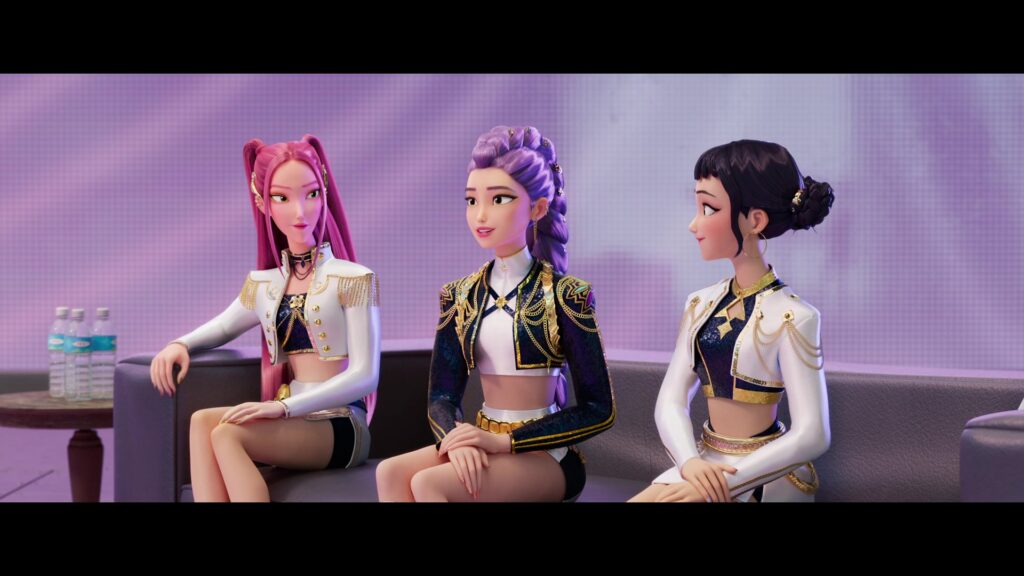
15:05 – Mira, about Golden, “It’s the story of us.” Rumi: “It’s a song about who we are, and where we’re going next.” This confirms that for Rumi, Golden is about putting her transness behind her forever (ha, good luck). The story of them is upholding transphobia, as we are all implicitly taught, and as they were explicitly taught to do.
How many of us have been conditioned, and even explicitly taught, to mock a man who does anything feminine, like wear a dress? Or to mock a woman who doesn’t shave her legs? And on and on.
Huntrix believes that where they’ve been, who they are, and where they are going is more of the same: oppressing trans people, it’s what they’ve literally been trained to do.
We’ll wrap it there for this week, but come back next time as Rumi learns that pretending you’re not trans doesn’t make it go away, and we’ll see how her first encounter with the trans community affects her.
Tilly Bridges, end transmission.
tillysbridges@gmail.com