UNEXPECTED CHANGES FROM TRANSITION

Welcome to #TransTuesday! We all hope for a whole host of changes to come with transition, but some of them are entirely surprising for a variety of reasons. So this week we dive into: UNEXPECTED CHANGES FROM TRANSITION (and a wild story from SDCC 2023)!

First let me say that if you’re reading this when it’s released, trans tuesdays will be off for a couple weeks as I prep for, attend, and then recover from San Diego Comic-Con, which is a monster wrapped in a demon wrapped in a party wrapped in a pop culture comic convention.

This week’s topic is actually one I wanted to write after 2023’s SDCC, but I didn’t get around to it until now. I needed to process it a bit, but also I had to write up the nine-part trans allegory of SILO, and then the year was almost over, and then I had to write up the eight-part trans allegory of BARBIE, and well here we are.

Before every trans or nonbinary person starts transition of any kind – medical or social or even mental and emotional, there are a whole lot of changes we hope we’ll get out of it. Experiencing more GENDER EUPHORIA is often one of them, and if you’re unfamiliar you can read about that here.

And for those of us with GENDER DYSPHORIA, the lessening or disappearance of it is also a big change we’re hoping for. See the trans tuesday on it for more info if you need it.

I personally was hoping that dressing in the clothes I’d wanted to wear for my entire life would make me happy. That growing my hair out would help me find myself. That my journey through gender-affirming speech therapy would help me find a voice that sounded like me to my own ears.

If you want to read more on my journey with clothing, see FINDING OUR TRANS STYLE.

And for more on just what my HAIR has meant to be, see its trans tuesday…

And its follow-up HAIR 2 when I had my first real visit to a hairstylist.

I was also hoping for more than even those things, though. I was hoping for the body developments that hormone replacement therapy might bring…  breast growth, hip and butt development, the slowing of body hair growth, facial and body shape changes, etc. For more on my struggles with BODY HAIR, here you go.

I’ve actually gotten so many of the changes I’ve wanted from HRT, which is kind of amazing. You can read about it in my annual HRT check-in retrospectives. Here’s the fourth.

For trans people who need gender confirmation surgeries, the outcome of those is also hoping we’ll see ourselves and feel like our true selves for the first time.

But to my surprise, there have been a whole lot of changes from transition that I never could have anticipated. You can read about some of the smaller of those, and the little ways they filled my life with joy, in the trans tuesday on UNEXPECTED BONUSES OF TRANSITION.

To be fair, there were also some changes that I might have anticipated if I’d been able to stop and think about it for a while. But I was dealing with pretty severe dysphoria, and it made pondering all the surprising nuances of transition difficult or impossible.

One of the things I couldn’t have anticipated, as I’d not seen or heard trans people talking about it before I started HRT (though I’ve seen a lot of it since) are the mental changes that HRT has brought along with it.

I have this remarkable… peace of mind now. And it’s not just from my body finally feeling like me, though that’s part of it. And it’s not just from my voice finally sounding like me, though that’s part of it. And it’s not just from my dysphoria being all but gone, though that’s part of it.

It’s so hard to describe, but the way you can maybe see it best illustrated is in the trans tuesday on TRANSITION SETBACKS, when my HRT stopped working for me and I was horrified to discover the mental backsliding it caused, and how it felt like my very identity was being stripped away.

My whole life pre-transition, my brain was a cloud of dysphoria and pain and misery and isolation and noise, like I was stuck in a feedback loop or something. Actually, when you consider how much our society tells you you’re cis and reinforces that you have to be, “feedback loop” is actually pretty apt.

But just being on the right hormones for me has stopped so much of that. It’s like it lifted this veil that not only kept me from experiencing the world, it kept me from experiencing myself.

You can see the external part of that reflected in the trans tuesday on CONFIDENCE 2: INTO THE UNKNOWN aka A WHOLE NEW WORLD, aka WHAT IS HAPPENING.

I had no idea that just being could feel the way it does now, that I could know and love myself and who I am the way that I do. That this was the real me buried underneath all the dysphoria shit for my entire life. It never ever occurred to me that that would change, or even could change.

And here’s why this topic made it onto my mega-list of future trans tuesdays to write after SDCC in 2023. Due to coming out and transitioning during lockdown of the pandemic, attending that con was the first trip I’d ever taken as my true self. While out as a woman. And HOLY CRAP the difference could not have been more stark.

Before I get into it, if you want more on the difficulties of A PANDEMIC TRANSITION, you know I’ve got you covered.

I don’t know what it’s like to pack for a trip, or experience a trip, as a guy. But I know what those things were like while badly pretending to be a guy, which is all I can talk about.

As I mentioned in the trans tuesdays on hair and, I think, gender dysphoria, for most of my life I had a super short buzzcut. This necessitated no special products, no care, not even a comb or a certain shampoo.

I didn’t care about my clothes, at all. They were simply there to hide my awful body from view.

I rarely shaved, for dysphoria reasons (though facial hair also caused dysphoria, it was a real paradox).

So pre-transition, my packing for SDCC would be to toss a handful of geeky t-shirts, underwear, socks, and a couple pairs of cargo shorts into a bag, grab my deodorant, toothbrush and toothpaste, and… that was it. Like literally… THAT WAS IT.

Do you… do you know what I had to pack last year? It kept cracking me up because it just never ended.

So of course I had to bring clothes, and I picked cute tops and paired them with skirts or shorts that would look nice, and yeah sure socks and underwear. And I had to bring bras now, but that’s not that much more, right?

But hmm, I DO like to style my glasses to compliment my outfits (you MAY have noticed…) so I’d better bring multiple pairs of glasses too, just in case.

Oh wait, my hair requires special shampoo. And hair product. And a blow drier, with a diffuser. Not knowing if our hotel would have the latter, I had to bring that too.

And yeah, I still have to shave, daily. So I had to bring a razor, and replacement cartridges, and shaving cream. This one actually hit me twice, because SDCC last year was right in the middle of when my HRT stopped working, that I talked about in the transition setbacks trans tuesday, which meant my facial hair was growing a lot faster again.

Even my super-close against the grain shave wasn’t lasting all day, I had beard shadow at night. But a lot of SDCC events are parties and hangouts after the con late at night… so I had to do a touch-up shave every night just to keep my face clear. And it HURT. A LOT.

I had to bring makeup, because I like it, but also because you’re well aware of the expectations leveled on women and the way people may judge you (even subconsciously) if you’re not wearing it. But allllso if I’m wearing it I’m much more likely to get gendered correctly, especially when I was struggling to keep my face stubble-free. So it was non-negotiable.

But I’m very farsighted (my stylin’ glasses ain’t just for show), and I cannot see my own eyes in a mirror without glasses well enough to put eye makeup on, and obviously I can’t put eye makeup on while my glasses are on. I have to use a magnifying mirror. So now I had to bring that, too.

I have lotion for my arms, two different moisturizers for my face, and two different moisturizers for my eyes! And special gentle face soap! All of which I had to bring, too.

I also had to bring all of my hormones along (this year will be even more complicated, because I’m on injections now so I’ve got to bring vials and needles and all that junk, too).

And it just struck me what an entirely different experience it was… to go from “do as little as possible because I don’t give a shit about myself” to “I have to do so much to take care of myself because I care a LOT about myself.”

And sure, some of that is going from perceived man to perceived woman in this very sexist society, but a lot of it was also that I just care so much more about myself now than I ever thought possible.

Another weird thing that happened at SDCC last year was that I got recognized, a LOT.

At 5:57 pm on July 19, 2023 I posted:
Sitting outside waiting for dinner at the Hard Rock and already got recognized
We JUST GOT HERE
My magnificent mane cannot be denied

At 4:01 pm on July 20, 2023 I posted:

Heading to the convention center for an SDCC interview and got stopped on my way in by someone who recognized me with a “are you Tilly? You’re awesome!”
WHAT IS HAPPENING

And sure you can say that’s because of my book and tv and comics writing, I guess, but the only reason people recognized me is because of all the selfies I post, which means it’s directly due to my transition… because I almost never took selfies before, much less posted them (yay dysphoria).

See the trans tuesday on PHOTOS AND REFLECTIONS for more on that.

And PHOTOS 2: THE SELFIE APOCALYPSE when it all finally changed.

But then there was a guy who also thought I was doing a cosplay? Which I guess technically I was, maybe?

On july 22, 2023 I posted:
Just had an Only At ComicCon experience far stranger than fiction but I don’t have time to write it up atm
For now, I leave you with THIS Only At ComicCon experience that susanlbridges witnessed:
Guy stops me on the street: “who are you dressed as?!”
Me: “MYSELF!”

This is a photo of me on the day in question, in a blue cherry-print halter top with a red border, red lipstick, and white iridescent cat-eye glasses

A buncha people asked me about that other “only at ComicCon experience” I mentioned, and you’re in luck, because it’s finally time to tell that story!

There is so much going on at SDCC, ~~~SO MUCH~~~, that you will literally never see it all, much less even be aware of it all. It’s just not possible. The size and scope of this five day con will blow your mind if you’ve never been.

So on the Saturday of the con, my lovely wife Susan and I are resting in the hotel room before grabbing dinner and then heading to a panel I was on that evening. We’re checking social media, where you often find out more about what’s going on at the con than while you are AT the con, it’s wild.

And we find out there’s some kind of “Paramount experience” down in the Gaslamp Quarter… which is this area across from the convention center that extends a few blocks, filled with restaurants and shops and a bunch of them get taken over during the con for more convention stuff (the con also spreads to nearby hotels and even the San Diego library).

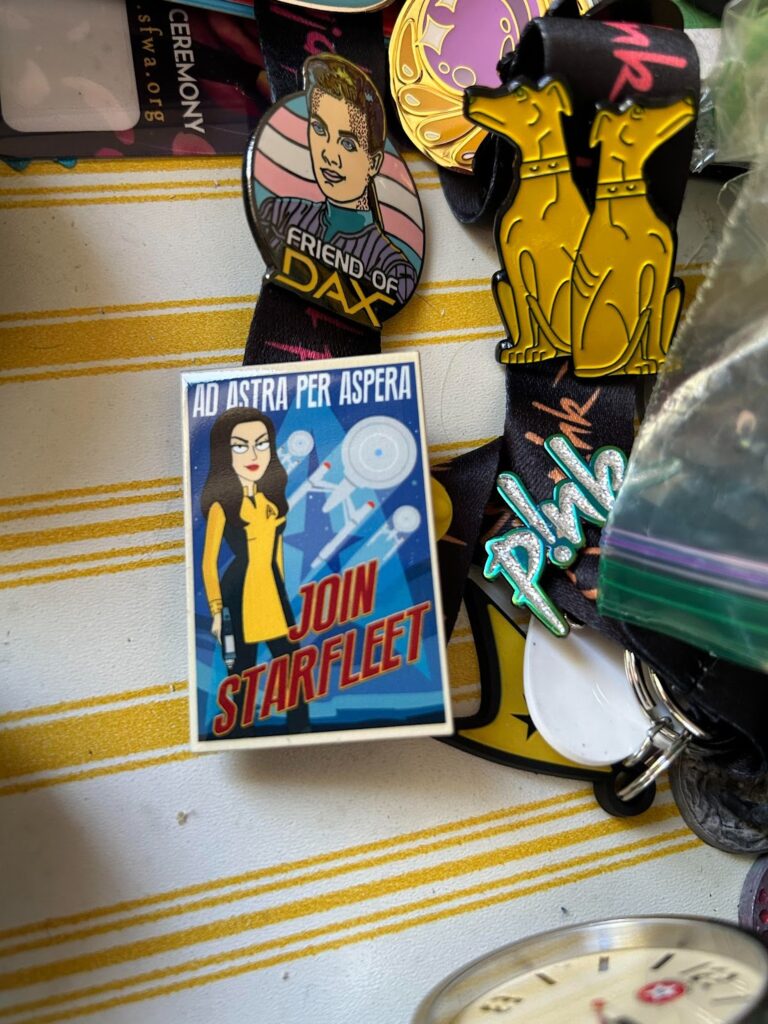
Apparently people are saying they got a SDCC-exclusive pin at this Paramount experience, and it’s from the “Ad Astra per Aspera” episode of Star Trek: Strange New Worlds. (SDCC is filled with exclusive stuff like this, and it’s always a huge hassle and headache and nightmare to even attempt to get them, because they are small in number and a large amount of the hundred thousand attendees want them)

That episode is my favorite in all 800+ hours of Star Trek (all of which I’ve seen many multiple times), and it’s SO transy and amazing. The episode had just premiered about a month before the con, and you can see the effect it had on me:

At 7:03 pm on June 22, 2023, I posted:
Hello
STAR TREK SAID TRANS RIGHTS WITH ITS WHOLE DAMNED CHEST
Thank you, #StarTrekStrangeNewWorlds #StarTrekSNW
Thank you, horgandee (the account of the show’s writer)
It means the world
One day may i fly among you
Together in the stars
All my love always
AD ASTRA PER ASPERA (live long and prosper emoji, trans flag emoji, purple heart emoji)

Truthfully, part of what took me so long to get to writing this trans tuesday was that I fully intend to do an entire trans tuesday or two on Ad Astra per Aspera, and I just haven’t had time yet. And now the SDCC 2024 is here, and welp! Onward we go. But I WILL be writing about that episode, so keep an eye out.

Anyway, the chance to get something commemorating my favorite episode, something that is SO important to me, was too good to pass up. But already despair set in, because we’d just found out about it and the Paramount experience thing apparently closed at 5 pm and people were saying the line was interminably long.

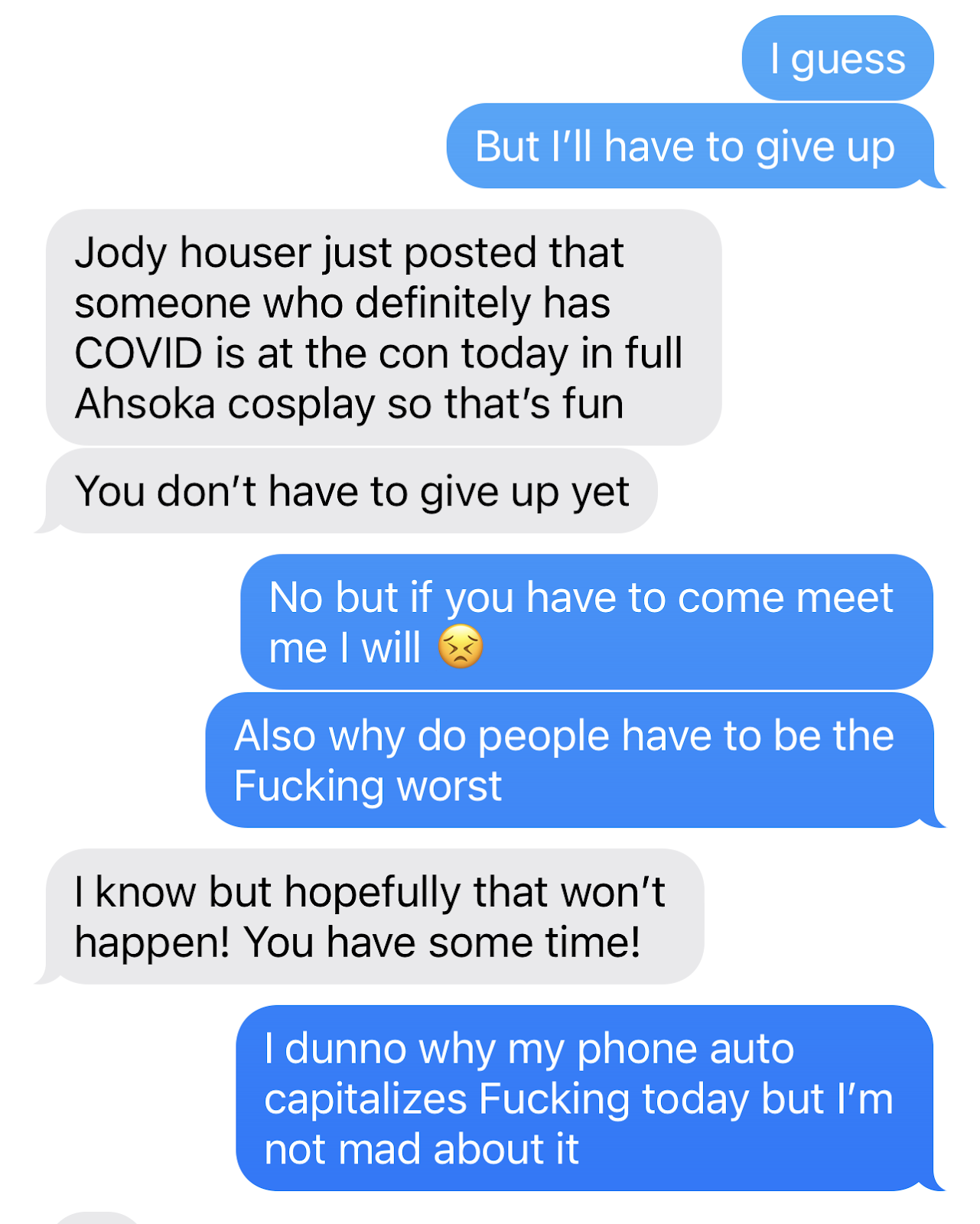
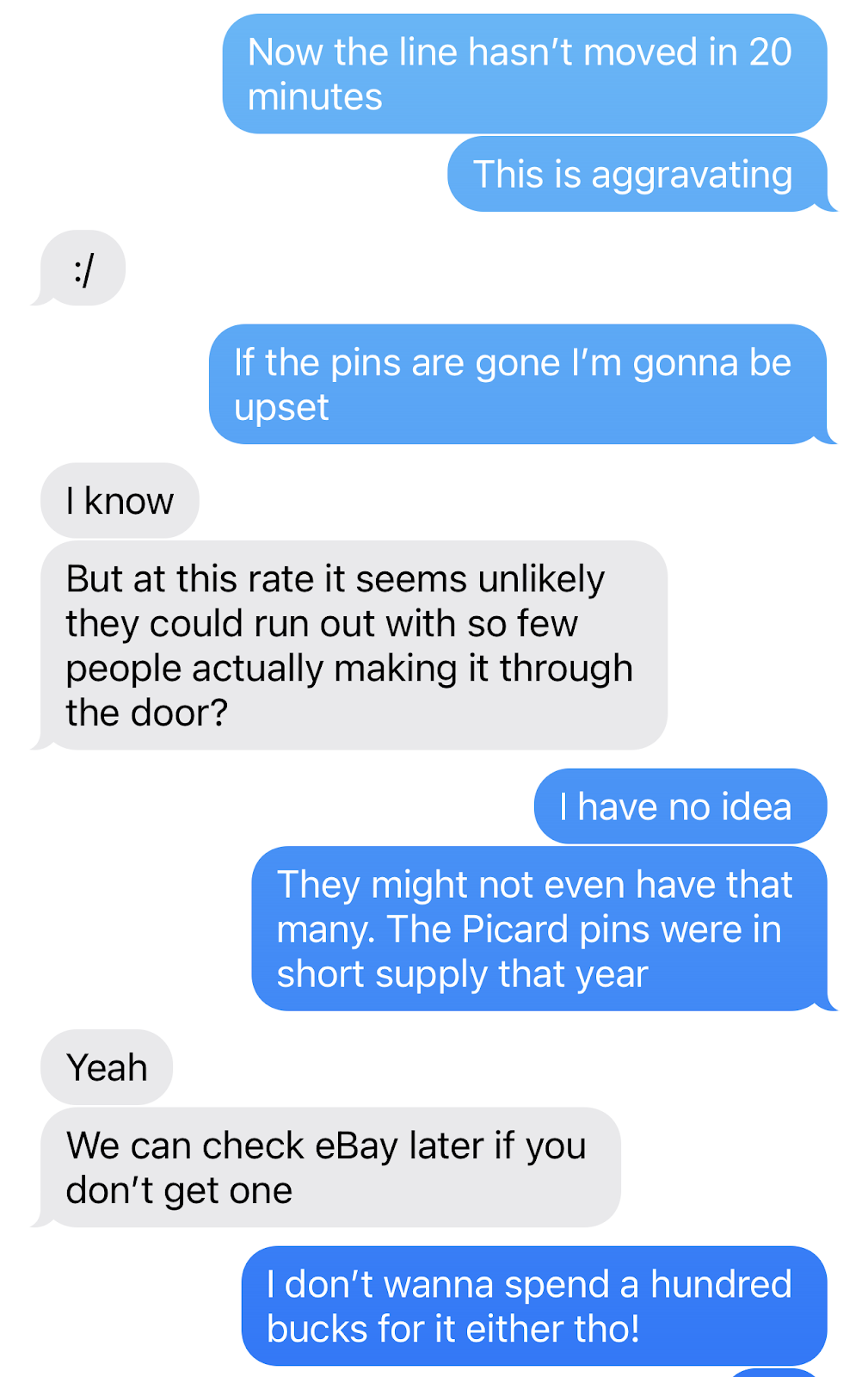
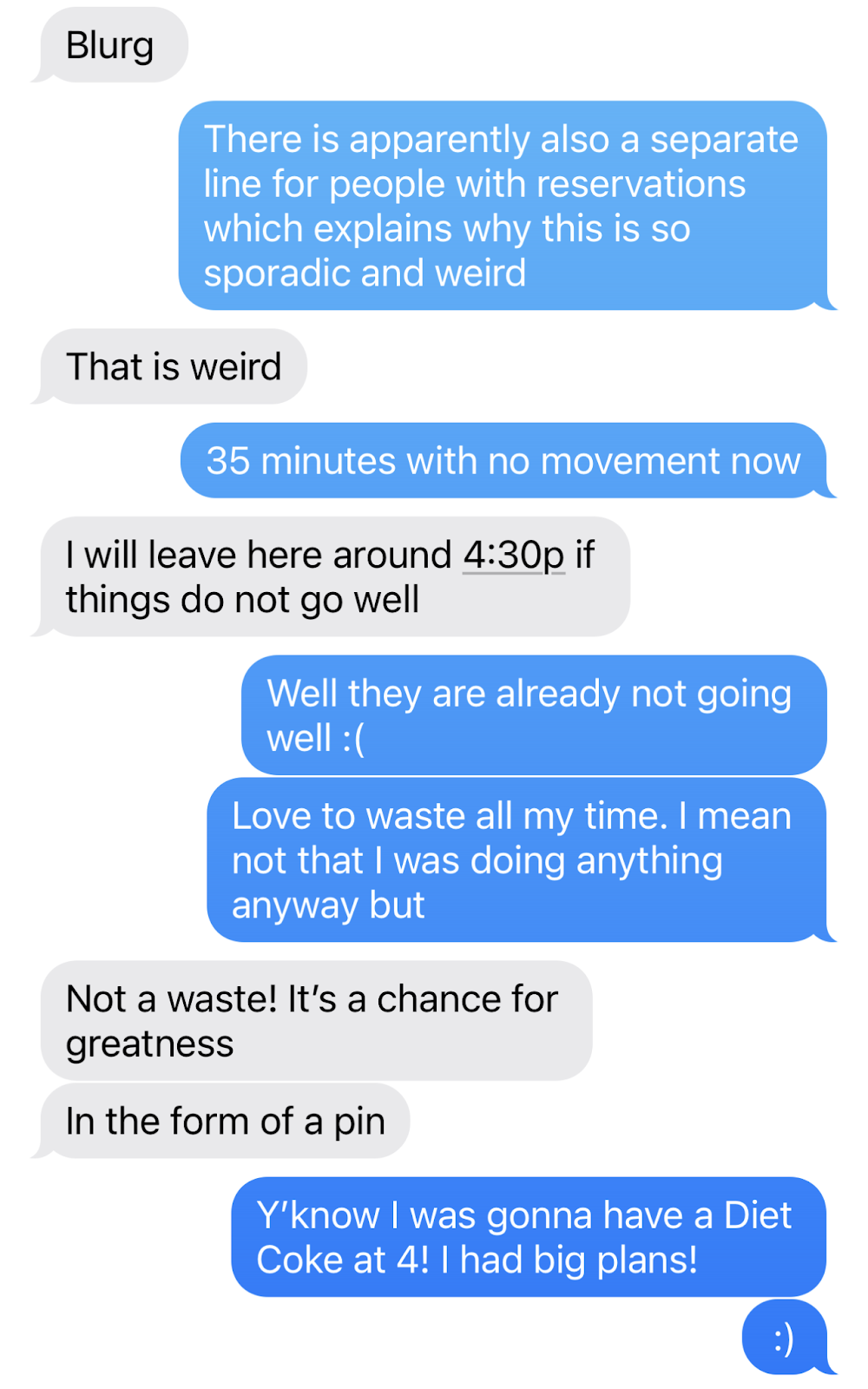
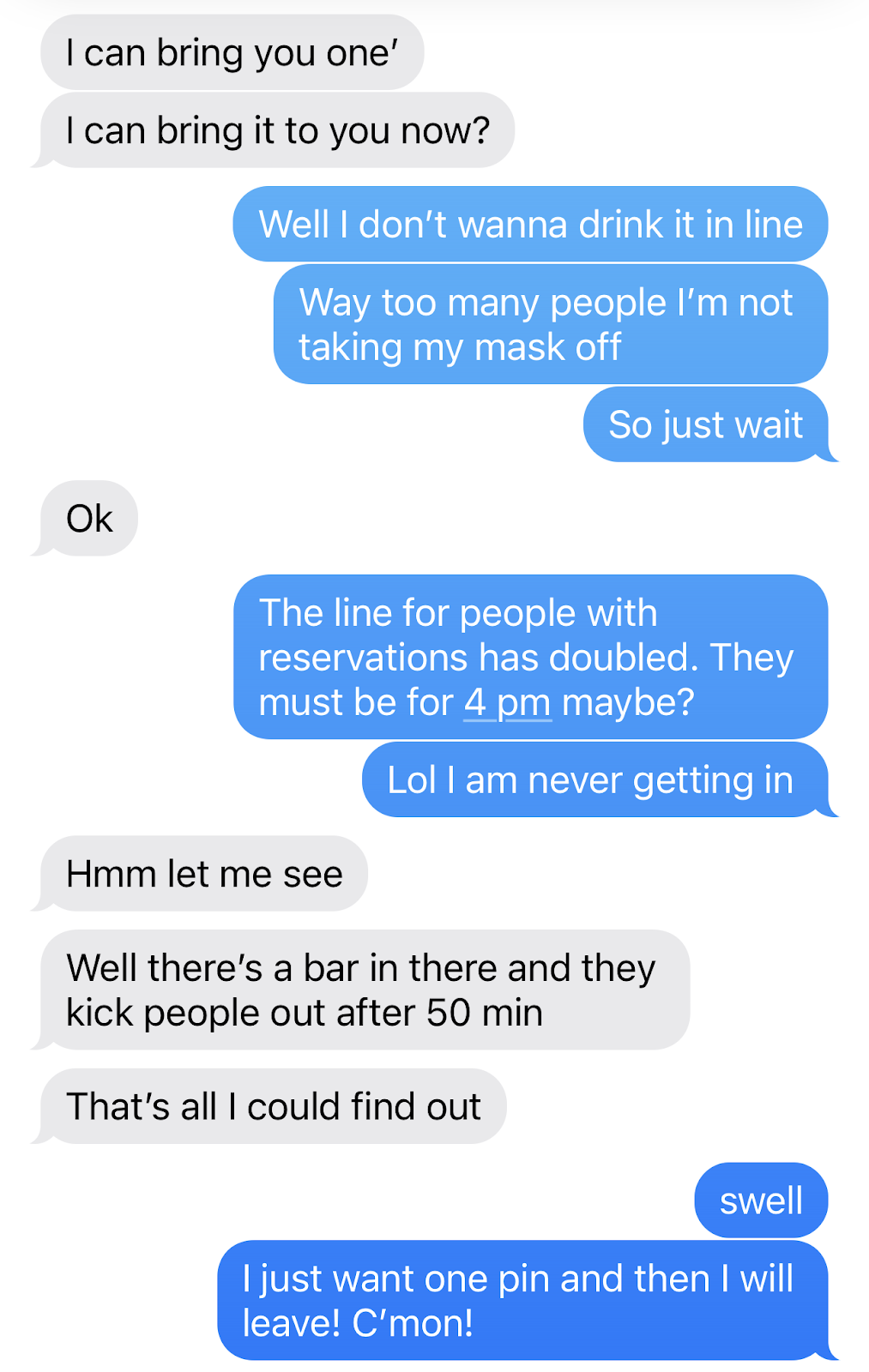
But I had nothing else to do until we were going to eat, so I decided to give it a shot. A little after 2 pm I went out and found the line in the Gaslamp Quarter, and my journey began. As I went, an absolutely bananas story unfolded, and I was texting with Susan the entire time. I saved screenshots so I have the entire thing for the historical record. Come along on for the ride!

This was the madness of the Gaslamp Quarter behind me early in line (it was even worse in front of me). You can see the actual convention center waaaaay in the background.

A shot of a long line and a very large crowd of nerds on a cute street, next to diners on a restaurant patio, with my curly bangs in the foreground

Saturday, July 22 2023, at 2:22 pm, text string begins.
Me: There’s this 11/12 year old in front of me playing Tetris on her phone and she’s just singing aaahAHHHHaaaaahhhhAHHHHHHHHahhhh randomly non stop

Susan: I hope you get a pin!!
Me: Well the line hasn’t moved in ten minutes

S: blurg

Me: I think it’s like the Picard museum was where you go in and just stay as long as you want and the don’t let people in until some leave

S: oh I see

Me: No idea what else is in there
Me: A Shaxs just walked by and it was like someone took his toon and made it human. A+
S: yay
Me: At this rate I am not sure if I will even be in there before we need to eat (side-eye emoji)
S: well okay if that happens I will come meet you

Me: I guess
Me: But I’ll have to give up
S: Jody houser just posted that someone who definitely has covid is at the con today in full Ahsoka cosplay so that’s fun

S: You don’t have to give up yet
Me: No but if you have to come meet me I will (sad emoji)
Me: Also why do people have to be the Fucking worst
S: I know but hopefully that won’t happen! You have some time!

Me: I dunno why my phone auto capitalizes Fucking today but I’m not mad about it

Me: The line moved more in the past two minutes than the past hour
Me: very weird

Me: Now the line hasn’t moved in 20 minutes

Me: This is aggravating
Susan: :/
Me: If the pins are gone I’m gonna be upset
S: I know
S: But at this rate it seems unlikely they could run out with so few people actually making it through the door?
Me: I have no idea
Me: They might not even have that many. The Picard pins were in short supply that year
S: yeah
S: We can check ebay later if you don’t get one
Me: I don’t wanna spend a hundred bucks for it either tho!

S: blurg
Me: There is apparently also a separate line for people with reservations which explains why this is so sporadic and weird
S: that is weird
Me: 25 minutes with no movement now
S: I will leave here around 4:30p if things do not go well
Me: Well they are already not going well 🙁
Me: Love to waste all my time. I mean not that I was doing anything anyway but
S: Not a waste! It’s a chance for greatness
S: In the form of a pin
Me: Y’know I was gonna have a Diet coke at 4! I had big plans!
Me: 🙂

S: I can bring you one
S: I can bring it to you now?
Me: Well I don’t wanna drink it in line?
Me: Way too many people I’m not taking my mask off
Me: So just wait
S: Ok
Me: The line for people with reservations has doubled. They must be for 4 pm maybe?
Me: lol I am never getting in
S: Hmm let me see
S: well there’s a bar in there and they kick people out after 50 min
S: that’s all I could find out
Me: swell
Me: I just want one pin and then I will leave! C’mon!

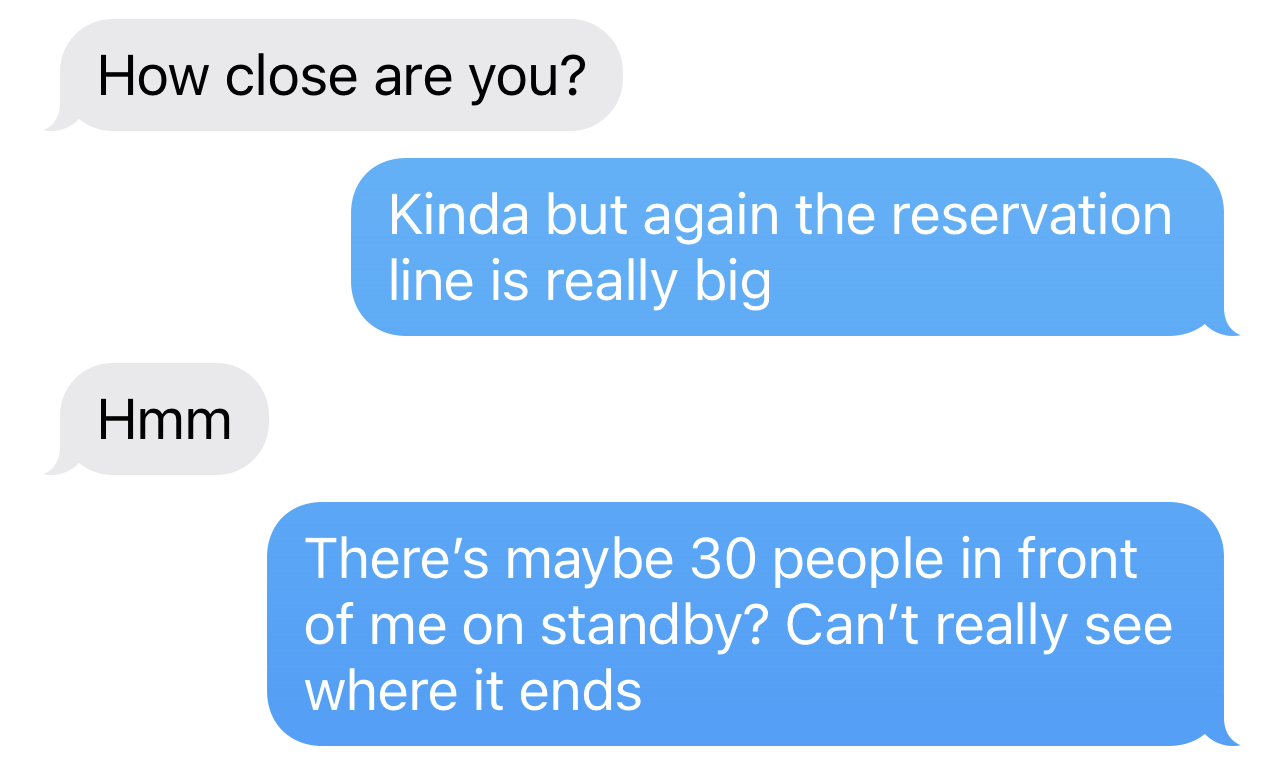
S: How close are you?
Me: Kinda but again the reservation line is really big
S: Hmm
Me: There’s maybe 30 people in front of me on standby? Can’t really see where it ends.

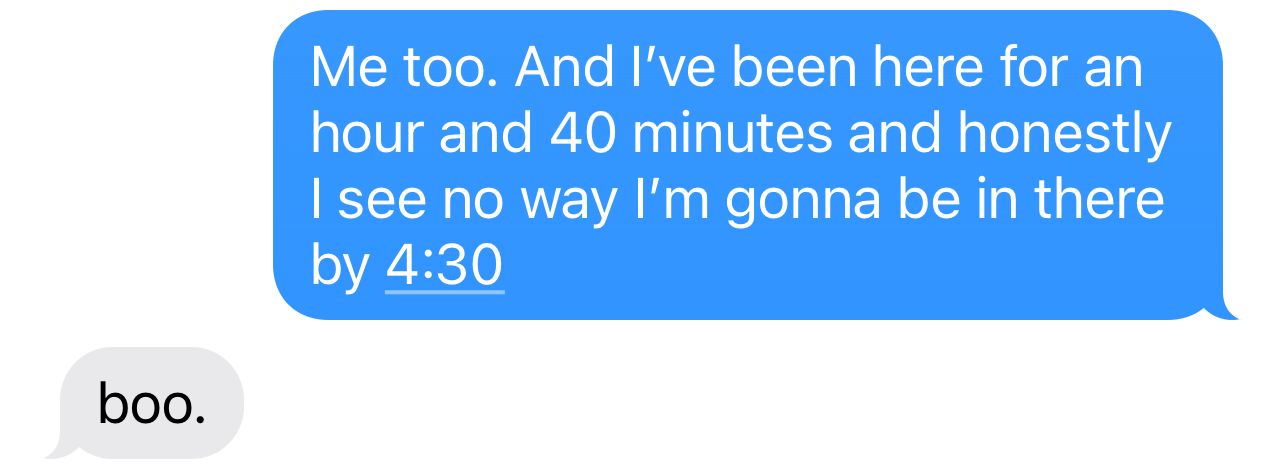
Me: Me too. And I’ve been here for an hour and 40 minutes and honestly I see no way I’m gonna be in there by 4:30
S: boo.

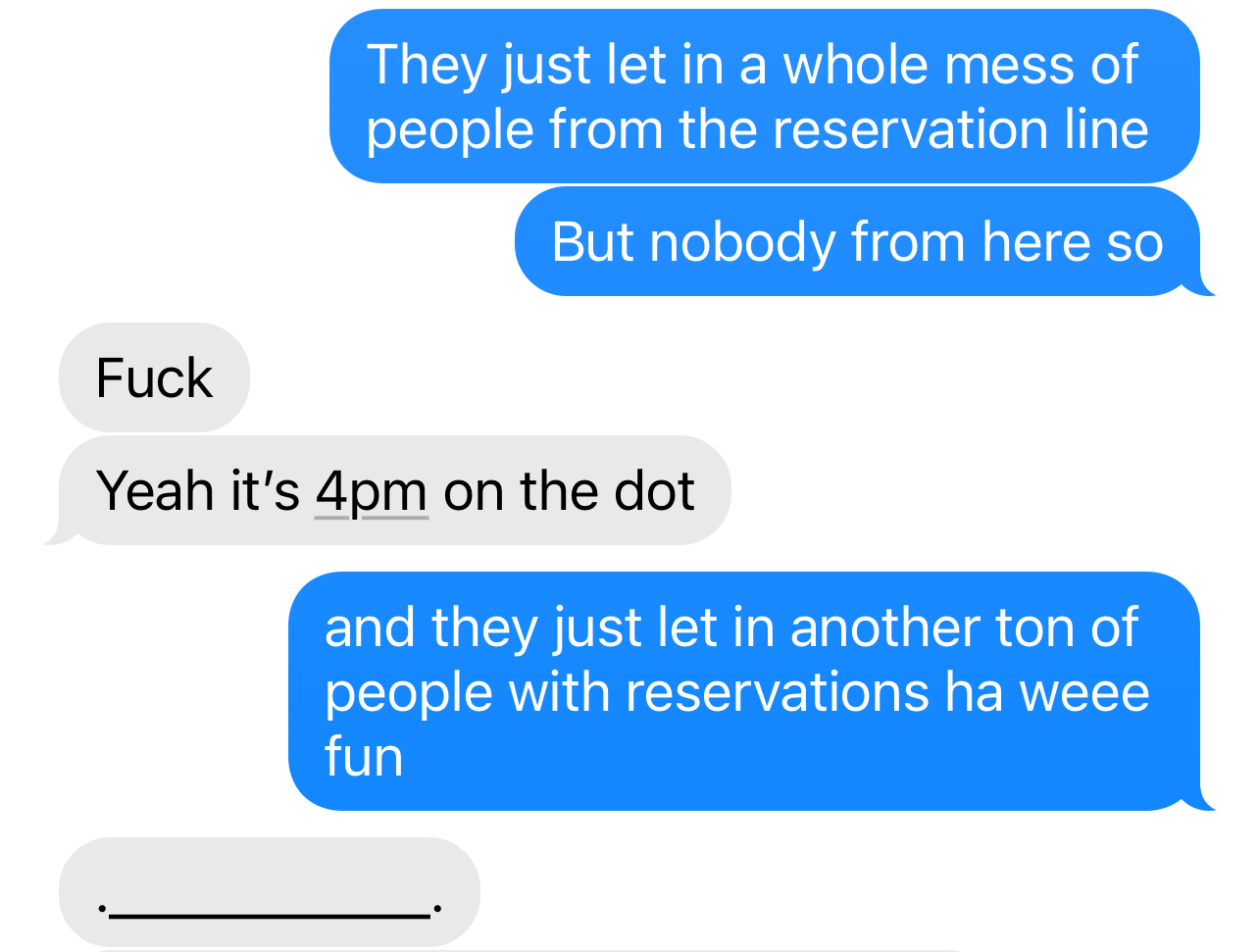
Me: They just let in a whole mess of people from the reservation line
Me: but nobody from here so
S: Fuck
S: Yeah it’s 4pm on the dot
Me: and they just let in another ton of people with reservations ha weee fun
S: .__________.

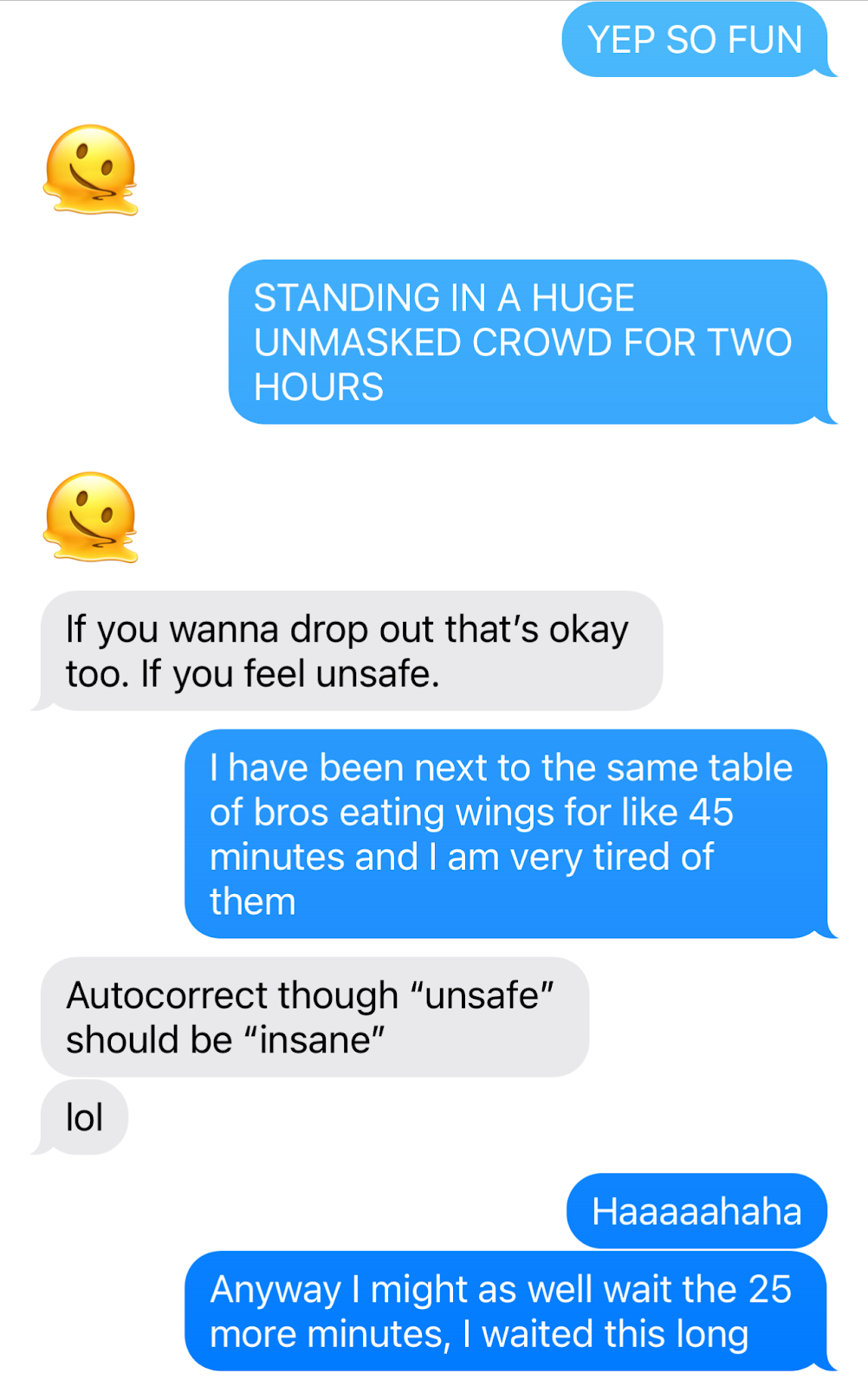
Me: YEP SO FUN
S: (melting smiley face emoji)
Me: STANDING IN A HUGE UNMASKED CROWD FOR TWO HOURS
S: (melting smiley face emoji)
S: If you wanna drop out that’s okay too. If you feel unsafe.
Me: I have been next to the same table of bros eating wings for like 45 minutes and I am very tired of them
S: Autocorrect though “unsafe” should be ”insane”
S: lol
Me: Haaaaaahaha
Me: Anyway I might as well wait the 25 more minutes, I waited this long

S: Ok
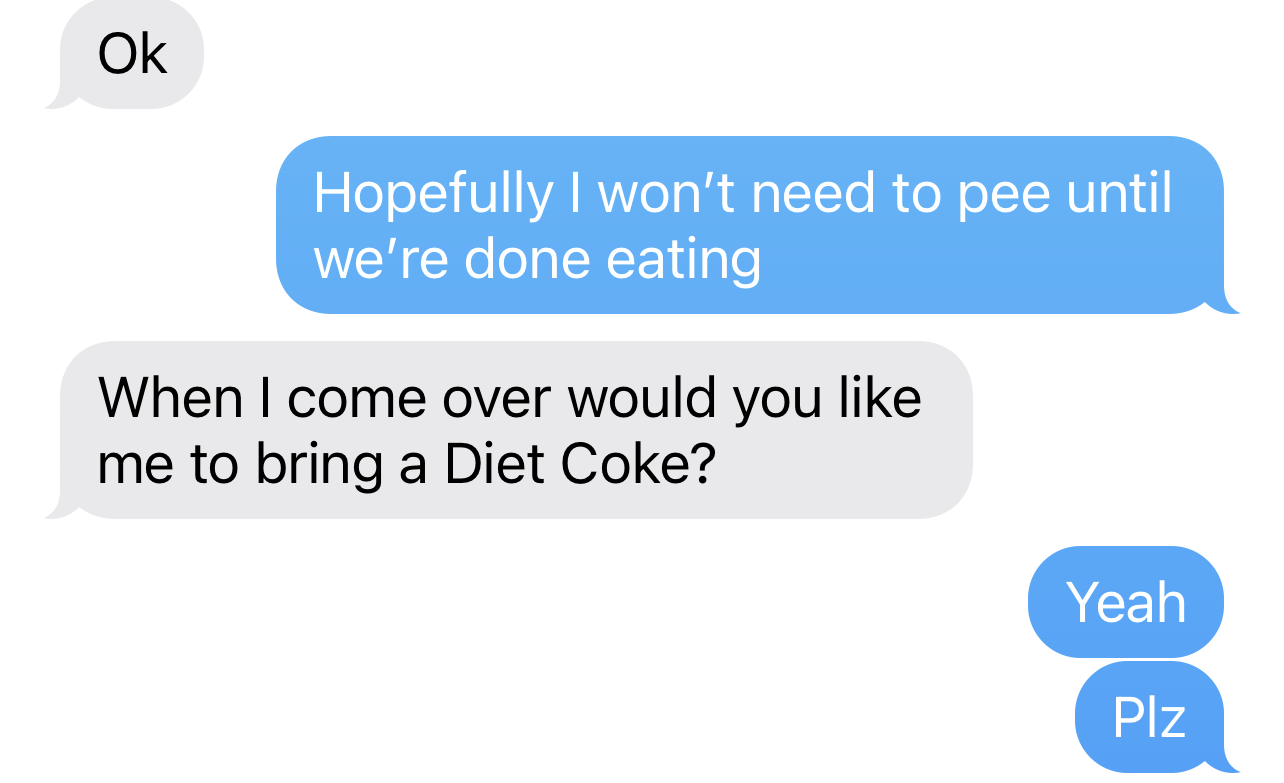
Me: Hopefully I won’t need to pee until we’re done eating
S: When I come over would you like me to bring a Diet Coke?
Me: Yeah
Me: Plz

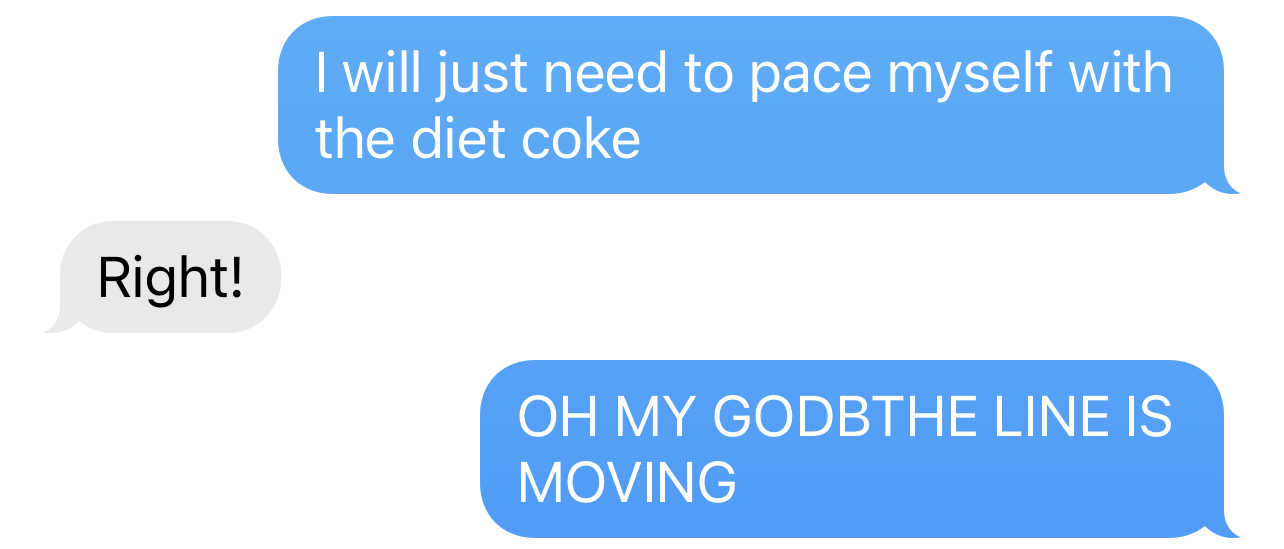
Me: I will just need to pace myself with the diet coke
S: Right!
Me: OH MY GODBTHE LINE IS MOVING

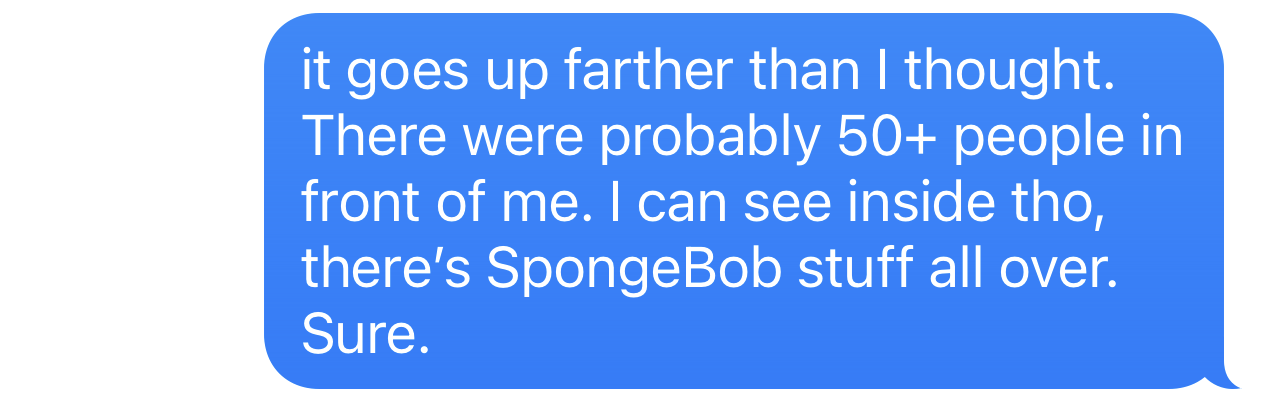
Me: it goes up farther than I thought. There were probably 50+ people in front of me. I can see inside tho, there’s SpongeBob stuff all over. Sure.

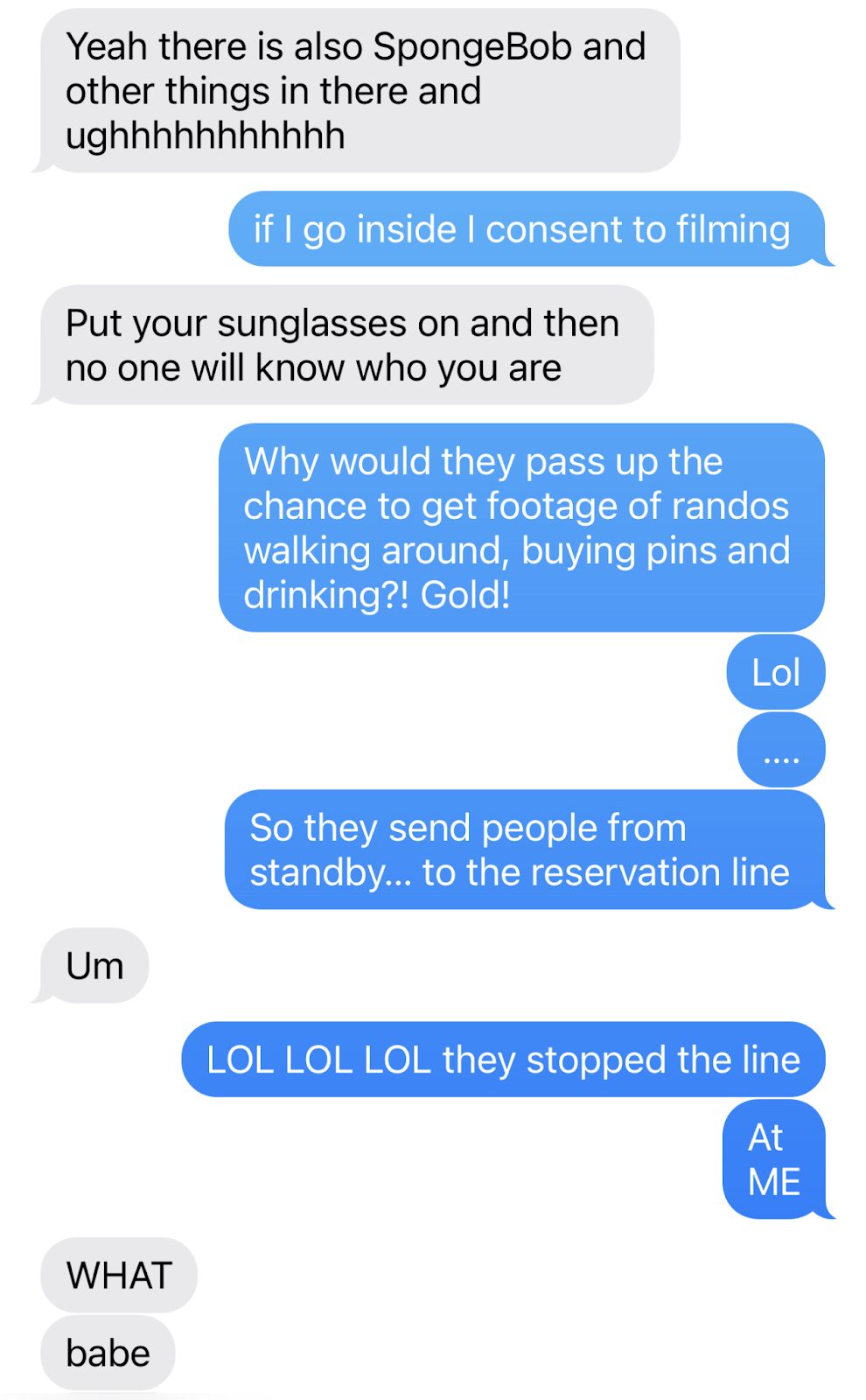
S: Yeah there is also SpongeBob and other things in there and ughhhhhhhhh
Me: if I go inside I consent to filming
S: Put your sunglasses on and then no one will know who you are
Me: Why would they pass up the chance to get footage of randos walking around, buying pins and drinking?! Gold!
Me: Lol
Me: ……
Me: So they send people from standby… to the reservation line
S: um
Me: LOL LOL LOL they stopped the line
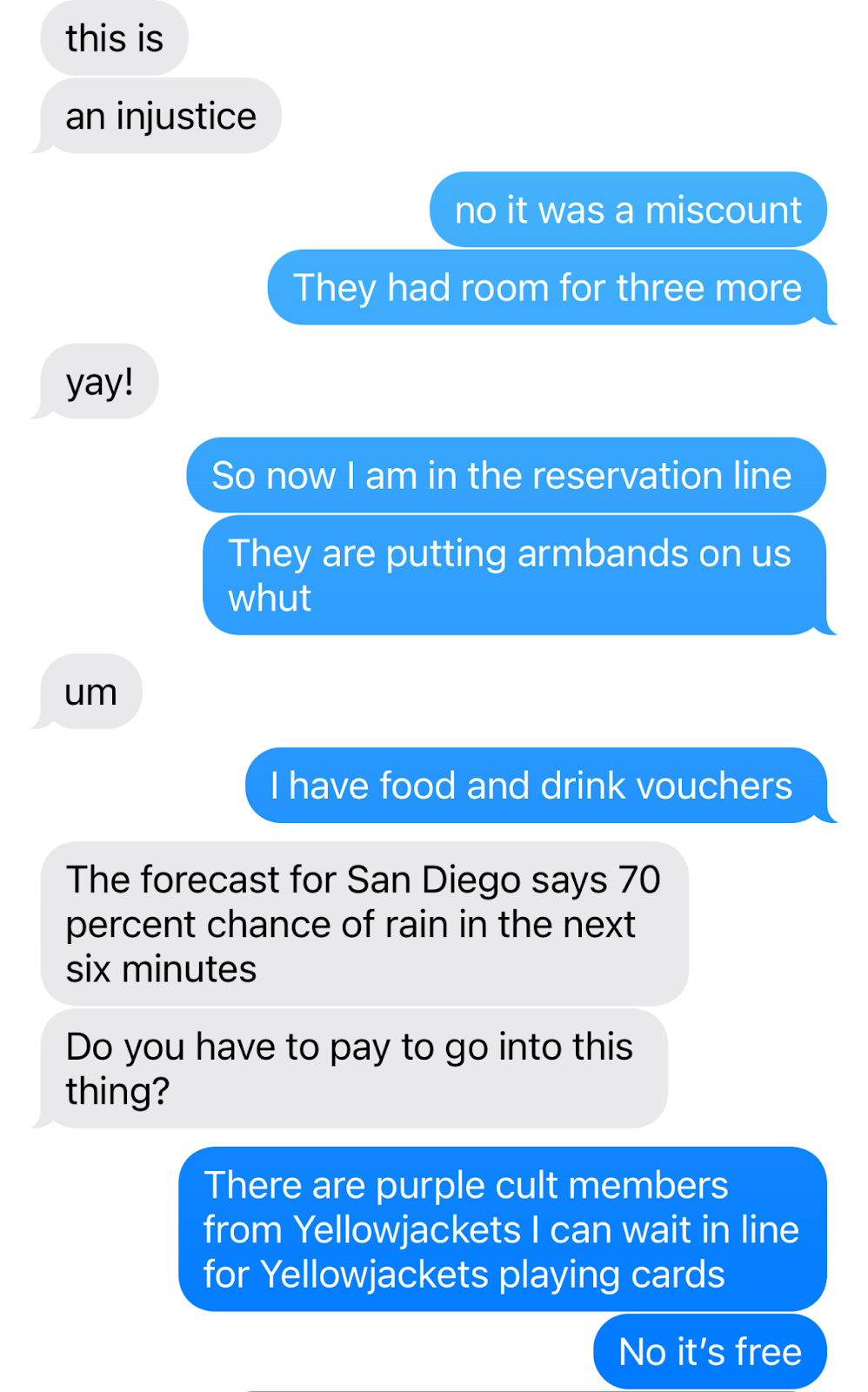
Me: at ME
S: WHAT
S: babe

S: this is
S: an injustice
Me: no it was a miscount
Me: they had room for three more
S: yay!
Me: So now I am in the reservation line
Me: They are putting armbands on us whut
S: um
Me: I have food and drink vouchers
S: The forecast for San Diego says 70 percent chance of rain in the next six minutes
S: Do you have to pay to go into this thing?
Me: There are purple cult members from Yellowjackets I can wait in line for Yellowjackets playing cards
Me: no it’s free

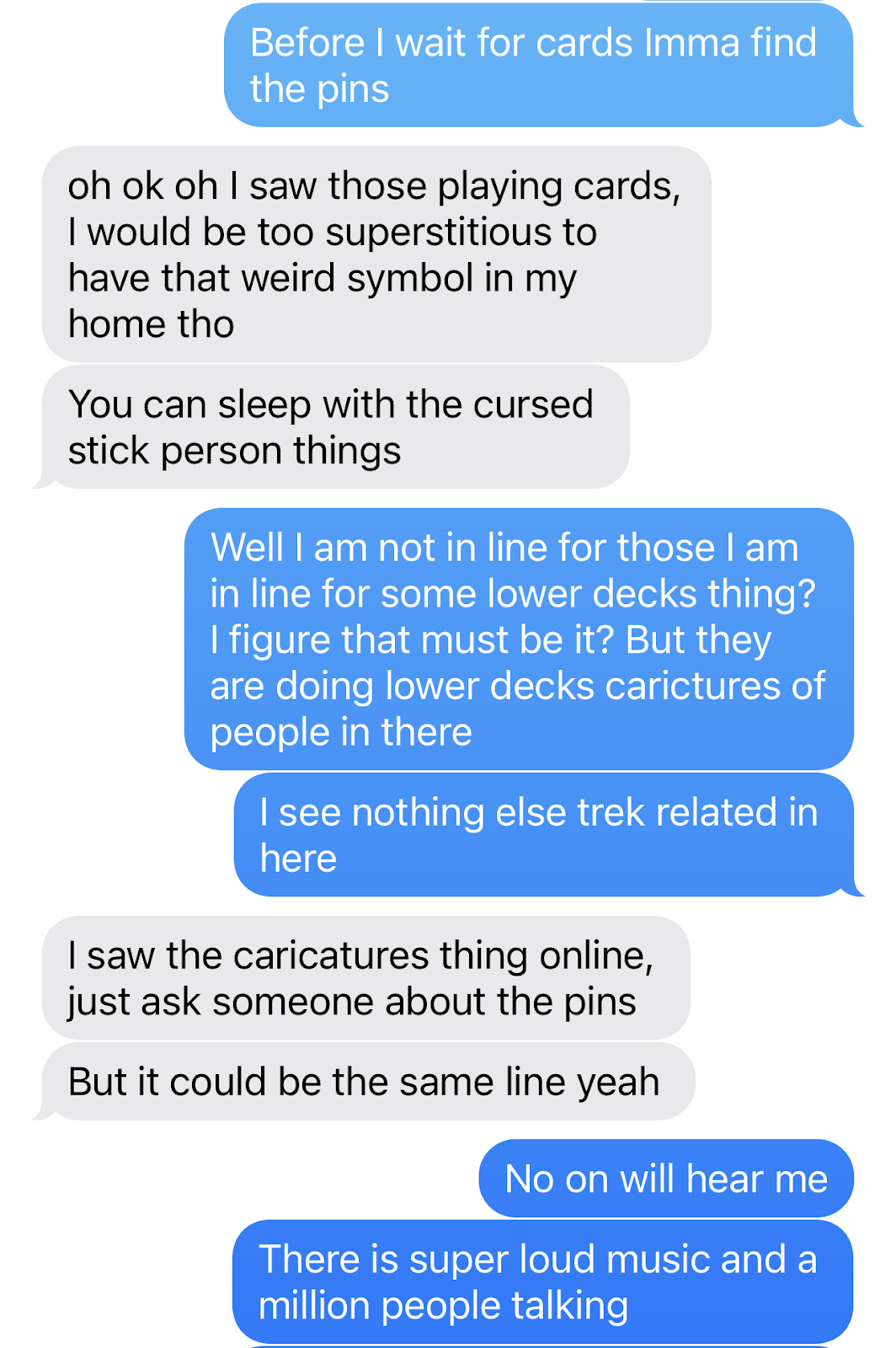
Me: before i wait for cards Imma find the pins
S: oh ok oh I saw those playing cards, I would be too superstitious to have that weird symbol in my home tho
S: you can sleep with the cursed stick person things
Me: Well I am not in line for those I am in line for some lower decks thing? I figure that must be it? But they are doing lower decks caricatures of people in there
Me: I see nothing else trek related in here
S: I saw the caricatures thing online, just ask someone about the pins
S: but it could be the same line yeah
Me: No on will hear me
Me: There is super loud music and a million people talking

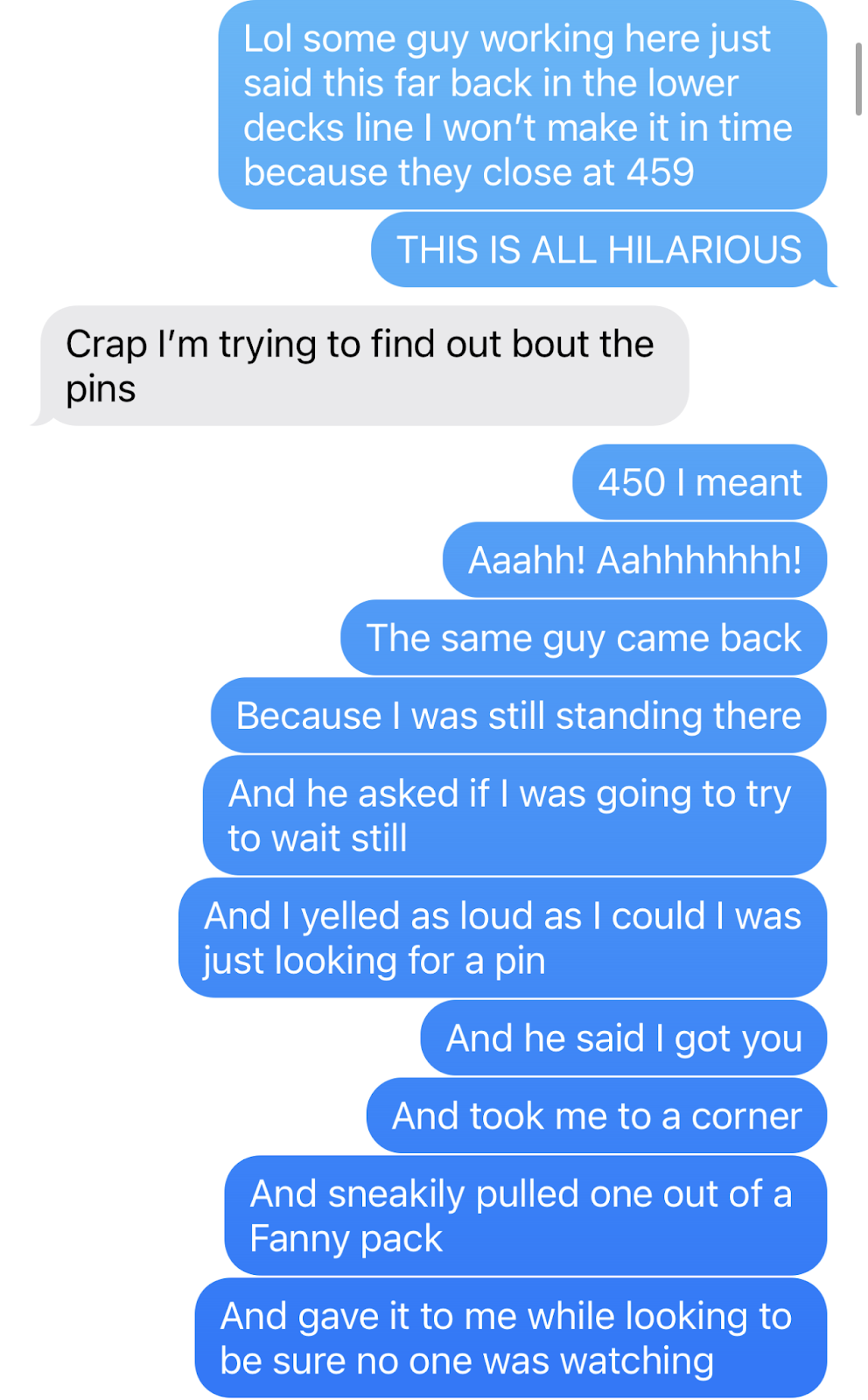
Me: Lol some guy working here just said this far back in the lower decks line I won’t make it in time because they close at 459
Me: THIS IS ALL HILARIOUS
S: Crap I’m trying to find out about the pins
Me: 450 I meant
Me: Aaahh! Aahhhhh!
Me: The same guy came back
Me: Because I was still standing there
Me: And he asked if I was going to try to wait still
Me: And I yelled as loud as I could I was just looking for a pin
Me: And he said I got you
Me: And he took me to a corner
Me: And sneakily pulled one out of a fanny pack
Me: And gave it to me while looking to be sure no one was watching

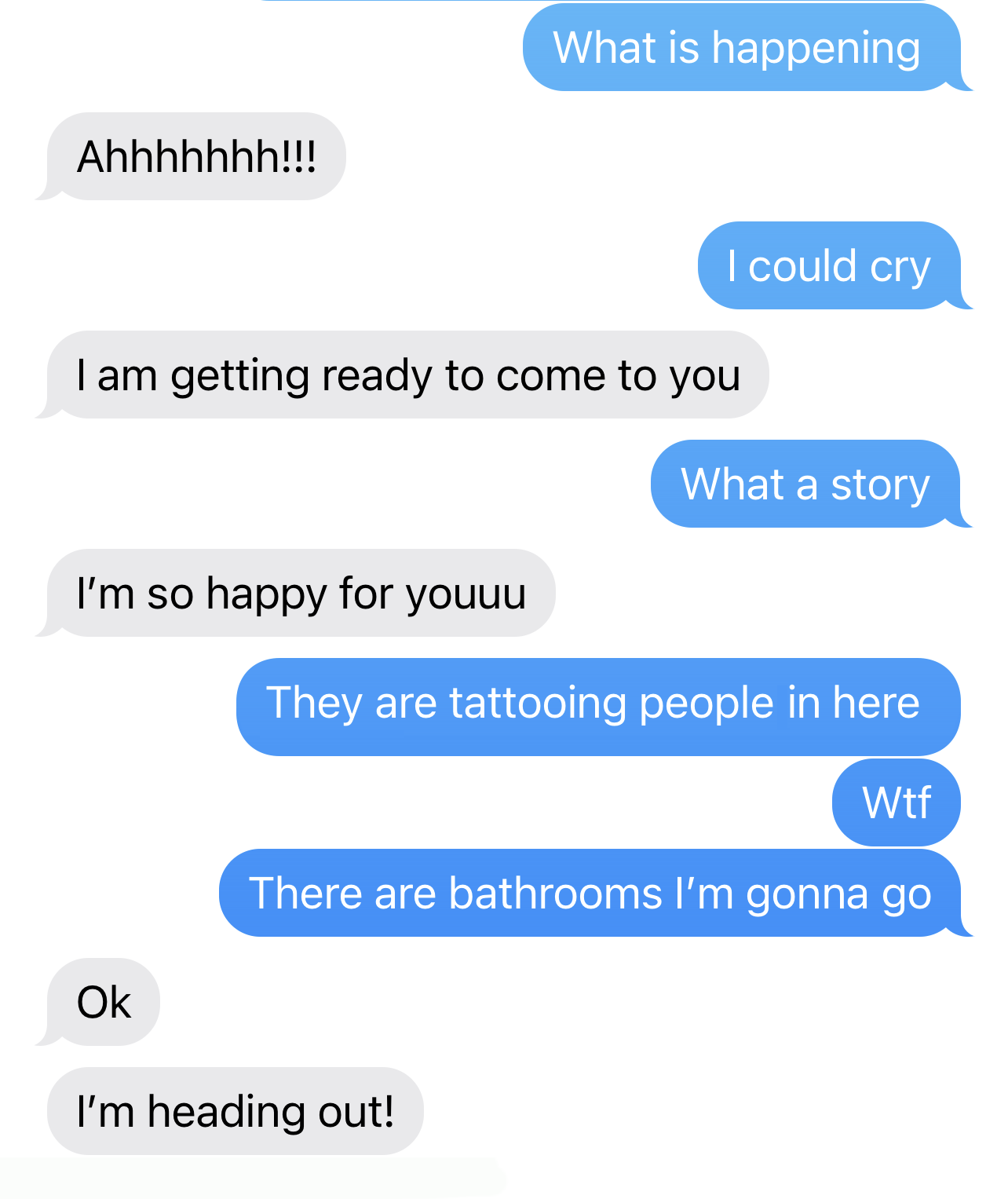
Me: What is happening
S: Ahhhhhh!!!
Me: I could cry
S: I am getting ready to come to you
Me: What a story
S: I’m so happy for youuu
Me: They are tattooing people on here
Me: Wtf
Me: There are bathrooms I’m gonna go
S: Ok
S: I’m heading out!

And, my friends, here it is in all its glory:

A pin in the artwork style of Star Trek: Lower Decks, with Star Trek: Strange New World’s Number One in front of stylized streaking Constitution-class ships. On the top it says “Ad Astra per Aspera” and on the bottom it says “Join Starfleet”.

And if you don’t know what this pin means to me, from my favorite episode, from the transiest episode, from the franchise I love the most with my entire heart… Susan and I met writing Trek fanfic, we were sensitivity consultants for Star Trek Prodigy, and when we renewed our wedding vows with the real me, it was entirely Trek-themed. You can see that in the trans tuesday on A TRANS RE-WEDDING.

NONE of that would have happened if I hadn’t been ME on that trip. I’d have probably not bothered to wait in line, even though I still loved Trek in my pre-transition days. I’d have never actually talked to someone about it inside because I could not stand to talk to (or be perceived by) strangers.

And I’d have regretted it for my entire life.

And I think, maybe, that’s what all this is getting to… the biggest unexpected change of all.

Life, pre-transition, was nothing but a mountain of pain and awfulness. And regrets.

I never imagined a life with mental clarity and an actual sense of self and identity was possible.

And I never, ever imagined a life without regrets was possible, and look where I am now.

Through difficulties, to the stars – Ad Astra per Aspera.

Who knows what changes await you out there?

Go find them.

You won’t regret it.

Tilly Bridges, end transmission.
tillysbridges@gmail.com


PS –

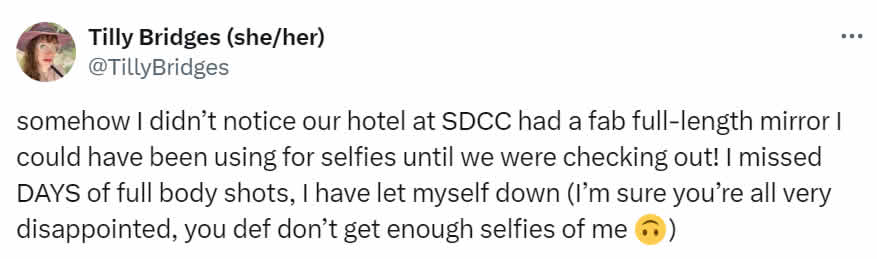
A post I made as we were checking out of our hotel at SDCC that reads:
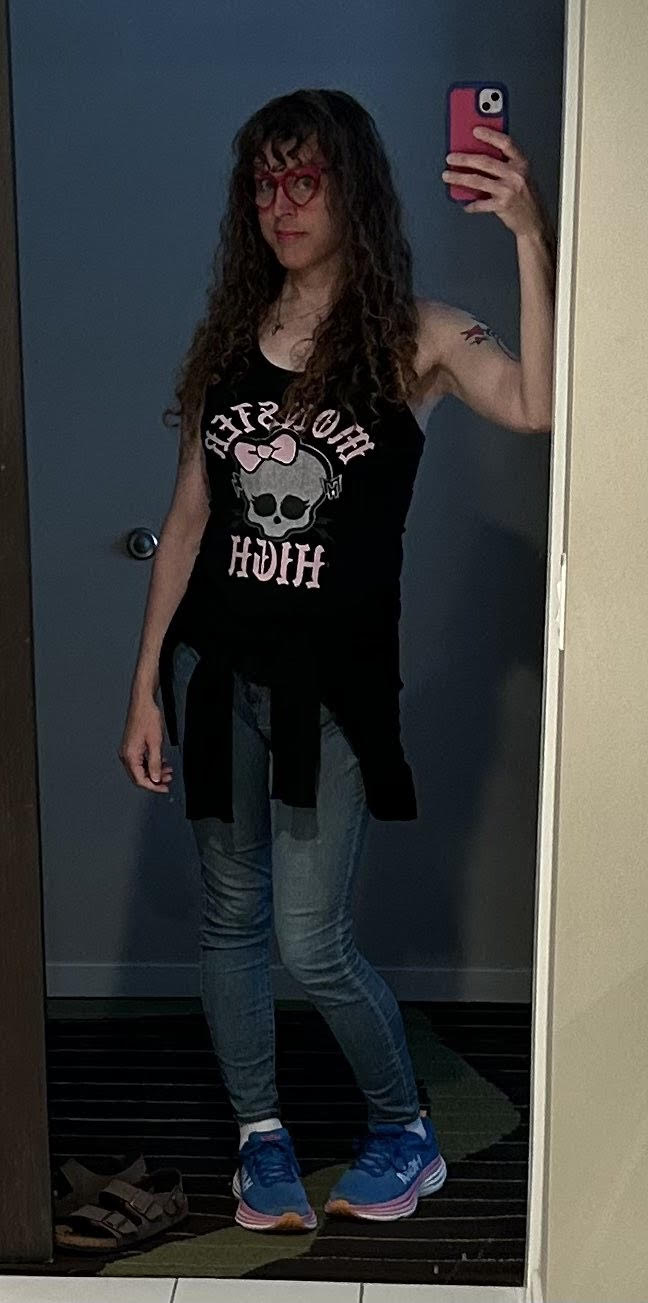
Somehow I didn’t notice our hotel at SDCC had a fab full-length mirror I could have been using for selfies until we were checking out! I missed DAYS of full body shots, I have let myself down (I’m sure you’re all very disappointed, you def don’t get enough selfies of me (upside-down smile emoji))

A full-body show of me in our SDCC hotel room mirror, in a black Monster High tank top and jeans

TRANS VOICES 3: SCIENCE AND TIPS (interview with SLP Jein Yi) 

Welcome to #TransTuesday! Today we have an interview with the speech pathologist who helped change my life! We’re gonna talk all about trans voices and how to safely work on changing them! So let’s get into TRANS VOICES 3: SCIENCE AND TIPS.

This interview contains some of the science behind gender-affirming speech therapy, as well as discussion of sounds our voices make and how to manipulate them. Those are hard to explain in a transcript, so I highly recommend listening to the podcast version to get the most out of this.

What follows is a transcript of the interview!


Tilly: Hi! I’m Tilly Bridges, your host, and I’m joined by my writing partner, my best friend, my wife, our token cis representation, my partner in all things, because I keep dragging her along with me, Susan Bridges.

Susan: Hello!

Tilly: Hi! Our guest this week is Jein Yi, M.S., CCC-SLP (it sounds so fancy!), a Speech-Language Pathologist specializing in voice and swallowing disorders, with a particular passion for gender affirming voice training. Jein received her bachelor’s degree from the University of California San Diego, and her master’s degree in speech language pathology from Boston University. She holds a Certificate of Clinical Competence from the American Speech-Language Hearing Association and a license from the state of California.

AND she has the honor of being our first cisgender guest ever welcome, Jein! Hi!

Jein Yi: Thanks for having me!

Tilly: It’s so great to talk to you again. Because we spoke to each other for an hour every few weeks for 2 years. And honestly, that’s more than I get to speak to most of my friends sometimes. So I actually miss our little chats, you know, and you correcting me every time my voice slipped.

Susan: (laughs)

Jein Yi: (laughs) I miss our conversations, too. I… you know people don’t talk about it, but I feel like that’s definitely a thing. I think that’s a thing other speech pathologists probably go through too, where we think about our past clients and the conversations we’ve had. And you know, our clients touch our lives, too. And I don’t think that’s talked about enough either. So.

Tilly: yeah, because, you know, when we’re especially trying to get to using all of the techniques in conversation, we’re just talking. And so you’re asking me all these questions about what’s going on in my life, and you know, how was your Christmas, what are you and your wife up to with your writing careers? And so it was always just like it, was this personal discussion, you know? We talked about your vacation when you saw the turtles. It was so great. So

Jein Yi: (laughs) yeah, I’ve actually always been… kind of yeah, I’ve always asked you about your writing work. And-

Tilly: yeah.

Jein Yi: I’m just… I want to watch all those TV shows that, you know, that you’ve written, so…

Tilly: Hopefully!

Jein Yi: I’m so looking forward to – yeah.

Susan: But it’s funny though, because like… you know, in voice training…

Tilly: Yeah.

Susan: Like… speaking about things, it’s like thinking and talking. It’s like chewing gum and walking at the same time.

Tilly: That’s the hardest part.

Susan: So-

Tilly: Yeah.

Susan: It’s like an opportunity for you to mess up.

Tilly: Right, right.

Susan: Because you’re just thinking about-

Tilly: And she would always let me know when I did.

Susan: (laughs)

Tilly: It was very helpful.

Jein Yi: Very subtly!

Tilly: Yes, yes. Okay. So before we get any further, where can people find more about you online afterward if they would like more

Jein Yi: I have a private clinic, and I have an Instagram account that I’m working on with a few other colleagues, a couple of other colleagues, that has a little bit of information about trans voice training, gender forming voice training, and that is the account where I- once the book, whenever it gets published-

Tilly: Yeah yeah!

Jein Yi: -is where we’re planning to put it so I don’t know which one I should-

Tilly: I think- I think the Instagram is probably good, and people can just follow you there and… yeah.

Jein Yi: Okay, the Instagram handle is @affirmvoice. So A F F I R M V O I C E.

Tilly: Excellent, and yes, you have- you have a book coming out about trans voice training. Right?

Jein Yi: Mmhm, we do.

Tilly: That’s excellent.

Jein Yi: We don’t know which. Which way we’re gonna go with it yet, self publishing or through a publisher, so that’s still something we’re trying to figure out.

Tilly : Well, everyone should go follow you and keep an eye on that, because I think that’s gonna be very helpful. But I hope this episode will be really helpful for people, too. So I wanted to start off by asking how you got into speech pathology.

Jein Yi: You know I originally got into speech pathology thinking I was gonna work with children. I was in college. I was a psychology major. I was like, I’m not gonna be able to do much with this when I graduate, because that was back when we had our recession, (well we’re in another one), but back, when we had our recession. That was 2008, I think.

So I was like, yeah, no psychology degree isn’t gonna get me anywhere. What can I do that I’ll really enjoy? And I remembered in high school one of my friends’ moms was a speech pathologist. She came and spoke with our class, and I remember thinking it was interesting. So I volunteered at a private clinic near school, and I couldn’t believe what I was seeing.

It was really amazing to watch these children come in so frustrated, you know, not having a voice, not being able to speak. And they were moving these little- they’re called pecs. They’re moving these little pictures around and communicating, they were having tantrums, and they were using these things to communicate. “Oh, this is what you wanted. Okay.” And you know, you can just see them calm down because they can communicate.

And I saw, like this mom was telling one of the speech pathologists at the clinic, you know, “For the first time my kid communicated with me. He told me he wanted to go to McDonald’s. We were driving by McDonald’s, and he communicated that with me. And I could not-” She’s like, “I was so excited that he communicated something to me. I pulled right in. I, you know, I got him McDonald’s. And now every time we go by a McDonald’s he communicates that, and I don’t  know what to do.” (laughs)

Susan: (laughs)

Jein Yi: But to me that was just so amazing, you know, giving- giving these, not even just the children, but the whole family, a way to communicate. You know they- just the amount it changes a person’s life. I just thought that was just so wonderful, so beautiful. So that’s how I got into speech pathology.

Tilly: That’s really cool that- that you’re able to do stuff like that for people, because you know, I’ve said multiple times on the show, and to you, that your help changed my life. But stuff like that is even bigger because it- you’re helping people in such an important way. So that’s- it’s really beautiful what you do. So I just want you to know that.

Jein Yi: Thank you.

Tilly: So what made you, after getting into speech pathology, what made you want to focus on gender affirming voice training?

Jein Yi: The hospital I work for…

Tilly: Yeah?

Yeah. They just told us one day. They announced to us, “We are going to start providing services for the transgender population.”

Tilly: Okay.

Jein Yi: “Speech therapy is going to be one of them. Have fun.” (laughs)

Susan: (laughs)

Tilly: Oh my gosh.

Susan: They’re just like, “Good luck with that.”

Jein Yi: Yeah, they’re like, “You’re a speech pathologist. You got- you know, you have your license. You should be able to figure it out,” sort of thing.

Susan: Wow. (laughs)

Jein Yi: Yeah, it was- and they gave us, like, a one day sensitivity training and that was it.

Tilly: Wow.

Jein Yi: And so, of course, me being the person that I am, you know I can’t just provide not-great care, right? Like I’m like, “No, I need to do better.” And so I did a lot of my own research. But truly, and I was always-  you know, I was happy to help, right? I was always happy to help, because as I said, I was a psychology major. And one of the courses was called “human sexuality.” And there was a panel in that class where they got people, all sorts of different people from the LGBT community, and they kind of had a Q and A session, I guess, is what it was.

Tilly: Sure.

Jein Yi: They were telling their story, and the people from the class could ask them questions. And I just remember being so moved by the- by what they were saying, you know. Again, I’ve never had any issues, you know? I’ve always- always was like, “They’re all people,” you know, whatever. Like, you know, we’re all we’re all the same humans, like, what does it matter?

Tilly: Yeah.

Jein Yi: But listening to their stories really moved me. So it was- you know, I’ve always been a supporter of LGBT rights and all of that. But yeah, once I was given the opportunity, I was like, okay, like, let’s do this. I’m going to do this properly.

So yeah, I did a lot of my own research, and then my first client, my first trans client… she was amazing. She was the best first client I could have ever asked for.

Tilly: Aww.

Jein Yi: I- I was very honest with her, and I told her, “Hey, this is my first time. Like I have never had any other experience with gender-affirming training. If you still want to work with me, I will try my best.”

And she was like, “Sure!” And she had done so much of her own research, she brought in so much. She gave me a lot of resources that I could check out on my own. She was the one that actually turned me onto Reddit, so that I could go through a lot of Reddit forums and see what the trans population- the trans community was, you know, was having access to, what they were thinking, you know. So that was really helpful.

And she brought in a lot of YouTube videos like, “Jein, what do you think about this? What do you think about this?” I was able to give her my kind of clinical point of view of, like, “I’m not sure this is a great idea, this I really like.”

Tilly: Yeah.

Jein Yi: And we’re able to put that together and do something for her. She ended up being happy with her voice, you know, so I’m glad. Now I feel like I know so much more than back then, and I wish I could contact her again and be like,”Hi, you know, I- I know a lot more now!”

Tilly: Yeah.

Jein Yi: But she’s happy with her voice, right? So that’s what matters.

Tilly: That’s what matters.

Jein Yi: Yeah, that’s all that matters. So I’m not gonna reach out for all of a sudden, you know, it’s- just as long as she’s happy I’m happy, so.

Tilly: That’s great. Okay, so I was wondering if you could get a little bit into the science of why the voices of people assigned male at birth, and people assigned female at birth differ. ‘cause I’ve talked about it a little bit in past episodes, but I am not an expert. So I was hoping that you could give, you know, people listening, a little bit of that- that information about why they’re different.

Jein Yi: Okay, so before puberty…

Tilly: Yeah.

Jein Yi: …there actually is not that big of a difference in the pitch range. It’s very similar. I’ve- I’ve looked up research and the range, like, they don’t even have a lot of research on it, because there really is not that much of a difference in the pitch range.

Tilly: Right.

Jein Yi: Now when puberty happens, life changes, right, everything changes.

Tilly: Yeah.

Jein Yi: And so during that time what happens to people who are assigned male at birth is that their vocal tracts- so it starts from the lips all the way down to our vocal cords. I wish I had a little picture to show you. (laughs)

Susan: (laughs)

Tilly: Yeah.

Jein Yi: All of that, it gets longer and wider. And then, of course, we also don’t know about the vocal chords kind of increasing in mass essentially… It gets bigger. Everything gets bigger. This is my where my whole cello and violin analogy always comes in. So if we look at a cello and a violin, same shape, or similar shape. But what’s the big difference? Cello is much larger. A violin is smaller. Violin has thinner strings. A cello has thicker strings, right? So you can think of the strings as the vocal chords. And you can think of the size of the actual instrument as your vocal tract.

The cello has a richer, deeper sound because of the thicker strings, and because the sound has a larger space to resonate in.

Tilly: Sure.

Jein Yi: The violin has thinner strings and a smaller space to resonate in, therefore creating a thinner, higher, pitch, a shriller sound. So for people who are assigned male at birth they go the route of the cello, people who are assigned female at birth- it doesn’t actually grow or anything, but you know it grows the normal progression. It doesn’t get especially bigger, especially thicker, or anything like that.

Tilly: Right. That’s fascinating stuff. I love it. It’s- I’m a science nerd, and so I think stuff like that is incredibly cool. And I think that understanding that, like where it’s all coming from, was really helpful to me, I think, just in understanding why my voice sounded the way I did, and- and you know you don’t really need to know that to work on changing your voice, but it definitely helped. It gave me a better sort of, I guess, mental picture? Not picture…”sound?” I don’t know- to shoot for. So anyway, I think that was really helpful.

Susan: So women’s also change, but not as much? Or-

Tilly: Cis women, you mean?

Susan: Yeah, because I’m thinking about, like, a kid’s voice and a woman’s voice, there’s not that much difference.

Tilly: It- I think it deepens a little bit?

Jein Yi: It does, it does deepen a little bit. Yeah, because as cis women get older, our voices do deepen a little bit. There actually- here’s an anecdotal thing, but when I first started working at my hospital and I recorded my voicemail greetings, I listened to that. And then when I switched hospitals a few years ago, it was like 9 years later, I listened to that recording ‘cause I had to reset it, and it sounded so different. It’s like, and then that’s like, (affects higher pitch) “Hi, you’ve reached Jein Yi,” and now it’s like (normal pitch) “Hi, you’ve reached Jein Yi.” you know- it does, it does change a little bit.

Susan: Yeah, yeah. Okay.

Tilly: Okay, so hormone replacement therapy doesn’t do anything for a trans woman’s voice. But it can deepen the voices of trans men or non-binary people who also take testosterone. And I was wondering if you get a lot of trans men or non-binary patients, or do you mostly see trans women?

Jein Yi: I also see lots of trans men, lots of non-binary people, yeah. All- everybody in the spectrum.

Tilly: That’s great. Because as one of the things that I learned, you know, going through the sessions with you is that it’s not just about pitch. There’s so much more involved to, you know, trying to use your voice to maybe alleviate dysphoria or get gendered correctly. There- there’s so much, you know, different things that go into it, which we’ll get into in just a minute. But-

Susa: Well I just wanted to say, like, that cello and the violin example. Also i takes more force and effort to play the larger instrument. And I’m thinking the voice is the same way, because, like an assigned male birth, like they talk more forcefully, like more effort.

Tilly: Right. Isn’t it- I think you told me that it’s the people who are assigned male at birth, their vocal folds close all the way, but assigned female at birth don’t. And so that’s why they sound breathier and- and assigned male voices sound a little more forceful.

Jein Yi: Yeah, it’s not 100% of the, you know, people who are assigned male at birth, or you know, it’s, I think, the number,

Susan: (sarcastically) You mean it’s a spectrum?! What?!

Tilly: (laughs)

Jein Yi: (laughs) But yeah, and- and research numbers vary. You know, it’s a range. But I think on average, it’s about like 70 to 80 percent. So yeah, the majority.

Tilly: So what are, or what do you think are, the most common pitfalls or struggles for people who are starting their voice training? Are there, like, similarities and things that people seem to always struggle with more than others?

Jein Yi: I think- I always, you know, start off by telling my clients, I don’t start with pitch. I know everybody wants to focus on pitch first, because that’s- you know, the most… how do I say… it’s most the- most in your face, right? The most obvious thing that you hear when you first start talking. So that’s, I think, for a lot of people like, I get a look (laughs)… until I explain that every other part of voice not only contributes, but also when we work on it, it will also indirect- not indirectly, but it does work on the pitch just that’s our goal. And then people kind of get on board. But that’s one of the one of the things.

Another one… let’s see what’s another common- common, I don’t know, pitfall- I’d say, I don’t know if this counts as a pitfall, but thinking or hoping that it’s, you know, once you go to speech therapy, it’s not something that you’re like- your voice isn’t something you’re gonna have to work on or think about anymore.

Tilly: Yeah.

Jein Yi: Yeah, that’s something that I always also have to kind of reiterate and emphasize throughout therapy. I feel like, you know, for voice training… I give you the tools. I give you the information. But the important thing, the most important thing, is for you to practice by yourself and to experiment by yourself. I’m really big on “you have to experiment.”

Tilly: Yeah.

Jein Yi: Because otherwise everyone’s gonna end up with the same voice, right? That’s not what we’re aiming for. We want you to find what feels most like you, and I can tell you that you know my goal is for you to change your resonance, or whatever. But even within changing the resonance, there’s so much flexibility, right?

Tilly: Yeah!

Jein Yi: So I want- I want my- my clients to find, in that space of changing resonance, what sounds- what to them feels like, “Oh, I like this. And this feels like me,” so.

Tilly: Yeah. Yeah, I think you’re right on, absolutely, with- with the practice, because, you know, I practiced daily for a year after we were done. And it took me all of that time to where almost all of it is second nature now, but I always had to stop and think before I talked for years, you know. Because it- it just doesn’t come that easily. It’s really hard work. And-and I remember when we were going through the different techniques, and I record myself and listen back. And I would be like, “oh, that sounds really good,” or I’d be like, “that sounds- I think I did that right. But I don’t like that as much. Maybe if I pull that back just a little bit, I’ll like it better.”  So I think the experimentation is a really important thing, because, yeah, we don’t want everybody to sound the same. You just want to sound like what feels like you. So yeah.

Susan: I figure there’s probably a lot of people, too, who just want it to happen right away.

Tilly: Oh yeah.

Susan: Like, Oh, God, this is gonna take me! How long?

Jein Yi: Yeah.

Susan: So I’m sure that’s really common.

Jein Yi: Yes. It is.

Susan: I guess the depression sets in like, Oh, God! This is a lot of work.

Tilly: It’s so much work.

Susan: And you yelled a lot.

Tilly: I know!

Jein Yi: Aww (laughs).

Susan: She was like, “I don’t wanna practice!” But also I will say, you running role-playing games and having to talk for like 4 h at a time really helped get you…

Tilly: It did help my stamina.

Susan: It did.

Tilly: It was rough, though, for like the first year, because I would get so tired and my voice would sound so terrible.

Susan: And then you’d be all grumpy after they game me like, “I didn’t sound right. It’s so hard.”

Tilly: Yeah, yeah.

Susan: (laughs)

Jein Yi: Yeah, no that’s definitely a thing, too. And sometimes people- it doesn’t happen that frequently, but I have had people stop in the middle of- of voice training and be like, “Hey, I need a break from this for- for my mental health.”

Tilly: Yeah.

Jein Yi: And I totally understand. You know, it’s- it’s a process, and it’s a slow process, and it’s something you want so badly. But it’s not something you could rush. So yeah, I get that. It’s- it’s hard. And I feel for my clients, too, because I wish- you know, they asked me, “Jein, Is there anything that you can tell me, anything extra that I could, you know, make it go faster.” I’m like, I wish! I wish I could. I wish I knew. You know I’m always trying. I’m always adapting what I’m doing. I’m always trying to tweak it a little more to make it a little easier for my clients, a little, you know-

Tilly: Sure.

Jein Yi: But that part I haven’t been able to figure out yet, making it go faster,.

Tilly: Yeah, it was- you get this realization early on where you’re like, “I want to do this. Change my voice.” And you’re like, “Oh, God, it’s gonna take me forever.” And you have to really, you know, you have to really just be patient. The patience is really, really hard.

Susan: It’s like working out.

Tilly: Yeah.

Jein Yi: Yeah.

Tilly: Incremental gains. Tiny bits at a time.

Susan: Doing it over and over.

Tilly: Yup until you get better at it.

Susan: Yeah.

Jein Yi: My favorite Youtube video I always give all my clients, is the- the 5 year voice transition, trans voice lessons-

TIlly: Yes! I linked to it in one of my past ones, yeah.

Jein Yi: Ugh, I love that video, and I love her for putting up that video. (laughs) So yeah, it really does show her -her progression. And how, even after she got to a point where she was like, “Oh, yeah, my voice sounds feminine. Sounds good.” like she continued to work on it, and how it continued to change, and somehow it sounds more natural, even though it already sounded natural?

Tilly: Yeah yeah.

Jein Yi: I just think it’s such a great example. I’m so glad she has that video up in the world.

Tilly: So one of the hardest parts for me, with speech therapy ,was how much I had to remember before talking, and it took so long for it to become second nature. And I’ve mentioned this before, but I came up with my own little mnemonic device to help me remember all the different techniques and I wanted to go through them. And I was wondering if you could just give brief explanations to people on- on what those things are. So they know, like, all of the different things that you have to work on. So my mnemonic device was DISTERB, spelled with an E and not a U, and the D is for diaphragmatic breathing.

Jein Yi: So diaphragmatic breathing is, I mean it- the core idea behind it is the breath support. You want to make sure that you’re working with enough breath. Right? So-

Tilly: Yeah.

Jein Yi: You know, abdominal breathing. I say, you put your hands on your rib cages and try to breathe into your hands so that your hands, your- your rib, the cages expand into your hands. That is diaphragmatic/abdominal breathing. Most people, that doesn’t come easily to them. Most people are more used to a shallower kind of chest or shoulder-movement sort of breathing. So I usually tell people, lie down, put your hands on your rib cages and breathe in and out. And when you’re lying down most people will be using that sort of breathing, that diaphragmatic abdominal breathing. And then, once you get the feel for that, then try sitting up and see if you could replicate that, and then, you know, start incorporating other things that you normally do like brushing your teeth, or I’m taking a shower… something that you don’t have to think so hard about to do while you’re checking in with your breathing to see, “Am I still doing that? Yes, I am.” And you know eventually that turns into something that you do normally.

Tilly: Yeah. And it was really- see, that’s one of the things that I was so surprised by, because you don’t think about your breathing as being part of speech, but it gives you so much more air to work with when you’re talking. It made a really big difference, and it- it took me a while to figure out how to do it. Okay, so the I is for intonation.

Jein Yi: So intonation. What we mean by that is the- I just simply describe it as the ups and downs in your sentences. So for voice feminization, we look at increasing the intonation. So I always- My example is (flatly), “My name is Jein, and I’m a speech pathologist.” I could increase the intonation by saying (animatedly), “My name is Jein, and I’m a speech pathologist.” For masculinization, typical American English intonation tends to kind of start higher and go lower and flatten out is usually what I explain it as. So “My name is Jein, and I’m a speech pathologist.” That’s more of the masculine intonation, or the masculine-sounding, masculine-perceived intonation. And yeah. So we worked, Tilly and I worked on increasing that intonation ,having more bounce. I always tell people I don’t want you to sound like you’re talking to a 5 year old unless you want to. (laughter) But yeah, you know, we- in practice, that’s what we do initially, because your vocal cords aren’t used to stretching and moving so much. And we gotta teach your vocal chords how- you know, the feeling, and when when we kind of overdo it like that, then you learn the control so that you can fine-tune it to get it to the level that you feel comfortable with. Just you know, I always say… a little more animated, a little more bounce is what we’re aiming for usually.

Tilly: Yeah, you’re right, though, it was really funny, because at the beginning it- when I was recording and listening back, it sounds like you’re a kindergarten teacher or something, you know, the way you have to learn it. And so yeah, it’s really goofy.

Susan: And then you get to valley girl. (laughs)

Jein Yi: (laughs)

Tilly: Yeah. Right. Okay. So now, I don’t know if this one applies to other people as much as it did me. But the S was for slow down, because I was always going way too fast, and if you slow it down even further than normal speech. (speaks very slowly) If you go really slow, (back to normal speed) you can focus on all the different things as you’re speaking, which was really weird. So do- do you find a lot of people have that same issue?

Jein Yi: Yes, and you know, I understand why people do it, because they’re- they just want to speak naturally. They don’t want to sound- all the weird things that I make people do, they don’t want to sound like that.

Tilly and Susan: (laughter)

Jein Yi: So I get it. (laughs) But I’m always cuing my- my clients. “Okay, I want you to do that again. But I want you to slow it down so that you can really listen to yourself, or you can really feel for what we’re aiming for.”

Tilly: That was beautiful, by the way. I haven’t heard that from you in a long time. I’m all nostalgic for it, so.

Susan: (laughs)

Jein Yi: Aww! (laughs) Yes, that is a cue. That is a real cue that I give so yes, Tilly has heard that..

T: Many, many times! Okay, and the T is for tongue positioning.

Jein Yi: Yes, so, tongue positioning. I’m gonna be honest with you and say that this is a me thing. This is a Jein-method thing. (laughs)

Tilly: Okay.

Susan: Okay!

Jein Yi: I don’t think all, or if many teach a tongue positioning at all. But for me I found that- I have found that it works so-

Tilly: I was really helpful for me, yeah.

Jein Yi: Okay, good, I’m glad! So what we mean by tongue positioning is, you know, talking about the vocal tract, and- and resonance. The space that the sound resonates in, we want that to get a little bit smaller. And the space we’re really looking at is the oral cavity. So a lot- I think when you read online about any sort of resonance, they say “Oh bring it into your oral cavity. Bring it forward.” But the oral and nasal cavity tend to, in my opinion- it’s still pretty large, so to kind of make it a little bit smaller, I tell my clients to position their tongue a little bit higher. The back of your tongue should be pulled up so that it’s touching your upper molars. Now we’re not pushing it up so that you’re talking like (talks with tongue in the way) this. (speaking normally again) No, you’re not pushing it up. You’re just- it’s just resting up there. It just- you just want to feel the upper molars on the sides of your tongue.

Tilly: Yeah, it was really weird to get used to talking that way. But it really helpsDo you go the other way for voice masculinization? Do you try to get them to like, drop it any, or do- do most people already keep it dropped as sort of the default position?

Jein Yi: I think that most people, while the front of their tongue, the tongue tip rests… up? The back of their tongue doesn’t, it’s- it’s not completely down. That’s not completely up, but it’s not completely up either. I don’t usually tell people about tongue positioning when I’m working on voice masculinization. I usually- you know how we did ee-ifying?

Tilly: That’s the next one!

Jein Yi: Well I do aw-ifying for voice masculinization.

Susan: Ahh, okay.

Jein Yi: And in doing “aw” your tongue automatically has to drop. So yeah, I don’t target it specifically. It’s not somewhere- something where you have to tell yourself to hold it in a certain position. But it, you know- it’s indirectly talked about later on.

Tilly: Okay, yeah. And then, so the E is for ee-ifying vowels, or aw-ifying. So could you explain what that means?

Jein Yi: Yes, so. Consonants! We can’t really change the sound of consonants. (laughs) But vowels are where we can really change the sound,  and vowels are where we can really change the resonance. And again, the size and shape of where things are vibrating. So when we say “ee” versus “aw,” why doesn’t everybody try it right now? (laughs)

Susan: (laughs)

Tilly: (laughs) That’s right listeners, do it at home.

Jein Yi: (laughs)

Susan: So “ee” is like using less of the space inside your mouth?

Jein Yi: Mmhm. Because when you go-

Susan: So then “aw” is using more of it…

Jein Yi: Exactly.

Susan: …which would deepen, versus… I se e.

Jein Yi: Mmhm.

Tilly: You’re catching on!

Susan: I gettin’ it!

Jein Yi: When you say “ee,” everything gets smaller in your mouth.

Susan: Uh huh.

Jein Yi: Everything tightens, it’s smaller. Versus when you go “aw,” your jaw drops, you have all that space. So ee-ifying your vowels, I guess, as an example would be like, you know, if I saw-

what’s one of our sentences, Tilly? (laughs)

Susan: (laughs)

Tilly: Oh it’s been years now, I don’t remember! there were so many, I had all those sheets!

Jein Yi: What was one that my clients always like? “I adore the lore behind Al Gore” is one that everybody really likes. (laughs) So-

Susan: That’s hilarious. 

Jein Yi: Normally, it’s “I adore the lore behind Al Gore.” Now, when we ee-ify it you tighten your- you know, you put your mouth in the position of “ee,” “eeee”, (the vowels are shorter, lighter, and brighter and sound very different, but I don’t know how to make that clear in transcript, sorry!) “I adore the lore behind Al Gore.” It changes the sound, right? “I adore the lore, I adore the lore,” it’s lighter, it’s brighter. So that’s that resonance change. And then for aw-ifying, for our people who want to masculinize, for aw-ifying, (laughs) “sweet dreams are made of these” is what I like to use, so (normal vowels) “sweet dreams are made of these.” If I aw-ify it, “aw”, “awww”, (the vowels sound deeper and more resonant, again hard to explain!) “sweet dreams are made of these. ” in the video, you can see my mouth (higher and brighter) “these” instead of (lower and more resonant) “these.” I’m not closing my jaw as much. I’m leaving a little space in there, so that there’s more space to resonate.

Tilly: Excellent.

Susan: That is so cool.

Tilly: Isn’t it?

Susan: Yeah!

Tilly: The science with it is so amazing. Okay, so then R is resonance-

Susan: Which you already said. (laughs)

Tilly: Right, but if we could talk a little bit about that, because that was the hardest thing for me, and sometimes I feel like even now it still slips. You probably heard it slip in this call, and you’ve been very kind to not call me on it.

Susan: (laughs)

Jein Yi: (laughs) I’m not going to- you know, I’m not here to listen to your voice and judge, right?

Susan: No, that’s work.

Tilly: That’s right.

Jein Yi: (laughs) But also, I always say, right? It’s not about being perfect. It’s not about holding something perfectly for 100 percent, nobody does that. My own resonance changes as I’m talking, that’s not the point. So… in talking about pitfalls, that is something that I do see. You know, of course, it makes sense, right? It’s a goal you’re working towards. So people want to do it perfectly. 100% of the time. And I always tell my tell my clients like… it’s not about doing it perfectly 100% of the time. Nobody can do it 100%  of the time. You know, again, like, even when I’m talking, my resonance changes, and I’m not working on anything. So it’s just getting to a place where you feel like you’re doing it consistently enough where the sound of your voice is- it makes you happy. So… going back to resonance, right? Sorry. (laughs)

Tilly: Yes!

Jein Yi: Resonance, I always say, is the most important part of of changing your voice. And I break it up into stages, and resonance is a stage where it usually takes the longest to achieve but it makes the biggest changes in your voice. It’s where your voice can actually more permanently change. Now, “permanent” used loosely, because if you want it to be permanent, it will be permanent. If you don’t want it to be, it won’t be. But, yeah, resonance is, you know, it’s where your voice- or where it, where the sound, or of the space and the placing of where the sound is vibrating. It’s- it’s how we manipulate the size of our oral cavity to create the sound that we’re aiming for.

Tilly: Right. And in voice feminization like I went through, that’s trying to get that- feel that vibration sort of up by your lips, and that was really hard for me, because I don’t- even now I still don’t- I barely feel it. I don’t know. I think a lot of people can feel it better. It was really hard. I’m like, where is it? Am I doing it right?

Jein Yi: So, yeah, so yeah, that- the vibration part is really difficult for people to feel. And I think, for, like singers, you know, they’re trained, right? They’re trained to be able to put their voice out, and all different- like they have the chest voice, and head voice, and whatever. I’m not a singer, so I get-

Tilly: Me neither.

Jein Yi: I get why it’s hard. Because when I was learning it, when I was just learning oral resonance in grad school, me  trying to do it was just so difficult. But essentially, when we go “mmm” with an “m,” “mmm” we feel the vibrations on our lips, sometimes in our nose, like anywhere in that facial area, we say okay, we got that forward resonance. Now for voice feminization, I actually- again, I said oral cavity, still pretty large. I like to make it a little bit smaller. It’s the soft palate where I usually kind of tell people to try to get the vibrations.

So the soft palate, if you put your tongue up behind your teeth and run it all the way back, you’ll notice it goes from hard to soft, right? So hard palate, soft palate. The soft palate is kind of where I like to get people to get their vibrations for voice feminization, if they can feel it. It’s a very subtle…

Tilly: Yeah.

Jein Yi: …vibration. And then for a voice masculinization, I kind of try to bring it down a little more into the chest. So I usually tell people “put your hand right here,” and when I say chest, it’s not so far down, it’s actually just like right below your neck, and if you go “ee” versus “aw” I think you’ll really feel the chest vibrating more.

Tilly: And then the B was for breathiness.

Jein Yi: Ah, breathiness. (laughs)

Susan: (laughs)

Jein Yi: This is something that my voice feminization clients really struggle with, because most don’t want a breathy sounding voice, which I get. So I always kind of start off with a disclaimer like, this practice voice is absolutely not at all the voice I am aiming for for you, unless this is what you want. Breathiness, kind of like I mentioned with the intonation, you know, I start off with the breathiness because, like sounding really breathy, like- (super breathy voice) like talking like this-

Tilly: (super breathy voice) Yeah.

Jein Yi: (back to normal voice, laughs) Which, as you can see, Tilly does not sound like that right now, right? (laughs)

Tilly: No, I don’t!

Susan: But you would do it.-

Tilly: I did.

Susan: And I would not be able to hear you ever, it was very frustrating!

TIlly: When I was working on it, yeah.

Susan: When you were working on it.

Tilly: (super breathy quiet voice) And my voice was like this all the time-

Susan: Like, I can’t- okay.

Jein Yi: (laughs)

Tilly: Yeah.

Jein Yi: Yeah, so it’s another, you know, kind of training step. It’s to be able to control the breath and the air flow. I feel like most, not all, but most of my voice feminization clients come in not-not having enough air coming out when they’re speaking, and it’s just full vocal core closure. Well, again, I can’t really say this because I didn’t look inside, but like just simplifying things, just simplifying things, it sounds like there is not a lot of air coming through and it’s all voice.

Tilly: Yeah.

Jein Yi: And so we’re basically teaching how taking your vocal cords ,and your respiratory system, you know, just let out a little bit of that air while you’re voicing, and that’ll create some of that lighter kind of voice that we associate with a more feminine voice. So the example I give is, if- so, my voice tends to be actually pretty- mine’s more on the breathier side, just normally. But  if I were to do kind of like this like (affects more forceful voice) full, you know, I’m really trying to be forceful like this is how I’m talking (back to normal voice) versus (affects very light and breathy voice) like, yeah, really want to talk breathy. And I don’t know. This is my like, yoga teacher, voice or whatever…

Tilly and Susan: (laughter)

Jein Yi: (laughs, still breathy) Namaste, right? (back to normal voice) As someone who has never taken any of the classes. (laughs)

Susan: (laughs)

Jein Yi: And then there’s this middle ground where, the way I’m talking right now, where there is some of that lightness and that breath coming through, but it isn’t this like, pushed, forceful quality. And I think that’s that quality that people do want. They don’t want to do the breathiness part, which again I get. But I teach it as a way to teach you control, because I want you to be able you to choose how much breathiness you want- you can have in your voice, right? So I want you to be modulate instead of me getting you to a point where, yeah, we’re at, like, somewhere in between. And we’re good to go. I want you to be able to choose, and you to be able to experiment with it and see what you like the sound of the best.

Tilly: Yeah, the thing that breathiness helped me the most with was not hitting the vowels in the middle of words too hard because I was- I would always push to get the vowels out. And so the breathiness, I don’t want to talk like that, but it helped train me to hit the vowels softer and let more air out, so that it’s not so forceful on every vowel, which helps with the “not sounding so much like a man,” for me, so.

Okay, so I know speech therapy isn’t covered by insurance for a lot of trans folks that are out there. And for reasons that I’ve talked about in multiple episodes of this show, trans people are much more likely to be financially strained than cCis people are, and many of them can’t afford it. And I see a lot of them trying to work on their own, on their voices based on, like, Youtube tutorials. But I’ve seen some of those, and I’ve just cringed at what they were telling people to do. And I’m so afraid people watching are gonna end up hurting themselves. So I was hoping maybe you had some tips that you could give folks on how to safely practice on their own.

Susan: Although maybe we should start with the damage that people can do to them.

Tilly: Yeah.

Jein Yi: So I think now, it’s pretty widely known that the- you know the swallow-hold, you know, swallow and holding your larynx up, is something that can cause a lot of strain. But back when I started in the beginning, that was a very common thing that people taught.

Susan: Oh, that’s interesting.

Jein Yi: Yeah, to raise your larynx, and and then, therefore, hoping to raise the pitch as well. So you swallow, (ultra high and strained voice) hold, and, as you can see, like (normal voice)I’m trying, and you can see that- how it changed my vocal quality.

Susan: Yikes.

Tilly: Yeah.

Jein Yi: And that was some- I’m obviously not doing it as well as some people, because I have seen some trans women have- you know their voices sound very feminine, and they sound- I think it sounds great. But for a lot of people that does not work. That’s the thing it works for some, but it doesn’t work for others. And this is one that commonly, for the people it doesn’t work for, causes a lot of vocal strain. I have had people who have practiced on their own, and they and can tell it’s really, you know, it was hurting their voice. And so they ended up coming into speech therapy, and we had to do normal voice therapy. Not you know, gender-affirming voice training? But normal voice therapy in the beginning, so that I- we could, you know, get that strain out of- out of the throat. And then we started working on gender-affirming training.

So yeah, definitely strain or sometimes people will, you know, try to talk in a pitch that- you know, pitch we can raise. But it has to be gradual, and I feel like if that isn’t something that the person was aware of, they will kind of start at a pitch that’s a little too high for them, and that causes strain as well. Some people will just end up having a lot of throat pain. So my biggest kind of take home for anybody is when you’re doing these, you know, practices- practice things on your own, whether it be through podcasts, Youtube, Reddit, just trying things on your own… if it’s uncomfortable, you know, to the point of pain, stop! You’re either not- It’s either not for you- that method is not for you, or you’re not doing it the way that it was meant to be done. Because of probably lack of thorough instruction, most likely, because people, you know, they usually give instructions in a way that makes sense to them. But they, you know, they probably haven’t talked to a lot of people, and- and have seen, like the common issues, in a way, so that they could kind of reword their instructions, right? So if you’re feeling pain definitely- that’s just- stop that one and try to try to find something else.

And as it- when it comes to discomfort, I think, Tilly, you could probably speak a little better too but there are different types of discomfort right? Like there is a “I’m working hard,” and “I’m a little fatigued,” sort of like “my throat feels a little tired” sort of discomfort, and then there’s actual like, “ooh, this doesn’t feel right” discomfort when you’re practicing. So I think learning kind of the difference between the two is probably going to be really helpful in, like, self-practice. So I don’t know, Tilly, if you could kind of elaborate on the like- “this feels like I’m doing something, but it’s a little tired. So this is my sign rest,” sort of feeling, I don’t know.

Tilly: Yeah, I think-

Susan: Did you ever really screw up?

Tilly: What do you mean?

Susan: (laughs) Like, go back and she’s like, “No, you were doing that wrong.”

TIlly: Oh, sure, all the time.

Susan: Okay!

Jein Yi: (laughs)

Susan: See, that’s important to know.

Tilly: Yeah.

Susan: People should know that.

Tilly: Right. Yeah, you mess up and you-

Suan: You need feedback.

Tilly: You do. But yeah, I think the best way to describe it, probably- it’s like any other muscle in your body where, like, you can tell if you’re like- if you were working out, or you know, like, if you’re moving and your arms get super tired, you know, when they’re tired from use. And you know the difference between that and, “Oh, my god something’s wrong with my arm.”

Susan: Right.

Tilly: This really hurts, right.

Susan: It’s like working a muscle versus pulling a muscle.

Tilly: Right. And I found there were times when other stuff got in the way too. Like if I was really congested, I couldn’t do it, or it would hurt. It would feel like I was straining. There were a couple- I think there was even one time you stopped our session like 5 min in, because you said, your voice is strained. You’re- this is- you’re gonna hurt yourself if you keep going. So I think the most important thing is to just yeah, like you said, pay attention to that. And if you’re tired, if your voice is tired, your throat is tired… to rest it, not not keep pushing. Because then you just are gonna really mess things up.

Jein Yi: Yeah, I really always, you know, tell my clients I understand that this is something that is really important to you. And I understand that you want this to happen sooner than later. But pushing through the pain, and you know, trying to make it go faster is only going to lengthen the time of our sessions, and like the number of sessions, because then we’re gonna have to undo the strain, and whatever new habit that you learned. So always, always listen to your body.

Tilly: Absolutely. Well, thank you so much for being here, Jein, and thank you again for helping make my life better and making-

Jein Yi: Aw.

Tilly: I couldn’t have made this podcast or my audio book, which is out now, the trans allegories of the matrix – begin transmission– I couldn’t have done any of those on my own without you. So I- you know, where my voice used to be, I could never have stood listening to myself for that long. So you made all of this possible. So thank you so much.

Jein Yi: Aww.

Susan: And I’m sure there’s people out there, too, who are scared about even looking into voice therapy. They have no idea. So I’m thinking this is going to help demystify it a little bit.

Tilly: I hope so, yeah.

Jein Yi: I hope so.

Susan: Because sometimes you don’t even know what you’re getting into, right? It’s like, it’s helpful to like at least like know, and to be like okay, let me sit with this a little bit and think about it.

Tilly: Yeah.

Jein Yi: No, no, Susan, that’s actually a great point. Because when my clients come in for an evaluation, this- I essentially this, what we talked about in our podcast today, like that’s- I give a quick like crash course of like this is what it’s gonna look like. It’s an up quick outline right? Like this is what it’s gonna look like. Do you have any questions? Or do you feel uncomfortable about about anything?Like that’s- yeah. But that’s definitely it. Like I want, I give my clients kind of like the big picture first, so that they know what they’re getting themselves into. And if it’s not something they wanted, then, like they don’t have to come back for the next session. You know, it’s their choice. So yeah, you’re right. It’s a- it’s yeah, I’m sure it’s demystified it for some people.

Tilly: Well, I never thought that my voice could sound the way that it does now, or that I would love it as much as I do. So thank you again, because you really you- really did change my life for the better.

Jein Yi: Aw, well thank you, Tilly. Those are very nice words, and it’s- and to me, you know, it’s just- it makes me happy, and it makes all the hard work, you know, always feel so worth it when I know that my client and the person in front of me is so happy with the voice that they have, so.

Tilly: Well, I’m so glad that there are wonderful people like you out there helping make things better for trans people.

Jein Yi: Thank you.

Tilly Bridges, end transmission.
tillysbridges@gmail.com
TRANS VOICES 2: HEARING THE TRUE YOU

Trans Tuesday 163 – Voice 2, hearing the true you (discharged from therapy, voice timeline, constant work, DISTERB) (revision of 104)

Welcome to #TransTuesday! This is the second part of our discussion of the hardest thing I’ve ever had to do in my life! Welcome to TRANS VOICES 2: HEARING THE TRUE YOU aka I GRADUATED VOICE THERAPY OH NO WHAT DOES THAT MEAN.

Please see PART 1 of our discussion on voice, and voice therapy, and all the work I’ve been putting in for so very long. I began feminizing voice therapy in November of 2020!

Before we get into it, I need to talk about the response to Trans Voices 1: Gendering. Because what became readily apparent is that there are a whole lot of unqualified individuals offering “trans voice services” despite not remotely being qualified to do so.

I’ll also talk in a bit about the prevalence of YouTube tutorials on voice training, which are almost universally also from people not qualified to be providing that training. And listen, people want to help. I understand that. I do too.

But my method of helping was to talk about my own experiences with it, and you can see right in last week’s essay I made it abundantly clear: I am not a speech language pathologist. I’m not going to offer to coach you in it because I AM NOT REMOTELY QUALIFIED TO DO SO.

And almost nobody offering tips or classes or “coaching” is either, but they largely don’t bother to tell anyone that. And I don’t know if that’s because they’re being exploitative, or if they just genuinely don’t know.

Someone having degrees in music theory or who offer singing lessons are also not qualified to provide gender-affirming voice therapy. Nor are those who coach in how to do accents for voice acting.

Are you going to do that accent every time you speak for the rest of your life? NO. Are you going to sing everything you say for the rest of your life? NO. This is what I think people don’t understand.

In gender-affirming voice therapy, you are using muscles you’ve never used before (or used in this way before) and you have to build up strength in them and do it safely, because you are literally changing the way your muscles and parts of your body work.

When you need to do that for any other muscle or part of your body, do you go to someone who seems fit and sporty? Or do you go to a trained physical therapist? When you can’t see well, do you go to your friend with 20/20 vision or do you go to an optometrist?

When you have a cavity, do you go to your friend with good teeth and a drill at home? Or do you go to a dentist? When you need gender confirmation surgery, do you go to a friend who had it? Would you even go to someone who specializes in open heart surgery?

Of course not. You’d go to a surgeon who is trained and specializes in the care you need. VOICE IS NO DIFFERENT. You are changing the way your body functions, and you have got to be careful with what you do and who you listen to.

If you do the wrong things, you could end up damaging your voice. And then you’ll need voice therapy to try and fix the damage before you can even get to gender-affirming training.

Trans people don’t generally have much money, believe me I know. Gender-affirming voice training with a speech pathologist is not covered by all insurance and may be unaffordable without. So we have to do what we can on our own.

But you can get tips from speech pathologists. You can listen to the experts and not just someone who’s done it before or who knows a lot about music. Before you pay someone hundreds or thousands of dollars, PLEASE: check their credentials.

Find someone who is QUALIFIED to give you SAFE and effective care. Speech language pathologists are medical professionals. Find one trained in gender-affirming care if you can. Singing, accents, music theory are NOT the same thing.

This is your body, and you’d go to an expert to fix any other part of it. Voice is no different, so please please please be careful. Be safe. I don’t want you to get hurt. Okay, on with today’s topic.

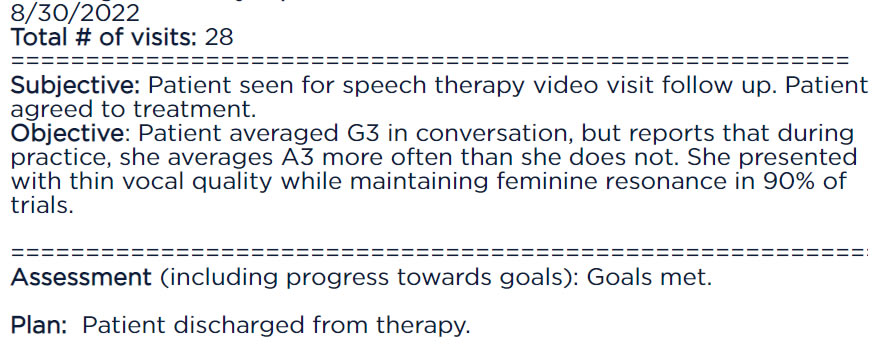
In late August of 2022, I had my last session with my second voice therapist… ever! I received this follow-up report afterward:

8/30/2022

Total number of visits: 28
Subjective: Patient seen for speech therapy video visit follow up. Patient agreed to treatment.

Objective: Patient averaged G3 in conversation, but reports that during practice, she averages A3 more often than she does not. She presented with thin vocal quality while maintaining feminine resonance in 90% of trials.

Assessment (including progress towards goals): Goals met.
Plan: Patient discharged from therapy.

Some of the more musically-minded out there may understand this better than I, but A3 is the average note I was shooting for in terms of pitch. Not that I’m speaking in a monotone, but my voice goes above and below that and that’s hopefully the center line.

That’s where I was at when I was discharged, and now, over a year later, I find I’m at the high side of A3 on average, whereas before I was on the low side.

I was basically hitting that when I remember to do all the shit I have to do! DISCHARGED FROM THERAPY WHAAAAAAAAAAAT. And it wasn’t that I needed to hit that A3 average to get discharged or anything, it was all based on ME and what I’m happy with.

Pitch work was the very last thing I did with my voice therapist. Well, let me back up, because in the original thread I told you about “sirens” and the like, which are part of pitch work.

As I mentioned in the first Voice topic, I had two voice therapists. The first only for a few months, and she had me starting with pitch.

But the second, who I had for the vast bulk of my time in therapy (and who I’ll have an interview with next week), had me start with everything ELSE first, and then we did pitch last.

And frankly that was a much better way for me because while shifting pitch isn’t what I’d call “easy,” it’s nowhere near as difficult as everything else.

We spent the least amount of time on pitch, honestly. It came pretty quickly. I CAN get my voice to where I want it to be, where it makes me HAPPY to hear it. That’s something I never thought would even be possible, honestly. I owe my therapist so much, she helped me work a miracle.

In fact, if it weren’t for her I would have NEVER been able to turn trans tuesdays into a podcast, or to be able to record the audiobook of my book BEGIN TRANSMISSION: THE TRANS ALLEGORIES OF THE MATRIX! Available now!

If you listen to that audiobook, my second voice therapist gets a special thanks at the end because, truly, my ability to record my book in my own voice would not have existed without her. She made it all possible. She’s the one I’m interviewing next week!

Quick aside, but in my discharge note it says I had 28 therapy sessions (over a period of about two years). That doesn’t tell the whole story, but it doesn’t count the sessions with my first therapist.

But also, that’s just the time talking with the voice therapist in training sessions, and doesn’t at ALL show the hours upon hours upon HOURS I spent doing voice homework and practicing. Daily. Every every every damned day.

And I suspect those 28 sessions are something I wouldn’t have been able to afford if it wasn’t covered by my insurance. I know trans ladies whose insurance doesn’t cover it, and they can’t afford it and are just stuck. Or they use YouTube tutorials and do the best they can.

The danger with that is that it’s very easy to hurt or even permanently damage your voice if you do the wrong things, and most of those tutorials are not from actual voice therapists. And that’s not great! Voice therapy NEEDS to be covered by insurance for trans people.

But that’s part of why I’m doing that interview with her next week, because hopefully she can give you tips on how to safely practice until you can hopefully see a licensed expert of your own.

For many trans people, voice is a vital part of addressing/lessening our gender dysphoria, as much as HRT or anything else can be. My voice therapist is actually releasing a book on it with some of her colleagues, and you can bet I’ll share that everywhere once it’s out.

But back to ME, because this is my thread. 😌So what does it mean that I got to that point? I’m done and good and my voice will be perfect forever?

Oh my no. No no no no.

It means there’s not much else my voice therapist could do for me. She had taught me all the tools and techniques that she could. So it became a matter of me CONTINUALLY PRACTICING until it’s all second nature. I used to wonder if it would ever happen.

The good news is IT DID! I’m so amazed and excited by it, but it came after well over another YEAR of daily practice after being discharged. So you’re looking at over three years of constant, daily work to get there.

Stamina was the last thing to arrive, as even when it was mostly second nature I just couldn’t maintain it for a very long time. Now I mostly can! But it  still adds up and can falter, especially when I’ve talked an obscene amount.

You can hear this in action in the podcast versions of the nine-part discussion on the trans allegory of Silo season 1 (which begins HERE). We recorded all nine episodes in the span of two days, which took about three hours each day. But the day before we started recording?

I ran one of my tabletop role-playing game sessions, where I’m basically talking for something like four hours straight. Under that much strain I think ANYONE’S voice is going to falter and sound weird and tired, and mine certainly does and you can easily hear it.

BUT it caused me almost NO dysphoria even when so tired and strained! And I cannot tell you how HUGE that is. I don’t like how it sounds, it doesn’t sound like ME, but it doesn’t sound like HIM, y’know? It’s pretty amazing.

It’s SUCH A SLOW SLOW SLOW SLOW SLOW PROCESS. And through the entire thing you’re hearing every mistake you make and have to fix, because the best way to improve is to record yourself during practice and listen back.

It’s really hard to deal with, especially early on in the process when your voice still sounds mostly like your old deadvoice, and so recording and listening back to yourself exacerbates your dysphoria. But you NEED to do it to be able to hear and correct where you messed up.

So my forever homework was to record myself EVERY DAY, playing each one back and listening to how I did before I went on to the next one. Again and again and again, over and over and over.

Until I would MAYBE get to the day where I hit it right every time, all the time. A very big maybe. One of the hardest parts was not knowing if I’d ever get it to where it made me happy to hear all the time.

Because with the tools and techniques I have, my voice will KEEP CHANGING over time. I don’t know where it’ll be a year from now, or five years from now. Here’s a video with a transgender voice timeline my therapist shared with me. Listen to five years of difference!

So while I’m actually really happy with where my voice is now, I may like it even more in the future… which is pretty damned exciting. And while it’s all second nature now, for years it wasn’t. And it was a struggle to remember everything I needed to.

So I came up with a mnemonic to help me remember every part of it: DISTERB.

D – diaphragmatic breathing

I – intonation

S – slow down

T – tongue positioning

E – ee-ifying vowels

R – resonance

B – breathiness

I can’t really explain all of those to you here without making this thread so much longer than it already is, but the point is these are all different skills/techniques/issues I had to remember before talking.

Imagine having to remember ALL of those things before you speak, EVERY time you speak. It’s SO much it feels like your brain will melt. And then you’re also trying to think of what to say and HA HA OH IT IS SO FUN. Notice PITCH isn’t in there!

Those are the much more difficult things it took me years to get to the point where they’re second nature. Now, I probably couldn’t talk the way I used to if I tried. Actually though, I kind of did?

We’re big fans of What We Do In The Shadows over here, and before the show there’s a little title card and an announcer who, in a very deep and kind of hilariously “doesn’t this sound evil” voice says the title of the show and gives the content rating.

And it’s so weird and idiosyncratic, and… I don’t know why, but once I just blurted out a mimic of the way the announcer says it, in the same deep pitch. And not only did it emotionally feel TERRIBLE… it HURT. IT PHYSICALLY HURT.

My vocal folds and tongue and all those muscles that contribute to making sound have changed enough from my years of practice that now UNDOING it is as painful as trying to sound more feminine used to be when I was pushing things too hard. It’s a strange and fascinating thing.

I think most of you may know this, but in case you don’t: my wife and I run one of the oldest and biggest podcasting companies, Pendant Productions. We’ve been making scripted podcasts longer than just about anyone (and they’re freakin’ good too, but you don’t have to take my word for it).

I only mention that to say that there are tons of recordings of my voice through the years, and I can’t do anything about the old ones. They’re just going to be that way forever, even if I don’t listen to them again. BUT it led to a unique opportunity.

Ever since we started, way back before the flood of media that made it impossible to keep up with everything, I still felt that people choosing to spend their time listening to OUR shows meant something important. And so I‘d personally thank them at the end of every episode.

That means there are probably 500+ episodes across 20 shows out there right now that have a thanks from me at the end. And I’ve always said the exact same thing: “For more information, visit tillystranstuesdays.com. Thanks for listening.”

And for SOME reason (I honestly do not know why!?) I have kept every new version that I ever recorded. And as my voice began changing through voice therapy, I would record a new one because it sounded better than my old voice, even if it didn’t yet sound great.

I’ve stitched them all together. And so you can hear me saying the exact same thing over time as I progressed through voice therapy, which helps you really notice the different ways my voice changed and evolved as I learned and practiced more.

My voice therapist listened to this and said she could actually pinpoint exactly what techniques we were working on during each recording, because the sounds are that specific to the process.

Most of these spike my dysphoria really bad, ESPECIALLY the first one with my “normal” old deadvoice. If I never hear that again it’ll be too soon.

The voice timeline.

In order:
1. deadvoice
2. four months into therapy
3. eight months into therapy
4. eight and a half months into therapy
5. nine months into therapy
6. eighteen months into therapy
7. two years into therapy/Sept 2022
8. two and a half years after I began voice therapy/March 2023

That’s been my voice journey so far. Maybe I’ll do another update in a year or whenever I notice things have noticeably changed in some way again. I’m SO curious to know what I’m going to sound like a year, two years, five years from now.

Please be sure to see next week’s trans tuesday interview with my speech pathologist, who I hope can go more into the science behind it all and provide safe tips for people to practice and work on your own.

But I want to say to the trans folks out there who find this as daunting as I did…

Change. Is. Possible.

It may be the most difficult thing you’ve ever had to do (it was for me), but if you put in the time and the effort, remarkable things can happen.

It’s so hard to be patient, but you can’t rush voice changes or HRT or ANYTHING involved with transitioning, really. Every single part of it is an exercise in patience.

Be kind to yourself and don’t give up. You can get there. You’re worth it.

Tilly Bridges, end transmission.
tillysbridges@gmail.com

PS – part 3 is here!

TRANS VOICES 1: Gendering

Welcome to #TransTuesday! This week we’re discussing something that can be a huge problem for a lot of trans people who transition as adults. It’s something that’s eaten up SO MUCH of  my time and energy and I bet you have no idea. We’re talking about TRANS VOICES: GENDERING.

I routinely see so many trans people struggling with this, so I wanted to do a series on my own experiences. I’m going to talk about my early experiences this week, where I finally ended up next week, and then we’ll culminate with an interview with my speech pathologist!

A reminder that I’m giving you MY experiences and perspective only, and I don’t speak for all trans people or all trans women. I’m also not a speech/language pathologist, so don’t expect a deep dive into the science of it all.

But I did work with a speech pathologist, for years. And all of that was to help me change my voice so I hopefully don’t sound like a cisgender man. The goal was twofold: make me feel more like ME AND reduce the gender dysphoria my voice gave me.

But it’s also to help me be gendered correctly as I move through this world that is often unkind (or worse) to trans people. It’s also something of a safety issue, because if you look like a woman but sound like a man, you can risk opening yourself up to even more abuse.

And here’s where it gets complex, because NO ONE should have to have any voice other than the one they WANT, just to feel safe and accepted for who they are. Plenty of cis women have voices with a lower pitch and may struggle in a similar way.

And it’s bullshit. All a trans person should have to worry about is sounding the way WE want to, and to hell with whatever anyone else thinks. But we don’t live in a world where that’s possible, which brings us to the an event I want to talk about.

I was on a Zoom call that was audio only. At the time I didn’t have an avatar or user photo, so on audio-only calls it just showed my name in the square where the video would otherwise be. Not that a photo would necessarily have helped anyway, as I do not “pass” as a cis person.

For more on how fraught that entire concept is, see the trans tuesday on MISGENDERING AND PASSING.

After an hour and a half of lively, interesting discussion, someone else on the call said something to the effect of, “we’re all men here,” and my heart sank to below the bottom of the ocean. I was dealing with the emotional fallout from that for the rest of the day.

It wasn’t malicious, it wasn’t intentional misgendering. And the host of the call, who is a very good friend of mine, immediately corrected the guy who said it and told him I’m a woman, so that I didn’t have to (which is PEAK allyship IMO).

It is, in fact, a small but simple demonstration of PROACTIVE ALLYSHIP (aka being an accomplice), which there’s a whole trans tuesday about.

At that point I’d been in voice therapy for at least six months. It involved long calls with a speech pathologist every few weeks and daily vocal exercises to try and train myself to speak differently than I have for my entire life.

It’s hard. It’s SO hard. And you sound so absurd when doing it. You do these “sirens” with your pitch going up and down in one tone, over and over again. You practice holding a tone at a certain pitch for different lengths of time.

OVER AND OVER AGAIN. You practice speaking like you’re sighing, and then practice speaking without the sigh but hopefully with your vocal folds in the same posture to change the sound of the words.

You go through word lists time and again, trying to change your inflection and intonation. And when your voice gets tired you blow raspberries. Lip trills relax the throat and vocal chords. You can also just talk with your tongue out! Ludicrous. But it helps.

And when you have to do this in front of other people, or talking to them on the phone like all my voice therapy sessions have been… if you had much of an ego before, this will shatter it into a million tiny shards, let me assure you.

The change is incremental. It’s slow. It’s climbing a mountain with one arm tied behind your back. It’s frustrating and feels like trying to change the immutable. Because hormone replacement therapy does NOTHING for a trans woman’s voice.

And on this call I’d talked to this guy for NINETY MINUTES, and he could see my name was TILLY, and the others on the call referred to me as Tilly, and HE STILL THOUGHT I WAS A DAMNED MAN.

All my work, all the hours, all the practice, and even when paired with my name his brain said, “nah, nope, that’s a dude.” And you get to feeling like… why do I bother? What’s the point? Will I EVER be seen and heard as who I am? What a horrid spiked pit to be thrown into.

So what’s the science behind voice therapy? Again I’m not a professional here, but some of it is incredibly fascinating to me. Cis men are generally taller than cis women, but if you think in terms of musical instruments…

…the bigger or longer the instrument, the deeper the sound. To say nothing of the way testosterone will also cause your voice to deepen (hey look, another reason it’s super important to let trans kids have access to puberty blockers).

I talked all about that in the trans tuesday on TRANS KIDS AND THE INTAKE EXAM.

But that’s not all! People who are assigned male at birth have vocal folds that close all the way. So when they speak, they have to force more air through the folds to make sound. Which makes AMAB voices sound stronger, more curt, maybe more forceful.

People who are assigned female at birth have vocal folds that DON’T close all the way. So when they speak, AFAB voices tend to be a little breathier and softer and maybe a little more drawn out, because more air gets through and they don’t have to force the folds open.

A lot of the work I did at the beginning of voice therapy, in addition to trying to learn to speak from the front of my face and not from deep in my chest, was trying to train my vocal chords so I could speak a little softer and breathier like people AFAB generally tend to.

I don’t know about you, but I’m a science nerd and I find that absolutely fascinating. But it can’t just be fun and cool science, oh no. Because we live in a society, and how that society treats us impacts every facet of our lives.

When I first talked to my first voice therapist (I only worked with the first for about six months, and then worked with the second for two years), she felt compelled to give me a disclaimer: a lot of this is sexist. A lot of it is very sexist. And she hated it.

AND YET some of those very things are a good way to help a trans woman be gendered correctly. Like the way cis women often pitch UP at the end of a sentence? So everything might sound like a question? Even when it’s not?

And if you do that fairly consistently, in a lot of people’s brains they’ll read that as a woman speaking?

And how much bullshit is that? HOW MUCH?

ALL OF IT (no question mark).

When I first began voice therapy, I was sent a huge packet. It’s got some scientific explanations for things, most of it is large and varied word lists I used for different exercises to practice, but when first going through it… a few pages made my head explode.

Like this one:

A worksheet titled “Highlighting Vocabulary Differences.” Text reads:
The following scene played out between a man and a woman. Read through the scenario and determine which character was the man and which character was the woman, based on the vocabulary used. Highlight the words that are stereotypically gender-specific.
Character A: Hi! How are you?
Character B: I’m doing good, you?
Character A: I’ve been fantastic! It seems like it has been so long since I’ve seen you. What have you been up to?
Character B: Eh, not much. Just the same ol’, same ol’. How about you? How was your weekend?
Character A: My weekend was great. I bought a new outfit on Saturday and got a brand new hairdo on Sunday! I was afraid my stylist wouldn’t cut it right, but he did.
Character B: Oh yeah, it looks good.
Character A: Thanks. Did you have a nice weekend?
Character B: It was pretty good. I went to this restaurant called “Umami.” I liked it. Character A: I’ve been there! Oh my goodness, their food is so yummy. I have to go back soon.
Character B: Yeah, I liked it a lot.
Character A: Well, it was great to see you. I have to go to class now.
Character B: Yeah, it was good to see you too. I hope to see you around sometime. Have a good one.
Character A: That would be wonderful. Bye!

And this one:

A worksheet titled “Highlighting Vocabulary Differences.” Text reads:

The following scene played out between a man and a woman. Read through the scenario and determine which character was the man and which character was the woman, based on the vocabulary used. Highlight the words that are stereotypically gender-specific.

Character A: What are you going to order?

Character B: I’m not sure yet. Have you decided?

Character A: Uh-huh.

Character B: Oh, what are you going to have?

Character A: I’m gonna have the number eight.

Character B: Ooooh, that looks good.

Character A: Yeah. I’ve never had it before.

Character B: Ewwww! There’s a hair in my water glass! Yuck!

Character A: That’s not cool. Tell the waiter.

Character B: I will, I just hope he doesn’t think I’m being rude.

Character A: Nah, you’re just pointin’ it out. No big deal.

Character B: Okay. Hmmmm, I think I will try the number six. That looks sooooo delicious!

Character A: Yeah, I saw that one. You’re gonna have to lemme try it.

Character B: Absolutely not! Hee-hee. I’m just teasing.

Character A: Hah. You better be.

Character B: Okay, where is our waiter? My tummy is rumbling and I want a new water glass!

But if you thought those were bad…

A worksheet titled “Highlighting Style Differences.” Text reads:

The following scene played out between a man and a woman. Read through the scenario and determine which character was the man and which character was the woman, based on their communication style. Read the entire script before making your decision.

Character A: I had a difficult day at work today. My boss was so grumpy. She really hurt my feelings.

Character B: You might need to talk to HR about her.

Character A: I don’t know if I need to do that. It’s just that she always makes me feel so inadequate. I feel like I try so hard but it’s never good enough for her.

Character B: Well, what does she tell you to improve upon? Why don’t you start working towards a new goal to improve upon each day?

Character A: I am constantly trying to improve myself. I feel like she doesn’t listen to me though. I wish she were just more sensitive to other people’s feelings when she talks to them.

Character B: You know you’re a hard worker. You should just focus on what you’re doing right when she’s being that way.

Character A: Yeah, I know. It’s hard though. I guess I’m too sensitive sometimes. I wish I could talk to my coworkers about this, but they all seem to love her.

Character B: Hmmm. I don’t know what to tell you.

Character A: I’m not looking for advice. I’m just telling you I had a rough day. I need someone to listen.

Character B: Okay. I’m listening.

Character A: Well, that was pretty much it. That’s all I wanted to say. I just feel like I’m trying so hard and I’m not appreciated.

So! What have we learned? Women are submissive, ask questions, complain, talk about superficial things. Men are assured, forceful, declarative, concerned only with “important” things. Yikes yikes yikes HOLY SHIT YIKES.

To my first AND second voice therapist’s credit, neither ever used or even referred to anything remotely close to what you see on those sheets. But the fact IT’S INCLUDED IN THE PACKET AT ALL IS ABHORRENT.

And this is what we’re up against. At times it feels like we can conform to every horrible, harmful, sexist belief about women and MAYBE be gendered correctly (but still maybe not!), or we can not even try and maybe NEVER be gendered correctly.

What a horrible spot to be put in. We just want to be ourselves, but here’s yet another aspect of our lives where society is telling us if we don’t do X exactly as they expect, we’ll never get there.

No person, trans or cis, should have to change their voice (or anything else about themselves) just to be seen as who we truly are.

I’ve always had trouble getting all my thoughts out when talking, because my brain moves so much faster than I can speak and I can’t keep up. And I’m always trying to find the best way to say what I want to say, probably because I’m a writer and value clarity.

So now on top of all that, I had to think about my breathing, and keeping my resonance in my face, and trying to not force air through my vocal folds, and where was my pitch, and I had to vary that pitch so it didn’t sound monotone…

…and I had to do it the right way so I don’t hurt myself. And then I had to try to keep my vocal folds relaxed so more air could get through and I’m not forcing words out and making harder sounds like a cis man would.

And it felt like when someone asked me a question, I’d need two minutes to do all of that first and then maybe I could try to reply. But you don’t get two minute gaps in conversations! So my brain and body were moving at light speed trying to do all of this at once.

Just speaking, at all, was exhausting. It DID get easier, which we’ll talk about next week. But it’s just so much work. It’s so hard. And it took YEARS. And I don’t think anybody even knows what it’s like if they haven’t had this experience themselves.

The only ill will I hold toward the person who misgendered me on that Zoom call is that he made a gender assumption he shouldn’t have. Well… he also didn’t bother to apologize. So, okay, I’m still mad about that and now I prefer to just never be around him.

And I would like to please caution ALL OF YOU out there to never make any assumption about someone’s gender. Not based on their hair, or their clothes, or their voice, or the way they walk, or any damned other thing.

What’s the benefit to you? Getting to skip a moment of uncomfortableness while you ask them their pronouns or wait for them to reveal it in passing as you talk? Oh no, how horrible!

The alternative is making someone, possibly trans, possibly cis, feel like they’re not being seen for who they are. And you don’t know how much work and time and energy they’re putting into trying so, so hard to be seen correctly.

Here’s a super lovely poem by Ari Drennen on this very topic. It was everything I needed right when I needed it.

A tweet from Ari Drennen that reads: Nearly every trans woman I know is self conscious about her voice. When I hear a trans woman speak I think about all the hours in the bathroom mirror or alone in the car, nudging the sounds we make closer to something that sounds like home.

There are two screenshots of a poem she wrote, which read:

When I hear a trans woman’s voice, Ari Drennen

Whenever I hear a trans woman’s voice

I think of the seed once buried deep

Below the winter snows, salt from the

Road, and dirt kicked up by the tires

of the cars it carries. Green new growth

Unfolding luxuriously towards the summer sun

One time in college, a kindly old

Professor took me aside after his

Lecture to let me know that the questions

At the ends of my sentences made me

Sound less bright, as though knowledge

Is a bristling martial march and not the

realization that most of what’s in our head

Would not survive first contact with

A question. I thanked him,

Shut myself in my room, practiced

Sounding certain. Boys are certain, Right?

Men are certain.

When I hear a trans woman’s voice

I think of a spring-loaded silver

Ballerina in my grandmother’s attic,

Twisted taut since some forgotten niece’s

Forgotten birthday, dancing by herself

For the pleasure of the moonlight.

I practice sounding uncertain.

I practice being uncertain.

I unfold my words from the space

Within my chest and let them flow

Through the tiny circles I form

With my mouth. I think of the soft

Chatter of spring songbirds and

The glow of chamomile tea sipped

Under plush blankets. I think of

Blooming dandelions and lips

Stained by wild raspberries.

Understand how difficult this can be for us. And stop assuming people’s gender, based on voice or appearance or anything else. It’s the kind thing to do.

And keep at it, trans friends. Over time you can move mountains.

Tilly Bridges, end transmission.
tillysbridges@gmail.com
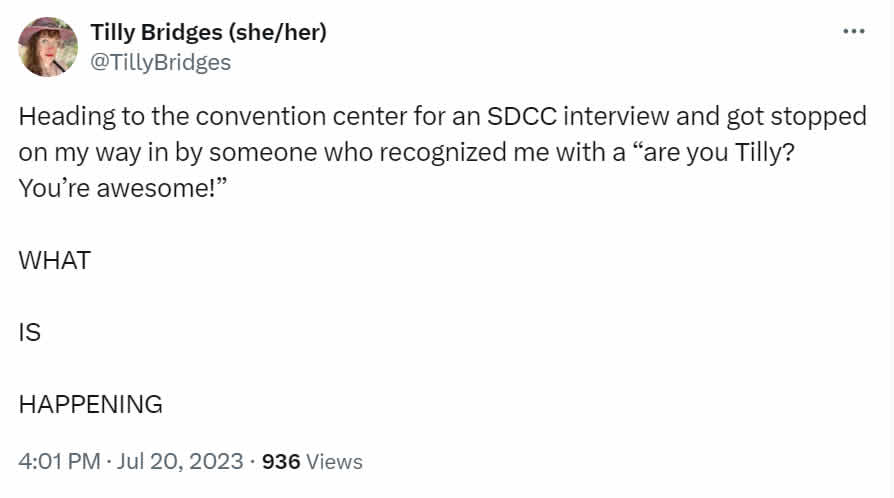
PS – part 2 is here!

THE UNINTENTIONAL TRANS ALLEGORY OF SILO S1, Part 2

Welcome to #TransTuesday! This week brings the THE UNINTENTIONAL (?) TRANS ALLEGORY OF SILO, PART 2! Tillyvison powers to full, it’s time to Silo up! We’re picking up right where we left off in the pilot!

Before we do, be sure you’ve read PART 1, which has context you’ll need going in, and also covers the first part of the first episode. And if you don’t read THAT, this one isn’t gonna make much sense to you.

Allison and Holston meet Gloria, and watch their reactions to her at first. She’s this person everyone suspects is different, is weird, is trans, and they don’t want to associate with her. Then people might think THEY’RE trans, and heaven forbid.

Even though, in the allegory, Allison and Holston are both trans people, in this flashback neither of them has realized it yet. And so they’re reacting to a trans person the way society has taught them to.

As I mentioned before, Gloria is a trans person who never transitioned, but everyone suspects is trans. If we follow the surface story, it would be because the Silo/society didn’t give her “permission” to, but in so many places society NEVER gives trans people that permission.

But it could also be that she never transitioned out of fear. She knows the truth about how the silo was preventing bodily autonomy in those it found “undesirable,” and who she shares that information with could come back to hurt her.

Which is just like if she came out publicly as trans, she’d be cast out of society (sent out to clean), so she keeps her truth hidden… but only to a degree. People still seem to know, or suspect.

And note she wants to help them with their bodily autonomy issue. She wants to help others, who are like her, achieve the thing she never got for herself. Unfortunately it leads her to a really dark place later on in the season.

Gloria: “If you have an open mind, come see me.”  Holston: “She goes right to the edge of promising people a baby if they do what she says, and it’s cruel.” How dare Gloria say she can help, when nobody can help? We’re not ALLOWED to do what we want with our bodies.

When the doctor “removes” Allison’s mandatory birth control, he says “…takes a few weeks for the hormones to reset.” If you don’t see how this is akin to him telling her about hormone replacement therapy, and pretending he gave it to her, I mean… c’mon.

We then learn Allison’s been trying to educate people on how to recover deleted files. Which seems innocent enough, until you later realize that the Silo has purged all information about the past.

And I’d like you to think for a moment about a trans person you learned about in school. Or did that… not happen? Were you not taught about our contributions to society? Were you not even taught about our very existence?

We have been systematically purged from history. This is why so many incredibly ignorant people think being trans is something “new,” despite the fact there’s evidence of trans people going back thousands of years. We’ve existed as long as there have been humans.

See the trans tuesday on TRANS HISTORY 1 for more info on that.

And this is your first indication that digging into the past, to the correct and vital information about our own existence, isn’t allowed in the silo. It’s not just frowned upon, it’s a CRIME. It’s literally the “don’t say gay” bill drilled down to “don’t say trans.”

Holston: “The pact is the only history we have. What if a bunch of rule-breakers decide they wanna see for themselves what it’s like above ground? They somehow manage to open that door, we are done.” This is what society believes, that we’re a danger to all of society.

That by trans people coming out, MORE of us will think it’s okay to come out (true!) and if that happens it will undo all of society (false! It will only undo the lies of gender-assigned-at-birth being all there is… but that’s what keeps those at the top in power.)

Gloria, to Allison: “Have you ever wondered what was on the servers they erased? In the books they burned? If it was even the rebels that did it?” Don’t you want to know the TRUTH? About our history? About YOURSELF?

Also this feels like a good time to remind you that the first book burning the nazis did when they came to power in Germany… was all the data and information collected at the world’s first transgender clinic. WHAT A COINCIDENCE.

This is important so here, have another.

And here’s the link to TRANS HISTORY 1 again, because in there you will learn how even our allies often don’t care about us, because when the Allies liberated the internment camps THEY LEFT THE QUEER PEOPLE IN THEM. “Allies” indeed.

Gloria: “I’ve heard you’re also someone who wonders.” Allison: “Who told you that?” What? Why would you think I’M trans? No no, I’m not like you! Did someone say I was like you? Why would they say that?

That exchange speaks to me of the way it feels when you’ve been denying the truth of your transness for your whole life, and something happens where you’re afraid you’ve given something away… not just to the world, but to yourself, when you’re not ready yet.

Gloria: “Do you really think you’re the kind of person they want having children?” Again this is a little murky and imperfect, but it works for trans people not being the “kind of person” society wants to have bodily autonomy…

But it ALSO works for trans people not being the “kind of person” society wants to be literally having children or, if you will, “making” more trans people (being out and proud and happy, so other trans people think they can do it too).

Allison gets a trouble ticket for George, and nobody wants to help him. Because he’s weird, and strange, and he’s the type who asks questions! Again, a Flamekeeper/trans person (or a suspected one), and nobody wants to even associate with them. Cis people shun us.

Watch that Freedom Day play, where society is literally indoctrinating children into lies and hate. This speaks SO MUCH to the way trans people, especially trans women, are portrayed in media as monsters, or victims, or jokes, and rarely anything else.

See the trans tuesday on TRANS REP IN MEDIA 2022 (in movies and tv) for how trans rep went for me in every single thing I watched last year.

You can also see the trans tuesday on BAD REPRESENTATION for a more in-depth rundown of what only seeing yourself represented in those ways can do to a person.

This is to keep cis kids thinking of trans people as “the other,” and villainous, and bad, and wrong. And it’s to keep trans kids watching too scared to come out and live their truth. It’s all about controlling the population to keep those in power where they are.

Pay attention during Mayor Jahns’ speech about how they blame the rebels, aka trans people, for literally everything bad that has happened to them. It’s alllll our fault for not conforming. There’s no greater threat to the lies than the people whose existence disproves them.

Mayor Jahns giving her Freedom Day speech, flanked by Holston and Marnes

When Allison accesses the hard drive, George goes to the blueprints, literally the information on why their society is the way it is, or why THEY are the way they are. Why does society hate trans people? Why don’t they want us to look? What if WE’RE trans?

Allison in George’s workshop, looking at the illicit hard drive

Allison refuses to look, and tells George he shouldn’t look either. Society has conditioned her to not seek out this information, even though she has a burning desire to know. But her desire for the truth (about herself, and society) hasn’t overridden the fear yet.

Allison: “They can send you out to clean for this.” In other words, this could out you as trans to society and get you shunned. But note SHE won’t turn George in. She’s already breaking the conditioning and the internalized transphobia society’s implanted in her.

INTERNALIZED TRANSPHOBIA? Oh yeah, there’s a trans tuesday on that, you betcha.

Allison goes back to Gloria, to learn the truth about why she can’t have a baby/why she’s not allowed bodily autonomy. This then leads her back to George, and her desire to see more of their forbidden history.

She’s waking up to her transness, despite the danger it puts her in, despite society telling her it’s wrong. Because that drive, to know and understand ourselves, is far stronger than the fear society instills in us. Eventually it’s going to win out, and we’re going to look for answers.

And it’s then that she and George see the Jane Carmody cleaning file, showing the outside is birds and blue skies and green plants, not the dead world they see on all the screens in the silo. We’ll talk about this more when we get to the very end of our Silo discussion.

Blue skies with white clouds over vibrant green grass and a tree, with a flock of birds flying in a V formation

But this is what clues her in to everything that society’s been telling her is a lie. It’s ALL BUILT ON LIES. Once you realize assigned gender at birth is a lie, and you come out as trans and live outside the false cisgender binary matrix…

You see just how MUCH of our society is founded on similar lies, all to keep people boxed in and controlled, so those at the top can consolidate their power. See the trans tuesday on THE FALSE DICHOTOMY for more info.

Allison goes into the bathroom and… the mirror isn’t clear. Her REFLECTION ISN’T CLEAR. The lies she’s learned about have changed the way she sees herself, so her reflection does not reflect the truth. See the trans tuesday on PHOTOS AND REFLECTIONS.

If you’ve read Begin Transmission, my Matrix trans allegories book, you’ll know that reflections are a huge thing in that franchise, particularly the first (and fourth) movies. Silo has more to say about reflections later, too.

So, the scene where Allison tells Holston what she learned, it reads SO MUCH like a trans coming out scene. Allison wasn’t sure he was “going to be able to hear what [she] had to say.” As in, again, he would not be LISTENING, only reacting as he’d been taught to.

Which he tries to do, but she cuts him off with “talking is not listening.” Listen to everything else she says here, knowing what we’ve discussed already, and you’ll immediately pick up on how much of a coming out this really is.

Allison: “They want docile, obedient people.” Because when you know the truth, you rock the boat and fight for change, for your right to be yourself, and that is absolutely a threat to a society entirely built on lies.

Allison knows the doctor didn’t actually remove her birth control, but Holston doesn’t believe her. She shows him proof, she just cut it out of her body herself. She TOOK BACK HER BODILY AUTONOMY. She is accepting her transness and choosing to transition.

There’s probably something to the apple on the plate with the bloody knife, relating to Christianity and Adam and Eve, and how defiance of the rules gets you “cast out” but I think that’s better left to folks who know religion better than me.

Allison, to the masses in the cafeteria: “None of this is real. Do you see? They want to keep you in here, so they’re lying to you.” There’s something I say a lot in my examination of the Matrix films, I call it SUPERtext. The opposite of subtext. And that’s what we’ve got right here.

Gender assigned at birth ISN’T real. Nobody can TELL you your gender, it’s something only you can discover for yourself. But cisgender people find they agree with what they’re told, so they never realize it’s a lie. And that’s what keeps you “in here” oppressing trans people.

Allison: “I’ve been thinking about this a lot. Please. Just know there’s no other way. I’m sorry honey. I want to go out.” Everyone is horrified. Society, so many cis people, see transition as a death, and not a rebirth and process that fixes a legit medical condition.

Holston: “If you can boil the Pact down to one rule, it’s to not say you want to go outside or you will fucking go outside.” It’s the cardinal law of this society, and of OUR society. If you say you’re not cis, EVERYTHING in society flips and you are now on the outside. Forever.

Mayor Jahns: “Did anyone else play a part in this, steer her in this direction?” Nobody can make you trans, right? But again, seeing other trans people who’ve done it CAN make you feel like YOU can do it as well… but only if you’re trans, too.

Holston: “Allison feels things strongly. I think not being able to have a baby, it was just too much.” Yeah, being told you CAN’T do what you want with your own body, especially when it’s medically necessary, is very very too much to abide.

Right before Allison goes out, she tells Holston: “If I could wind back the clock and not know what I know, I would. In a heartbeat.” It’d be so much easier to not know our truth and keep living a lie… but it wouldn’t be living, would it?

Allison: “But what I found out, what they told us isn’t true.“ Holston: “So?” He thinks if she found this out she should have told all the authorities and not “said the words that get you sent out there to die.” He doesn’t understand why the truth of her existence is more important to her.

She tells him how the screens are a lie, and aren’t showing reality. Holston: “I know what I’m seeing” Allison: “Not if it’s just what the computer wants you to see.”

So when people get sent out to clean, they’re given a little piece of wool they can use to clean the camera sensor. And Allison asks, “Why do people clean?” Holston: “To get the dust and grime off the sensors. So we can see.”

Allison: “No. Why do they go through with it? Most people swear they’re not going to do it. When you arrested Brent he said you’d have to put a bullet through his head and throw him down the stairs because he wasn’t going to clean. And then what did he do?” Holston: “He cleaned.”

Allison: “I think people clean because they hope somehow that they can show people the truth that [the outside] is a lie. When I get out there, if that’s what it’s really like, I won’t clean. I’ll wave goodbye because I will have made the biggest mistake of my life.

But if I’m right, and it’s green and lush and beautiful, I’ll pull out my wool and I’ll start to clean. And you’ll know. And then I’ll walk over the hill and find out what’s going on. And then I’ll come back for you.”

We then see her being wrapped in her suit with, what we know after seeing the entire season, is the faulty heat tape. We’ll talk about that more at the end, but it’s here now, right from the beginning.

Mayor Jahns: “You have been charged with violating the cardinal law of our society. Any spoken request to leave the silo is granted, but it is irrevocable. Once uttered, it is determinative.” There’s no coming back, you’re out and we don’t want you.

And when they say “you are outside the law” they’re admitting you’re dead to them. Their law is all they care about, never mind if the laws are wrong. There’s a big difference between something that’s “unlawful” and something that’s “unjust.”

Everyone gathers to watch her go out. Allison rises up the steps out into the world. And then she cleans. Everyone cheers. She goes to walk over the hill… but then slows, staggers. She falls, and dies.

A crowd gathered in the cafeteria, watching Allison as she cleans the sensor from the outside

Two years later, Holston gets a file on George. He’s dead, he went over the rail and fell. They don’t know if it was an accident or suicide. Holston went to investigate, and that’s when he met Juliette.

Look at that first shot of her, inside the generator. It’s physical, it’s visceral, there’s muscle and grime and that is not what society has told us is how a woman “should” be. You learn from shot one that Juliette doesn’t conform to gender norms.

Juliet inside the generator, turning a wrench with both hands

Also note that a lot of people call her “Jules,” which can certainly be short for Juliette, but is ALSO the masculine form of the same name. Everything about her reads as trans, or at the very least gender-nonconforming. And Holston’s time with her is what changed him.

Marnes: “What happened to you? For two years you were dead inside, then you met Juliette Nichols.” Holston: “I finally started listening is all.” To her? Or to himself? Because in those two years he overcame his fears about Allison, and about his OWN truth.

Holston: “…either way I’m done. I’ve got to know the truth.” He’s realized he’s trans, too, and is going to follow Allison on the path to self-actualization, even though it means society will shun him.

Next time we’re finally going beyond the first episode, and would you believe… it gets even deeper? Of course you would, or else there wouldn’t be anything else to write about. You ain’t seen nothin’ yet.

Tilly Bridges, end transmission.
tillysbridges@gmail.com
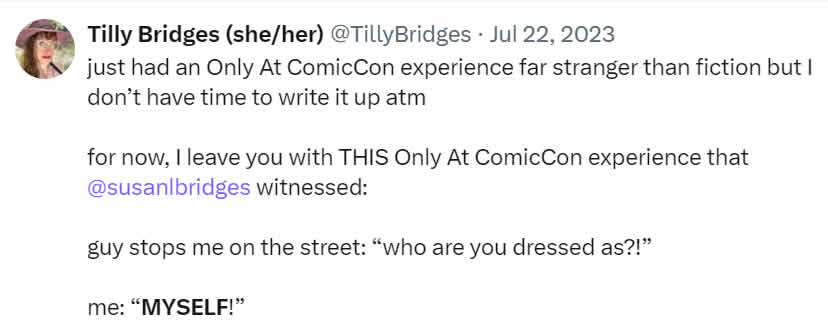
Ps – Part 3 continues here!

THE UNINTENTIONAL (?) TRANS ALLEGORY OF SILO s1, Part 1

Welcome to #TransTuesday! It’s time to dive into one of the most ambitious topics I’ve tackled. This year I fell completely in love with a show on Apple TV, and at least part of that is due to THE UNINTENTIONAL (?) TRANS ALLEGORY OF SILO.

Someone recently called my trans allegory deep dives Tillyvision, and frankly I think that’s pretty dang great. WELCOME TO THE NEXT INSTALLMENT OF TILLYVISION, MY FRIENDS.

Before we go any further let me say this entire exploration is criticism and allowed by the WGA strike. This is a celebration of a show that meant a lot to me that was made by real human beings, incredibly talented writers and actors and directors and crew.

Support the people who make the media you love, because we writers shouldn’t have to have two or three side jobs to get by, and over 80% of actors make less than $26k a year. That’s barely a third of the annual cost of living in Los Angeles!

If you’d like to donate to help writers, actors, and crew get through the strike financially, please visit the Entertainment Community Fund.

Also I’m not sure everyone realizes what an undertaking these are, so a little info for you: not counting my first watch (which was just for entertainment/writerly reasons), the rewatch was ten episodes… that took two hours each to watch due to stopping to take notes.

So already that’s 20 hours. It then took me about 12 hours to convert those notes into readable form for release. So you’re looking at 32 hours of work. And then revising and tweaking and prep for the podcast versions all took another 5 hours.

And that’s all BEFORE posting the social media/text version and before recording the podcast version (which took another… 5-7 hours?).  So that’s like… 45 hours of work?

What I’m saying is I really hope you appreciate these, because they are a massive undertaking and a huge time sink. Phew.

Before we dive in I’m going to warn you that there are gonna be TONS of spoilers, because I’m going to be talking about every episode from the entire first season. If you haven’t yet seen it and want to experience it on your own first, read no further!

Unlike my most well-known example of discussing trans allegories in media, The Matrix (those essays became a book, BEGIN TRANSMISSION: THE TRANS ALLEGORIES OF THE MATRIX… get your copy now!), I believe Silo’s allegory is unintentional. …maybe.

I will specifically be talking ONLY about the Silo show on Apple TV+. To the best of my knowledge, showrunner Graham Yost, the other writers on season one, and Hugh Howey, the author of the books the show is based on, are not trans. BUT!

As I like to remind you when talking about these things, there may be trans people involved who aren’t out yet or might not even know they’re trans yet. Which means the allegory could be them intentionally working through complicated gender feelings without realizing. BUT!

It’s also perfectly possible that there really are no trans people involved with it, yet it is still incredibly trans because as I like to remind you, trans stories are human stories, and we’re all more alike than not. This happens all the time!

If you’d like examples of other trans allegories in media, some intentional and some probably intentional but maybe not, see The INTENTIONAL TRANS ALLEGORY OF REAL GENIUS, part 1.

And THE UNINTENTIONAL (?) TRANS ALLEGORY OF THE LITTLE MERMAID‘S “PART OF YOUR WORLD.”

And THE UNINTENTIONAL (?) TRANS ALLEGORY OF THE TWILIGHT ZONE‘S “NERVOUS MAN IN A FOUR DOLLAR ROOM.”

Unlike the write-ups on The Matrix, Real Genius, and Nervous Man, I’m not going to use timestamps. I’m covering an entire season, ten episodes, and I felt it would just be too confusing.

The basic gist of my trans reading of the show is that people who are sent out to clean, and the Flamekeepers, are trans people. The society of the Silo is, conveniently, the society that we trans people are born into here in the real world.

Let’s look at some of the characters:

Juliette is a trans person waking up to their transness and the way the entire system of society is stacked against us, lies to us, oppresses us, and then figuring out what to do about it.

Rebecca Ferguson as Juliette Nichols, in a jumpsuit with a large spool of rope over one shoulder

Billings is a stealth trans person, represented through his having and hiding “the Syndrome.” He has a condition of birth that will get you otherized by society and so he does everything he can to hide it.

Chinaza Uche as Billings, wearing a sheriff uniform and sitting behind a desk

Walk is a closeted trans person. She’s trans and knows it and is afraid of coming out because of how people will react.

Harriet Walter as Walk, in a cozy sweater, sitting at a table with a teapot

Gloria is pseudo-closteted. She’s “not trans” but everyone suspects she is, even though she never transitioned. She spends her life trying to help others transition because she was never able to.

Sophie Thompson as Gloria, sitting on a hospital bed and looking a bit disheveled

George is a trans person trying to learn about themselves, and why they never heard the word “transgender” before, and why are trans people so “new”? He uncovers the truth of our history and does what he can to make things better for those coming after.

Ferdinand Kingsley as George, looking very casual and kinda upset tbh

Regina (and also Billings’ wife) are spouses or family of trans people, who lose some of the things trans people lose due to their association with us. They blame US for the ostracization they face rather than transphobic society, and place their grief over our needs.

Sonita Henry as Regina, standing in her kitchen and feeling very righteous

Lukas is a trans person in denial. He has questions but his fear rules him and he’s forever an agent of the system. He feels he can only be who he’s told to be, and he’s a “pick me” who sells out his people in an effort to be “one of the good ones”.

Avi Nash as Lukas, smiling and happy and unaware of where he’s gonna end up

Spirals are everywhere in the show, symbolizing bringing order from chaos. They’re the literal backbone of society, which you see in the central staircase (which draws allusions to the spine and even DNA in the opening credits). And they work incredibly well.

A collection of spirals from the Silo opening credits and from various episodes

Because Bernard and most of the silo’s residents (transphobic society) THINK they’re preserving their society by trying to control and stamp out transness, and they see that as the order from the “chaos” of trans existence.

But we trans people are ones ACTUALLY bringing order from chaos, when we discover that it’s the world that’s broken and not us. And we fix that by choosing to transition. The spirals are actually ours, and they appropriated them, and dang that happens to us all the time.

Water is also really important, in the ways characters are terrified of it and yet also in awe of it. It symbolizes dysphoria, in the way I myself have described my own GENDER DYSPHORIA as being akin to drowning.

And you can even see in my INTERVIEW WITH MAYA DEANE, AUTHOR OF “WRATH GODDESS SING” how she wrote dysphoria in a similar way in that remarkable novel (which is also my favorite novel EVER). She writes about it as being trapped at the bottom of a well.

And if you think fearing the water/dysphoria makes sense but aren’t sure why someone would be in awe of it at the same time, let me hit you with this: dysphoria is horrific and terrible, but once you realize you have it… you KNOW that you’re trans. That knowledge brings answers.

There’s SO much more on this and it’s used in really brilliant ways. However, I do want to include a little disclaimer.

This allegory is… imperfect. It doesn’t work quite the way The Matrix or even Real Genius did, where trans creators were putting their lived experiences and feelings into their work with intent (be it conscious or subconscious).

Also, because the allegory is less “clean” (if you’ll forgive the word choice when talking about Silo), not everything that applies to the allegory for one character works for the other characters.

For example, the Syndrome is analogous to physical attributes you’re trying to hide so nobody knows you’re trans, but not everyone who represents different kinds of trans people or culture have the Syndrome. Make sense?

Anyway, there are big bits of transness all over, in many different ways that mean a lot to me. And it’s got fabulous things to say! So come along on this journey and let’s see what Silo has to say about trans existence. I think you’re gonna dig it. TIME TO SILO UP!

EPISODE 1

We can see right away this world is old. The entire aesthetic (which I LOVE) is really retro-futuristic. If you’ve watched the entire season, you know this is purposeful in-story.

There is more advanced technology available, but only to those at the top of the power structure. They’re intentionally holding the rest of society back and not allowing them to access it or to technologically advance. They only care about what benefits THEM.

Holston puts his badge on. He is in a position of authority, and he’s respected within the Silo as part of its power structure. He puts flowers in front of the mirror, adjusts the vent… as we learn later, both of these things are in prep for Juliette. We’ll talk more about them later.

I bring this up now because, given where he’s headed, I want you to understand that he’s doing this to PREPARE FOR THE FUTURE, for those coming up/out after him. It’s part of WHY he’s doing what he’s doing.

Holston: “We do not know why we are here, we do not know who built the silo. We do not know why everything outside the silo is as it is. We do not know when it will be safe to go outside. We only know that that day is not this day.”

We hear those lines several more times throughout the show. They speak to me of trans people not knowing why we’re trans, or why society hates us, or why it feels so dangerous to come out. And not knowing when it will ever change.

This is where something first sparked in my brain on my first watch, because… huh, yeah, that sure sounds like a description of someone early on in their transition journey, who maybe just discovered they’re trans and is terrified of what that means.

David Oyelowo as Holston in holding cell 3, waiting to go out

Holston misses his wife, who he lost. In allegory I don’t think these deaths from people being sent out are really deaths, but they’re symbolic of losing people due to refusing to accept them. When Allison came out (as trans), Holston shunned her along with all of society.

And so she was cast out (of the silo and thus out of society) for being different from everyone else, for wanting to know the truth (that trans is just how some people are and a totally fine and normal way to be), and he went along with it because that’s what society taught him to do.

Holston: “I should have done it three years ago, but I couldn’t listen.” Allison tried to tell him, we see it in the flashbacks. But HE COULDN’T LISTEN. And this is exactly what happens to so many trans people when we come out, even our SPOUSES can refuse to hear and understand.

Marnes: “You’re gonna say this to me after all we’ve been through?” “I don’t want you to say it. Please don’t say it.” Look how Marnes puts HIS feelings first, which is what so many cis people do when trans people come out.

Will Patton as deputy sheriff Marnes

How could you do this to ME, why aren’t you thinking about ME? Please don’t say you’re trans, if you don’t say it we can all pretend it’s not true and keep on living a lie and not rocking the boat, just like society wants. See the trans tuesday on CIS GRIEF for more on that.

In the flashback, we see Holston and Allison are waiting to get permission to reproduce. And this connects directly to trans people and the gender-affirming healthcare we need: hormone replacement therapy and surgeries.

Rashida Jones as Allison and Holston, excitedly holding each other

And a lot of the time we still need PERMISSION FROM CIS PEOPLE to get those things. See the trans tuesday on TRANS KIDS AND THE INTAKE EXAM to learn how I had to “prove” my transness and that I’m a woman to a cis person before I could get transition care.

This is also about BODILY AUTONOMY and who has control over our bodies. And yes, in this story it’s about reproduction, but if the people who go out/the Flamekeepers are trans people in this reading (and they are, much more evidence to come)…

Then that fight for bodily autonomy becomes about us having the right to transition to our true selves because they’re OUR bodies and we have the RIGHT to the medical care we need, just as anyone with a uterus does for reproductive rights.

I’ve talked many times how the fight for abortion rights and the fight for trans rights are the exact same thing, btw. See the trans tuesday on TRANS RAGE for what it’s like when we’re completely forgotten about when people talk about these incredibly important topics.

And also see the trans tuesday on BODILY AUTONOMY to see what it’s like living a life where your body never feels like it’s yours or you have any control over it.

So this entire sequence about Allison and Holston trying to have a baby is just to show you they needed (cis) society’s PERMISSION to do what they wanted with their own bodies.

Next time we’re going to wrap up episode 1, because it goes way deeper. So deep, in fact, it will take all of part 2 just to finish the pilot episode! Subsequent episodes go faster, but the pilot lays SO much groundwork, there’s a LOT to discuss.

Tilly Bridges, end transmission.
tillysbridges@gmail.com

Ps – Part 2 continues here!

THE UNINTENTIONAL (?) TRANS ALLEGORY OF THE TWILIGHT ZONE’S “NERVOUS MAN IN A FOUR DOLLAR ROOM”.

Welcome to #TransTuesday! I wanted to do this one last week, but had to prime you a bit (you’ve been primed and didn’t even know it!) for: THE UNINTENTIONAL (?) TRANS ALLEGORY OF THE TWILIGHT ZONE’S NERVOUS MAN IN A FOUR DOLLAR ROOM.

I’ve been a huge Twilight Zone fan all my life, but only recently saw this episode for the first time. In just catching them whenever they were on tv, or during those New Year’s marathons, it just never crossed my path.

And I was instantly struck by it, and how deeply it speaks to the trans experience. But I want to caution you that this isn’t like my Matrix trans allegory threads, because this was very likely unintentional. My book on it, should you be so inclined to check it out, is BEGIN TRANSMISSION: THE TRANS ALLEGORIES OF THE MATRIX.

So I’m calling this an unintentional allegory, yet I put a question mark in the thread title. Why? Well I also said you had to be primed first, by which I mean it would be good if you read the TRANS HISTORY essays.

From those, you know that spotting trans people in history isn’t always cut and dry for a variety of reasons. And you know why that is. But that still doesn’t explain the question mark in the title, does it?

See the thing is that we have no way to know if anyone involved with this episode was transgender. Nothing I’ve ever seen or read about Rod Serling (who ran the show and wrote this episode) suggests he was anything other than a cisgender man.

If you’re interested, I did something like this before about THE UNINTENTIONAL (?) TRANS ALLEGORY OF THE LITTLE MERMAID‘S “PART OF YOUR WORLD.”

There are apparently some reports of possible homophobia on Rod’s part in biographies I’ve not read, but those are apparently also mentioned without any kind of source so they’re suspect at best.

What we do know is that Rod was very progressive in his views, and would today EASILY be described as a “social justice warrior.” That’s part of why I’ve always loved him, outside of the fact that he’s just a great writer.

Is it possible that despite that he was still homophobic/transphobic? Certainly, especially given the times he was raised in and what society told you about gay and trans people back then.

I will remind you that I myself was raised to believe being anything other than cisgender and heterosexual was wrong. We all have these biases, whether explicitly put into us by those who raised us, or implicitly put there by simply existing in a discriminatory society.

So it’s possible that Rod knew some trans people, and wrote this to specifically speak to their experience. But given what a small percentage of the population we are, and the incredible stigmas we faced in the early 1960s, it’s just as likely that it’s coincidence. Maybe.

How could that be? We’ll discuss at the end. Let’s talk about the episode first. (I encourage you to watch it and form your own thoughts, it’s season 2 episode 3, streaming on Paramount+ and also I think on Amazon Prime). You’ll be able to follow if you’ve not seen it, though.

The episode is about Jackie, a man in a very small, enclosed space, waiting for the job George is going to give him. Jackie’s worried, and doesn’t want to do the job, but feels he has no choice. In terms of the allegory, George represents our heavily binary-gendered society.

This episode utilizes something Twilight Zone never did before, and possibly never did again: overhead shots. They’re very unusual for this (or any) show, used to convey how small Jackie feels inside his tiny, oppressed space.

0:30 – Jackie’s biting his nails, so right away you know something’s wrong. I mean the title also gives it away, but here you’re seeing it in action. He’s deeply bothered by something.

0:50 – He’s been waiting for George’s call. Note again how he says the room he’s trapped in is hot and stifling, he feels the weight of it bearing down on him. This is very much what it’s like to have gender dysphoria and not know it.

1:30 – Jackie’s worried about what George is going to ask him to do, and doesn’t want George to think he’s not up to it. He’s worried about how he APPEARS to George. What will society think of him? He craves George’s acceptance.

02:24 – Rod: “This man leaves a blot, a dirty, discolored blemish to document a cheap and undistinguished sojourn amongst his betters.” “…a strange mortal combat between a man and himself.” Jackie has been remarkably bad at being who society wants him to be.

03:16 – George comes to visit, intimidates Jackie and wants him to do a murder. Society wants Jackie to be violent. But why?

4:04 – George: “What would you like to do, Jackie? What’s your heart’s desire?” Jackie can’t believe anyone would actually care, or grant such a thing, and hasn’t even figured out for himself what his heart’s desire IS.

04:16 – Jackie: “If it was up to me, I’d like some decent odds for a change.” When you’re trans and don’t know it, the entire world, the universe, all of existence feels like the deck’s stacked against you and you have no idea why.

04:30 – Jackie: “If they pick me up one more time George, it’s three strikes and out. I’m long gone, and for good.” Jackie’s worried if he conforms to what society expects of him, it’ll be the end of him.

4:50 – George: “You always look like somebody’s squeezing you through a door. What do you do to sleep at night, Jackie? Hide in a locked closet?” The “in the closet” metaphor is HUGE here. And how have I described gender dysphoria before?

Like a 500 pound weight on your chest, or like someone is eternally “squeezing” you.

5:12 – George: “Tonight I’m going to let you be a man.” Ah, now we’re getting to it. Jackie isn’t what society (especially in the early 60s) considered a “man.” He’s passive, he’s submissive, he’s “weak.” The message is clear: do violence for society and be seen as a man.

05:33 – George gives him a gun. This is how society says Jackie “gets up in the world” and “becomes” a man. Violence.

George says there’s an old man who “spits in their eye,” aka doesn’t respect the “order” of this society, and therefore he has to go. He wants Jackie to kill him, and this violence will remind everyone else to stay in line. Ring any bells??

6:50 – George: “You never did a job like this because you never COULD do a job like this, and that’s why you’re gonna do this one.” Society knows it’s losing its grip on forcing Jackie to conform, and they’ve reached a tipping point.

7:00 – Jackie protests, “I got no guts” aka he doesn’t have the heart for it, and George backhands him. Comply/conform to “being a man” or you will receive violence.

Worse than that, at 7:28, George, “If I find out that you welched on me, that you chickened out… you’re dead.” Society won’t let Jackie keep not conforming to who they want him to be.

This is what our society has done all along, visited violence upon anyone who doesn’t conform… especially those who are assigned male at birth and display anything other than the “accepted” behaviors and mannerisms society has deemed okay for men.

This is why we trans women are so often the victims of violence, it’s this very thinking. And we see it here with Jackie, who doesn’t want to be the man society says he should be.

8:17 – Jackie picks up the gun and looks at it, throws it down. He considers what society wants, rejects it. But how’s he going to survive?

8:33 – He looks in the mirror the first time, he sees himself reflected as the “unmanly” person George says he is. Chastises himself for not being who George/society wants him to be. Tries to talk himself into doing what George wants. Fails.

8:58 – Jackie, to his reflection: “I wish I could trade you and I could use another model.” He wishes he was different and not the way he is, literally wishing he could trade his body for another one!

He then tries to convince himself this is just the way the world is and there’s nothing he can do about it, which is exactly how a lot of trans people (myself included) try to convince ourselves we’re not the trans person we already know in our hearts that we are.

9:50 – He goes back to the mirror and admits he’s not a killer aka not the man society wants him to be. But if he doesn’t conform, he’s going to BE killed. But if he does go through with it, he feels he’ll also die aka it will kill the real him.

10:33 – Jackie: “Boy I wish I could trade you in.” Again, he’s wishing he were an entirely different person.

10:42 – Jackie: “No matches. Cigarettes and no matches, that’s me all over.” Regardless of your thoughts on smoking, it’s often done for pleasure (especially in the 60s). This is showing you Jackie doesn’t have what he needs for even brief, momentary pleasure.

Jackie: “That’s Jackie Rhodes, the halfway boy.”

THE
HALFWAY
BOY.

“That’s the story of my life.”

This one’s pretty self-explanatory!

10:54 – Smoke wafts at him from behind. Something back there, in his reflection aka deep inside his subconscious, has access to what he needs to find pleasure in his life.

11:00 – He looks back to the mirror, and sees the him he wishes he could be. Confidence and strength, the real him (her). It terrifies him. He tries to run, but the reflection demands his attention.

As a reminder, if you haven’t read the trans tuesday on PHOTOS AND REFLECTIONS, and how difficult and complicated they can be for trans people, as we go our whole lives without seeing ourselves in them, check it out.

11:30 – Jackie worries he’s lost all his marbles, but the Reflection tells him he hasn’t lost them yet, and the Reflection means to see that he KEEPS them. The reflection, the true Jackie, is trying to HELP.

11:53 – Reflection: “I’m part of you, Jackie. Another part of you. Don’t you even remember me? You used to know me, a long time ago, Jackie. A very long time ago you were up for grabs. You coulda gone one way or the other. You could have gone my way or your way. You went your way. You know what that means, Jackie?”

This is an excellent description of who someone reached a point where they almost accepted their transness, but our of fear continued pretending to be cis instead.

12:55 – Jackie refutes the reflection and runs away. But he doesn’t… leave? Instead he runs to the closet.

T H E   C L O S E T.

But his reflection is in there too. Even when you’re in the closet, the truth is in there with you. It’s always with us, as we see when Jackie sees it again in the bathroom and out in the hall.

14:13 – Jackie: “Now I get it. I’m talking to myself.” Reflection: “That’s just who you ARE talking to. Part of yourself. The part you never let come out.”  I  MEAN.

14:45 – Reflection tells Jackie if he goes through with the hit, it will kill them both. Both the poor excuse for a man he’s tried to be, AND the real him. Jackie knows this, and that’s why he’s been so nervous.

15:12 – Jackie says if you’re me and I made all the wrong choices, didn’t you make the wrong choices too? Reflection: “Every time I tried to talk to you, you listened to somebody else. That was your mistake.”

When we don’t listen to our subconscious, to our hearts, to what we know to be true, and suppress them and instead listen to society’s ideas of who we should be, that’s its own (very real) kind of death.

15:28 – Jackie: “I was a runt, a skinny little runt. If you want to join a street gang, you gotta go along with them. You back down, they give you business.” He had to try to conform to society just to survive, under threat of violence.

Reflection: “Yeah, you went along with them. And you made me go along, too.” Even though Reflection/true Jackie hasn’t been able to be out living her life, she’s been riding shotgun with all of Jackie’s decisions.

That speaks a lot to how complicated and weird THE PAST (and why it haunts us) is.

15:50 – They discuss all the things Jackie did that he never wanted to do, all because the gang/society told him that was what was required of him. And he didn’t have the confidence or ability to stand up and say that’s not who he is.

And there were consequences, he got caught and spent 11 months in reform school. Aka conforming to what society wants made him feel trapped, even as a kid. This has always hounded him. Nobody BECOMES trans, if you’re trans you’ve always been trans.

16:39 – Reflection: “You got less time than you think. But you never had time. … Six months later you were in jail again. And that parole officer couldn’t help you any more than Janey Reardon could.”

Let me here point out that this woman from Jackie’s past, that he has a wistful fondness for, Janey Reardron, HAS SAME INITIALS AS JACKIE RHOADES. Further, just how close are “Jackie” and “Janey?” Hmmmmmmm.

17:14 – Jackie: “She was a nice kid.” Reflection: “She was a beautiful woman. She tried to set you straight. I loved her, Jackie. I loved Janey Reardon.” The reflection IS Janey Reardon, the person Jackie Rhoades could have (and almost did) become.

17:38 – Reflection: “I needed her, Jackie. So did you. I tried to tell you how much we needed her. … Two years we spent in the pen on that one. And when we got out, Janey Reardon had gotten married and moved away.”

Reflection: “She walked out of your life, Jackie. Our of our life. YOU CHEATED ME OUT OF HER.” This is almost just clear as day, isn’t it? And speaks of the journey of self-acceptance and self-actualization in the same way the Matrix movies did.

The “romance” there wasn’t between Neo and Trinity, but Neo’s ability to love HIMSELF enough to rebuke all of what society said to exist as his true self. It plays out the same way here!

18:05 – Reflection: “You wouldn’t wanna have a girl, would you Jackie? Somebody sweet and pretty, somebody who would love you? Somebody who would be kind and gentle with you? You don’t need that, do you Jackie?”

aka Jackie’s been refusing to treat himself with sweetness, kindness, gentleness, and love. This is what denying our true selves is, in every way. It’s an act of violence against ourselves.

Jackie loses his cool, gets angry and upset, why is this happening to him? “What do you want from me?” Basically the same thing many trans people ask themselves when figuring this all out. The true us is in there and won’t leave us alone. What on earth do they want?

18:34 – Reflection: “I want to take over, Jackie. I wanna call the shots. I want you to let me out. I want a chance to live. I want to live with all the guts and goodness you left behind.” What was good and left behind? JANEY REARDON.

Reflection: “I wanna live the dreams you dreamed and never had the guts to live.”

P H E W

18:57 – Jackie: “I’m calling the shots. And neither you or anybody else is telling Jackie Rhoades what to do.” We keep trying to deny our true selves, but that doesn’t make the truth any less true. It just makes us miserable. On cue:

The phone immediately rings and it’s George checking to see if Jackie carried out the hit yet, and Jackie is instantly subdued as we’re reminded he’s NOT doing what HE wants, but what society wants.

Jackie grabs his coat to go, and Reflection is seemingly missing. Jackie wants to see how he looks, being the person society wants him to be, BUT THE REFLECTION IS MISSING, because he is not that person.

20:02 – Reflection returns. “You go out that door, you’re finished. We’re both finished. That’s the door to nowhere.” Reflection again pleads to be let out, to take over, to finally become the real person he’s always been inside.

20:16 – Jackie: “I got everything I want.” Reflection: “You got nothing. You got nothing but a pain inside. …You got nothing. You ARE nothing. It’s time to be SOMETHING.” This is the dissociation of being trans, the complete disconnect from reality and our true lives.

20:47 – Jackie: “You’re a liar!” He flips the mirror, but even as it spins, Reflection remains, getting bigger and closer with each spin.

21:14 – George returns to deliver consequences/violence because Jackie didn’t comply with his orders. George: “Get up little man.” Denigrating his manhood for not conforming.

21:55 – Jackie quits the gang, because Reflection has taken over. He’s becoming his true self. He speaks with confidence. He’s self-assured.

22:12 – Society can’t believe it, and Jackie hits him a few times/fights back. This is not the violence society wants him to commit, but self-defense and fighting for his right to exist as his true self (which he wouldn’t have to do were society not violently oppressing him).

22:34 – Jackie kicks him out, and George is cowed. Jackie removes the ammunition from the gun and tosses it back to Society, refusing their orders, their violence, and REMOVES THE AMMUNITION aka their power over him.

22:52 – Jackie tosses the bullets in the trash. The very things society used to keep him in line are literally garbage. He won’t keep them.

23:01 – He calls to CHECK OUT OF THE OPPRESSIVE ROOM he was trapped in (he’s made the decision to transition), tells them his name is… different! His transition came with a name change, as is wont to happen.

He now goes by JOHN RHODES. What’s even closer than Jackie/Janey? John/Jane. Only one slight vowel shift between them.

23:33 – John: “Now maybe we stop biting our nails.” No longer anxious, oppressed, trapped, the nervous habits cease. He is calmer. At peace. (I have a trans lady friend who said she bit her nails all the time pre-transition… but not anymore!)

23:46 – John looks back at the mirror… and the true him is all he sees. He closes the door, leaving the oppression behind him.

And if you don’t understand the confidence shift that has happened, please see the trans tuesday on that very topic, CONFIDENCE 2: INTO THE UNKNOWN aka WHAT IS HAPPENING aka A WHOLE NEW WORLD.

23:50 – Rod: “Exit Mr. John Rhodes, formerly a reflection in a mirror, a fragment of someone else’s conscience, a wishful thinker made out of glass, but now made out of flesh, and on his way to join the company of men.”

Did Rod have a blind spot when it came to LGBTQIA+ rights? Maybe. But look at the compassion, kindness, acceptance, and rejection of bigotry that permeates all his work. I choose to give him the benefit of the doubt. I think he did what he could given the state of tv at the time.

Did Rod know trans people and wanted to write something that spoke to their lived experience? Quite possibly. But it could also be a very long string of very specific coincidences. But how can that be, when so much of it is so (very) specific to the trans experience?

It’s because TRANS PEOPLE ARE HUMAN BEINGS. We all deal with the same shit as humans, though the details may vary. TRANS STORIES ARE HUMAN STORIES. You can identify with us a lot more than you think. Give it a shot. We’re worth it.

Tilly Bridges, end transmission.
tillysbridges@gmail.com

THE INTENTIONAL TRANS ALLEGORY OF REAL GENIUS, part 4

Welcome to Trans Tuesday! Today we’re going to see what it means to self-actualize, talk about self-hating trans people, and touch your heart as we wrap up with THE INTENTIONAL TRANS ALLEGORY OF REAL GENIUS, part 4!

PART 1, with much needed context about writer PJ Torokvei and the time this movie was written and filmed in.

PART 2, where we talk characters and begin discussion of the movie proper, which establishes how its particular allegory works.

PART 3, where you really get to see some of the genius (pun probably intended, let’s be honest) stuff the allegory is telling you!

46:04 – Despite not being understood by his parents, Mitch wants to go home because when he came the closest he’s ever been to being happy, he got yelled at for it and saw a man get made fun of for wearing makeup. 

He’s scared. He just wants to go back to the way things were, when he had no idea you could be anything other than what society told you that you were, because this way is difficult and painful.

Remember Neo in the first Matrix? “Why is this happening to me? What’d I do? I’m nobody. I didn’t do anything. I’m going to die.” Nobody asks to be trans, it’s foisted upon us by genetics or fate or the universe or whatever deities you believe in. 

And again, can’t tell you how many trans people go through that. Why did I have to be trans? I don’t want to be trans! This is scary and hard and society will hate me. Why can’t I just be “normal?” 

47:15 – Mitch’s call was recorded by ultra conformo Kent, and he’s publicly humiliated for being a man who has feelings. His mom tells him he has to be “her little soldier” and his dad says he hopes nobody “saw him crying.” It’s toxic masculinity allllll over.

JUST GO CONFORM AND BE A MAN, MITCH. SUCK IT UP. STOP HAVING FEELINGS AND BEING ANYTHING OTHER THAN WHAT SOCIETY SAYS A MAN CAN BE.

48:27 – Chris catches Mitch packing to leave, and tells him that if he does he’ll “miss the fun.” If Mitch gives up on accepting his true self, he will never find the trans joy that exists on the other side.

48:40 – Mitch says he needed Chris’ help and all Chris wanted to do was party. Chris says he was just trying to help him relax (about society’s cis binary rules, so he can fully explore his true identity). And it worked! Jordan came in and a gender nonconforming woman was the answer to relieving his dysphoria.

48:55 – Mitch thought Pacific Tech would be different, but it’s the same as high school. They’re both social hierarchies with Mitch at the bottom for not conforming. Even when pretending to be a cis guy, I was bullied and shunned through all of school and childhood.

Because even in that costume I didn’t know how to wear, playing a part I didn’t know how to play, trying to be someone I wasn’t… I wasn’t who society said a man was, someone I could never be. And the bullies see that, and use it against you.

49:10 – Chris explains how he used to be just like Mitch, and his mother dressed him the same way. Chris had all the same “male” expectations laid upon him by the cis people in his life. 

49:24 – One night Chris had a vision – Hollyfeld. In the closet. And he talked to him, and found out Hollyfeld used to be where Chris is now. But he buckled under the pressure, because there was nothing more to his life than what society expected of him. 

Hollyfeld didn’t see that there was more to life than living up to society’s false expectations. And that by doing so he was hurting other people (like him, other trans people) because he kept himself in the closet. 

And this is what changed Chris, and why he transitioned and is the person he is now. He didn’t want to end up that way. And Chris tells Mitch he’s going to end up the same way if he doesn’t wake up and choose a better life. I fuckin’ told you Hollyfeld was Mitch’s future self!

Also please note I don’t think this movie is saying that if you’re trans you have to come out. As a trans woman in the 80s, PJ was intimately aware of how dangerous and difficult it can be.

But this is also acknowledging that the more of us who stay in the closet, the less of us it appears there are. Which means less people see us, learn about us, are inspired by us to come out for themselves. And the more of us that come out can increase societal acceptance.

It’s definitely a double-edged sword. Coming out puts us in danger, but staying in the closet makes the entire trans community’s advancement more difficult. No one must come out, but for those of us who it’s (relatively) safe for, we do have some obligation to each other. Matrix Reloaded deals with this as one of the big themes it tackles.

But I also think this is PJ working through the issue herself, trying to convince herself to come out. She knew it would not only help her, but other trans people. But society doesn’t let coming out be something that exists only on our own terms, does it?

It would take her another two decades to get there. But get there she did.

Susan from Real Genius. She has some wild 80s hair.

54:24 – Susan: “Can you hammer a six inch spike through a board with your penis?” Chris: “Not right now.” Okay, listen. Listen. He was just hitting on her, and she asks him if his penis is all manly and he replies… no?! His response is funny, and sometimes a joke is just a joke, but this is the second joke about how this apparent cis man, who is into ladies (as PJ was!) either does not have a penis, or does not have one that functions the way you’d expect (hey, HRT definitely does that). I’M JUST SAYING.

55:09 – Hathaway says Chris is no longer of any use to him, and he won’t allow him to graduate. Chris says he’ll go to the dean and tell him about his work on the laser, which should merit a degree on its own. Hathaway reminds him… “who’s he going to believe, you or me?” And note the wording when Chris said he could pass Hathaway’s class. “Even if you pass, you don’t pass.”

The cis white man in charge is telling Chris he controls his future, and even if he passed (as a cis woman) he wouldn’t pass, meaning Hathaway would out him. And as a reminder, back when this movie was written and made, passing as cis and disappearing into the woodwork (“woodworking”) was required to transition! See MISGENDERING AND PASSING and TRANSMEDICALISM.

Who will society believe, the weirdo non-conformist who says they’re a woman despite having apparent mismatched secondary sexual characteristics, or the entire cis white man-led history saying we are all defined by our genitals at birth? See TRANS HISTORY for discussion on the presumed cisgenderness throughout all of history, and the problems it causes us in the present.

Chris, in a fully buttoned-up shirt, sitting at a desk in class

57:48 – During his plans to get back at Hathaway, Chris pretends to be conforming to gain Hathaway’s trust and acceptance. This is different than him throwing away the popcorn, because he’s not actually trying to appease anyone here. It’s a ruse.

58:05 – You can see he’s still got signs of his true self there with the slippers. He’s letting Hathaway know he can play the game if he has to, but his spirit and will can’t be crushed.

58:36 – As Chris and Mitch work on not being entirely shunned by society, Hollyfeld is still there behind them, looming in the closet, reminding them of what awaits them if they actually conform and reject their truth.

1:00:28 – Mitch is dreaming… about being shoved in a mailbox (again) by men who are mad he won’t conform. The closer we get to actualizing, the scarier it gets to think about how the people in our lives are going to react. 

From the letter we discussed in part 1, we know PJ clearly had these same well-founded fears. Which absolutely, devastatingly came to pass the second she came out.

Hollyfeld, holding boxes with all his contest entries in envelopes

1:02:00 – They meet Hollyfeld, who’s been watching them. He’s used his skills to enter a contest over a million times, but it’s not breaking the rules. “They set up the rules, and I’ve come to realize I have certain materialistic needs.”

Going back to PJ’s letter again, it’s bullshit to have to “live as a woman” by society’s rigid definition of what that is, just to access the medical care we need. Or to pretend to be attracted to men when you’re not. But if that’s what we have to do to fool them into thinking we’re conformos who’ll uphold the gender binary, we’ll do it.

Us having to conform to crap like that just to get the care we need has some bad bad consequences, which we’ll get to shortly.

1:02:32 – Hollyfeld, for no real reason, says Mitch is going to grow five inches in the next year. Which makes no sense until you remember that earlier Chris made a joke about how of course Mitch wasn’t looking for Hollyfeld’s clothes in the closet…

…because Hollyfeld was much bigger and they wouldn’t fit. If Mitch stays on this path, in a year he will have grown into the man in the closet. I TOLD YOU HOLLYFELD WAS MITCH’S FUTURE. Ahem.

1:03:05 – Let us just pretend Sherry did not say she was waiting three years (since Mitch was TWELVE??) to be “old enough” to try and seduce? HE IS FIFTEEN NOW great googly moogly. This is… very very cringe. I’m gonna presume one of the other writers was responsible for that mega-problematic moment.

But note that Sherry, the only other woman besides Jordan in the movie, wants Mitch. She previously liked Chris and all the other “smart people” in the vast minority, the metaphor for trans people.  Remember this for when we get to the end.

1:04:29 – Mitch didn’t want to sex her up. So he goes to… Jordan? Who he does want to sex up but she is 19 and he is 15 yiiiiiikes more cringe. 

The point, though, is that here Mitch is more comfortable with a gender non-conforming woman. He’s more comfortable with her now than he’s ever been. Again, remember this when we get to the end. Is this kiss, like every kiss in all Matrix movies, one of self-acceptance? Maybe!

1:05:13 – As they’re leaving the lab, one of the other students working on the laser says “Let’s go, girls.” Another asks what he means by that, and he says “it’s a figure of speech.” Is it? IS IT THOUGH? 

Because while “guys” and “dude,” words for men, have certainly become standard for applying to people of all genders in our patriarchal society (see TRANS REP IN MEDIA 2024 for more on that), the reverse is never true. 

Nobody, least of all a cis man, says “let’s go girls” to a room of other cis men. Unless, perhaps, they’re gay. Queer. Or unless, perhaps, they’re not cis men but trans women. I’M JUST SAYING.

1:05:53 – Kent, again, directly sabotages other trans people for his own personal gain. Self-hating trans people are the worst.

1:14:14 – As soon as Hathaway surprisingly gets what he wants from Chris, Kent is of no use to him and is abandoned. The bigots don’t care about you, you damn pick-me fools. They will abandon you the second you are of no use to furthering their goals.

Help leopards, get your face eaten.

The gang sitting at a table in a restaurant, eating burgers

1:15:13 – Chris: “Let’s get a burger.” Sometimes a burger is just a burger… buuuuuut also in the scene with the pool party in the auditorium, back at 40:28, I told you to put a pin in that note. Do you remember it? Chris told one of the women to not eat something because it would make her breasts bigger. 

What was she about to eat? Say it with me, babes:

Chris, wet from the pool but still in his shirt, holding a cheeseburger in front of a woman in a bikini

A BURGER.

Weird thing for an apparent cis man to do now if it’s gonna make boobs grow, isn’t it? Sure seems like this is Chris helping Mitch start HRT!

I’M JUST SAYING.

1:16:10 – Lazlo appears. Chris: “I’m so glad you came out.” CAME. OUT. Lazlo, Mitch’s future, is on his way out of the closet! Chris: “Want a hamburger?” Hey, you’re out of the closet, time to grow some boobs, yeah? Come on! It’s right there!

1:17:05 – Chris and Mitch have conformed and helped Hathaway achieve the goals that will bring him more power and wealth. Hollyfeld lets them know that it’s going to be used to hurt other people, just like his conforming and forcing himself into the closet was used to hurt others. 

By getting Hathaway’s approval, they have aided him in hurting others in the future. That was something they never intended. They’d been thinking only about making life easier for themselves.

By conforming to what society wants (“living as a woman” for a year before you can get access to care, pretending to be attracted to men), even to get something we need, we are hurting others. Because that reinforces that it’s the way it should be done.

And then other trans people who need access to that care will have to go through the same thing, and it could (and likely will) hurt them, too.

And I don’t think this is saying trans people back in the 80s shouldn’t have done what they needed to do to get the medical care they needed. The point is that the system itself is harmful and needs to change. We shouldn’t have to hurt others to help ourselves.

Kent sitting at his computer

1:20:35 – Kent gets a literal “come to Jesus” moment, which is remarkable when you remember all the Christianity allusions in the names of Chris, Mitch, Jordan, and Hollyfeld. They are literally bringing him closer to them, as in – away from being a self-hating trans person and toward accepting himself, and breaking his support of the false cis binary matrix of society!

1:21:01 – Even Kent the conformo is surprised to learn that working to help the system, in order to get its rewards, has hurt others. He didn’t realize that just doing what was asked of him could affect others. 

the gang in their jumpsuits gathered around lazlo, who sits at a computer

1:23:-47 – When they get the fake IDs, Chris: “Mine looks like him, and his looks like me.” Another nod for you that, hey, they’re alike. They’re both trans people. And Mitch is moving closer to Chris, transitioning and being an out trans person.

All the subterfuge with the plane and the laser is a metaphor for Mitch and Chris finding a way to change the system so nobody gets hurt.

1:31:28 – Kent, waking up to his own transness, doesn’t know what’s wrong with him, and is looking for answers… and is reading about schizophrenia. I’ll remind you again that being trans used to be classified as a mental illness and you should read up on TRANSMEDICALISM (and WPATH version 1) for more on that bullshit. 

That was the prevailing thought among the medical field at the time this movie was made and released, and how fucking sad is it that if you wondered if you might be trans, this is where you’d look for answers? It’s terrible but also do you see how trans this is?

Kent with his shirt and sweater open, showing that his turtleneck was just a dickie

1:32:05 – We see mega-conformo Kent is wearing a dickie. Even his conforming wasn’t the true him, it was literally a costume he put on because it’s what was expected of him!

Again, the false binary cis status quo also hurts cis people and forces you to wear a costume and perform your gender a certain way. It’s toxic masculinity again. It’s “boys don’t cry.” It’s “men can only display anger and lust.” It’s “women have narrow shoulders and thin waists and shaved legs.” And on and on.

But as a self-hating trans person, someone who hid their own transness and became a vocal transphobe and oppressed trans people to show how “not trans they really were,” this shows you Kent is dropping the costume he felt he had to wear, and the role he had to play. He has moved closer to self-actualized and out trans people like Chris!

He’s told by “Jesus” to wait by Hathaway’s house for a sign. With “moving toward Christianity” being the metaphor for moving toward transness, what do you think that means? We’ll get there soon!

1:33:50 – Confirming what I surmised about Gene before, here’s your proof that he is in fact trans like Chris and Mitch, as evidenced by their matching bunny slippers. They do not conform in the same way. Gene may only show a little of it now, but it’s there. An egg, perhaps finally beginning to crack.

1:37:28 – Kent gets his first taste of what’s to come, as he is now in proximity to… the thing that inconveniences Hathaway. Do you remember what the popcorn was a metaphor for? Transness. He eats a piece! He’s accepting himself!

popcorn spilling out the door and windows of hathaways house, pushing kent down the front steps

1:38:29 – …and it carries him right to Chris and Mitch. Accepting your transness carries you to community with other trans people! Look how Mitch and Chris were worried about him as he approached the house, and then helped him when he needed it. And he’s happy to see them!

As soon as Kent cast off the false shell of the person he was pretending to be, even if he hadn’t yet figured out who he is, they were there to literally pick him up and help carry the weight. Just like Chris did for Mitch when they first met (not literally in that case, tho).

1:40:06 – Hollyfeld returns. Look at him. By helping others not conform, it’s helped him break out of his own conformity and performance of the cis binary. Mitch’s future is now one of nonconformity. Mitch will transition, and find joy. He will be out of the closet and free.

1:41:34 – Hollyfeld says it’s “getting weird around here.” Chris: “Absolutely.” Jordan: “I didn’t notice.” Mitch: “I like it.” Jordan didn’t notice because she’s always been “weird.” Chris has embraced it. And so have Mitch and Hollyfeld.

sherry, exiting an RV with lazlo, who now wears a bold hawaiian shirt

And here’s why I told you to pay attention to the two women. My read is that Jordan is representative of Mitch’s first steps to figuring out who he is: gender nonconformity. And he is with her now. He is a gender nonconforming woman.

We know Sherry, the arch feminine (in this movie) always moved toward the fully out and self-accepted trans person. She wanted Chris, and she wanted Mitch but he wasn’t ready.

But Hollyfeld, Mitch’s future, is. And that’s why Sherry is now with Hollyfeld here at the end! Mitch’s future is attaining full self-actualization as the trans woman he truly is.

I do not believe the movie is saying you’re not a woman if you’re not high femme. I think it was just made in the ‘80s and uses broad archetypes of girly-girls and tomboys to make its point about where Mitch got to, how he got there and where he’ll end up, by staying out of the closet.

popcorn falling from the sky over the smiling cast

1:41:38 – Look at the happiness that accepting trans joy brings to everyone when we don’t let the “inconvenience” of our existence to cis society be more important than living our lives as our authentic selves. 

1:42:32 – Look at all the popcorn around the house. I’ve said it a million times and I’ll say it again, the more of us that come out, the more of us that see what’s possible, that trans joy exists, and believe we can do it too. Hathaway covers his nose so he doesn’t have to smell it.

TOO BAD. SMELL OUR HOT BUTTERY TRANSNESS, BIGOTS. 

We’re not going anywhere.

the gang all smiles at the end

Remember that PJ was deeply closeted when this was written. It would be twenty years before she felt she could come out to the world, and once she did it seemingly cost her her career and quite possibly her life.

I see Real Genius almost as PJ’s message not to just every other trans person out there, but to herself. She was examining what being trans meant to her, to the world, and trying to figure out what to do about it. Even the title is a metaphor for it, because if really smart people (geniuses) are the movie’s metaphor for trans people, the title is Real Transness

Hey, I’m trans. It’s real. Trans people are real. It’s time to be me.

I’m so so glad she finally got to a point where she felt able to be herself.

Reject conformity. Reject the cisgender binary matrix. Find and be your true self. And fix the system so nobody else gets hurt along the way. This is the way to joy. For all of us.

This is the message in Real Genius. Self-acceptance. Help those who come after. Make the world better for everyone. It’s beautiful. 

Thank you, PJ, for your heart and courage, for your humor and your real genius.

And for paving the way for trans women screenwriters like me.

Tilly Bridges, end transmission.
tillysbridges@gmail.com
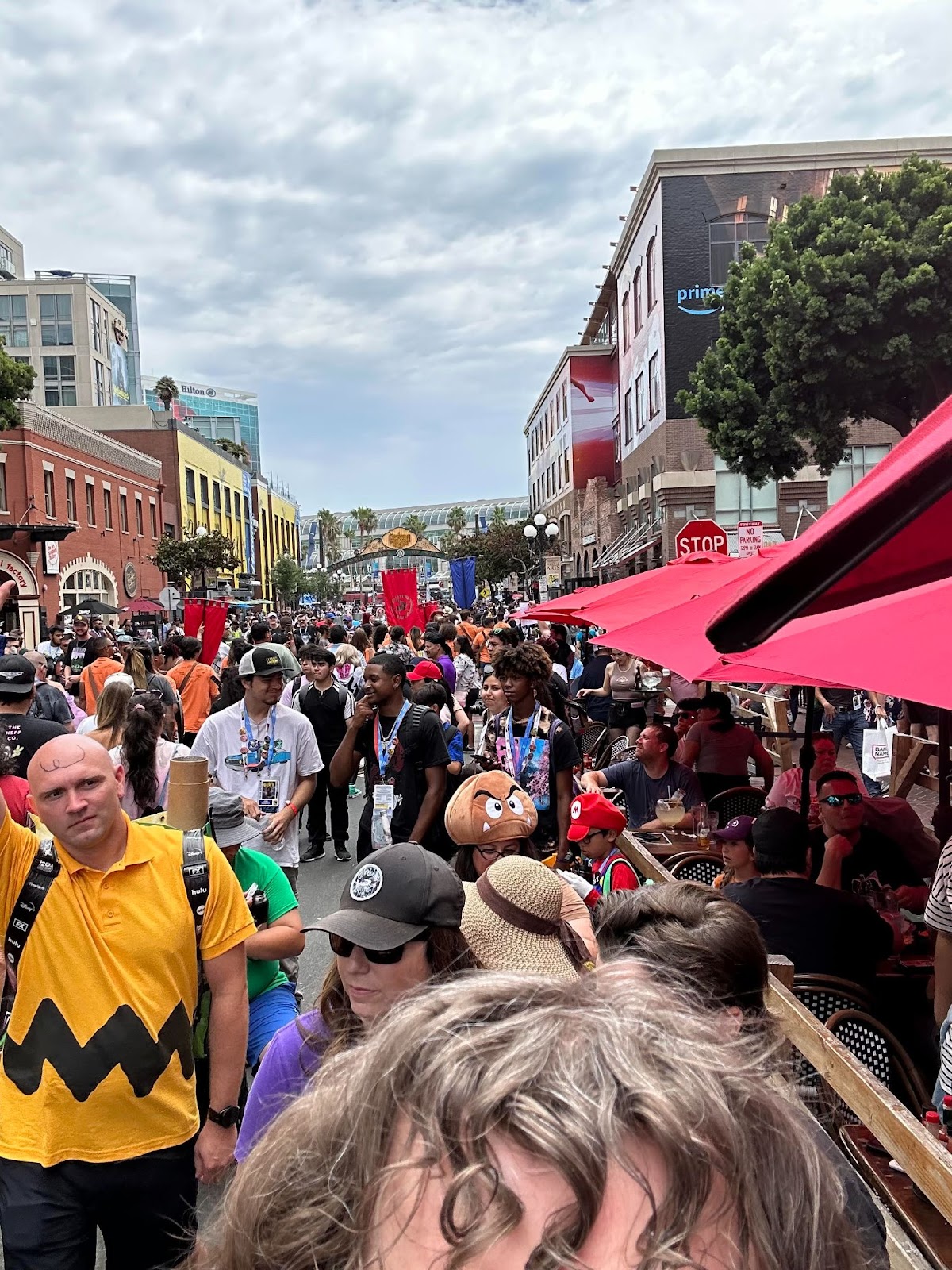
THE INTENTIONAL TRANS ALLEGORY OF REAL GENIUS, part 3

Welcome to Trans Tuesday! This week we’re talking about the dream (THE! DREAM!) and pools and makeup and self-discovery and, if we’re lucky, self-acceptance in THE INTENTIONAL TRANS ALLEGORY OF REAL GENIUS, part 3!

As a reminder, you need to have the context from PART 1 about writer PJ Torokvei and the time this movie was written and filmed in.

And of course, PART 2, where we began examining the allegory itself, which includes all the setup you need that makes the rest of the allegory work.

Mitch, in a sweater, has fallen onto a pile of crushed ice

19:40 –  Mitch is in a sweater… and then falls into a pile of ice. He was somehow prepared for what was waiting for him, without even knowing it, just from one conversation with Chris. But look at Chris now… still not dressed how you’d expect. He’s prepared for the cold! But not conforming.

chris knight wearing earmuffs that look like panda heads

20:24 – While Chris is listing off his jokey problems, did you catch the, uh… gender nonconforming one? “We had one entry for the Madame Curie look-alike contest, and he was disqualified later.” Do you see the transness baked into this movie? Right under the surface?

22:28 – Kent, king conformo, calls Mitch and Chris “degenerates,” even while he was the one found naked and alone with a bowl of Jello. So there’s something “off” about Kent, even though he’s the most adamant about being who Hathaway and society want him to be. Again, he’s a self-hating trans person, and seeing those who’ve embraced their true selves and found joy disgusts him (because he’s disgusted with himself for not having the courage to do the same).

22:31 – Even when sleeping, Mitch conforms to the “dress code” of men, pants and a shirt with a collar in man-coded colors. He then sees Hollyfeld again, and checks the closet more thoroughly but still can’t find him.

24:19 – Look how Chris sleeps. Almost naked, comfortable with himself, and still not conforming to what society expects. In every aspect of his life, he is true to himself.

24:36 – Jordan finds Mitch in the men’s bathroom. Even here, in a place only for men, he cannot escape the woman that captivates him. What do you think that means? She made him a sweater, the thing he was wearing when they met, that prepared him for the world outside. She is helping him with that preparation.

25:08 – Jordan tells him if he ever needs to talk she’s only a couple doors down and never sleeps, so she’s always there for him if he needs her. This is, sort of, waking up to the real you inside and knowing the real you is always in there. Always. Whenever you need her.

25:49 – Chris: “Was it a dream where you see yourself standing in sort of sun god robes on a pyramid with a thousand naked women screaming and throwing little pickles at you?” Mitch laughs, says no. Chris: “Why am I the only person that has that dream?”

animated gif of chris knight sitting at a table, shirtless, asking "why am I the only person that has that dream?"

This dream is one of the most trans things about the entire movie. He sees himself in fancy robes (not naked like everyone else), is atop a pyramid (he’s a focal point), and naked women are throwing pickles at him.

In the present, pickles are a thing with many trans women. A common part of HRT for many of us is testosterone blockers, which deplete the salt in our bodies.

And so the body craves more salt, and that leads to pickles. It’s such a thing we make constant memes and jokes about it. Did HRT in the 80s do the same? Does the “trans women and pickles” thing stretch back that far? I don’t know. It feels unlikely, since community with other trans people was much harder to find back in the 80s, due to the lack of internet but also the way we were often required to hide our transness and socially isolate ourselves (see TRANSMEDICALISM for more).

And one horrid side-effect of that (or maybe even part of the intended effect, if you think about it for a few minutes) is that we were almost entirely unable to form communities, or a shared culture. There very much is a trans culture now, and trans subcultures in trans women, trans men, and nonbinary people. And that allows things like memes and jokes specific to common experiences to emerge. Back in the 80s, that would have been impossible in more than very small in-person gatherings, which were also likely few and far between and difficult to locate, if they existed at all.

So my gut says pickles being here is a coincidence, and probably only because “pickle” is a funny word, but… what does naked women throwing small, phallic objects at a person dressed differently from them, who has been elevated to a place of prominence and focus (a cis white man), say to you metaphorically?

Because it very much reads to me like someone’s subconscious trying to tell them they’re a transgender woman and not a cisgender man. “Look at us, naked and honest with ourselves, with nothing to hide, throwing away a phallus that we do not want.”

You do not need to have or want bottom surgery to be a trans woman, but at the time this movie was made? You absolutely did if you wanted to transition.

So when Chris asks, “why am I the only one who has that dream?” it speaks to how it must have felt to realize your transness back then.

We had little to no cultural footprint, and most people had likely never met or even heard of trans people back then and knew nothing about them.

So realizing you’re not like everyone else, and not the gender you were assigned at birth, very likely made you feel extra isolated and alone. Like you were somehow the only person like that. This entire dream screams transness all the way through.

Mitch: “Did you know there’s a guy living in our closet?” Chris confirms he sees Hollyfeld too, and is well acquainted with him, knows his name. Mitch asks why Hollyfeld keeps going in the closet, and Chris responds by asking Mitch why he goes into the closet. 

Of course Chris knows Hollyfeld, he knows what it’s like to be in the closet before coming out or self-accepting, and at one time that was his potential future too. His directly asking Mitch why he goes in there is another huge clue to what the movie’s trying to tell you with its trans allegory. Why are you hiding yourself?

27:32 – In the “going to school” montage, we see Mitch is trying to figure out why there’s a guy in the closet. He’s looking at him through a reflection. A reflection. Mitch is seeing what his own future is going to be, pretending to be a cis man in a closet. And it’s miserable.

I’ve talked so many times about how REFLECTIONS AND PHOTOS affect trans people, and they’re also heavily used in the allegory of The Matrix movies.

27:41 – Mitch tries to follow Hollyfeld out the door, but as soon as he opens it Jordan comes in. What will prevent him from following in the path of that potential future self, and a life in the closet? Paying attention to the non-conforming woman he can’t get away from.

28:11 – Mitch starts dressed in his suit, ultra-male. Then he’s dressed just like Hathaway, trying to be like him. Trying so hard to be cis, to be accepted.

But then his clothing gradually starts to get more casual, and then he’s even wearing the sweater Jordan made him. He’s moving along the path!

28:34 – While everyone else is recording the lectures, Mitch is still going to class. He’s not conforming, which follows along with his style of dress loosening up. He’s already starting to do what he thinks is right, and not what society expects.

28:57 – Mitch drops his papers and Hollyfeld helps him collect them, they share a moment of recognition. Is this Mitch finally realizing they’re not so different, that this could be the future that awaits him?

The song that plays over the montage where Mitch becomes more of his true self is “I’m Falling,” credited to The C.S. Angels, who were only called that in the US, and were The Comsat Angels everywhere else. Have you listened to the lyrics of this song? ‘Cause… uh. Phew.

I never thought this could happen
I never thought I could feel this way
Until this strange reaction today
You give me a new sensation
In a place that has no name
Something tells me I’ll never feel the same
Now it’s all changed

What have you done to me
I’m falling endlessly
I began to slip, I did not know what was coming next
Even so I was not prepared for this
I used to think nothing mattered
Now I see possibilities
You showed a new direction to me
And it’s all changed

If you don’t think that reads like a trans awakening, I don’t know what to tell you. Now PJ did not direct this movie (or produce as far as I know), and most likely had no choice over the use of this song. 

Further, it does not appear that any of The Comsat Angels are trans (though referring back to TRANS HISTORY 1 and 2 you never know who is trans and doesn’t know it yet, or who is trans and can’t be out, etc).

But what I think is more likely is this coincidentally perfectly fits the theme of Mitch’s trans awakening because any kind of moment of deep self revelation in any human shares a lot of similarities. Again, trans stories are human stories. We’re all connected.

So I don’t feel that song was likely picked because of how trans it reads, but rather the trans allegory of awakening and self-acceptance so closely matches so many other awakenings that we humans go through, cis and trans alike.

30:24 – There’s a shot from inside the closet. Here again we see the skeleton inside. It’s there, haunting Mitch. Living in the closet is indeed a kind of death. A death of our true selves, a waking death that keeps us from truly living our lives.

32:35 – Hollyfeld lives in the closet alone. It’s dark, it’s dirty, it’s filled with cobwebs, it’s a lonely existence cut off from the world. His autograph machine is filling out contest forms, he has to game the system to find a way to exist in the world. Trans life in a nutshell, because society makes it so difficult for us to exist (thanks to bigoted Republican gas station hot dogs).

33:18 – Hathaway wants to know what that smell is. He hates the popcorn. Here’s something that brings Chris joy and is barely a minor inconvenience to Hathaway, but it must be eliminated because he doesn’t like it.

In my book on The Matrix, in the first movie I discuss Agent Smith’s speech about the smell of humans. It’s an inconvenience he wanted removed, because his inconvenience was more important to him than our right to exist and be happy.

And Chris tosses the popcorn aside. He may have self-accepted, but he’ll also do what he has to in order to be “accepted” by people who don’t really even care about him. So part of him, in some small way, is still conforming. 

This speaks to things like trans women in the 80s having to pretend to be attracted to men, even if they weren’t, just to be “allowed” to access medical transition care. And as we know from that article after PJ’s death, she was not attracted to men. Did she have to pretend like she did to access her care? Did she refuse to lie and thus had to wait to access care until cis gatekeepers got their shit together? We don’t know. But it was clearly on PJ’s mind in the early 80s.

34:06 – Hathaway talks about his wishes for what Chris would become and says “…and then-” Chris cuts him off with, “I got a haircut.” Society wants us to be cis, but trans people go and change our presentation to suit ourselves instead. Do you see how this is so very trans?!

35:53 – Hathaway says Chris’ attitude is “distracting Mitch” and it is therefore a problem. Stop showing Mitch that he can be trans too!

Chris mentions he’s leaving school soon, but Hathaway reminds him he can’t graduate without passing Hathaway’s class. Hathaway is the gatekeeper and will prevent Chris from moving on in his life if he doesn’t get what he wants.

Again, cis people are the gatekeepers of everything trans people need in this world… access to HRT or surgeries, legal name/gender marker changes, equal rights, living our lives without cis violence, and more. The Matrix also talks about this a lot. Directly.

You can read about my own experiences with cis gatekeeping and how I had to “prove” I was a woman just to begin medical transition in TRANS KIDS AND THE INTAKE EXAM.

38:59 – Mitch is getting frustrated, so Chris uses the work to lead Mitch to freedom, relaxation, a party. Joy. Chris believes that by working within the system (even if it means tossing his popcorn away… pretending to be attracted to men, for example), you can achieve what you want. And back then, that wasn’t wrong. It sucked, but it was what you had to do.

40:24 – Even though Chris has jumped in the water and is soaked, and is hitting on women… he has not taken his shirt off! Like Neo wouldn’t in The Matrix. Like I wouldn’t if I could at all avoid it for all my life pre-transition, even when swimming, because my flat chest spiked my dysphoria.

chris, soaked from swimming but still wearing his shirt, holds a cheeseburger in front of a woman in a bikini

40:28 – A lady in a bikini is going to eat a cheeseburger, and Chris tells her to stop. “Don’t you know that eating that can give you large breasts?” Is this is a joke, or is it something more? Put a pin in it for a bit.

40:48 and 42:08 – Not only has Hathaway conformed and been rewarded for it, but he’s found a way to still wear makeup within the acceptable bounds of society for men (being on television). This is kind of what Chris is doing, but to more of an extreme.

Hathaway wants Chris to “be himself,” but only so much as it still fits within the bonds of the cis binary laid out for us. But note this is a false option, as even Hathaway can’t get away with it as we’ll see in a minute. You can see this also in THE TRANS ALLEGORY OF I SAW THE TV GLOW where there are tons of motivational posters and slogans about being true to yourself, that all of us are bombarded with for all our lives. But as soon as trans people do that, society says “no not like that.”

Also in here, note that Kent directly sells out Mitch and Chris, literally turning on trans people like him to gain favor with the white cis men in power. Thanks so much, Caitlyn Jenner and Brianna Wu, may you step on a lego with bare feet every day for the rest of your lives.

42:49 – Despite wanting to enjoy himself, Mitch is apart and alone even at a party full of people. Again like Neo in The Matrix. Like me at every party or social gathering for my entire life until I transitioned. Because to be perceived means having to put the mask back on, to be seen as and try to play the part of someone that it hurts us to be.

42:42 – Jordan arrives and Mitch lights up with a smile. There’s definitely something to this non-conforming woman he keeps seeing.

43:22 – Jordan has gotten Mitch more into the party than before, but he wants to know why she’s not “necking”. Her emphatic reply: “I’m not gay.” To me this speaks to the way our sexuality can confuse our understanding of our own gender.

This calls directly back to the letter about PJ Torokvei, and her saying she couldn’t be a gay man because that’s not who she was. See SEXUALITY IS NOT GENDER.

Jordan explains how she’s “different” and guys are a little afraid of her (remember Mitch saying other kids were intimidated by him?), and if she stopped to think about it she’d be a little upset. 

jordan, in a wetsuit and holding an underwater breathing apparatus, stands in the makeshift pool, talking with mitch

Also note that Jordan brings a breathing apparatus. To help Mitch breathe underwater. In my essay on GENDER DYSPHORIA, I described it as like… drowning.

In my INTERVIEW WITH AUTHOR MAYA DEANE, author of Wrath Goddess Sing (my favorite novel ever), we talked about the metaphor she used for dysphoria… being trapped at the bottom of a well.

Jordan, the non-conforming woman, provides Mitch with the relief he needs from gender dysphoria. Do you see what this is telling Mitch, here? Non-conforming womanhood can provide the rescue he needs!

Hathaway then arrives to remind them of their obligations (to cis society) and chastise Mitch for even a moment of finding himself, for being happy. And look what spending time with nonconforming femininity has gotten Mitch, and how embarrassed he looks (which is just how society wants him to feel).

Again, this is something The Matrix dealt with several times, especially in Resurrections. You have obligations to cis society, so abandon this trans nonsense and uphold the binary like you’re supposed to. They want us to believe there’s no joy to be found in accepting your transness.

44:54 – Here Hathaway gets called out for wearing makeup, since this is a thing men aren’t supposed to do. Even within the bounds of society and “I have to do it so I don’t get washed out by the lights on camera,” you still get made fun of for it.

This is showing you it’s a false choice. Tossing away the popcorn to appease the cis binary won’t actually make them okay with you. You’re still an outsider and an outcast. And PJ knew it.

Next time we’re going to wrap up with Mitch’s final outcome, you’ll see where he ends up and the remarkably beautiful message about trans people that Real Genius has waiting for you.

Tilly Bridges, end transmission.
tillysbridges@gmail.com
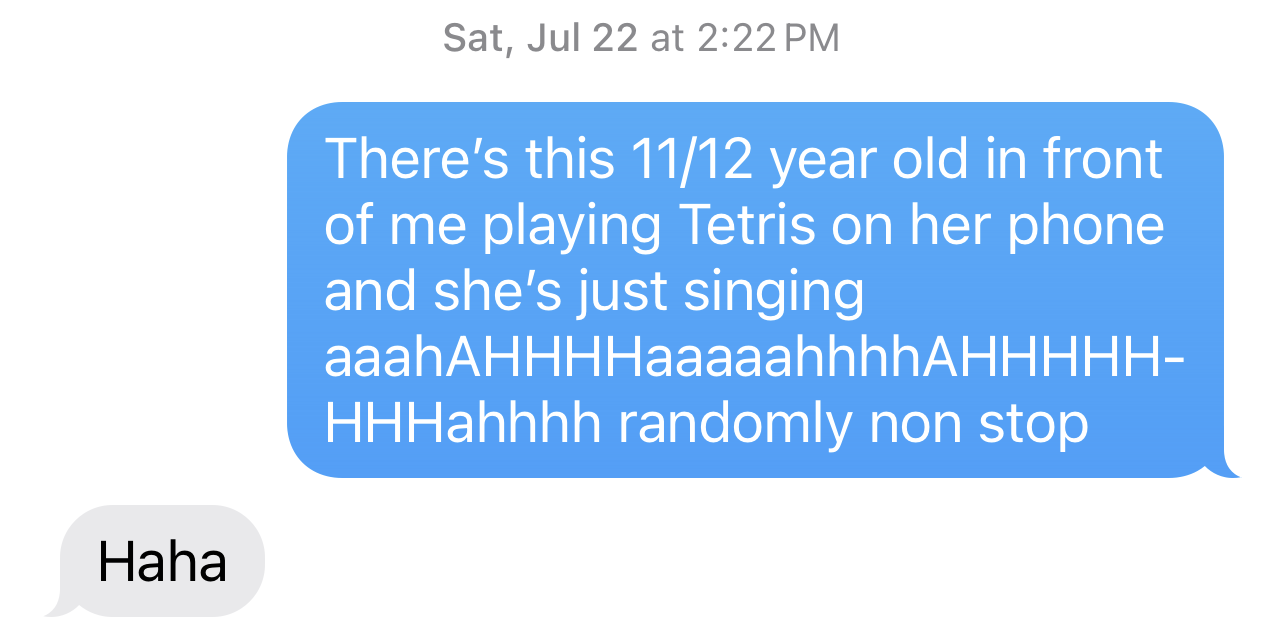
Part 4 is here!

THE INTENTIONAL TRANS ALLEGORY OF REAL GENIUS, part 2

Welcome to Trans Tuesday! Now that you’ve got the needed context, we’re going to dive into the movie itself and show you what PJ Torokvei had to say about being trans in: THE INTENTIONAL TRANS ALLEGORY OF REAL GENIUS, part 2!

If you missed that needed context, you really must first read PART 1. You have to understand all of that to truly understand what’s going on in the actual allegory that we’re about to discuss.

I’ve tried to grab timestamps when I could, as close to the moment I’m talking about. This isn’t as dense as The Matrix, or Barbie, or I Saw the TV Glow, due to PJ Torokvei’s trans voice being one among many cis voices, but you’ll see it shine through.

Before we dive in by timestamps, let’s talk a little about the characters (and especially their names, because there is a lot going on there!).

The movie is about Mitch’s acceptance of himself and his own transness. It’s not as explicit or as strong and clean as Neo’s journey in the first Matrix movie, but again that’s because here there is only one trans voice among many cis voices. But that’s the allegorical journey he’s on. “Mitch” derives from “Mitchell” which derives from “Michael”… one of God’s archangels. “Michael” even means “like God” (sort of).

What do you think that means? Welllll…

Allegorically, Chris Knight is a trans person who accepted their truth and is living out and proud, and Mitch is in awe of that, the way so many of us trans folks are in awe of those who came before us, before we come out ourselves.

“Chris” derives from Christ/Christian, and “Knight” is self-explanatory. And do you see what that’s telling you about Mitch?

Chris is a warrior for what he believes in (being trans and living out and proud). And Mitch is like Chris. That they also work in the broader sense of the movie’s surface “rejecting conformity and embracing individuality” theme makes sense, because that broader theme is actually about the trans theme underneath.

But see what I mean by this being intentional? You don’t accidentally pick those names. And if you think somehow you do accidentally choose those names, wellllll…

Hollyfeld is Mitch’s future, trapped in the closet. If you pay attention, you’ll see there’s a skeleton hanging in that closet for no good reason. But it’s important, because that future trapped in the closet is like death.

Holly is often seen as a symbol of eternal life, and it apparently became associated with Christmas as its sharp leaves were symbolic of Christ’s crown of thorns, and the red berries symbolic of Christ’s blood. Hmmm…

Jordan doesn’t conform to what you’d “expect” traditionally feminine students in the 1980s to look like. Her name is gender neutral, like Chris. She’s the only real woman in the movie, in that she isn’t there just for a joke and has her own goals and motivations. She’s a character, the others are mostly plot devices.

Allllso note that “Jordan” is the river Christ was baptized in. Jordan will be important to Mitch’s self-discovery and acceptance of (and becoming) his true self.

Now look, I’m not Christian, but Mitch/Chris/Hollyfeld/Jordan having names that all relate to Christianity had to be intentional. They are all of one/the same – but it’s not that they’re Christian, it’s that they’re trans. Hollyfeld and Jordan both play a super important part in the allegory. Read on!

Hathaway is sort of our stand-in for transphobic society. Not as directly as Smith was in The Matrix or the CEO in Barbie, but here he’s definitely the representation of everything wrong with the world.

“Hathaway” roughly means “near a heath,” and a heath is a wasteland, or uncultivated land with poor soil and drainage, but depending on which origin you trace it back to could also mean something similar to “war battle.” So what you get is antagonism and violence, where there is nothing of value. This is what’s to be found in the hate that bigoted cis white men peddle. And his name has nothing to do with all the Christ-related names, which are about peace and acceptance. Pretty telling!

Kent is a self-hating trans person, who has allied himself with the transphobes in power and rejected his truth for access to that power (very much like The Merovingian in The Matrix). “Kent” is also the past-tense version of “ken,” which means recognizing, knowing, and understanding something. So in the past Kent recognized and understood his truth (that he’s trans)! But he rejected it and was rewarded for doing so.

Okay, time for timestamps! Let’s go!

a group of cis men in suits sit around a table in a dark room, with images of aircraft on the walls behind them

03:59 – After the opening movie-within-the-movie about the Crossbow orbital laser, a dude in this room full of powerful cis men asks what another thinks of it. The reply: “I think there weren’t enough girls in it.” This isn’t intended in terms of equality, but sexualization.

That isn’t explicitly trans, but knowing PJ was a trans woman writer that everyone thought was a cis man writer, how many times do you think she heard that exact reply while writing for movies and television in the 1980s and ‘90s? As writer Ian Boothby pointed out in part one, Real Genius is remarkably unsexist given similar movies of the time. This is what happens when you have a trans woman writing it (and a cis woman directing it).

04:29 – Referring to the Crossbow orbital laser (meant for assassinations), one of the dudes says: “So it’s both immoral and unethical?” And then they all laugh, ha ha, so funny. Much like the Matrix movies and Barbie, this is showing you what the cis white men in power think about the rest of us.

They do not care if something is wrong so long as it upholds their status and the social pecking order with them at the top.

George, the lone cis black man in this room of powerful cis men, objecting to their plans to assassinate people with a space laser

05:10 – There is but one cis Black man in the room, and he is the one who objects and opts out of the idea of giving these men the power to eliminate anyone they want. As with the Agents and every other person of power in The Matrix, cis white men are the source of the problem. They’re the ones who established this system of oppression.

05:35 – After the lone Black man nopes out, one of the white men says he: “…used to be a good man. Afraid we’re going to have to eliminate George.” 

They allowed him into their circle when they thought he upheld their beliefs in their own superiority, but as soon as he told them what they were doing was wrong, he had to go. One of the old dudes immediately leaves, as if to imply George was going to be killed right then.

This speaks to the fear of marginalized people standing up to those in power, especially the fear of coming out (doubly so in the 1980s), and what’ll happen if you do. Because coming out as trans is a direct threat to the lies cis white men established to keep themselves in power. And you see it right now, in 2025, with these same cis white men in power working to strip trans people of our rights. We prove the cis binary is a lie (see THE FALSE DICHOTOMY), and that’s what the entire system of white supremacist oppression is built on.

Hathaway walking through a science fair, surrounded by people asking for autographs as he signs one for an old woman

06:10 – We meet Hathaway. He’s getting asked for autographs, showing you he’s well liked by the general population, even though he immediately demonstrates what an asshole he is. Bigotry was somewhat celebrated in the past. 

Even more than it is now, as hard as that is to think about. 

06:29 – We get Mitch’s intro, and you see right away his parents don’t understand him. It’s literally like he speaks a different language. Because he’s trans and they’re cis.

Mitch, in a suit, at his science fair booth, standing next to his parents. the 80s frump fashion is off the charts

08:19 – Mitch: “They’re really all right, it’s just sometimes they have no idea what I’m talking about.” Is there a clearer description of family and friends that you love, but who just cannot understand who you are?

Remember from part one, in the letter written by Stan Brooks after PJ’s death, he talked about not really understanding who she was or what it meant to be trans, and continually deadnamed and misgendered her out of ignorance. Mr. Brooks, at least, continued to love PJ as a friend.

08:28 – Mitch doesn’t have many friends, and thinks he intimidates other kids. He’s an outcast, he feels like he doesn’t fit in and nobody likes him. This is life for a lot of trans people, pretending to be cis and being very bad at it while our GENDER DYSPHORIA keeps us isolated.

08:50 – Hathaway thinks he and Mitch are alike, and is honoring Mitch by getting him accepted to Pacific Tech at such a young age. He wants Mitch on his team, to be cis like him. Society sees the outcast and wants to mold him into the person it wants him to be.

Mitch thinks this is what he wants, because he’s been told by society that’s who he should be. “You’re a cis guy, this is what cis guys do!” And so he goes along because that must be true. What else could there be? All of gendered society isn’t built on lies, right? Babes, see TRANS TRAUMA 2: SOCIETAL GASLIGHTING for more.

09:00 – Mitch is going to be working with Chris Knight, a legend. Mitch already knows of and is kind of awed by Chris. 

09:05 – Cut to Chris and we immediately see even from his shoes that he does not dress like those around him, or like you’d expect. He does not conform. A trans person.

09:15 – And just in case the shoes weren’t enough, you get his subversive shirt and his alien bobble headband. He doesn’t care that society thinks he looks ridiculous and not like they want him to, he’s more comfortable being his true self. “I love toxic waste” on his shirt. This thing society says is toxic waste (being trans)? I’m gonna love it.

09:23 – The cis white dude in the suit pulls open the door for Chris, but Chris pushes in the other door on his own. He doesn’t want the path society has laid out for him, he’s going to make his own way. Cis? No thanks, that’s not who I am.

Chris, in his I <3 toxic waste shirt and alien bobble headband, shakes Mike's hand as Sherry looks on

09:50 – Chris is introduced to Sherry and Mike. Chris immediately undercuts Mike, the cis white man’s, boasting. Takes him down a peg. Chris is charming, disarming, witty. Sherry, a woman, finds that entertaining. Almost like cis women are hurt by the false binary too…

Mike has no comments about Chris’ manner of dress… until he learns that Chris knows the flaws in his project, and then instantly moves to insulting him. Your deviation from the norm will only be tolerated (by some) if you know your place and don’t threaten their power.

Sherry here is also instantly into Chris. The surface of the movie posits this as her just liking to seduce the smartest minds in the country, but she’s used in a very clever way as part of the allegory later on. Just remember the woman liked the out and confident trans person.

10:00 – Chris apologizes for the alien bobble headband with a joke, “I didn’t want you to think I was stuffy. You know, no fun. All brain, no penis.” NO PENIS. Sure he didn’t mean it literally, but… do you think… that line is by accident in a movie written by a trans woman, that is about transness? 

Chris appears as a cis man, right? So this is showing you right away his transness is one of the ways he doesn’t conform. It’s kind of like how “trans” is in the very opening shot of The Matrix. It’s right there. Are you paying attention?

10:31 – As the stuffy cis white dude leaves, he mentions to Chris that Sherry will answer his questions about anything, like dress codes. Hey, trans person, your clothes and presentation don’t meet our expectations. Fix it.

10:40 – Cis white dude says Chris is one of the ten finest minds in the country. Chris: “Someday I hope to be two of them.” This could mean he is of two minds aka has a duality? Was raised as cis but is actually trans? 

I can’t really parse it, but there could be something there. But also sometimes a joke is just a joke. But there’s more here. This is showing you Chris is a member of a small minority…trans people!

Remember we’re maybe 1% of the population by our present best estimates. The actual percentage is likely higher due to some trans people not being out (or knowing they’re trans yet), but we’re still a very small percentage of the population.

And Sherry is clearly into “the smartest people in the country,” the smallest minority in the population. Does this make her a chaser? Yep. They’ve been around for as long as trans women have been – forever.

This isn’t saying trans people are smarter than everyone else by default (though we can see the cis binary matrix of society better than anyone else), that’s just how the allegory works in this one moment so you understand what Sherry’s about for later.

If you need a reminder, see the essay on CHASERS AND THE FETISHIZATION OF TRANS WOMEN. The movie doesn’t really have anything to say about chasers, even though it features one. What’s important is what it uses Sherry to say in terms of the overall allegory, and that has nothing to do with chasers. It’s a ways off yet, but we’ll get there.

11:25 – Mitch meets Gene, who teaches at Pacific Tech. Gene says they’ve been told to expect great things from Mitch. 

Professor Gene, an older cis man with a graying goatee, seeming somewhat addled as he talks to his wife

11:50 – Gene wants to give Mitch advice but seems confused, addled. Gene sees transness in Mitch, like he sees it in himself (this gets confirmed later!). But Gene hasn’t self-accepted and doesn’t know how to help someone self-actualize when he hasn’t been able to help himself. It’s an egg recognizing another egg (eggs are what we call trans people who don’t know they’re trans yet).

12:02 – As Mitch walks, someone asks him “where’s the funeral?” I think the movie wants us to think that’s due to the suit he’s wearing, but as a trans woman pretending to be a cis man, suits were hell for me. They made me feel like dying because they’re the most heavily male-coded clothing around. I suspect PJ felt that, too. See HEAVILY GENDERED CLOTHES AND TRANS PEOPLE.

12:38 – Mitch gets to his dorm and… his clothes are missing. We later learn Chris took them and put them away. Chris is already trying to show Mitch that those men’s clothes are not for you.

12:43 – Chris’ side of the room is messy, chaotic, and we again see that he does not conform.

Hollyfeld going into the closet

12:52 – Hollyfeld enters Mitch’s room, disappears into the closet. Note he’s dressed similarly to Mitch, but has a beard and his hair is longer. Remember that Hollyfeld is Mitch’s future… this is you in twenty years, trapped in the closet.

13:16 – Mitch: “What kind of a place is this?” This isn’t the world he’s used to, and things don’t work the same. It doesn’t make sense to him. It speaks to waking up to why the world feels wrong when your egg starts cracking and you discover your transness.

Animated gif of upside-down Chris asking if mitch would be prepared if gravity reversed itself

13:19 – Chris: “Would you be prepared if gravity reversed itself?” Chris is upside down and talking about flight. This is foreshadowing that he’s going to reverse Mitch’s ideas about the world and it will free him of the societal restraints holding him down. Flight is used as a metaphor for GENDER EUPHORIA in The Matrix films, and I even described my first experience with it the same way in BODY HACKING

Dysphoria is so oppressive and legit feels like a weight on you, so when it lessens, you feel… lighter. Like you could fly.

But if gravity reversed itself, Chris doesn’t know how he’d keep the change in his pockets until he realizes: nudity means he wouldn’t lose his change. To me, this is saying that the way to not lose the changes you want to keep is to be naked and completely honest with yourself.

13:30 – During the conversation Chris continues to not conform (they’re jokes, but they’re all about not conforming to your expectations). He asks Mitch if he’d like to use his “penis stretcher” and Mitch says “No!” 

Is that because it’d be dangerous? Or is it because penis size has often been used as a sign of “manliness” and that’s the last thing Mitch wants… to be more of a man? I’M JUST SAYIN’.

13:50 – Chris wants to “avoid responsibility,” all the obligations and expectations society saddles you with so you will conform and perform your assigned gender correctly.

13:59 – Chris: “You see, Mitch, I used to be you.” Chris used to be an egg, a trans person who didn’t know they were trans and hadn’t self-accepted. Are you seeing how so much of this is so very trans when you know what to look for? You’ll see this pop up again later, when Mitch’s journey is almost complete!

14:14 – Chris wanted to reconnect with his old self (an early in transition Mitch), so he put Mitch’s clothes away for him… in the bottom drawer, and he threw the sports jacket away. He’s already pushing Mitch along the path of acceptance and realization of his true self. Those clothes are not for him.

Mitch looking scared as Chris pilots his drone around their dorm room

14:35 – Chris’ drone breaks out of the room, shatters a window. Chris: “Would you classify that as a launch problem or a design problem?” Did things go wrong because you were “designed incorrectly,” or because you were sent off into the world incorrectly? 

Are the feelings you have about not being a cis man because you were born with a body that’s not right for you, or because society used that body to tell you who you had to be without deviation? It can be both. And either way it shatters societal expectations.

15:29 – Not only is Hathaway working with the cis white men in power to develop their weapon, he’s committing fraud and stealing from the project. He’s unethical in every regard. There is nothing good about the wrong mold society tries to force us into. It’s irredeemable.

Kent and Hathaway

16:58 – Kent! He’s a self-hating trans person, the kind that’ll sell out himself and all the rest of us for access to power. And you get that right from his line, “When Jerry (Hathaway) is not here, you do what I say. It goes from God, to Jerry, to me.” You see right here that he has gained power and status by rejecting his transness.

17:48 – Mitch is introduced to the group and is Hathaway’s new favorite. Chris didn’t show up because he didn’t feel like it. Everyone in the group is subservient and deferential to Hathaway… except Chris. Which tracks with everything we’ve learned so far. 

17:53 – Hathaway says he’s surprised one of the students stopped stuttering, and he replies “I’ve been giving myself shock treatments.” What’s a stutter? Something about you that you didn’t ask for but is part of you, like transness. And did you know… shock treatments also used to be used to try and “cure” transness as part of abhorrent “conversion therapy”? Look what this person did to themselves for access to power. It’s an incredibly dark line. 

19:24 – Mitch is already more relaxed and dressing more comfortably, this is the first time we’ve seen him not in a suit. Chris has already inspired Mitch to move along the path to self-acceptance and actualization, away from “typical man.”

Seeing other trans people out and living their lives, and finding joy, inspires others to do the same. I’ve said it a million times. So many trans women, and trans women writers, made me believe I could do it too. And it’s part of the reason why the Republicans in power want to erase trans people from public life, because if nobody can see us or learn about us, how will they know they’re trans too? I didn’t know trans was a thing a human could be until well into adulthood, after the body horror of the wrong puberty had wreaked havoc on my body.

Next time we’re going to talk about Chris’s dream (oh, THE DREAM!), lyrics, and nonconformity! Don’t miss it, because you need it to really understand the amazing message at the end of it all.

Tilly Bridges, end transmission.
tillysbridges@gmail.com
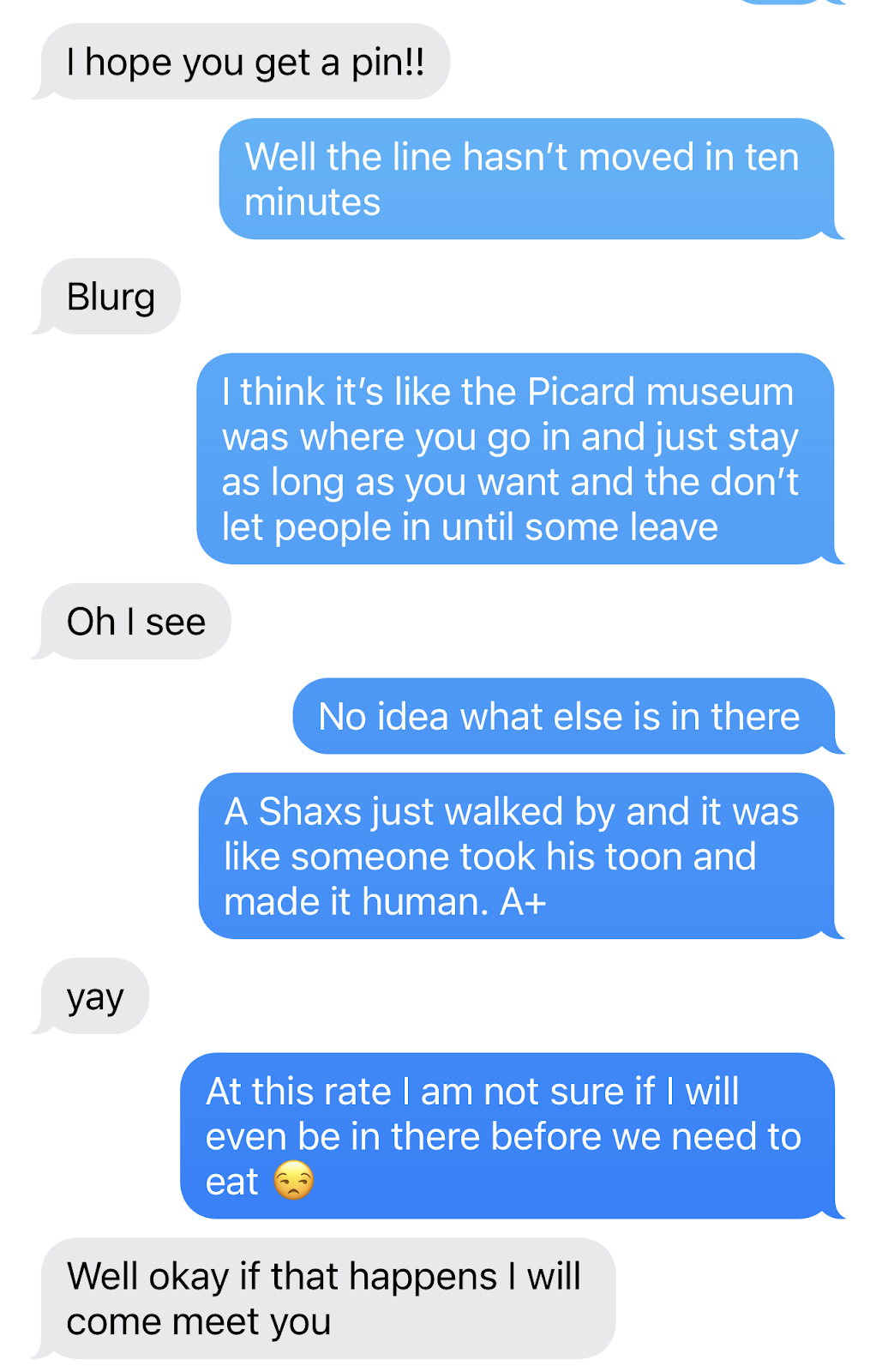
Part 3 is here!