Trans Media

THE UNINTENTIONALLY INTENTIONAL TRANS ALLEGORY OF LISA FRANKENSTEIN, part 4

Lisa Frankenstein part 4, an 8-week series examining its trans allegory. by tilly bridges, author of begin transmission: the trans allegories of the matrix, at tillystranstuesdays.com, over a black and white image of someone in a bride of frankenstein mask looking up between two sets of feet

Welcome to Trans Tuesday! Tillyvision speeds down the slopes in THE UNINTENTIONALLY INTENTIONAL TRANS ALLEGORY OF LISA FRANKENSTEIN, part 4! This week we discuss Lisa’s super trans dream, and how hate and bigotry can come in passive-aggressive forms!

Like a good student of the art of cinema, you’ll have read PART 1, PART 2, and PART 3 first, so you have some idea what’s going on, yes? Yes.

Good, because I’m not waiting any longer. Lessgo!

16:22 – “Strange” by Galaxie 500 plays. The lyrics sure read to me like someone just going through the motions, doing the cis things everyone expects of them, and wondering why they ever agreed to it.

Why’s everybody actin’ funny?
Why’s everybody look so strange?
Why’s everybody look so nasty?
What do I want with all these things?

16:40 – We cut to black and white, a world run by the FALSE DICHOTOMY, the false cis binary matrix, and the tears on her face. She’s still in bed but in a fancy dress with bows on it. Ultra femininity.

17:06 – She sits up, and a Pabst Blue Ribbon beer blanket falls off of her. It, and the Doug it represents (I fucking hate Doug), was holding her down and confining her to that box.

She looks at a photo of her mom, who tells her to wash her hands and calls her “kiddo,” infantilizing her. Remember just a few minutes (of screentime) ago, Doug called her the same thing. It’s no coincidence it happens again here, from her mom. Neither of them respect her.

And the “wash your hands,” well… where did Lisa have her hands when she was assaulted? Note that her mom also winks at her after saying it. It all reads as very “boys will be boys” and “you were probably asking for it, Lisa” and “if he says you led him on, you must have” so just be a good girl and clean up afterward.

A doll looks at her and calls her “Mama.” Being a mother is also a box society wants to force her (and all perceived women) into, and that can be dysphoric when you’re not the gender that word’s associated with. Getting called “dad” was always painful for me, even though I love being a parent, and I never knew why, until I figured out I was trans. See TRANS PARENTS (Mother’s Day) to learn more about that.

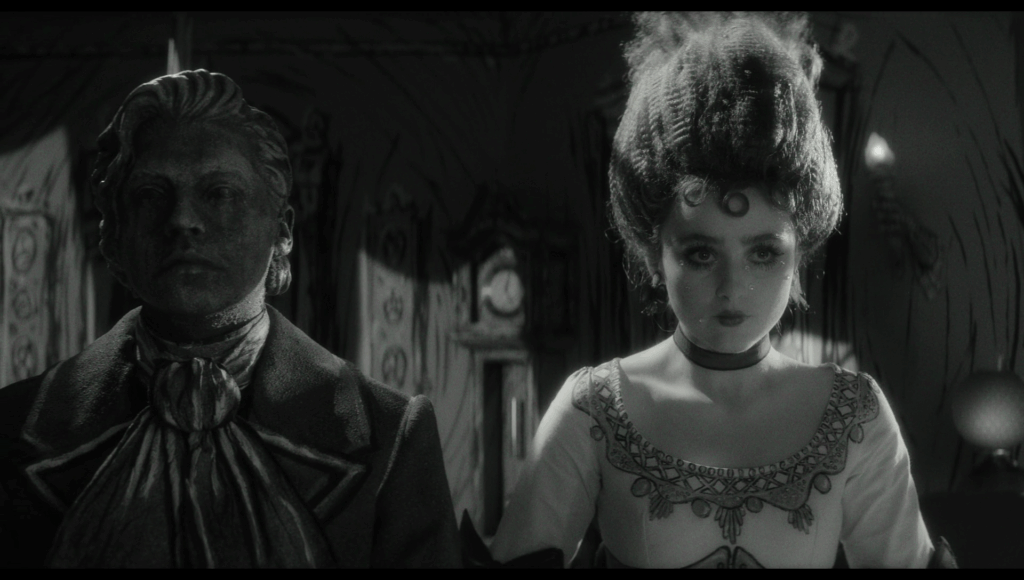
Black and white still of Frank, looking like a statue, sitting next to Lisa, looking like the Bride of Frankenstein.

17:30 – She sits up further, and Frank, as the statue from his grave, sits next to her. You can see her hair really well here, and what’s it look like? The Bride of Frankenstein. Frank’s not fully alive, she’s not fully his bride, so they’re not together aka a self-accepted and transitioned person, but they’re closer than they’ve ever been, despite the world seeing in only black and white, cis boy or cis girl.

They turn to look at each other, but she’s not scared. He opens his hands to reveal a package of Freshen-up gum. They clasp hands over the gum, squishing it, causing goop to run out and drip down. You don’t need to “wash your hands” and “freshen up” after a sexual assault, you need to squash the entire concept.

They both lean forward and look down, in sync, as a masked person comes out from under the bed and grabs their feet. That person is wearing the same Bride of Frankenstein mask that Lisa’s mom’s “murderer” wore!

A person wearing the same Bride of Frankenstein mask that the man who “killed” Lisa’s mom wore in the flashback, lying on the floor looking up between Lisa’s and Frank’s feet.

 The person in the mask then grabs both their feet, at the same time. These two are one. As in the flashback when the man in this mask was representative of Lisa’s transness, here it represents the same thing. Trying to get her to see the truth.

This man may look “dead,” may seem to be nothing more than a statue, an unreal representation of a person, but you can make him real, Lisa. All you had to do is let him out.

And you just did.

18:05 – They lean back and slowly put their heads together, as they look at old footage of the man in the moon from A Trip to the Moon, a silent film from 1902 (see Doug! (I fucking hate Doug!), Lisa’s a real fan), as a rocket hits the moon in the eye.

When they put their heads together, the man in the moon rests between them.

Black and white still of Lisa and Frank sitting side by side, heads bent to rest on each other, with the man in the moon footage (from A Trip to the Moon) in the space between their heads and shoulders.

This is them looking, together, at the place they want to be. Shoot for the moon. Aim for the stars. Flight. Joy. Freedom. GENDER EUPHORIA. A second after their heads touch, the rocket hits the moon right in the eye. Arrival at the destination. Will they ever make it there?

18:16 – Taffy wakes her up, and we see Lisa’s pajamas are in trans colors… Cathy from the comic strip of the same name, on a beach, with the words “unattached and cordless.” Unattached = unmarried = a not whole trans person, cordless = without a, uh… ahem. “Cord”. Supertext?

And her hand’s in her shorts. Implying masturbation maybe, sure, but that wasn’t a sexy dream in any regard, was it?

If you’re dreaming out the trans man you really are inside, one of your most likely sources of dysphoria is what you find, or don’t find, in your pants. And maybe you try to imagine what it’d be like if that was… different. (Standard reminder: you don’t need to have gender dysphoria or want or need bottom surgery to be trans, but many trans people do and this is metaphor.)

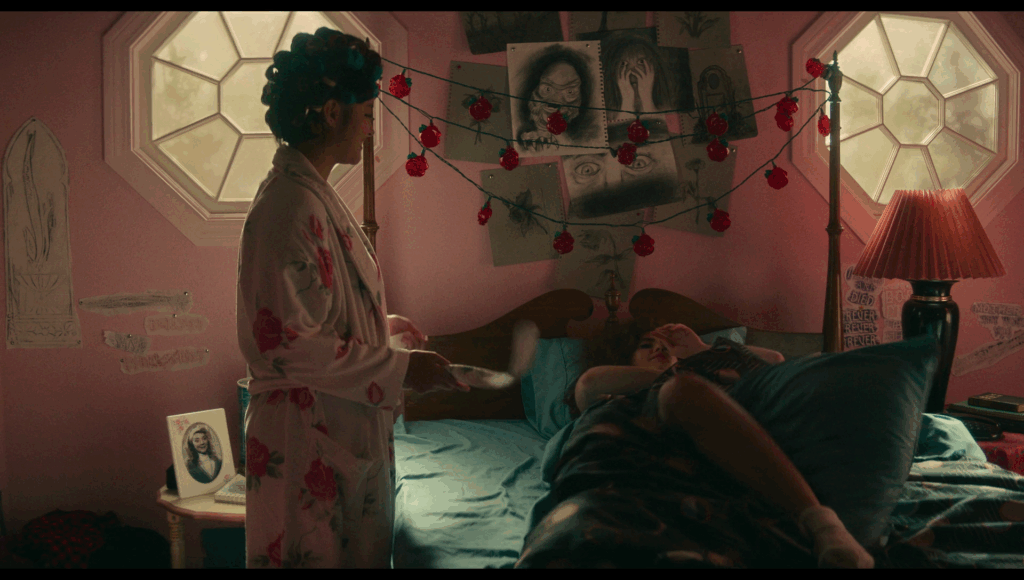
Lisa laying in bed, Taffy stands next ot the bed. Above the bed are two octagonal windows that look like eyes, and dysphoric black and white drawings that include a close up of terrified eyes, someone covering their face, and the creature from the black lagoon. On the far left is a drawing of… what looks like a penis.

18:28 – Remember when I said Lisa’s bedroom was her subconscious? Look at the windows above her bed, they literally look like lies. We’re inside her head, and it’s gender conformity pink and green-blue dysphoria everywhere. Her sheets were very blue prior to the dream, but now seem to more closely match that signature dysphoria color. That could’ve been done by switching the sheets, or even slightly tweaking the coloring when editing the film.

And there’s those dysphoric black and white drawings jailed behind red danger lights. Eyes that look scared, and someone covering their face as if they’re horrified by it. And there’s…The Creature from the Black Lagoon? From the old horror movie of the same name. Whaddaya think that means?

There’s actually a poster from that film on the walls of Lisa’s bedroom that you can see in other shots, so they’re really hoping you pick up on it.

Despite the fact that I’m calling him Frank, the movie calls him “the creature.” Remember I mentioned that in this film, black and Lisa together are a signifier of change and transition (and this is a great place for a reminder, because this is where all the black really starts appearing). Lagoon = water.

Frank, transition, water.

You can interpret the water as dysphoria, and the ways it drowns us, but I think this is actually more about foreshadowing where Lisa will transition to Frank…

Next to Lisa’s bed is a black and white photo of her mom, who only saw things in FALSE DICHOTOMIES, and her photo is bordered by the pink flowers of gender conformity.

And we still aren’t done talking about this, because look at the far left… and how that suuuuure does look like a penis drawing on the wall. The thing Lisa doesn’t have but was maybe just dreaming about having, to alleviate her dysphoria.

There’s so much going on in this one shot!

18:54 – Lisa goes down to talk to Janet about the destroyed bathroom mirror, and look at her. Remember how Barbie in BARBIE woke up the day after her egg cracked? Yeaaaah. Remember how Neo in THE MATRIX woke up after his egg cracked? Yeaaaaaaaaaaah. Metaphor, surely, but drastic changes to physical appearance clue you in to what’s going on with the character internally, and mean a lot when the story’s about transition.

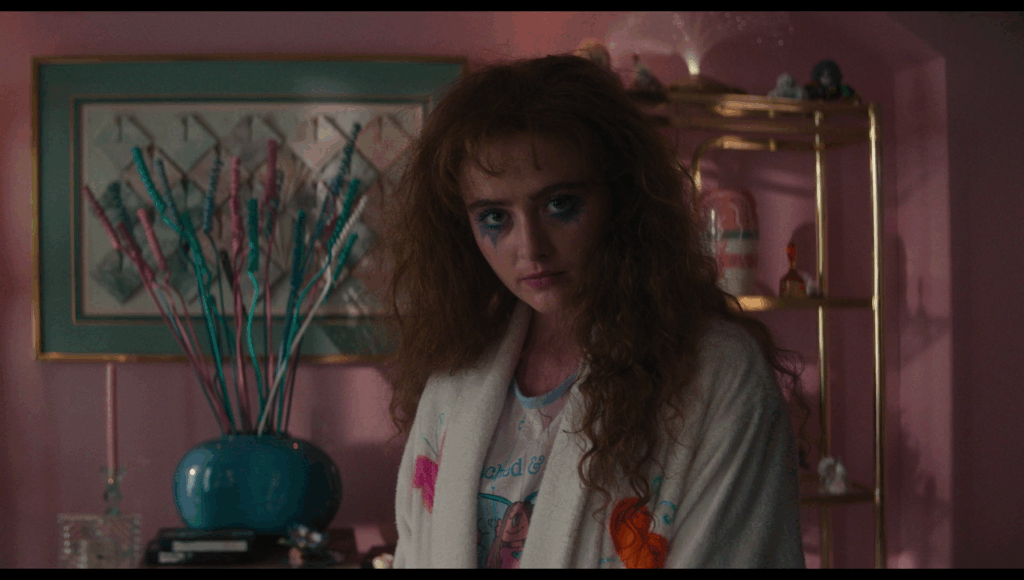
And look at the mascara under her eyes, even more pronounced than before. The black/change/transition is growing.

19:15 – Look at all the pink and green-blue between Lisa and Janet. This whole house is a nightmare for Lisa.

20:39 – Notice how none of them ask if Lisa’s okay, or how she’s feeling, they’re only concerned about how what she’s going through affects them. This is CIS GRIEF in action.

Janet: “Lisa, do you know what happens to people who act out? They wind up in the looney bin.” They literally used to do this to trans people, mind you, and certain people would love to again. It’s not a mental illness! It’s just how we are! But display any more signs of that, Lisa, and we’ll lock you up. How you affect us is more important than anything you feel, or the hell we’ve put you through.

And Janet’s a psych nurse, so that’s an extra big threat, saying she’ll have Lisa committed if she doesn’t drop this trans stuff. Taffy calls her out on how she shouldn’t be calling it a “looney bin,” but Janet doesn’t care at all (including not caring about her patients, as she feels they’re all nonconformos who “deserve” to be there).

21:19 – Lisa sees the news report that the statue and grave of Frank was struck by lightning, which “reignited neighborhood concerns”. The trans man she buried deep inside is coming back to life due to Lisa’s egg fully cracking, even if she hasn’t realized it just yet. And the cis sure have “concerns” about that.

Lisa with her ruined mascara running down beneath her eyes

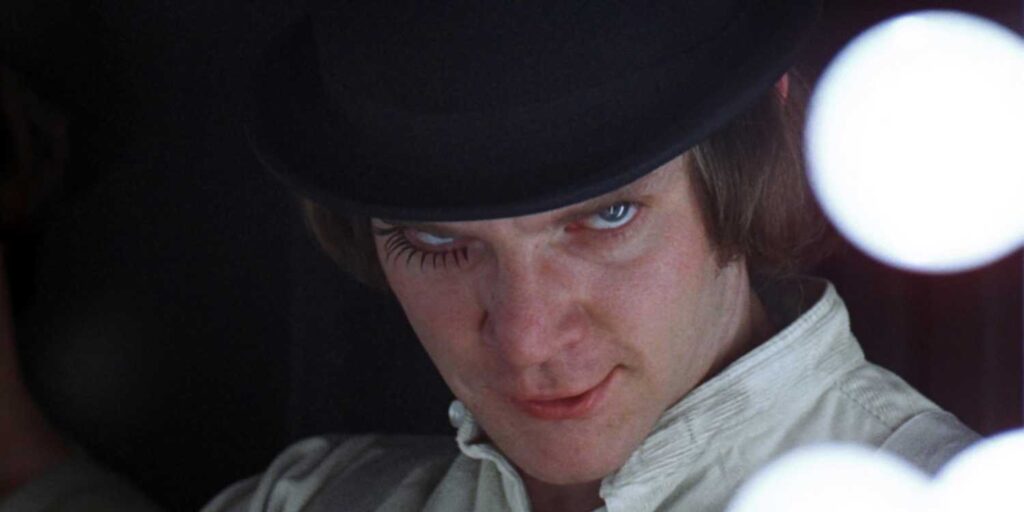
Throughout the scene, Lisa’s incredibly visually evocative of that striking, idiocyncratic look of Malcom McDowell in A Clockwork Orange. The entire scene she keeps her head down even while looking up, as if to drive the reference home even further.

A young Macolm McDowell in A Clockwork Orange, with one false eyelash on the bottom of his right eye, head down but eyes up.

So in A Clockwork Orange, the character Lisa’s drawing allusions to, Alex, is a violent criminal and sexual predator. Lisa Frankenstein isn’t saying here that Lisa is those things, but that Janet sees her that way.

But the most important part is that Alex is used as a tool by those in power, who try to brainwash his “undesirable” qualities out of him, and in so doing use him as a political pawn.

Given we know that Janet will soon make further references to having Lisa committed for her “deviant” behavior, and actually has the power to make that happen (and puts those plans into motion), and the way society weaponizes transphobia as a political wedge issue, this reference absolutely tracks.

21:19 – Lisa’s back at work like a good contributing cis member of society, but look how she’s walled in by the pink. And behind her, by the door when Michael Trent walks in, there’s a poster (in the iconic Patrick Nagel style so popular in the 80s) of overly sexualized Elvira, in a pink Frame.

Who is Elvira? An overtly sexualized performance of a woman, created and performed by Cassandra Petersen. These are the messages Lisa (and everyone) are bombarded with about who and what women are supposed to be.

This is not the fault of Elvira mind you, she’s great and that’s a performance where how overtly sexualized she is is part of the joke. The point is just that despite her overtly sexualized nature being part of the joke, many miss the “joke” part and just overtly sexualize her because that is what society tells us to do to women. And that can be extra dysphoria-inducing for trans men.

And look at Lisa’s magnifying glasses, they’re blue. All she can see in here is despair. She’s even dressed in blue.

21:53 – There’s another similar ultra sexualized, ultra fem art piece behind Lisa, framed with pink gender conformity and green-blue dysphoria.

Though just seeing Michael, who’s closer to the kind of man she wants to be, the kind of man she is, has helped her see things more as they are. Or, rather, as she wants them to be. She’s no longer looking through the magnifying glasses.

22:05 – Michael apologizes for the spiked drink (that was weird how you got gender feelings, we definitely didn’t mean to do that) and jokingly calls her an “experienced psychonaut… an astronaut of the psyche.”

But like… guess what looking inward and examining your heart and subconscious, which all trans people do, is? It’s exactly that.

Lisa says she’s the “Sally Ride of drugs.” Funny, yes, but also Sally Ride is… famously queer, though she was forced to pretend to be straight for a very long time because it’s what society required of her for her to be an astronaut.

Doooo you see any parallels there?

Do you?

22:36 – Lisa’s boss acts like she has no friends (what a dysphoric loner!) and she can’t get a date. When he says it and claps her on the back, the despair goggles fall to cloud her vision again.

He then says… he then says, “it’s probably because she’s so flat-chested.” Which is inappropriate on multiple levels, but also this white cis man with power has noticed Lisa is not as sexy as she should be. Maybe like she’s even… doing something… to make her breasts appear smaller? HUH. See TUCKING AND BINDING if you need more info on that.

23:13 – Lisa smells the jacket that Michael left to get cleaned and smiles, because she likes him… or maybe wants to be him (or both!). Again see SEXUALITY IS NOT GENDER. What would it be like to smell like a boy?

23:22 – Lisa comes home to Taffy telling a story about a teacher at school, seemingly about his being sexually inappropriate, and she and her parents all laugh. So funny! Boys will be boys.

Ugh and ew, and how extra difficult does that make it for trans guys who internalize that their whole lives but, y’know, actually respect women?

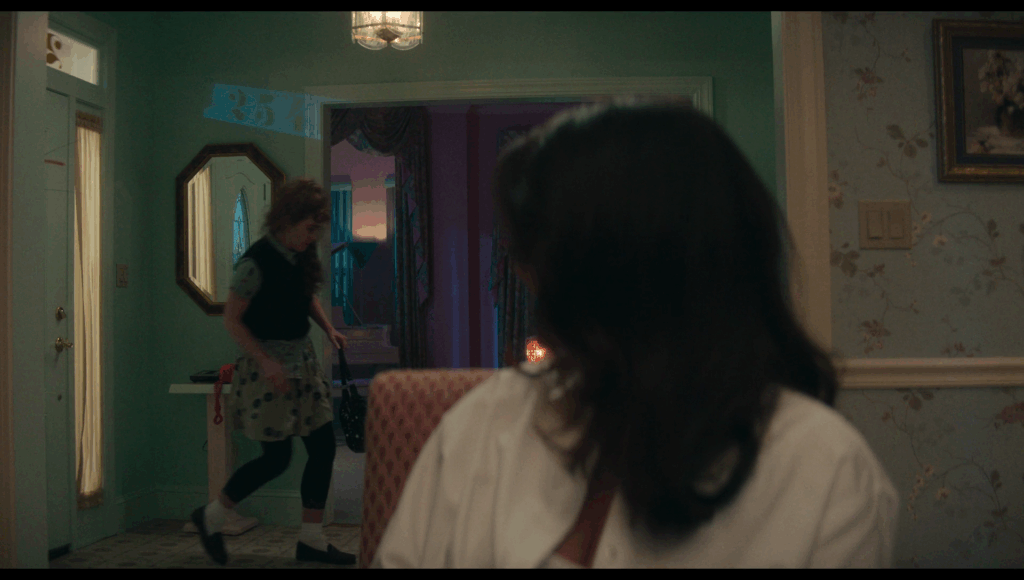
When Lisa comes in, we never see her face reflected in the mirror by the door.

Lisa entering the house in the background as Taffy turns back to look at her from the foreground. Above Lisa in blue lights, from light shining through a window with the house’s address above the door, is the number 254.

It also seems clear that they want us to see the “254” from the house’s address in blue light on the wall. Meanings on this vary, but when you look at numerology and astrology, there’s some rough consensus that it stands for self-sacrifice, balance, positive change and… transformation.

Welp! Supertext.

23:35 – Taffy invites Lisa to go with them to the late showing of Look Who’s Talking.

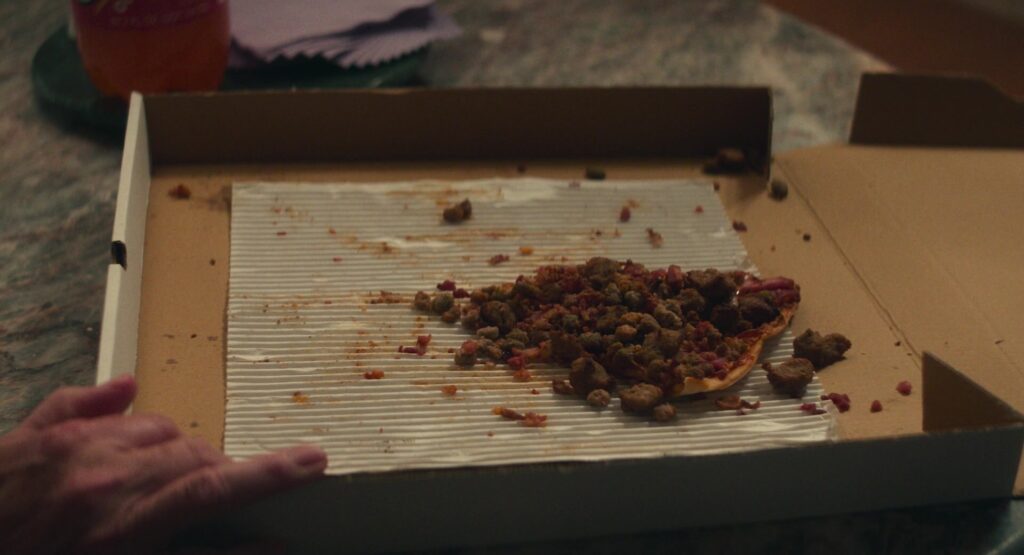
Lisa asks if there’s pizza left… the saved her one slice, but her dad says: “Looks like it’s got a little meat on it.”

One slice of pizza in a pizza box, comically completely covered in meat.

And it’s of course entirely covered with meat. This is a genius little moment that tells you so much.

Vegetarianism is a choice some people make for various reasons, and a lot of people disrespect vegetarians for that choice. For the way they live.

Being trans isn’t a choice (though you can be trans if you decide want to be, because you’re trans if you say you are (YOU ARE TRANS ENOUGH), but transitioning is a choice. Talking about your complicated gender feelings is a choice.

And her family does not respect that choice.

Janet: “Oh she can pick it off.” Never mind there would literally be almost no pizza left. Never mind it would all be contaminated from having meat on it. “We will not accommodate your choices, and if you don’t like it, you can have the nothing scraps (of society) that are left over for you.”

The disrespect is painful. And all too familiar.

Taffy wanted to get Lisa a veggie lovers pizza, but Janet wouldn’t allow it. Even though Taffy is gender conforming and clearly doesn’t get or understand what Lisa’s going through, and has done things to harm her (like spreading rumors about her), she doesn’t want to actively exclude her. She’s kind of trying, in her backwards way, to be supportive.

Janet also has no respect for Lisa’s job doing alterations, but Taffy’s cheerleading (a very gender-conforming physical sport) gets all the respect in the world. And though it’s funny, the line about Taffy spending hours screaming with her legs spread against the walls is pretty dark. Because Taffy says “it doesn’t even hurt anymore,” implying those are not screams of pleasure.

Highly conforming to gendered stereotypes hurts cis people, too.

Taffy thinks Lisa’s fingers probably hurt from sewing, and Lisa says: “Eventually a callus just forms.” But she’s so dejected and dead when she delivers that line.

She’s talking about her heart, because of the way her family treats her, for being different.

24:41 – Lisa’s watching Dawn of the Dead, and they make a point to show us Bub.

If you’ve not seen the film, Bub is a smart zombie who’s capable of learning. He screams and thrashes in chains. When you learn how society wants us all to be chained like zombies, all you want to do is break free. And he’s undead. Brought back to life.

Huh.

Lisa, in yellow, pink, and green pajamas, surrounded by yellow lights, smiles. This pain and discomfort is familiar to her. Light from outside the windows? That green-blue. She’s interrupted by loud banging and groaning from outside.

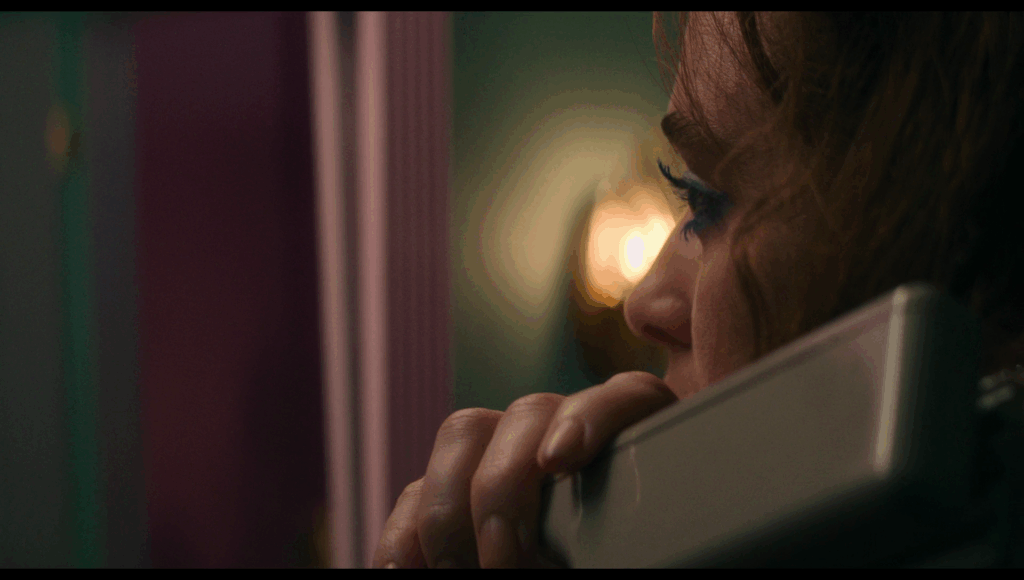
25:04 – Lisa sneaks toward the door and grabs the red phone, but she does not cross in front of the mirror.

25:10 – Too late, that egg you duct-taped closed has re-cracked, babe. Frank smashes in through the dysphoria window. She screams and runs as he zombie walks after her. You are Bub, bub.

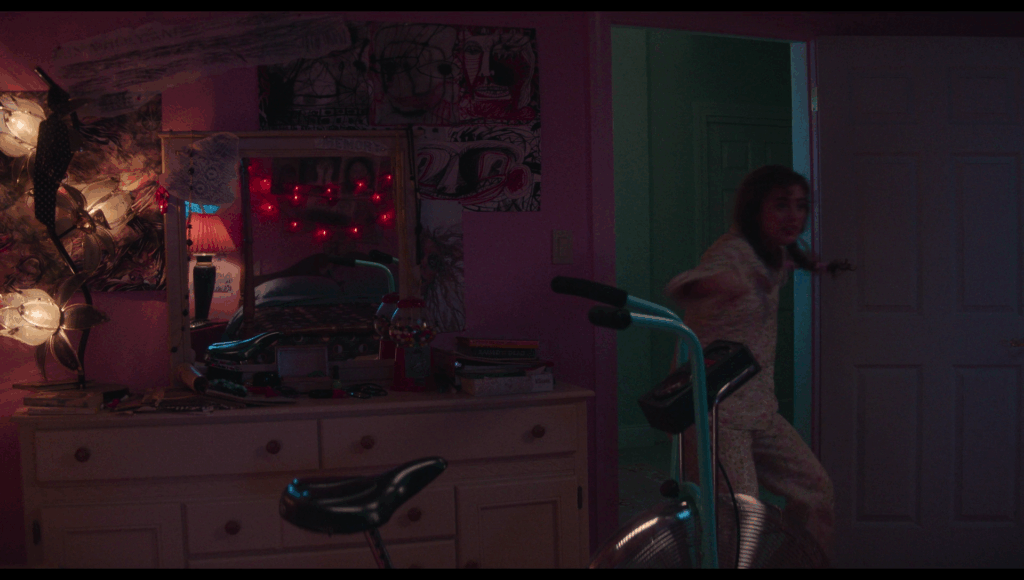
Lisa running into her pink bedroom from the green-blue hallway.

25:40 – She runs to her room, and look at the dysphoria hallway, the pink gender conforming walls, the yellow light, the red danger lights reflected in the mirror that she sprints past. More danger and change (red and black) art on the walls, and on the frame of the mirror, a rubbing that says “memory.” Remember how you figured this out a long time ago, Lisa, and it could have led you to your true reflection? Time to remember again.

Next week, we’ll see if we can escape this part of ourselves we thought was long dead, and finally get a clear picture of the prison we’ve been trapped in!

Tilly Bridges, end transmission.
tillysbridges@gmail.com

Part 5 is here!

THE UNINTENTIONALLY INTENTIONAL TRANS ALLEGORY OF LISA FRANKENSTEIN, part 3

lisa frankenstein part 3, and 8-week series examining its trans allegory, by tilly bridges, author of begin transmission: the trans allegories of the matrix, at tillystranstuesdays.com, over a still from the film of pink, white, and blue lightning

Welcome to Trans Tuesday! Tillyvision can’t be stopped as we dive into THE UNINTENTIONALLY INTENTIONAL TRANS ALLEGORY OF LISA FRANKENSTEIN, part 3! This week we see what loved ones not being accepting can do to us, and see if a little trans energy can wake us up!

You’ll want to read PART 1 and PART 2 first, because that just makes good sense.

Let’s go!

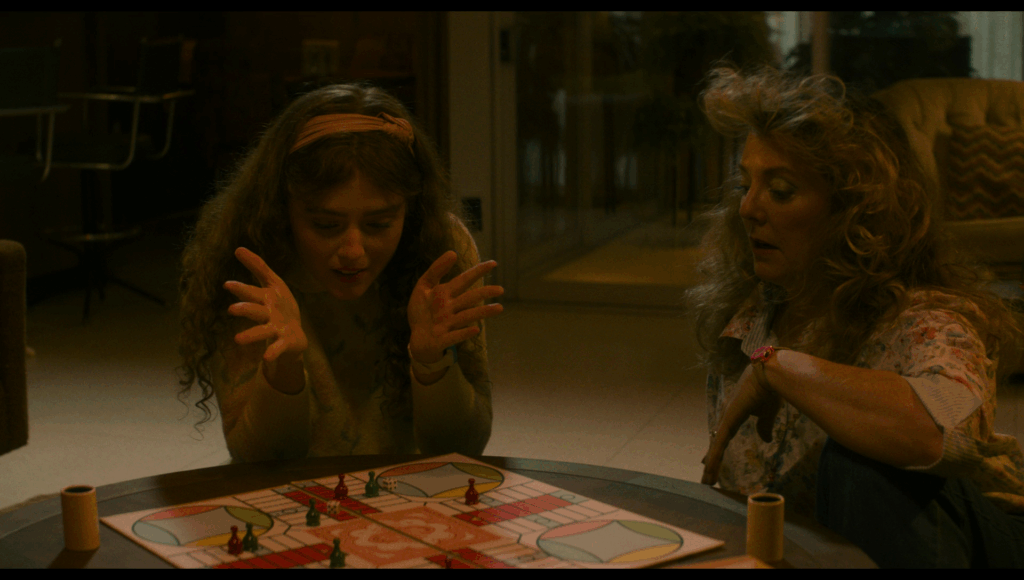
Lisa, in a white sweatshirt with pink flowers on it and a pink headband, sits on the floor playing a board game with her mom. The spaces on the board are pink and blue, green and yellow, red, and the pieces are red and blue.

9:21 – Flashback to Lisa and her mom playing a board game, and look at the board and pieces. Blue and pink! Red. Yellow. Transness, with fear and danger. Lisa’s got pink flowers on her shirt and a pink band in her hair, all gender conformity. Whaddaya think that all means?

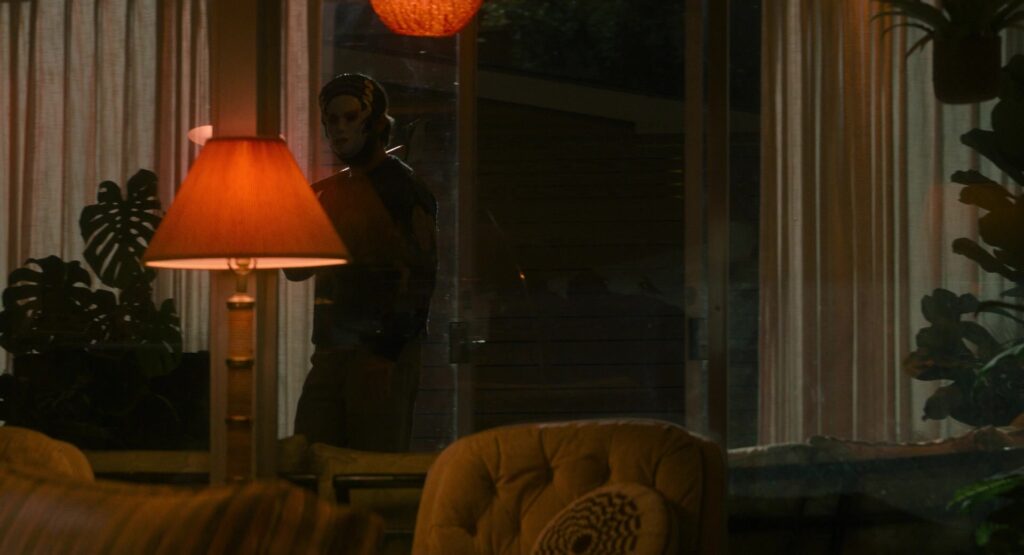
Taffy: “Like two years ago, Lisa was home alone with her mom, and this psycho broke in.” A man with an axe enters the house. He… he’s carrying an axe and wearing a Bride of Frankenstein mask!

A man in a bride of Frankenstein mask enters a house behind a red lamp, he’s mostly in darkness.

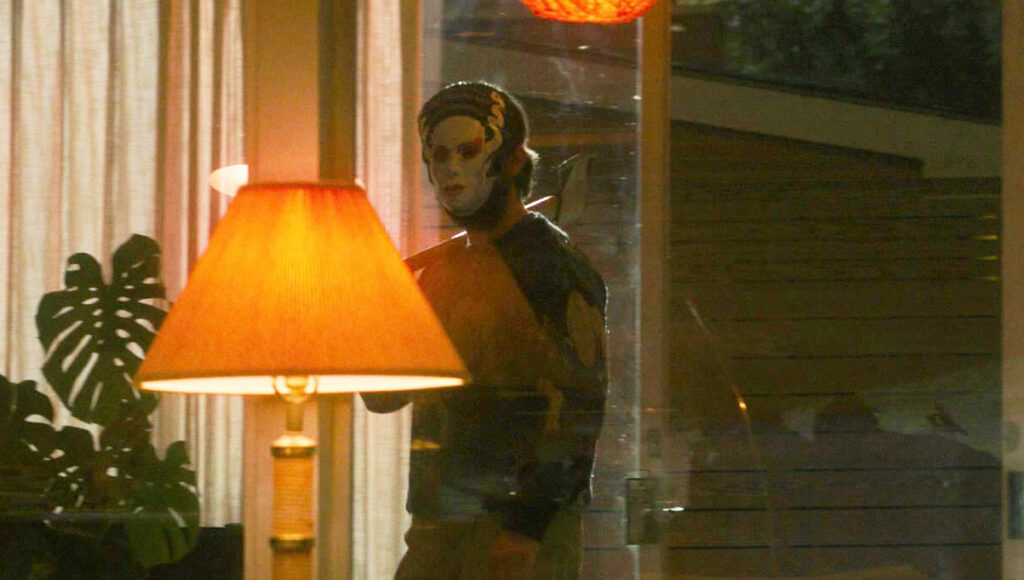
No, really. Let me lighten it up for you.

A man in a bride of Frankenstein mask enters a house behind a red lamp, he’s mostly in darkness, with the image lightened so you can see the man in shadow better.

There’s so much going on here.

You’ve already seen the movie, right? Right?

What is Frank? A man.

What does Frank kill people/reject the idea of being those people with? An axe.

If a man and woman pair are this movie’s symbol of a trans person accepting themselves, and they are (as established in the opening credit animation), who is the “bride” of Frank?

LISA.

This is Lisa “breaking in” to the happy home to tell her mom that

she
is
a
trans
man!

Listen, this mask alone makes me want to remove the “unintentional” part of calling this an Unintentionally Intentional Trans Allegory. Because why else would you put a Bride of Frankenstein on this guy who has an axe?!

I’M JUST SAYIN’.

Lisa’s mom freaks out, sure that she’s defending her child in doing so, because transness is bad and evil. And what does Lisa do?

9:37 – She runs to hide in the closet.

This is metaphor for Lisa previously feeling safe and comfortable with her mom, and telling her she was a trans guy, and it basically killing her mother (or making her mother feel dead to her, or made her mother treat her like Lisa was dead, etc), and sending her back into the metaphoric closet, “killing” the man she truly is.

This is why Lisa left her mother’s rosary, full of her mother’s fear, despair, and danger, at Frank’s grave. Those are what caused her to bury her true self.

9:42 – Now another person is sitting next to Laurie and hearing the story. The rumors of Lisa’s transness spread.

9:51 – The guy “escaped,” and “by the time [Lisa] came out, it was too late.” Lisa came out, but her mother couldn’t accept it, and the guy disappeared. I tolllld youuuu.

9:59 – Yet another girl is now next to Laurie, listening. Rumors spread fast. Laurie: “I’d be screwed up if I were her, too.” Can you imagine thinking you’re really a man? Can you imagine being a weird tranny?! That’s so fucked up! (those girls can go to hell)

10:07 – After that, Lisa “kind of just wandered around like a zombie.” Suppressing yourself makes you dead inside. In a lot of these essays I’ve even described it as “a waking death.” Y’know… like a zombie.

10:28 – Yet another girl is listening to the story. Taffy explains how Lisa’s dad met Taffy’s mom six months later and got married and Lisa “had a new mom right asway.” You can’t not have femininity in your life, Lisa! You need it to conform and be a good “girl!”

10:52 – Tamara asks if Lisa wants a sip from her green-blue cup. Michael says he does, and Tamara says “why would I assume [Lisa] parties?” Look at that weirdo who’s not fem like me, I’ve heard the trans rumors, why would I think she’d conform to the “cool thing” teens are “supposed” to do?

11:02 – Pressured, not wanting to be further ostracized and othered, Lisa drinks from the dysphoria cup. She coughs and gags, while Tamara laughs. Michael takes a sip and spits it out, the liquid is the same color as the cup. Michael: “What is this?” Tamara: “I’m not really sure.”

Michael got a taste of dysphoria (maybe from seeing Lisa’s reaction to it) and found it gross, maybe even drugged. Tamara can’t even identify it. Cis people have no idea what dysphoria even is, and cannot imagine anyone having it.

11:28 – Taffy runs to check on Lisa. Lisa’s vision is blurry, her hearing distorted. Taffy asks if they gave her something, and Lisa nods (yes, dysphoria). Taffy is upset… with Lisa. “This isn’t what I expected from you. You have so much potential.” Lisa’s face is awash in yellow even though she’s nowhere near the firelight.

How could you feel all dysphoric because of what other people did to you? This is your fault for being trans, and not the fault of the world that treats you like shit because you’re trans.

Sad tale as old as time.

11:52 – One of the kids, dressed in clothes with pink and that dysphoria green, plays a ukelele and sings part of the chorus of “I Can See Clearly Now” by Johnny Nash. This song’s pretty well known, but again look at the full lyrics:

I can see clearly now, the rain is gone
I can see all obstacles in my way
Gone are the dark clouds that had me blind


I think I can make it now, the pain is gone
All of the bad feelings have disappeared
Here is the rainbow I’ve been prayin’ for

It’s gonna be a bright, bright
Sunshiny day

Sure sounds like coming out of a dysphoric funk to accept the truth, doesn’t it? Guess what’s about to happen for Lisa?

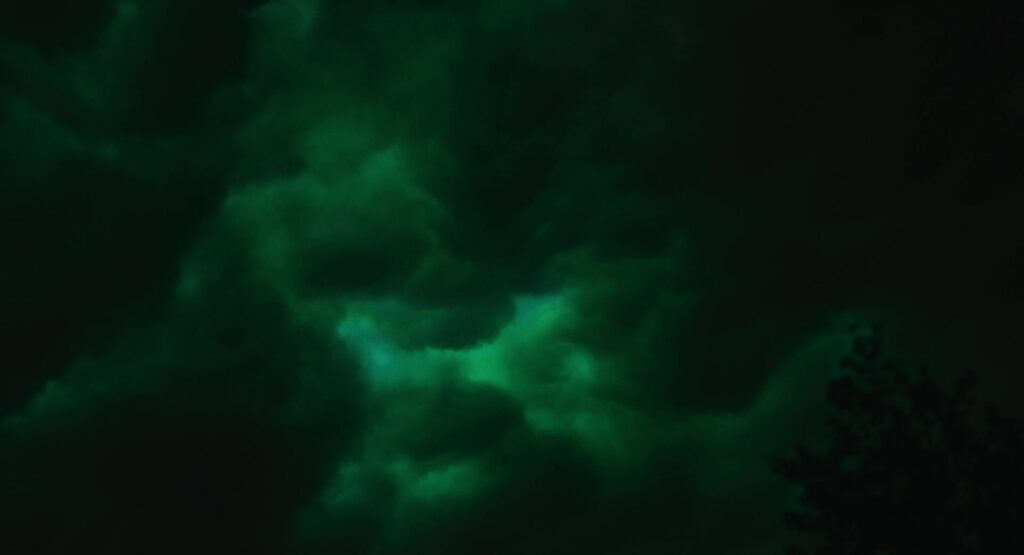
Green-blue dysphoria light in storm clouds

12:00 – Lisa stumbles into a girl who says she’s psychic and she thinks it’s going to rain. Lisa looks up at the storm clouds… and all that dysphoria green-blue.

12:07 – Outside and inside this house, the lights are all fear, the dysphoria fairy lights border the room.

12:25 – A dude comes to check on Lisa, asks if she’s okay. She touches and squeezes his face. This… how do I get… how do I become… this?

She asks who he is, he says he’s Doug (I fuckin’ hate Doug). “Doug” comes from “Douglas” which means, no shit, “dark river.” More darkness in the water, dysphoria dysphoria dysphoria.

He’s her lab partner, in is in a red, yellow, green-blue, and blue shirt. All the bad things, wrapped up into one. (I fuckin’ hate Doug).

He says he’ll find somewhere for her to sit and she takes his hand, he leads her past yellow light streaming down on a boy and girl making out on the couch. Lisa looks at them with wide eyes. Doug says he’d rather watch movies. What kind of movies, Doug??

There’s nothing wrong with adult entertainment, mind you, as long as it’s consensual and everyone’s treated fairly and not exploited, but bringing it up when talking to someone who’s not your partner is a weird and bad thing to do.

13:04 – Doug leads her down a hallway with yellow lights, and yellow wallpaper, still pretending he wants to talk about movies. He asks her favorite director, and she says “Pabst.” Doug thinks she just read his beer can, asks what kind of movies he made. Lisa says: “Silents.” Which Doug takes as “silence” and is a great gag, but also Lisa is right and knows more about movies than slimy skeezeball Doug (I fuckin’ hate Doug). G.W. Pabst was a director of silent films!

Anyway, remember Pabst for next week’s installment.

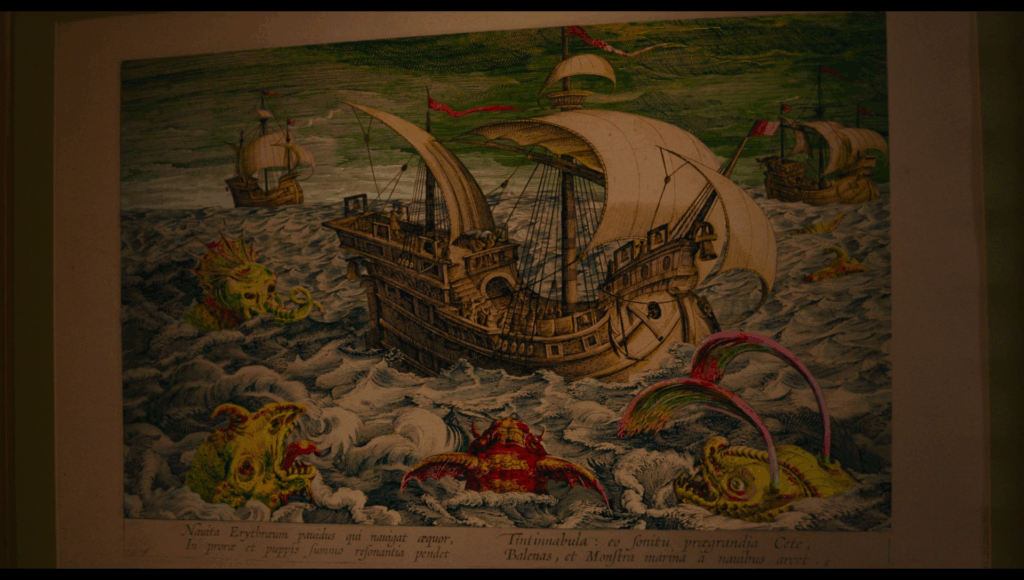
A framed painting of a yellow ship sailing on blue seas with red sea monsters all around, under a green-blue sky

13:21 – Lisa looks at a painting on the wall that seems to be moving, of a ship (with large bells fore and aft) sailing turbulent blue seas, red and yellow, sea monsters lurking, under a green-blue dysphoria sky.

This is a real piece of art (as in, it was not created specifically for this movie), but it’s actually an engraving that exists only in black and white. Meaning the color was added just for the film, so think about why they’d make certain things those colors and what that’s telling you.

The text on the bottom Is Latin:

Navita Erythraeum pavidus qui navigat aequor,
In prorae et puppis ummon resonantia pendet
Tintinnabula: eo sonitu praegrandia Cete,
Ballenas, et Monstra marina a navibus arcet.

Via Google translate, it reads:

The sailor who sails the Erythraean waters, afraid of the wind, On the prow and stern hangs the echoing bells: with that sound he keeps away the enormous whales, and sea monsters from the ships.

I’ve asked a few people who know some Latin to translate it for me as well, because translation is an art and humans can much better discern intent and meaning, and they came up with these:

(credit to AB):
A sailor sailed the fearful Erythraeum/Red Sea – In the bow and highest stern hangs a small bell/windchime, ringing: I go to make a noise to ward off colossal Dolphins, Whales, and Monsters of the sea from the ships.

(credit to Mo Ryan):
From the bow and stern, the frightened Eritrean sailor navigating the sea hangs the loudest of bells
With that sound, he drives from the ships the enormous whales and sea monsters

“Navitae” means sailor, that much is clear. So this could be about an Erythraean sailor, or a sailor on Erythraean seas.

But get this:

The Red Sea appears red due to a bacteria in the water, Trichodesmium erythraeum. “Erythraeum” is derived from the Greek “Eruthraî” or the related Latin term “Erythraeus”…

Which means “red.”

So maaaaaybe what we have is a red sailor.

If the sailor (a man, “navitae” is gendered male I think?) is red, they are wearing red, meaning they have love for themselves. So what you’d have is a self-actualized Lisa-as-Frank, sailing through despair, with fear and danger all around, dysphoria looming overhead… and only the bells, a loud proclamation (of her existence), can keep those things at bay.

You gotta transition, man! It will help you!

Look at what’s staring you in the face, Lisa.

I was sure the Latin on it was something added for the film, but it’s part of the original.

Dang, that piece of art was a find.

13:23 – The room Doug’s leading her toward is red inside, blue light on the door. Lisa barfs into the trash, as he holds her hair and says it feels like easter grass (what color is that, usually? A… greeny-blue maybe? Mmhm.)

Doug reacts to the smell. Sure, it smells bad. But maybe there’s more to it… I wonder if smells ever come up again?

13:38 – Doug calls her “kiddo,” infantilizing her. Not only is she 18 and an adult, we learn later that she’s older than he is. But because he’s a cis white man, society tells him he has authority over everyone. “Kiddo” is a recurring theme in this movie, watch for it.

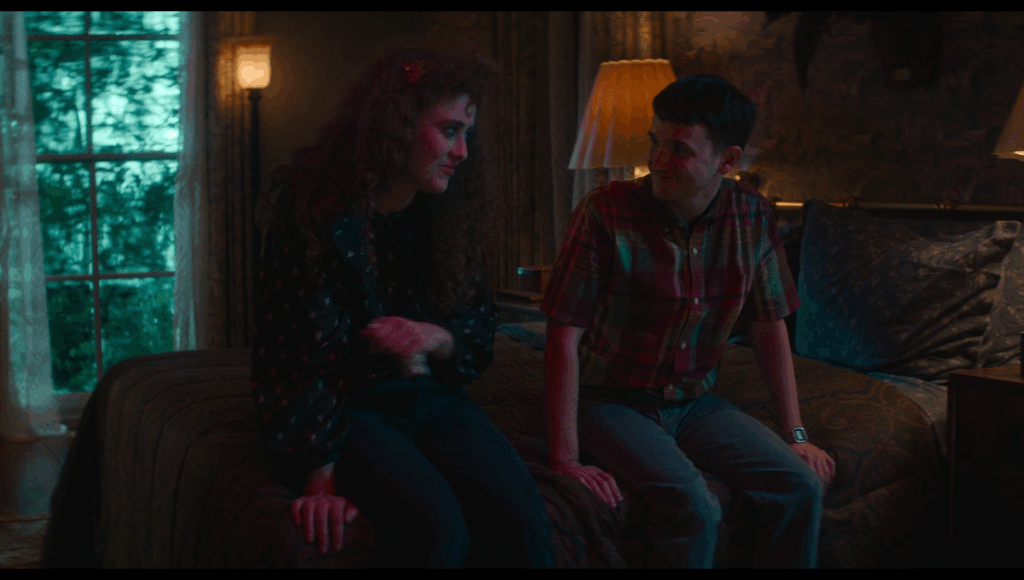
13:50 – The lights in the room are yellow, but the light on Lisa’s face is blue, as she tries to steady herself. Doug sits next to her on the bed.

Lisa and Doug (I fuckin’ hate Doug) sit on a bed with yellow lights behind them, blue light shining on them, and a green-blue flash from lightning can be seen outside the window behind them.

14:00 – Thunder and lightning outside the window behind them, the light that green-blue color that lightning actually isn’t (its color is very intentional, is what I’m saying).

14:11 – Doug says the thunder is “the angels bowling,” and Lisa says her mom used to say that. Doug is reminding her of her mom, which means this guy who offered to help is not going to be actual help… and so here comes the turn.

14:21 – Doug has his hand on one of her breasts and asks if that feels good. Takes her other hand and puts it right on his crotch. “Come on, you can’t stop once you’ve started. It’s the rules.” Never mind that he instigated this, and didn’t ask if it was okay, and she’s done nothing to make him think it was okay, and in fact is in an altered and vulnerable state. Since he started the rules are she owes him sex.

Doug’s even more toxic than the jocks were. (I fuckin’ hate Doug).

14:26 – Lisa’s horrified, there’s blue light on her face, and suddenly red light outside the window… for no reason whatsoever? But she is in danger, isn’t she. And there’s your reason.

14:30 – A haunting cover of “I can see clearly now” plays as Lisa’s mind reels. She doesn’t want to be a bro jock, she doesn’t want to assault women, why can’t she just be a guy like Michael? (Michael is also shit, but we’ll get there eventually).

Lisa gets off the bed and says no, as Doug pleads with her. There’s more red outside the window, but also blue, the yellow lamp, the very green wallpaper with hints of yellow. This is a torture chamber for Lisa.

Doug: “You know it’s not nice to lead people on, Lisa.” You’re supposed to let me sexually assault you, I’m a man.

And if you were a man, this is the kind of thing you’d do, too. It’s what society says we do.

14:50 – Lisa stumbles through the hallway and into more danger, look at the bright red angel behind her, a reminder of the dangers of coming out and how it means death (change), and possibly losing those you love.

14:57 – She stumbles through the dark, only the now-blue light from the lamp surrounding her.

15:05 – Look at the way the footage here gets choppy, like it’s sped up to be unnatural, it seems like there’s frames missing. Everything is surreal and inscrutable.

Lisa, hands in the air, looks up, bathed in a mixture of blue and pink light.

Lisa looks up, face awash in pink and blue, awash in her own transness, as the green-blue dysphoria lightning strikes through the clouds.

15:16 – She’s in the forest, heading toward Bachelor’s Grove. As she walks beneath the gate and turns around to look at it, the sides of her face that are pink and blue switch. They flip opposite of how they seemed before. Multiple times. They change. They transition.

15:24 – The green-blue lighting flashes inside the cemetery, leading the way to Frank’s tomb, which stands apart and above the others.

15:29 – Lisa: “It’s you.” Look at the lighting on the statue, still holding her mother’s rosary, he’s been chained by her mother’s transphobia, where she left him. She touches the statue’s face. “I wish I was with you.” Supertext. There’s a bright flash of white, and then:

15:55 – Lisa stumbles into her house, but it’s allll blue. There’s a mirror on the wall by the door, as she enters and steps forward, the reflection fractures around the mirror’s border. More continued problems with mirrors for her, but also foreshadowing what’s to come shortly.

16:07 – In the bathroom, all these girly things are now all blue. Despair. She sees her reflection clearly in the bathroom mirror.

16:09 – We flash between Lisa and Frankenstein’s statue, pinks and blues all over Frank, we flash back and forth, until there’s another electric zap (remember Lisa in the tanning bed?).

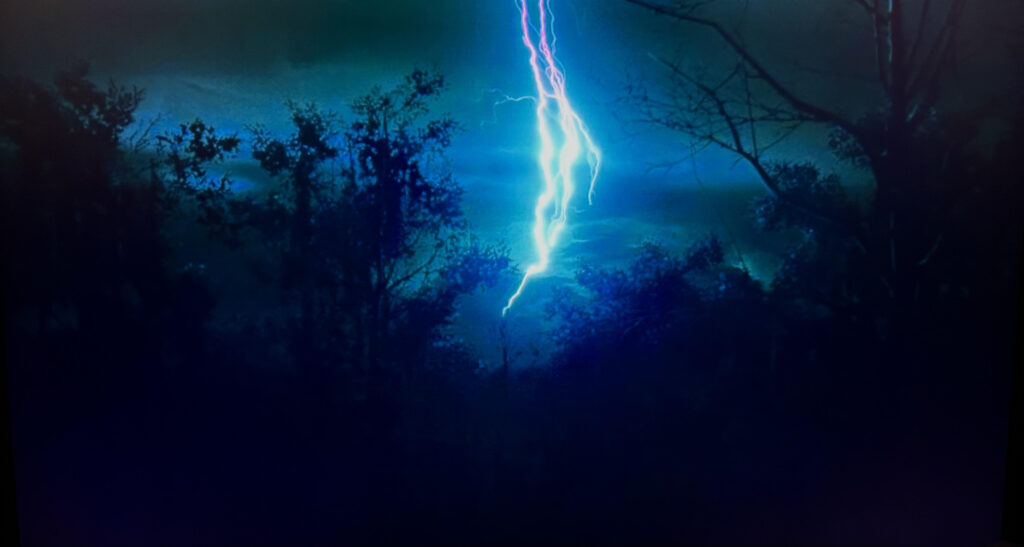
Pink, white, and blue lightning strikes in the forest, in front of a green-blue sky

16:10 – Lightning strikes, but it’s not that unique blue/green of dysphoria. It’s blue, and white, and there’s pink in it too. It’s pink, white, and blue! Have you… ever seen lightning like that? That was a choice that was made by the filmmakers. Hmmmm.

Lisa screams and smashes the mirror. Why is my REFLECTION so wrong?! Supertext.

16:11 – The instant the mirror shatters, the shot switches to the statue of Frank, specifically his face. And then the light radiates out from behind him in the same circular pattern the mirror glass fractured in. This is the face she wishes she saw in the mirror.

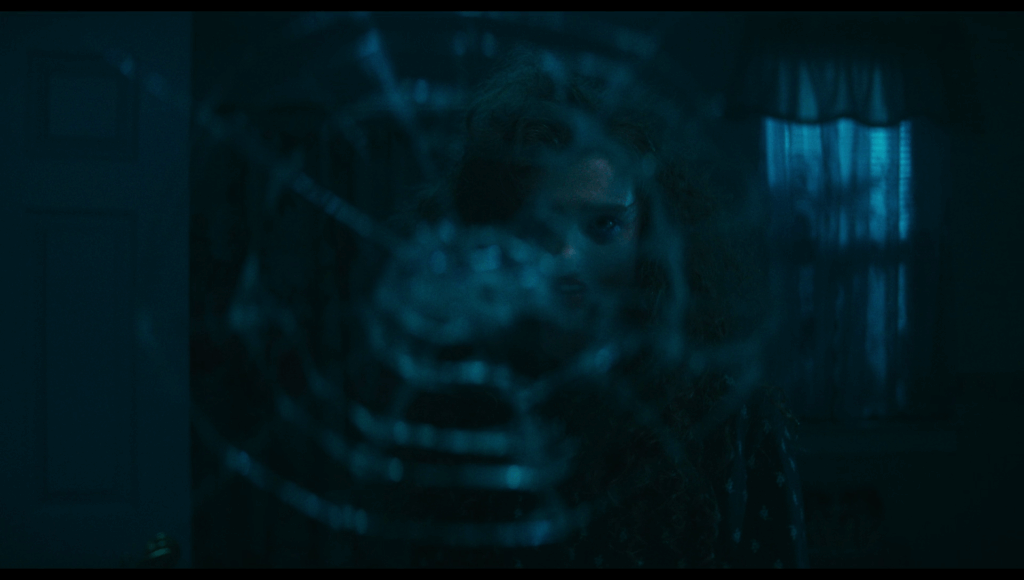
16:15 – We cut back to Lisa, looking in the mirror, her face entirely fractured.

Lisa looks into the mirror she just smashed, her reflection is cracked and fractured.

16:20 – That green-blue dysphoria fills the sky as groaning is heard from the cemetery at Bachelor’s Grove. Signs of life of someone long thought dead! From within her heart!

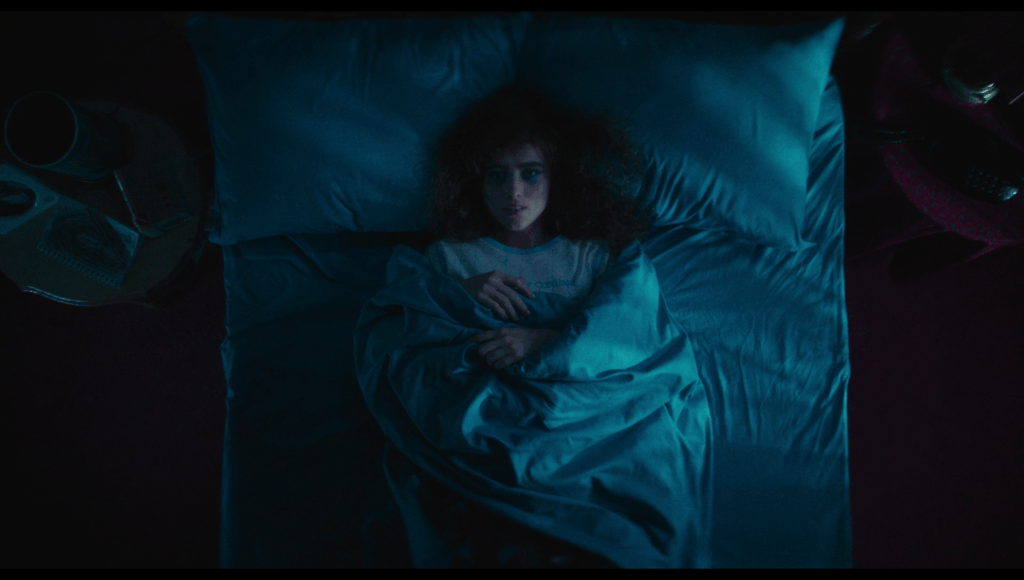
16:22 – This is the first time we’re in Lisa’s bedroom, which remember represents her subconscious. There’s lots more to talk about here, but we’ll get there when we can see more of it.

Lisa, wrapped up in her blue blankets in her blue bed, shadows from vertical blinds at the window casting shadows across her bed like prison bars.

Lisa wraps herself in blankets, all blue, the light from the window forming bars across the bed, she’s jailed and boxed in by trying to be the woman society says she is. Her eyes have blue eye shadow, her lips are extra pink. White light flashes across her face. Transness, babe!

From her makeup we can tell she’s been crying, and her mascara runs down beneath her eyes. The mascara is black. The first bit of black we’ve seen her in so far. Remember that in this film, black equals death, death equals change, and change equals transition. She’s begun the journey!

Why is Lisa all wrapped up in her blankets here. It’s foreshadowing of where this journey of change will take her! We’ll refer back to this later.

And you want to get to later, right? Yeah you do. So come back next week as Lisa dreams of a better future, and we see if her step-mom follows the same path Lisa’s mom did.

Tilly Bridges, end transmission.
tillysbridges@gmail.com

PS – Part 4 is here!

THE UNINTENTIONALLY INTENTIONAL TRANS ALLEGORY OF LISA FRANKENSTEIN, part 2

Lisa Frankenstein, part 2. an 8-week series examining its trans allegory, by tilly bridges, author of Begin Transmission: The Trans Allegories of The Matrix, at tillystranstuesdays.com, over a screenshot of Lisa leaning against Frank's grave in a forest, reading.

Welcome to Trans Tuesday! Tillyvision rolls on in THE UNINTENTIONALLY INTENTIONAL TRANS ALLEGORY OF LISA FRANKENSTEIN, part 2! This week we get into what chains our hearts, and how awful it is to be seen when you aren’t the real you.

Be sure you’ve read PART 1 before this, it came first for a reason and has context you need! On we go.

2:50 – The Promise by When in Rome plays, almost the entire song, until 5:00. Look at those lyrics telling you allllll you need to know about Lisa’s coming journey. That it starts when we see her love and infatuation with the “dead boy” says a lot. Read them as Frank, her true self, talking to Lisa, letting her know he’ll be there when she’s ready.

If you need a friend
Don’t look to a stranger
You know in the end
I’ll always be there
And when you’re in doubt
And when you’re in danger
Take a look all around
And I’ll be there


I’m sorry but I’m just thinking of the right words to say
I know they don’t sound the way I planned them to be
But if you wait around a while I’ll make you fall for me
I promise, I promise you, I will

Yyyyep yep yep.

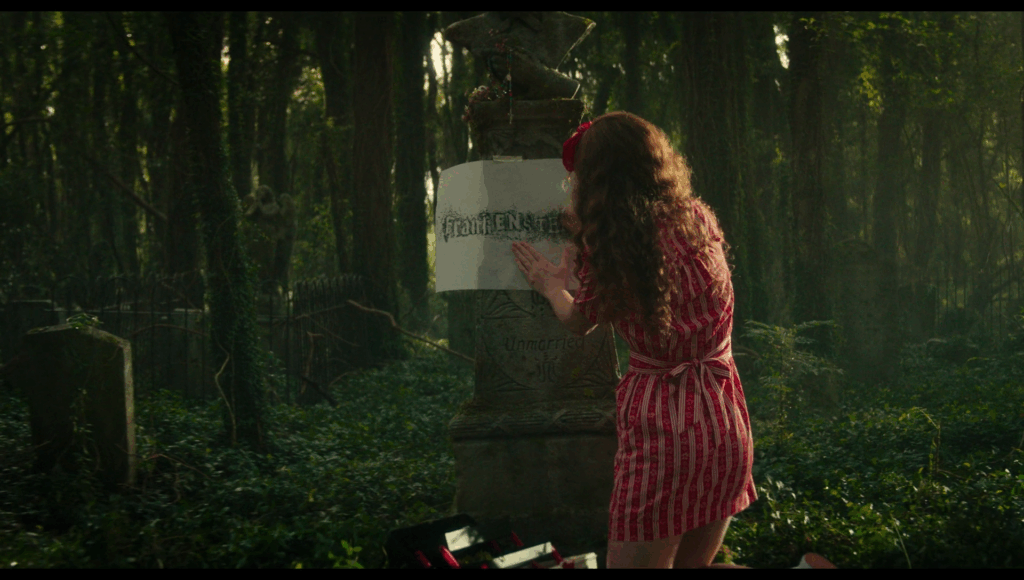
Lisa, dressed all in red, does a rubbing of Frank’s gravestone, in a cemetery inside a forest

2:53 – Lisa does a rubbing of the gravestone, to copy and remember him. She doesn’t want to forget him.

3:02 – She adds “Lisa”, with a heart over the I, in red lipstick above it. She’s infatuated with this dead (to her) man (inside), has feelings of love about him.

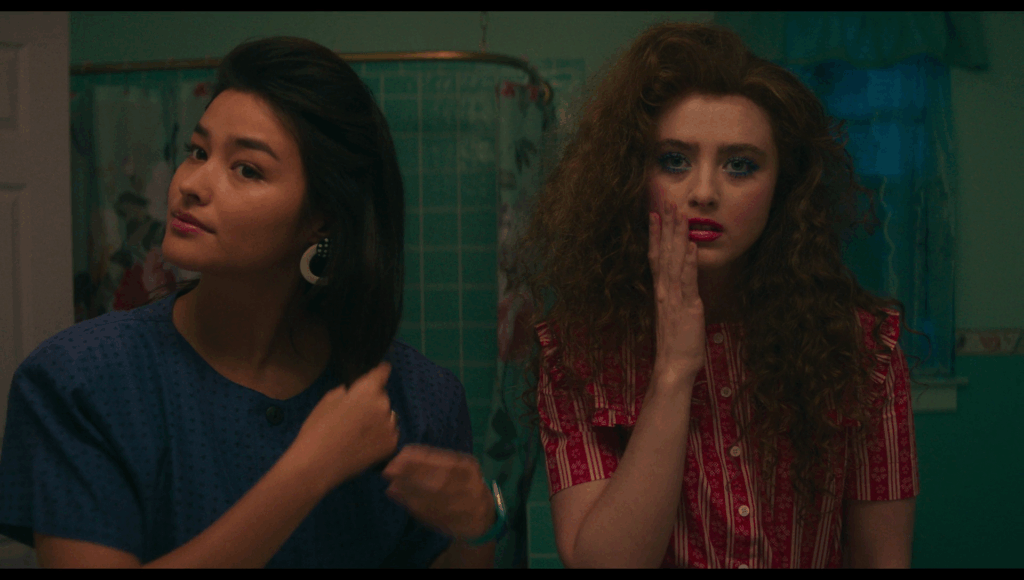
3:15 – Look at everything on this bathroom counter, makeup and hair products, a curling iron… things society tells us women and girls need to conform to the rigid gender binary, many of them the dysphoria green-blue. Things Lisa feels forced to use to be the person everyone tells her she has to be.

By the way, liking these things doesn’t make you a girl or a woman, and not liking them doesn’t mean you’re not… regardless of our feelings about them, they’re what society says we’re supposed to like as women.

Side closeup of Lisa crimping her hair, a yellow light on the wall in the background, on a green-blue wall, right in front of her eyes as she looks into a mirror with a pink frame.

3:20 – As she crimps her hair, look at all the green-blue around her, the yellow light right by her eyes (these things send warning signals through her, these are not for you), the pink framing the mirror. Bathrooms are a source of dysphoria and gender conformity. She sees herself in the mirror and averts her eyes, she doesn’t want to look at that.

3:23 – In this shot there’s even more green-blue around her, she’s surrounded by dysphoria when doing these things society says she should do, and liking the things society says she should like, because they told her she’s a girl.

3:35 – She spares little glances in the mirror just to try to do the girly things right, but the crimping didn’t work right, the makeup makes her miserable, none of it brings her any joy. She drops the makeup brush and averts her eyes from the mirror again, hides her eyes from it. See PHOTOS AND REFLECTIONS to learn how difficult those can be for trans people.

Taffy fixing her hair as she looks in a mirror. Lisa stands next to her, looking into the mirror, gently touching her face, looking miserable.

3:43 – Despite the misery, Lisa’s trying to girl correctly again, when Taffy, her step-sister, enters. Taffy’s dressed in blue, being a girly-girl holds only sadness (in Lisa’s eyes). Taffy: “I don’t think that blush is your shade, Lisa.” A girl who does like those things tells her she’s “doing girl” wrong. Lisa looks at herself in the mirror, still miserable, touches her face like something’s wrong with it. Is it the blush Taffy mentioned… or it is that that’s not her face?

Is that the face someone makes if they put their makeup on wrong? Does her makeup even look wrong to you? She can do it however she wants. But dang, that hollowed-out despair stare is something you see in so many trans people’s photos from pre-transition.

3:48 – Lisa says she’ll probably just stay home. There is a gathering, a party, an event, and she’s not thrilled about going and being perceived. We see this same thing in THE MATRIX and REAL GENIUS, a thing that speaks truth about trans people pre-transition. Even if we want to be at a gathering or around people we like, it means being seen as someone we’re not and having to put on the act of who everyone says we have to be, and that hurts.

Watch in here how rarely Lisa looks at the mirror. She mostly keeps her eyes down, and when she does look up… she tries to look absolutely anywhere else.

3:53 – Taffy tells her this party is critical and “compulsory”! Like the compulsory cisgender heterosexuality our society foists on us all! See GENDERED CHILDHOODS for more on that.

3:55 – Taffy: “You know what your doctor said. You need socialization.” Lisa has seen a doctor for a problem she’s having, and a medical professional basically said “use more makeup, wear a dress, conform to who we say you should be and you’ll feel better! You only feel bad because you don’t conform!”

Like, medical transition care is real and needed for a lot of us, but allllso it’s basically treated as a “last resort” option they try to keep from us. They’ll try absolutely anything else first, even when we directly tell them what we need.

4:13 – Taffy wants Lisa to use her tanning bed. What is a tanning bed? A thing you use to fake a real thing you might otherwise have. It’s a way to conform to a visual aesthetic that society says is pleasing.

My friends, that’s gender-affirming care. Fine for the cis! Just not for us nonconformo transes. Check out CIS PEOPLE GET GENDER AFFIRMING HEALTHCARE TOO to learn more.

BUT—

Remember that the tanning bed is gender affirming care in metaphor, and watch what happens…

4:22 – Taffy turns Lisa’s head, forces her to look at herself in the mirror. Look at Lisa’s miserable face, again. Taffy: “You’re in need, babe.” Lisa is in need, but not of the lies society offers. Look at the difference on their faces. Lisa is not a person who likes what she’s hearing.

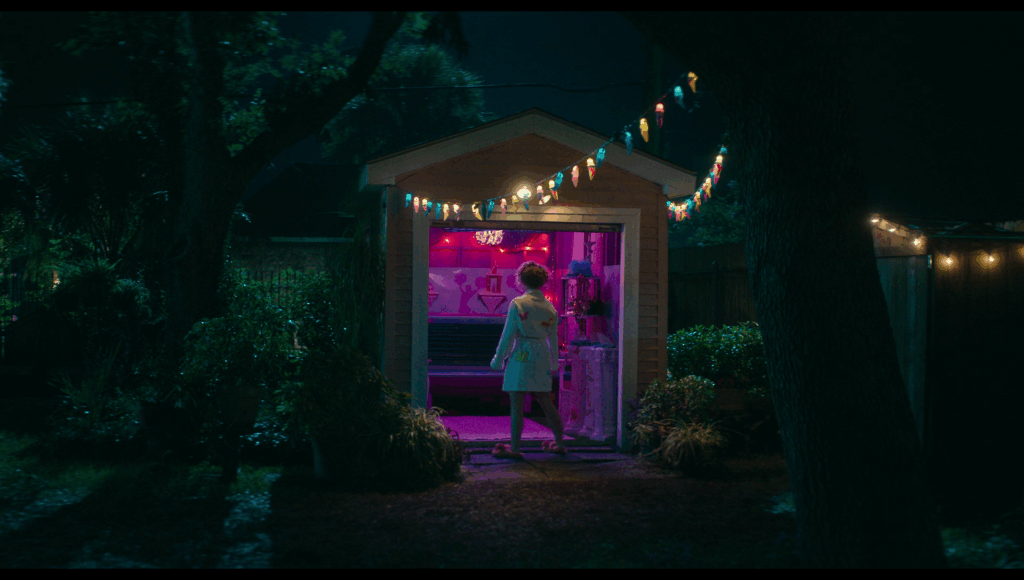
4:29 – Lisa opens the shed and is bathed in pink light. Using this will only force gender conformity on her (or so she thinks).

Lisa stands in a bathrobe in front of the shed with the tanning bed in it, the interior all pink and blue. Strings of yellow, red, and blue lights lead toward the shed.

4:32 – The shed is awash in pink light, but there’s a lot of blue inside. Remember what the two together means? Yar, there be transness here!

The lights leading to the shed are yellow, red, and that same green-blue. The fear and danger of dysphoria have led her to this point. When you examine why you have those feelings, they can lead you to a solution… transition (here, in handy shed form).

More specifically, I believe this transition shed represents HORMONE REPLACEMENT THERAPY. I’ll explain why toward the end of the film.

4:35 – Look at her bathing suit, clashing in colors and patterns. Her love of self, all the warnings she’s picked up on, her sadness, and her dysphoria, have brought her to this point.

Behind her, the blue wall with silhouettes of pink cheerleaders. Transness.

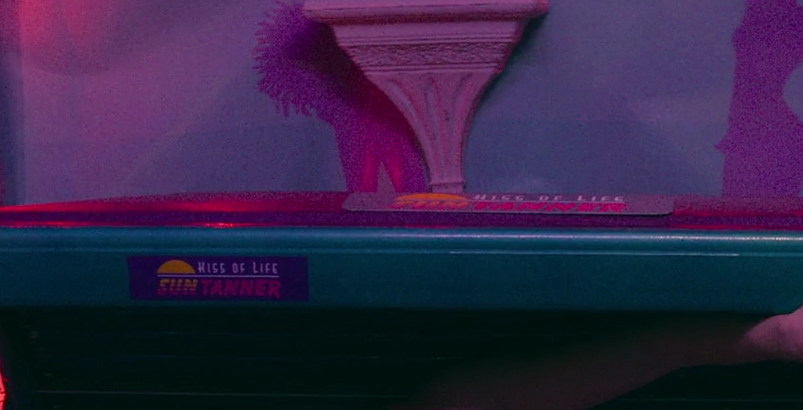
The tanning bed is blue and pink. Transness.

The tanning bed label says “Kiss of Life sun tanner”.

The tanning bed brand is Kiss of Life. Kisses equal love, and they bring true life. Loving yourself carries you to living your truth.

4:46 – When the tanning bed closes, looking much like a coffin, it lights up with the dysphoria green-blue. It zaps her and she screams! It didn’t work, because it was, in effect, set to the wrong hormones.“The Promise” stops playing with the zap. But that zap is important. It’s her realizing that trying to conform to this woman she’s told she has to be really is wrong for her.

4:52 – As they drive to the party, Taffy apologizes for her tanning bed electrocuting Lisa, who replies, “I’m fine.” Is she? Look at her face! She’s miserable! And no wonder, look at her top. The pattern on it is in the dysphoria green-blue.

Trying to be a woman (again) only covered her in even more dysphoria.

5:00 – Taffy asks how Lisa likes Brookview so far. Not for nothing, but I described my own GENDER DYSPHORIA as being “like drowning,” and other trans folks have likened it to similar things. In view of a brook means you can see the water, ie I have not escaped dysphoria even though I moved to a new place.

In the same dead monotone as before, Lisa again says, “It’s fine. It’s the same as my old school.” Running from your dysphoria doesn’t make it go away, it follows you everywhere. And it makes you feel dead inside.

5:17 – Taffy asks if Lisa’s hot for anyone, and Lisa whispers “Michael Trent.” Remember that Michael means “like god,” and “god is love.” Lisa’s attracted to him because she loves him… or is it because she loves the kind of man she thinks he is?

I don’t know how to tell you this, cis folks, but for a good number of gay/bi/non-straight trans people, part of the difficulty in figuring out we’re trans is in wondering if we’re into someone because we’re attracted to them… or because we want to be them? It can be both! See SEXUALITY IS NOT GENDER for more.

Lisa’s going to struggle to figure out that very thing for most of the movie.

Lisa says Michael’s the editor of the school literary magazine. Do you remember what we saw Frank doing in the opening animation, besides playing the piano? Reading. Lisa sees in Michael something she recognizes from the man she has inside.

5:56 – Taffy talks about how great the party will be, and Lisa says it’s just off of Bluff Road (bluffs are lies, supertext), and they could have walked. Taffy says that’s too far to walk in jellies (they’re wacko shoes from the 80s kids, look ‘em up) and it would have hurt her feet. Taffy’s more concerned with appearances than functionality. Which, by the way, is what society forces on women all the time, with things like corsets and high heels, and makeup that makes it so you can’t hardly touch your own face without ruining it.

Again again again, it’s fine to like those things if you’re a woman! I do. But it’s wrong for society to make it a requirement for being the “right” kind of woman.”

Lisa says there’s a shortcut through the forest… through Bachelor’s Grove. Taffy says that’s the “haunted cemetery,” a place for dead things and tormented souls.

Lisa: “It’s not haunted. It’s just… abandoned.” Hey, that’s her heart, remember? Supertext. Then she smiles as she says, “Desecrated.” Is that a thing to smile about? She clearly likes something about whatever’s in there…

6:20 – Taffy says she heard the Heshers did witchcraft there, and that Gina Marzak dedicated her unborn child to satan there. “Gina” can be derived from several different names, but one of those is Virginia, which means virgin. Given that Taffy references the name in relation to an unborn child, it feels like a safe bet.

The cis view of the place where they force us to lock our true selves away from the world? Where people have autonomy (listen, people can do whatever they want with their own bodies even if you don’t agree with it)? It’s evil and no one should go there. According to much of our society, bodily autonomy is for (cis white) men only, whether you’re talking about abortion rights or trans rights (they are the same fight, see BODILY AUTONOMY.)

Lisa says she’s never seen anybody else there. Being trans and dysphoric is lonely, you might think you’re the only one who has these feelings, if you’ve not be taught that we exist. Which is why Republicans are fighting so hard to erase us from history and public life again.

There’s a long history of trans people being erased from, well, history. Learn more in TRANS HISTORY 1: HOW AND WHY WE NAME TRANS PEOPLE IN HISTORY.

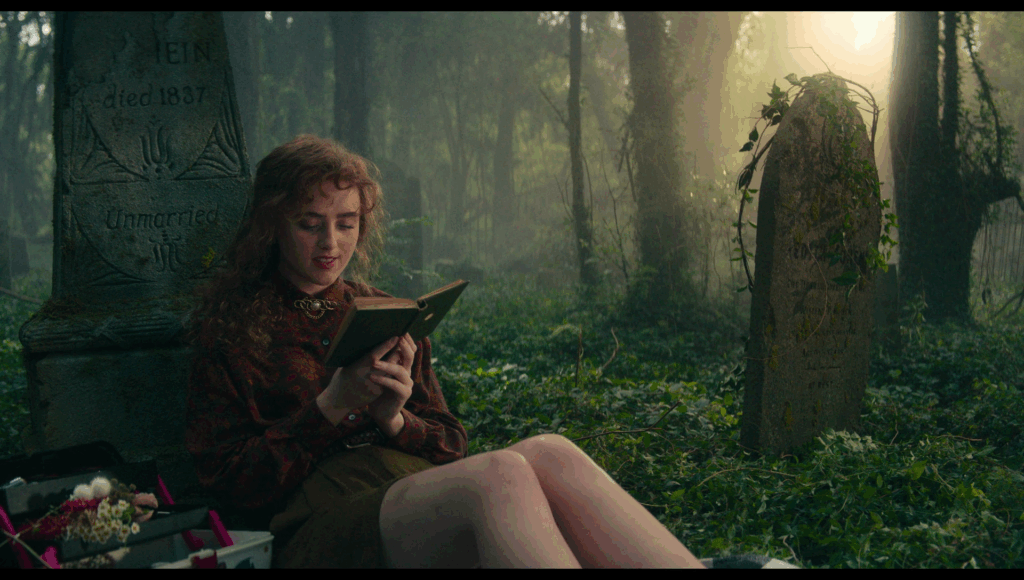
6:30 – In a flashback, Lisa is reading at the base of Frankenstein’s grave, dressed in red, deep in her heart she knows she still has love for her true self.

Lisa, in a red top, leans against Frank’s grave in the forest, reading a book. Next to her is a small bundle of red and white daisies.

Do note the flowers next to her, the small bundle of red and white daisies. I’ll remind you about them near the end of the movie.

She says she does wax rubbings of all the tombstones… Frank’s is her favorite. She does rubbings to remember him. She doesn’t want to forget him.

But pay attention to how his name is broken on the tombstone, so you can’t read it (and neither can Lisa). She doesn’t know his name, and won’t, until she becomes him and chooses one.

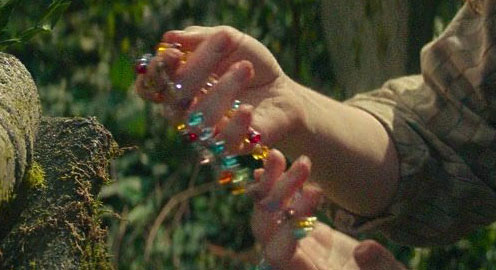
Lisa’s hands holding a rosary with red, yellow, and blue beads.

6:59 – In another flashback, Lisa now wearing green, she brings him a rosary with a crucifix that was her (dead) mom’s. Why would she bring that to the grave of a strange man, do you think?

Look at the beads… danger, fear, despair. There’s a crucifix attached, emblematic of sacrifice. That’s why it’s her mom’s rosary, and why she leaves it at Frank’s grave. This is when Lisa sacrificed her true self because of the fear, danger, and dysphoria her mother caused.

This gets confirmed in a bit!

And notice her top is green like the forest. By sacrificing her true self, she’s going to blend in to her surroundings. She’s gonna go GIRLMODE even if it kills her inside to do so.

Also, the book she was reading, and that she leaves him is titled, “Shelley’s Poems.” This is not just a nod to Frankenstein author Mary Shelley, it will also be relevant again at the end of the film. Just remember she left it with the man in her heart.

7:13 – Taffy: “That’s really weird, Lisa.” Cis people think us even talking about the smallest hint of our complicated gender feelings is “weird.” Lisa: “I just don’t think anyone should be forgotten.” That includes our true selves, buried deep inside.

7:22 – Taffy’s car is bright red. Danger, Lisa. Maybe not now, but beware. Head Over Heels by Blue Peter plays. Let’s have a look at those lyrics:

Swept away, I think I′m gonna fall
Late last night, when I got your call
Round and round my head, I still hear your voice
You said “Stay”, I guess I’ve got no choice


Just like a favourite song or a pretty face
When you’re gone, I’m still hungry for the taste
Building up the walls to keep the world outside
Out on the streets, we′ll take the world for a ride


The city’s on fire, we live for the smoke
I feel the heat when you get this close
Across the table, I light your cigarette
Just another story I could never forget


Head over heels
I′m falling fast
Head over heels
Will this romance last?

If we continue to interpret the “romance” as loving yourself enough to transition, you get a song wondering if there’s any hope for self-actualization in the future, and closing off from the world because being yourself out there is dangerous. Hmmmmm.

7:28 – Look at the lights at the party… they’re all green-blue. Dysphoria awaits you here. Taffy goes right over to other girls, they talk about hair and girly things. Lisa rolls her eyes and hangs back. Alone. Uncomfortable. THE MATRIX (see my book Begin Transmission: The Trans Allegories of The Matrix) and REAL GENIUS both feature this exact same event.

7:52 – Lisa walks past some boisterous jocks in red. Danger. She flinches at their stereotypical displays of tough man masculinity. But also those are often the types of people who punish us most for not conforming. There’s a boy in a pink and blue shirt just standing there, looking at them, following them around silently.

We already know she’s not into those kinds of guys. That’s not the kind of man she wants to be, or is. But she’s worried that she’d have to follow in those footsteps. For what it’s worth, BARBIE deals with that sort of bullshit on a macro level… if society says a woman (or man) is X, and I’m not X, does that mean I’m not “really” a woman (or man)?

8:23 – Look at Lisa’s reaction when she meets the kind of guy she thinks she does want to be, the famed Michael Trent. She’s panting! Excitement! An encounter with, seemingly, the kind of person she always wished she was.


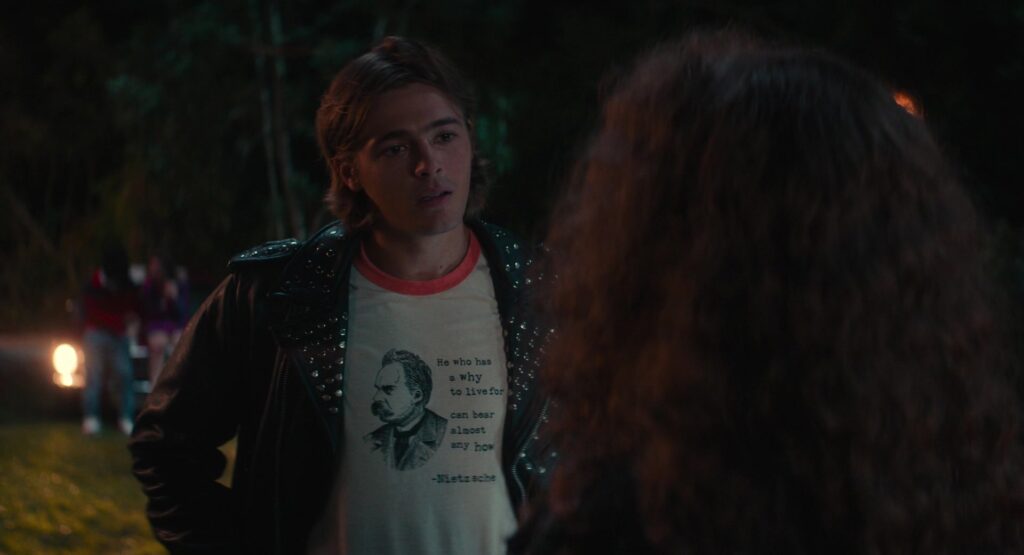
Michael wears a white tee with an orange collar under a black studded leather jacket. The shirt has a picture of Nietzsche on it, and says “he who has a why to live for can bear almost any how”

Look at his shirt! A picture of Friedrich Nietzsche with the quote, “He who has a why to live for can bear almost any how.”

As in… living for the he you want to be, Lisa, can help you do things you never thought possible (see TRANS MOTIVATION).

Nietzsche was a philosopher and complicated person (to put it mildly). Among many things, he was known for claiming “…the Christian faith as practised was not a proper representation of Jesus’ teachings, as it forced people merely to believe in the way of Jesus but not to act as Jesus did…”

Remember Taffy saying things in Bachelor’s Grove/Lisa’s heart were satanic? Remember Lisa had her mom’s rosary? These women who claimed to believe in “goodness” were themselves anything but (the bit about Lisa’s mom we’ll get to in a minute).

Nietzsche also “became increasingly preoccupied with the creative powers of the individual to overcome cultural and moral mores in pursuit of new values and aesthetic health.”

Okay listen. There’s trans things, and then there’s transy things. Supertext.

8:36 – Michael tells her she submitted good poems, even though they’re “pitch black.” Things are dark indeed from deep inside dysphoria. But remember Lisa and the color black is about change and transition. She was writing about her complicated gender feelings!

9:00 – Laurie, bathed in yellow firelight, asks Taffy what “happened” to Lisa because she’s “heard stuff.” Rumors that she’s, y’know… transy. Taffy says she can’t talk about it because she promised not to… but then does anyway. Gotta give that hot goss on us transes and not respect our privacy. Already we see the betrayal and why Taffy’s car is red. This foreshadows her later, much more severe betrayal.

That does it for this week! Next week we get into how horribly things can go wrong when we trust the wrong person to come out to, and how figuring out who we don’t want to be can lead us to who we do.

Tilly Bridges, end transmission.
tillysbridges@gmail.com

Part 3 is here!

THE UNINTENTIONALLY INTENTIONAL TRANS ALLEGORY OF LISA FRANKENSTEIN, part 1

Lisa Frankenstein, part 1. an 8-week series examining its trans allegory, by tilly bridges, author of Begin Transmission: The Trans Allegories of The Matrix, at tillystranstuesdays.com, over an animation cell of green lightning striking bare trees

Welcome to Trans Tuesday! Tillyvision is back again to talk about the first explicitly transmasc allegory I’ve seen! Let’s dive into the delightful, the weird, the wonderful UNINTENTIONALLY INTENTIONAL TRANS ALLEGORY OF LISA FRANKENSTEIN, part 1! This week: context, color, names, and more!

I’ve done a lot of trans allegory in media writeups, and they’ve kind of become what I’m most known for, thanks to the series on The Matrix films that became my book, Begin Transmission: The Trans Allegories of The Matrix. If you’d like to check out alllll the others I’ve done, head to the TRANS MEDIA section of this site and have a browse!

These are easily the most popular essays and podcast episodes I do, you all seem to love experiencing them as much as I truly love doing them. But as a reminder, they’re exponentially more work than my usual essays.

Between watching the film and taking notes, turning those notes into this write up, sourcing screenshots, research, editing and revising, and recording the podcast version, I’ve put approximately thirty hours of work into this. And this is why I can only do them every so often. But hey, the next one’s here! Hooray.

When I first saw Lisa Frankenstein, I not only loved its heart and its humor and its delightful weirdness, but so much transness leapt out at me that it immediately went on my list of films to do a trans allegory deep dive on.

Especially since it’s the first transmasc allegory I’ve found! Some, like SILO (which as far as I know is entirely unintentional) and STAR TREK: STRANGE NEW WORLDS’ “AD ASTRA PER ASPERA,” speak generally about transness, others like THE MATRIX and BARBIE and I SAW THE TV GLOW speak even more specifically to transfems. So I was really excited to dive into one for all the trans men and nonbinary masc folks out there. Especially given THE ERASURE OF TRANS MEN is a real thing that happens.

But I do want to say Lisa Frankenstein, like The Matrix and Barbie and I Saw the TV Glow, still speaks to the entire trans community in so many ways.

So what the hell is an unintentionally intentional trans allegory, Tilly? Well I’m so glad you asked, this is perfect timing because I was just about to tell you.

As far as I’m aware, no out trans people worked on this film. But in an interview with intomore.com, Lisa Frankenstein writer and producer Diablo Cody had this to say about the film’s queerness:

…the object of Lisa’s affection is literally in a closet for a lot of the film. …I grew up not just in the 80s, but Catholic in the 80s, at a time when people around me were encouraged to repress any queer feelings that they had. And this relationship in this movie is hidden, so I think you can read some subtext into that. And, you know, even though it is somewhat of a heterosexual love story… they’re definitely an offbeat pair… it’s not a relationship that would be fully accepted by society in any era…

From that alone, you know that there’s an inherent queerness to the film, in spite of its seeming cishet romance.

But here’s something super interesting, if slightly problematic:

The film’s director, Zelda Williams… played a trans man in a television show, Dead of Summer, in 2016. Here’s some quotes from her in an interview with etonline.com:

The thing I’m most terrified about is the transgender community being insulted by [Drew]. It’s great that [the public] will get to learn about a male-identifying transgender character as a lead in an ensemble show, but really, more than anything, he is for the transgender community, because they don’t ever get to see him. I hope that they’re happy with him, because I’m proud of him.

Although she was a bit nervous to take on her first-ever leading role, Williams reveals that in a lot of ways, she felt like she could connect with Drew. “Drew isn’t necessarily a far stretch from who I am,” she explains. “I’m not a girly girl. I never have been. I had a shaved head for six years.”

While a seeming cis woman playing a trans man isn’t great (see TRANS ROLES AND STORIES for more on why that is), she clearly got to experience some of what trans men go through in her prep and performance of a role. And that’s not to say playing a trans man and being a trans man are equivocal, but actors get inside the heads and hearts of their characters. That’s the job. They think about them and explore them in deep and intimate ways.

So while portraying a trans man is not living as a trans man, it does give her a perspective that most cis people don’t have. Especially when she was so concerned about not doing harm and getting it right. A cis person playing a trans character does do harm (again see TRANS ROLES AND STORIES for why), but I doubt anyone involved even realized that. It’s part of a long trend of cis actors playing trans characters, even though there are many out trans actors available, especially now in 2025.

And from those quotes, she’s maybe somewhat gender nonconforming, or at least lived that way for a while. And that also gives her some personal experience with the way society treats you when you don’t fit into the very narrow boxes they like to categorize us into (see THE FALSE DICHOTOMY for more).

So I think, when you combine a writer who’s trying to speak to queerness subtextually, and a director who’s intimately familiar with some of what trans people, especially trans men, go through… when you mix those things together, you get them intentionally making a very trans movie even if they might not have realized it.

I’ve mentioned in many of these allegory writeups how that’s absolutely a thing that happens. Writers (and directors, and musicians, and and and…) can often be exploring something subtextually in their work and not even realize that’s what they’re doing.

For years before I understood, could name, and accepted my transness, I was exploring gender themes in my own writing. There were always perceived men becoming or turning into women. Why would that happen? Nobody knows, it’s a mystery!

In fact, Jane Shoenbrun, who wrote and directed I SAW THE TV GLOW which I did one of these deep-dives on, said it was the process of making their first film, We’re All Going to the World’s Fair that cracked their egg (made them realize they were trans).

We’re All Going to the World’s Fair is also a deep trans allegory, which Jane admits was intentional, because they were unpacking all their complicated gender feelings in exploring the theme of the film. But they didn’t know that’s what they were actually exploring through most of the process, even though they were intentionally exploring it. (I was on the Progressively Horrified podcast, with other fabulous guests, to talk about this film and all the ways it speaks to dealing with gender dysphoria, if that’s a thing you’re interested in).

This is what creating art is, we tell stories about people exploring feelings and themes that we want to talk about, sometimes without even being able to name or identify what those feelings and themes are.

And thus we arrive at Lisa Frankenstein, an unintentionally intentional trans allegory.

However… there’s some compelling evidence that it might not have been unintentionally intentional at all. Once we get to the end, and you have all the evidence, that’s something you can ponder. 😊

Just remember everything in a movie is a choice made by the filmmakers. Even when coincidences or happy accidents happen, it’s a choice whether to include those in the final cut of the movie or not. There is artistic intent behind it.

So let’s get to talking about the film itself! On the surface, it’s a Frankenstein retelling about a teen girl who’s a bit of an outcast bringing a dead body to life, making him whole with pieces from other humans, and falling in love with him.

But just like with The Matrix and Barbie, Lisa and the creature (this is how he’s referred to in the film’s subtitles, and is how the monster is referred to in the original Frankenstein) represent the same person at two different points of transition.

Before we go any further, I don’t like referring to someone who is, in effect, a trans man as “the creature,” so for the rest of these deep dives, I’ll call him Frank.

Lisa is a trans man who has denied their truth, like society instructs us to do in so many ways (see GENDERED CHILDHOODS and TRANS TRAUMA 2: SOCIETAL GASLIGHTING). Over the course of the film, she self-actualizes and becomes who she truly is, Frank the trans man.

It’s important to note this movie is not about her egg cracking (realizing she’s trans), this is about someone who did realize, but the world reacted so poorly that she suppressed and denied her own truth. And then coming to realize they cannot deny that truth no matter how hard they try, and finally accepting it.

So Frank represents her self-actualization, exactly the way Trinity represented that for Neo in The Matrix. And just like in the Matrix films, the “romance” between the two apparently cishet lead characters is actually about someone loving themself enough to do what they need to do in order to be happy… transition, even in spite of society working so hard to stop that.

“Lisa” derives from “Elizabeth,” which is the Greek form of the Hebrew name “Elisheva” which means, “my god is an oath.” An oath is a promise, and though I’m not Jewish, if “god is love” holds true then Lisa becomes “love is a promise.” A promise to yourself, to love yourself. To be your true self.

Lisa’s last name is “Swallows.” Those birds are symbolic of homecoming (very supertexty for someone who rejected their truth but then comes back around to accepting it), but also of the protection and blessing of the divine (and if god is love, the love she has for herself is protected and blessed here in her heart). Swallows can also represent those who know the truth but refuse to accept it! So now it’s just SUPERsupertext.

“Supertext” is a term I coined  to mean the opposite of subtext, basically yelling the truth right in your face.

Lisa’s step-sister is “Taffy,” which in terms of names is the Anglicized form of “Dafydd,” which itself is the Welsh form of “David”… which comes from the Hebrew name “Dawid,” which means “beloved” or “uncle.”

So what the heck’s going on here?! Is the seeming gender-swap of the name important? I submit to you that no, it is not, and in fact I think the Taffy in Lisa Frankenstein has nothing to do with the origins of the name, and is instead there because of the candy. Because what is taffy? Soft, stretchy. Malleable. It can take whatever shape you mold it into.

And Taffy, the character, is everything society tells you girls should be. Pretty, overly concerned with her appearance, kind of obsessed with boys, ultra-fem. She’s everything Lisa doesn’t want to be. Though the fact that she’s someone who should, and seemingly does, actually care about Lisa (well, until she doesn’t) is also important.

Lisa’s dad is “Dale,” which literally just means a dale or valley. But what’s a valley? A low point that prevents you from seeing what’s around you. Dale is perpetually unaware of his surroundings, what’s going on, or even how to describe his own wife’s appearance. He’s kind of clueless, in the way so many cis people are about anything related to transness.

“Janet” comes from “Jane” which comes from “John,” which… okay, here we go… it’s the English form of Iohannes, which is the Latin form of the Greek name Ioannes, which comes from the Hebrew name Yohanan. And that means “god is gracious.”

But if god is love, why was this name given to Janet, the most cruel and evil person in the entire movie? Because Janet is a hypocrite in every way, which makes her name deeply ironic.

“Michael” is from the Hebrew name Miḵaʾel, meaning “who is like god?” or “like god.” Again, if god is love, then Michael is like love, but maybe actually isn’t love, which is important. Not just in what happens with him in the movie, but in what he represents for Lisa. We’ll talk more about that when he first appears.

As with The Matrix, and Barbie, and I Saw the TV Glow, all linked above, colors are used metaphorically to help tell the story.

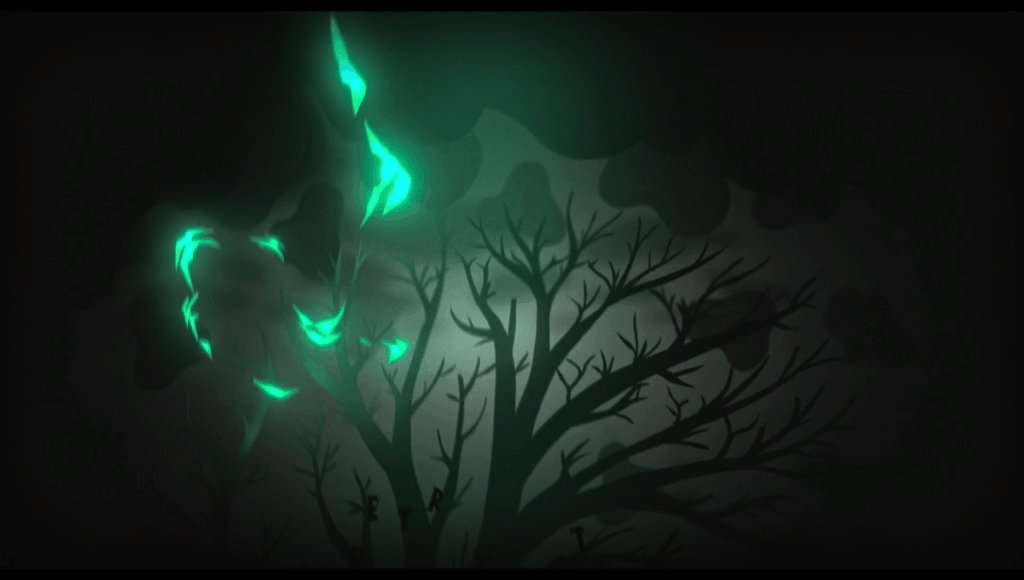
The single most important color in the entire film is the very specific green-blue in the lightning bolt in the opening credits animation.

A bolt of green-blue lightning striking a tree in a simple animated style

It’s the first color you see, it’s horribly destructive, and it shows up everywhere in the movie in very specific ways (which I think has to be very intentional for such a wildly specific color). This color is representative of GENDER DYSPHORIA, of everything wrong with the world when you’re not the gender you’re assigned at birth.

I tried to find a name for this color, and there are several that get close, but also because things like lighting and paints and fabrics are all colored in different ways, the color doesn’t always exactly match. So you’re looking for anything close to what you see in the screencap above. Trust it will be very obvious most of the time, and difficult to miss.

Pink is the color of gender conformity, which makes a lot of sense in a transmasc allegory. It’s the color the world forces on girls. And of course you can be nonbinary and like pink, you can be a girl and like pink just because you like it (like me), and you can be a boy who likes pink. But society says “pink is for girls” (see that GENDERED CHILDHOODS essay), and so in Lisa Frankenstein it’s representative of everything society forces on girls, and everything that transmasc folks may want to get away from.

Yellow is fear and caution.

Blue is sadness, despair, and depression.

Except for when you see pink and blue together, which is, you guessed it, indicative of transness.

Red is more complex, and has a double meaning. In the world, it’s a sign of danger.

But when Lisa is wearing red, it’s a metaphor for love. The colors Lisa wears conveys a lot about what’s going on with her.

When Lisa’s in black and going all gothy, well that kind of garb usually signifies death, or honoring death, respecting those we’ve lost. But as in tarot, many cultural beliefs, and many allegories, death is symbolic of change. The more black she wears, the closer she gets to the change of transition. And conversely, the more human Frank looks, the closer he is to being the fully realized man Lisa has always been inside.

I believe Lisa’s bedroom is indicative of her subconscious, and Bachelor’s Grove is a metaphor for her heart (which, yes, has a dude in it).

It’s important to note that all of the murders in this movie happen at the hands of Frank, and not Lisa, but more important is that each kill is a metaphoric rejection of what that person represents.

And just to be clear, though Lisa is a trans man, for clarity I will use she/her pronouns for her, and he/him for her true self, Frank.

Time for timestamps! Let’s. Gooooooooooooooooo!

0:58 – In our opening animation, we see Frank wake with a sigh, and the photo on the wall shows he’s alone. His parents disappeared from the photo after he looked at it. Maybe they died… or maybe they’re dead to him, and he to them, because they couldn’t accept his truth. It’s actually that second one, when you remember that Frank is Lisa’s final form, and what happened with Lisa’s mom.

1:04 – The food falls from the spoon, there’s no joy. Frank is reading, always reading or playing the piano. He’s artistic, inquisitive, soft. Not the stereotype of the manly-man, devoid of emotions except lust and anger, that the world tries to tell men they have to be.

1:18 – The woman blows a kiss at him, giving up her femininity and accepting him. This was Lisa’s egg cracking, realizing the soft, artistic guy that she really was.

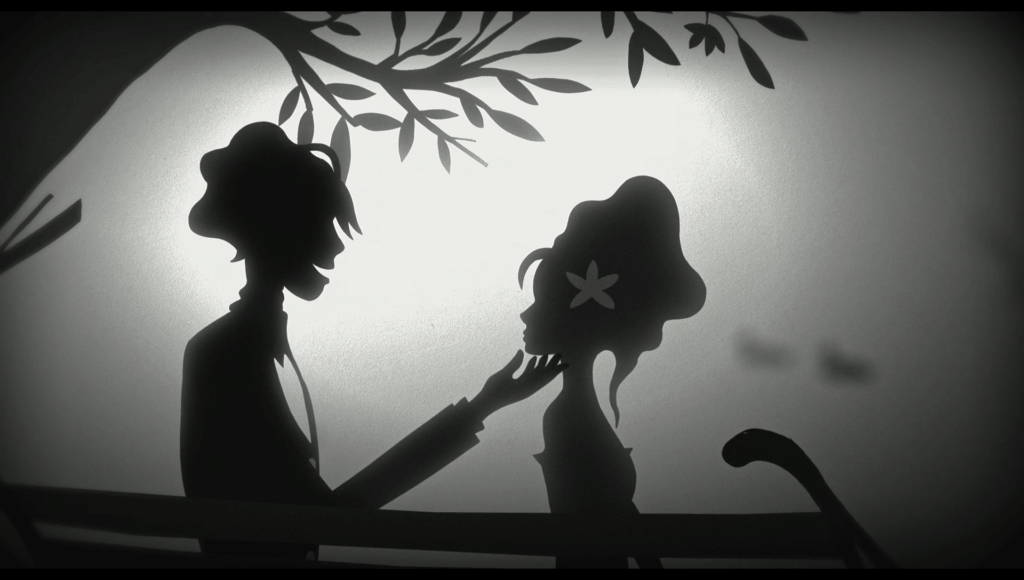
Still from a black and white animation of a man and a woman sitting on a bench in a park. The man is on the left, the woman on the right. The man has put aa flower in the woman’s hair.

1:27 – The pair are together on the bench in black and white, him on the left, her on the right, happy. Frank puts a flower in her hair, and she accepts it. This is her accepting his gift (his existence). And look how similar the silhouette of their hair is. Is that because they’re the same person? Yeah you betcha.

1:36 – The woman leaves Frank, when society still treats her like a woman, and you see the flower in her hair has been lost. She’s given Frank up, and it devastates her true self inside.

1:49 – The horse kicks a man off the balcony, and metal beams fall and crush a man (with a gun) on a boat. Masculinity is rejected and cannot fight for itself.

Note that Frank here is always walking from left to right. He was on the left of the bench, the woman on the right. He is moving from his true self back to the woman society said he was and had to be.

2:00 – He sits on the bench alone, forgotten, not whole, as a man and woman pair (representative of a trans person who’s accepted and reconciled who they really are) are blown away. Gone.

2:05 – And here our green-blue lightning of dysphoria strikes and kills him, the true man inside is dead (for now).

2:12 – On his gravestone it says “unmarried.” If the metaphor for a self-accepted trans person in this film is a man and woman being together (just like in The Matrix, and opposite of Barbie), then being unmarried means unactualized.

2:15 – The dirt falls into the grave, and the man inside is covered up and hidden from the world. Her true inner man has been buried deep in her heart… Bachelor’s Grove.

2:19 – The woman places the flower on his grave, she is sad to lose him, even though she gave him up to pretend to be who society said she had to be.

2:33 – Much later in the future, in the same graveyard, we’re in Bachelor’s Grove (it’s for the dudes!). And there’s Lisa, the woman, at his gravestone. In red. She still loves her true self, even if she rejected him.

2:39 – A closeup shows a gravestone reads “Frances Owens.” “Frances” means French. How are French men seen culturally in the United States? As “weak” or “effeminate,” artistic, not “real” men. Owen traces back to two different names in English and Irish, and both mean “born of.”

Here in her heart, where she has love for the man she truly is, her true self will be born! This is foreshadowing her entire arc, and the entire movie, right in front of you. Supertext!

We’ll wrap it there for this week, even though we’ve only just begun. Come back next week as we discuss what we’ve buried deep inside our hearts, and the horror of being perceived!

Tilly Bridges, end transmission.
tillysbridges@gmail.com

Part 2 is here!

Interview with Cicada Queen V about her game “When Summer is Over”

You can play When Summer is Over… right in your web browser window. Please read and heed content warnings.

NOTE: This week’s update is a transcription of a live interview done as part of the Tilly’s Trans Tuesdays podcast. Special thanks to Kate Rascali for the transcription!

Tilly Bridges: Welcome to Tilly’s Trans Tuesdays! This week, we’ve got an interview with Cicada Queen V about her video game, When Summer is Over, an indie free-to-play game that’s so, so trans, right down to its core.

Tilly: Hi, I’m Tilly Bridges, your host, and I’m joined by my writing partner, my best friend, my wife, our token cis representation, the star that makes my summers last forever, Susan Bridges.

Susan Bridges: Hello!

Tilly: Our guest this week, you may have guessed from the episode intro, is Cicada Queen V, the developer of Cold Call and When Summer is Over. Originally from Florida, now living in New England, she turns her experiences of growing up in an increasingly hostile state and living situation into art to make others who went through similar experiences feel less alone. Welcome, V!

V: Hello, thanks for having me! I really, I really like that. Endless Summer, huh? That’s pretty cool.

Tilly: Okay, so we generally like to start this show off with a few questions so our listeners can get to know our guests. I wanted to sort of get started by asking how you got into making video games.

V: I’ve always liked playing video games. There was a point in my, I would say probably, later teen years, which I guess you could call my childhood still, that I kind of realized that video games could be art, and not just entertainment.

Tilly: Right.

V: And that got me even more interested, and for the longest time, I always thought I wanted to make them, but I just never…(you know, undiagnosed ADHD and all these problems) I could never focus to get far enough into. And then enough stuff happened in my life, I just had all this, almost want to say fuel, I guess. And finally this dam burst. I’ve tried writing, I’ve tried art, I’ve tried drawing, I’ve tried making music, and, like, nothing ever felt quite enough. So I thought maybe combining all of it together, try to do this thing that I’ve always wanted to do. I just found myself in the perfect situation this year, and I just decided, let’s do it, let’s finally try it. So I’ve been doing it, and it’s reached more people than I expected.

Tilly: Yeah, it’s really cool when you find the medium that fits your creativity the best, and you’re like, hey, this is home, this is the best thing that I can express myself through, yeah.

V: Definitely, yeah.

Tilly: Okay, well, before we get into talking about the game specifically, I wanted to ask, for you, what has been the best thing about transitioning?

V: That feels like a loaded question. No, it’s a good question. I actually really like that, because I think it helps to slow down and try to think about the good things sometimes, because sometimes it feels like there’s so many harsh and bad things.

Tilly: For sure.

V: It’s been hard, I’m not sure. I feel like my transition has been a little bit different than a lot of other people I’ve interacted with, but to me, just getting to get closer to who I really am, to my true self, you know? Even though I look in the mirror and I’m still a little uncomfortable sometimes.

Tilly: Sure.

V: I don’t have these episodes where I disassociate anymore, I don’t have these episodes where I look in the mirror and I don’t recognize the person looking back at me. I feel more like me. And to me, whatever that shape is, whatever form you take. It’s always nice to be closer to that, and to me, that’s the nicest thing about transitioning.

Tilly: Yeah, and you know, one of the things that I’ve learned, especially from doing this show and from all the trans people I know, is that every transition is unique, and it’s different for all of us.

V: Absolutely. True, very true.

Tilly: Yeah, yeah, but that moment when you don’t see a stranger in the mirror anymore, even if it’s not fully you. You can feel it getting better, it’s so huge.

V: Yeah, definitely.

Tilly: Well, then let me ask, what do you think has been the most surprising part of your transition? Is there something that you totally didn’t expect?

V: Hmm… Surprising. I mean, there were a lot of things I didn’t expect. The hormones, when I started them, hit me pretty fast, and within 6 months, I was already kind of, like, very different. So I didn’t really have the option of trying to go undercover and stuff. So, I kinda had to come out a lot. And some of the things that surprised me were some of the reactions from some people that were… they either just didn’t care, which was nice, like nothing changed…

Tilly: Right.

V: But there were some people I didn’t expect to react the way they did. And, you know, people who would talk about things like “‘”being yourself” and, you know, “going against the grain” and all this stuff, and then when that happens, they’re like, “oh, you’re shoving yourself in a box for others.” Not the nicest thing to be surprised by, but.

Tilly: Yeah.

V: I suppose the way people have reacted, but to leave that on a positive note, my mother, things were a little bit rough at first, but she has since come into her own, and she’s been very supportive of all of it.

Tilly: Oh, that’s amazing, I’m so glad.

V: I’m grateful for that, yeah.

Tilly: Yeah, it’s weird, there’s this thing in our society, where our whole life, we’re bombarded with messages of, “be yourself,” and “break out of the box,” and “do things your own way,” and then when you’re like, okay, I’m trans, that’s what I’m gonna do. And they’re all like, “no, not like that.”

V: “No, you have to do it the way we tell you!”

Tilly: Exactly. “Break out of the box in the way that’s still inside the box that makes us comfortable.”

V: Don’t destroy the box!

Susan: There’s a whole series of boxes, and you have to fit into one of them, and when you don’t…

Tilly: Yeah, yeah, it’s terrible. All right, well, let’s get into talking about your game, When Summer is Over. You sent me a link to this game, and I played through it, and it hit me so hard that I had to have you on to talk about it. So, I guess to start off, do you want to tell folks a little bit about what the game is and why you made it?

V: Yeah, It’s funny, because everyone I’ve shared it with has had that same reaction, like, “this hit way harder than I expected.”

Tilly: Yeah!

V: And I made a joke with my friends about, like, I finally found my niche in art and games. I make the kind of games that people play, and then it makes them want to ask me, “are you okay?” But to start with the reason I made it… the game itself, the story, revolves around a trans woman’s last day in the only home she’s ever known, particularly in Florida. I grew up in Florida. I was born and raised there. There were a few years of my childhood I spent growing up in other places, but it was a very small portion of my childhood, and for the most part, I was born and raised in Florida.

I always had a sort of… it’’s hard to even call it a love-hate relationship with Florida. But things were always different and strange and complicated for me. A lot of people around me loved Florida for either reasons I didn’t agree with, which might sound weird, or they didn’t love Florida, and they hated it, and they wanted to leave, and I could never understand either of those. And then I realized I was trans, I started coming out, my time sort of came, and I started to realize this state is increasingly getting worse and worse. I don’t like this idea that I’m gonna be forced to leave, but I think I need to leave so that I can feel at least a little bit safer, a little bit more comfortable with myself, not worrying as much about things.

So I eventually left. It was not under the best terms, it was not the way that I wanted to leave. And, the first year that I arrived at the new place, as you mentioned, I moved up to New England, Vermont specifically. It’s been a hell of a ride. I’ve been very happy up here, but it’s been tough getting used to things. That first year, there was a lot of change, a lot of growth, whether I wanted it or not, and I sort of had the idea for this game. I wrote a lot of things down, I wanted to try to start working on it. I started to work on it that year, but I just was not in a good position for it.

Tilly: Understandable, yeah.

V: Yeah, so it got shelved for a little while, and then this year, I made my first game, which is Cold Call, which is a visual novel. It’s something really short compared to When Summer is Over. I did all the art, it’s not, like, pixel art. I did everything mostly black and white and stuff, and I made this thing, and I put it out into the world, and I was like, wow, I finally did the thing I’ve wanted to for my whole life! And I was like, okay, I’m gonna take a break. Then a friend told me about a game jam going on. And for folks who may not know what that is, basically the idea is, a community or a group of people set up a little thing where you have a time limit, and sometimes you might have something like a theme or, like, structure. And you basically go out and you develop a game in this time limit, and then you release it, and then a bunch of people play it, and they rate it, and they judge it. Some game jams will have ratings where they try to say, like, oh, this game got first place, this game got second place. Some of them will just be for the glory of making games and sharing it around.

And the theme, it was for an RPG Maker horror game jam, and the theme was “House of Remembrance.” And I read the description for the theme, and I was like, this is exactly When Summer is Over. I have to do this. So I kind of just dove in, and I made it. And, I surprised myself, because I made the game… I already joined the jam late, and I made the game in, like, about 25 days?

Tilly: Wow.

V: From the ground up, I pretty much didn’t use any of the assets that I had previously made besides just references and concept art stuff. And so I made it, and then I put some finishing touches on it, and it broke me in a lot of ways. But yeah, I put it out in the world, and then all of a sudden, a bunch of people started playing it and reacting to it in ways that I did not expect. Now I’m here.

Tilly: Yeah, I think it was this really genius way of putting the audience in your shoes, because a game is so much more active than reading or even watching something, right? The player is moving and causing things to happen, and so it’s more like those experiences are happening to them. And I think that’s a really brilliant way to get cis people, especially, to maybe understand a little better some of what we go through. Was that part of the hope with making it, or was it more just about getting out all of these thoughts and feelings that you were working through?

V: First and foremost, when I make something, I genuinely care more about art than anything. And to me, art is a conversation between two minds? And so it’s very possible that subconsciously I did have these ideas, because when I work, I never know all of what I’m feeling. I can get so lost in what I’m doing. And I sort of just make it, I get to the end of this tunnel, I share it with people, and then people say, “wow, that was really interesting, I got this out of it.”

I never intended for someone to get that out of it, but I really like that you saw it in your own way. So, to me, it was always just being honest about my own experiences, my thoughts and feelings, and hoping that in whatever way that that could reach people, if it reached cis people who wanted to try to understand more, or who could learn, they could try to understand more. Or maybe some of them, maybe it even changed some of their minds. That would be amazing. That wasn’t the initial goal by any means, but that would definitely not shy away from that.

Tilly: Yeah, I think all art is really like that. Like, we put so much of ourselves into it. Susan and I here, we write scripts, comics, movies, TV, and it’s always the same way. You never know how someone’s gonna interpret your art once you put it out in the world. It’s gonna change. Every single person will view it differently, because they all bring their own baggage and experiences and feelings to it. And so, I think that’s one of the most beautiful things about art, is that you never know what somebody else is gonna get out of it. And that’s kinda cool.

V: Yeah, I think it’s beautiful, honestly. That’s one of my favorite things about art.

Tilly: I wanted to ask you, Susan, because you played through it as well.

Susan: I did.

Tilly: As a cis person.

Susan: Yes.

Tilly: What was it like for you to play through something that was so, like, deeply trans?

Susan: I thought the plants were a great metaphor, kind of. Because, like, I feel like you’re a plant nerd.

V: What? Me? No…[laughs] Just a little bit.

Susan: So there’s, like, oh, these plants, and I love the plants, and then later, like, the poisonous sort of plants are in the house and everywhere, and it adds an interesting thing about the mixed feelings about loving and hating and all together. I thought that was cool.

Tilly: But did you feel the transness of it, the bits that sort of relate to, like, dysphoria and things? Like, how did that feel for you?

Susan: Yeah. Definitely, yeah, yeah. I mean, it was clear to me, but I’m married to you.

Tilly: You are.

V: Actually, I think one of my favorite things about it, is that some of the cis people I know, some of my friends, who are very supportive, they may not understand as much about things, but they do understand the state of the world, this country and some of the sad things going on, and they’re very supportive.

It was really interesting to see how they could relate to those trans struggles, and in their own ways, the things that they go through. You know, being uncomfortable looking in a mirror, it tends to be something trans people talk a lot about, but it’s something that anyone can experience, and having issues with family, or feeling unsafe somewhere, or not feeling comfortable, no matter what clothes you wear. Like, you know, these are all first and foremost, as I know them, trans issues. But a lot of people experience them in different ways that aren’t trans. I think to relate on that level, to realize, like, oh, yeah, we do go through similar things, you know? We’re all human. It’s really nice to see that.

Tilly: Yeah, like, cis people may not know what it’s like to not feel like you are the gender that the whole world has told you that you are, but there’s so many things… because we’re all just humans, you know, struggling through this world. And there’s so many things that I think cis people can relate to. You may not know exactly what it is like to have gender dysphoria, but you know what it’s like to have expectations laid on you by society or your family about who you’re supposed to be, and feeling like that’s not you.

I think that’s one of the most beautiful things about making art like this, is that it helps the whole world understand better, and that’s really cool.

Susan: I guess, yeah, also, parental garbage. I mean, we both have a lot of experience with that.

Tilly: We do!

V: That was something that struck the chord with a lot of people, yes.

Susan: Yeah, because my mother, growing up, was very unpredictable. So everything was trying to figure out what her mood was and when she was going to explode, and there was no real way to always be able to figure that out. And not being able to have an opinion about anything because it was just gonna be turned against you, or… conditional love, and all of those things. Which I definitely grew up with.

Tilly: I wanted to ask, was there a reason that you chose to go with the older 8-bit style of Game Boy-type graphics?

V: I’ve always really liked surrealism as an art movement. I’ve also been weirdly attracted to absurdism and certain philosophical ideals and things, and how they translate to art. And one of my favorite things, obviously, is how those art movements might translate to things like video games.

Tilly: Sure.

V: I wanted to pick something limited because I wanted it to feel nostalgic for a lot of people, even people who may not have played Game Boy games back in the day. I actually did get the chance to play a few Game Boy games on an old-school dot matrix Game Boy. There’s just something about the older, more limited styles that tend to breed this nostalgic feeling, for bad or good.

I wanted to do that because the whole idea of this game is looking back on this hazy memory, and this was another reason I really wanted to make this game relatively soon after I moved. Which was February of 2024. So I wanted to make it before I forgot. It’s hard to imagine myself forgetting, but I found the more and more I live in life, the more I forget things that I later am surprised that I forgot about them. I wanted to do it while they were still relatively fresh. And to me, this idea that it had to be this memory. And the best way to do that was something limited.

The other thing about limited art, colors and palettes… my previous game was mostly black and white. I’m still working on my art style and my art, and I find it much easier to work in a limited color palette. Which is very interesting, because I’ve had other artists tell me, like, “I don’t understand how you do it, my brain breaks when I look at it,” and to me, it makes much more sense, I feel less held down by the art I’m making, when I specifically choose a limited amount of colors.

Tilly: Yeah, I thought it was an excellent choice for the game, not just because of the nostalgic reason that you mentioned, but I feel like those older-style graphics, 8-bit style, they’re not trying to be realistic, like our present-day Xbox and PlayStation games.

I think that they cause us to use our imaginations more. We’re filling in the blanks that the graphics don’t give us. And in a game like this, that is so intimate and personal. And it’s a horror game. To me, that made it even spookier, because I’m seeing your representation of the tree, but my mind is filling in the rest of what that tree looks like, and what’s going on, and what’s happening on the ground at the base of that tree. And your graphics were great, but then my mind is like, oh, but I bet… it’s filling in all these tiny little details that the graphics don’t have, and so, to me, that made it even more of a personal experience.

V: Yeah, That’s actually really interesting. I never thought about it, but I do think that’s one of my favorite things about games like this. I played a lot before making this game. And I like reading, but I have a hard time with novels and books, though. But if you put me into a game, and you give me a ton of stuff to read, I’m all about it. I’m gonna read as much as I can. And I always loved games that gave you just enough art to sort of form the basis of the image, but then the rest of it is sort of obscured, and you have to think about it. I agree, one of my favorite things about horror is when you don’t fully understand the horrors that you’re experiencing?

Tilly: Yes, exactly.

V: There’s a mystery behind it.

Tilly: Yep.

V: So, definitely, that makes a lot of sense.

Tilly: Yeah, it’s like in the, like, original Alien movies, you know, where you never get a really good look at that alien and so your mind is filling in what it must look like, what it must be like, and that makes it even scarier, because everything we’re imagining… they couldn’t make anything that freaky on screen, you know? Our imaginations run wild with them.

Susan: I think the art style, like, gives it a little bit of a childlike quality, which very much plays into how we deal with our parents. Like, we never stop being treated like the child we were versus who we are now. We might as well live on Mars. My parents just can’t fathom the people we are. Like, it’s just beyond their understanding. But it feels very much like when you’re suddenly faced with things from your childhood, or interactions with parents, like, it puts you back in that place.

V: I very much tried to do that. So to hear that people did feel that way is a really nice feeling. Making this game was very hard. There were times I was very uncomfortable as I was writing things, and I thought, should I change something? Should I change this? But, I really wanted it to be raw, and the only way I could really elicit and put people in those feelings was to just, you know, be as transparent as possible is a good way to say it.

Tilly: Sure.

V: Yeah, within the confines of this type of game, of course. There were things that I couldn’t do that I wish I could have done. But with the time limit, and with the idea of just wanting to finally make this thing that I’ve been thinking about for a year, I definitely did everything I could to try to give a sense of, one, that powerlessness that you feel when you’re a child, and even if you’re an adult, if you interact with a parent that still doesn’t acknowledge who you are or accept who you are, which, for a time, my mother was like that when I was older. And it just puts you right back there. The yelling and screaming, or the- there’s no sense of identity, or this idea that you can’t choose for yourself. You can’t make your own decisions, you can’t be your own person, you have to be this person that they know you are, or they say they know you are, or whatever.

Tilly: Was it hard, then, to sort of relive all of the things that you were talking about? Or did you get a catharsis from it? Or was it just mostly, “hey, I’m reliving my trauma, this sucks.”

V: This is a great question, because one of the reasons I wanted to make this game was this idea of catharsis. And then once I finished it and put it out into the world, and saw all these people reacting to it, and playing it, and streaming it, and making videos, and making comments… and I’d watch the videos, and sometimes I’d sit in on some streams and I’d realize, this isn’t really doing anything! So, I do think it was, in a way, a type of catharsis, but it’s something that didn’t feel cathartic, if that makes sense? It was something I needed to do and I’m glad I did it, and I don’t regret doing it. But a lot of it has been reliving, in an unpleasant way, those things, which might be a little bit complicated. I don’t think that’s a horrible thing. But I wouldn’t want to get lost in that.

Tilly: Sure.

V: I think I got a little bit depressed near the end when I finished it, and put it out into the world, but lately I think I’ve been doing a little bit better.

Tilly: That’s good. Yeah, it can be so tough when we’re getting so personal. We’ve written scripts or whatever where we pull bits from our lives or from our past, and we’re sort of reliving those emotions, and sometimes it can help you process them, and sometimes it’s just like, “I’m just going through it all again.” And, yeah, it can be really tough.

I have to tell you that the movie theater level kind of ruined me, in a good way. It was so good at capturing the actual feeling of what it depicts. I’m not gonna spoil it, but, I wanted to ask how you approached the horrors that we experience in this real world, and translating them into the fictional horror of your game. Were you worried they would come across the way you hoped? Because you put these artistic liberties on them, which is great, but that’s what you have to do. But were you worried about how people would interpret those?

V: I actually wouldn’t necessarily call it an artistic liberty.

Tilly: Okay.

V: I know that might sound a little bit strange, but to me, the way that we experience the world, I’ve been in some weird situations, and sometimes it feels like the offenders in those situations don’t feel like humans. And maybe that’s what I wanted to portray. So, in that way, I wouldn’t use that term, but that doesn’t make it incorrect, and now I’m being a little bit nitpicky.

Tilly: It’s your game, nitpick all you want!

V: Still, I don’t want to be too much. Actually, just to clarify, and not to spoiler anything, I just want to make sure I 100% understand… you’re referring to the bathroom segment, correct?

Tilly: Yes.

V: Okay, and I won’t say more than that. What happened in that segment is not something I have experienced directly. Which I’m grateful for, but it is something that I was constantly terrified of, living in the state that I was.

Tilly: Sure.

V: And I knew people who experienced it, and I read stories about people who experienced it. And I actually remember, a couple of my friends were playing the game and they had this reaction to it during that sequence, that they were laughing. I realized that they were laughing because it’s so ridiculous that this is actually happening in the real world, these kinds of things.

It was kind of a weird catharsis, in a way, to be able to have someone there to laugh with me. Like just how insane and ridiculous that these things are happening and so, to me, that’s what they are. It’s one of the most insane things that could happen. So, I wanted to portray it that way, as just this senseless, nonsensical, like… what even is this thing?

Tilly: Which you did very well.

V: Thank you. When I was writing, the dialogue was probably the hardest part for that sequence. What’s difficult for me is that I know some people and some artists who are very good at obscuring and translating things into metaphor and poetry and this beautiful art, where it doesn’t come out and say what this thing is, but it is able to portray it. I don’t think I’m really that good at that kind of thing, and I also realized in the moment as I was writing it, that I don’t want to obscure it and risk it sounding like anything else other than what it is.

So to me, there was a moment of… this is something that’s really important to me. And actually, funny that you mentioned the bathroom scene, that was not originally going to be in the game, in any shape or form. It was actually near the last week as I was developing the game, that I had the idea for that scene. And I realized, with everything going on and the stories I was reading about the ridiculous things happening, what this game is and what it represented, it was a very necessary thing to put in.

Tilly: Yeah.

V: So when I was writing the dialogue, I actually became less worried that people wouldn’t be able to pick up on what it was. I became more worried that people might think it came off as… how do I describe it? Preachy? But then I kind of realized if people think that, then they are not the ones who know what’s going on, and maybe they need to see something like this and think a little bit more about what’s going on, because it is.

Tilly: Absolutely. I think there’s this danger sometimes when we’re making very trans art, where if you don’t explicitly say sometimes exactly what’s happening, so many people are going to miss it.

V: Yeah, absolutely.

Tilly: When we made our short film, there’s a line in there from one of the characters that says the lead character’s mother was transphobic. And that word is said, and we had this big discussion with our assistant director and our producer over… should that line stay in there? Is it too blatant? Is it saying, “look, everybody, what’s going on?”

But then, without it… right? That was the only thing that was 100% confirming, right, that this was a trans story. The rest is there. They’re talking about this trans woman, and her father refers to her as a boy as a child, but it’s like… people are going to miss it, and we need to be sure that it is said and seen and heard and understood. Because so many times, even in work that we’ve done, we’ve had it stripped out, where it can be nothing more than metaphor. Executives get scared, or what have you, and they keep pulling it back, and then people miss it.

So many people that need to see that, to know that they’re being represented on screen, or in a game, or wherever, or they’re going to miss it. And so I like that not only did you make it very clear, but there’s even a spot somewhere in the game where the character talks about her transition. And I love that it was just right there, because it’s a normal thing that some people do, right? And it’s a thing we can talk about.

V: I’ll get this thought out, just because I’m bad at holding onto my thoughts. I’m really glad you brought that up, because when I was initially developing the game and writing the dialogue, there was no mention of the word “transition.” It was, like you said, sort of obscured, and sort of metaphorical. And I looked at it from the top, and I realized, “I can hand this to a trans person.” And I handed it to many of my trans friends, and they read it, and they were like, that was so deep, that was so powerful, I really felt that. But then the more I thought about it, I realized, like, I think this is gonna go over a lot of cis people’s heads.

Tilly: Yep.

V: And I realized something, you mentioned Alien earlier. I tried to do a little bit of digging when I heard about this a while ago, and I think it might be true, I never actually confirmed it. You might know, you might have more information, but I believe in the second movie, Aliens… there’s a very blink-and-you-miss-it reference to one of the previous characters in Alien that is trans in the movie?

Tilly: Yes! There is.

V: I remember finding that out, and I loved Alien and Aliens. I loved both of them for two very different reasons, like Aliens are obviously not much of a horror

Tilly: They’re very different movies.

V: It’s more of a sci-fi action, but I love sci-fi action, and Alien is just such a great horror movie.

Tilly: Right.

V: And when I found out that there was that kind of blink-and-you-miss representation… I found out about that when I was early on in my transition, and there was something about it that was very comforting to me at the time. But as I got more and more into my transition, I kind of started to get a little bit upset. And I realized, you know, there’s plenty of that kind of stuff out there, and I think we need more blatant representation.

Tilly: Yeah.

V: That word that you use, blatant, and the whole execs problem, I kind of realized making this game I don’t think being blatant about things is that much of a problem, and I think we should actually not shy away from doing it more. I think maybe when it comes to art, there are times it could be very helpful to others. And to ourselves, especially in these times that we’re dealing with.

So, I deliberately, as I was starting to actually make the story, put things together, work on the art, touch up the dialogue, I started to deliberately make it so that there were many things that made it very obvious that she was trans. And at first, I always get this little fear in me about, like, oh, is someone gonna see it, and someone’s gonna misgender my character and be mean to her, or whatever. And I was like, you know what? No. I wanna be true to it. If someone’s gonna be that mean, that’s their own problem, that’s not on me. This is about portraying this in art, and that’s what I wanted to do. And, I’m very happy I actually went that route, because I wanted to try to be more poetic in obscuring everything at first, but I realized it just wasn’t right for this story.

Tilly: There are so many times when we aren’t allowed to be blatant. Like, when you’re making an indie game and you’re controlling everything, that’s the time when we can, right? Because we have been told on projects, we can’t say the word “trans,” that’s a bad word. We’re like, “No, that’s just what we’re called.” It’s not a bad word. We can and we should say it.

And so, I think especially in these times that we’re living in, when so many times we only can get our stories told through publishers, or past executives, where it has to be allegorical. On those times when it doesn’t have to be, when we can actually say it, we need to. Because there’s not enough of that, and we need to be sure that it is obvious representation for the people who need to see that, “No, you can be the lead character in a really cool video game. You can be the lead character in a TV show, or a movie, or a comic. You belong. We belong.” You know, we’re just human beings, and we can be those people, too. So, I love that you did that. It was a wonderfully bold choice, and we needed it really bad.

V: Yeah, absolutely, that whole thing about indie- indie art specifically, that gets the chance to do the things that the big exec arts don’t. I think subconsciously, something inside me knew that. And that’s one of the reasons I’ve always loved indie art, experiencing it and making it, because it’s not held back by, “oh, well, we need to be prim and proper, and we can’t use this word,” or whatever else. It’s like, it’s a raw experience from the heart.

Tilly: You talked a little bit about this before, but I just wanted to ask, have you heard from more people who’ve played it? What has the response been like? And have you noticed any differences between trans people and cis people who have played it in their responses or the things that they’ve thought or said about it?

V: Yeah, I have seen a lot of people play it, and see it, and one particular thing that comes to mind is that trans people, or as sometimes I like to call some people, “trans-adjacent” people… I have a couple of cis friends that have trans partners, they’re very supportive, they’re very deep in this stuff. They work on these things with us, they’re the kind of people and support that we really need at this time. Trans and trans-adjacent people can tell right away that it’s a very personal, raw story. They can tell that it’s something from the heart, and these kinds of people will often be the ones writing comments, like, “if an ounce of this is true and it happened to you, I’m so sorry for what you went through.”

And I’ve noticed that cis people, some of the cis people who’ve played it, have… they’re not quite as quick on the uptake about it. So some of them don’t realize right away. They can appreciate it, they can realize the visceral, raw, real story, but they don’t realize how analogous to real-life situations, it might be.

There was one particular streamer who played it, and then messaged me afterward about it. I think he saw a comment about how I had mentioned that I was originally from Florida, and he sort of made the eye-squinting gif reaction kind of thing. He messaged me, and it was like, “so, did any of that stuff…” I don’t remember all the details, but paraphrasing, “did any of this stuff actually happen to you, or is it…” And I’m like, I will be real with you, it is almost a one-to-one analog telling of things that I’ve been through.

There are plenty of things in there that I didn’t go through, and plenty of things that I exaggerated, plenty of things that I know other people went through that I discussed with them, but a lot of it is very personal. And he was like, “wow, I feel so bad for all the jokes I made while I played it! Sorry.” And I told him, please don’t be sorry, because to me, humor is one of the ways that we cope with things. And that’s incredibly important to me for people to be able to make jokes and laugh about things. I would never want to silence something like that, even if they made a really dumb joke that I didn’t like. So, that has been an interesting reaction.

Overall, you know, comments-wise, from what I’ve seen from the comments and the people who have played it, they’ve been so surprising that people were like, “it’s beautiful. It’s beautiful art, it’s a beautiful piece of this visceral story, it’s so personal.” Let me see if I can find this comment real quick… it said, “yes, I love this!” This person commented on the game on the itch.io page. “It feels like a direct glimpse into someone else’s mind. Deeply uncomfortable inner debates about identity and what to let go of made real, and then brutal recounts of abuse.” So, I’m really grateful that people have really seen and felt what it is, what I meant for it to be.

Tilly: Yeah.

V: And I’ve been surprised by some of the ways that people reacted, some people pointing out things that I didn’t notice or didn’t think of at the time when I was developing it. Almost everyone I’ve seen who’s made a comment or posted about it or talked about it had a positive thing to say about it, usually a very positive, personal, thing to say about it.

Tilly: That’s amazing, and well deserved. So, what is next for you? Do you have, like, a new project that you want to tease or talk about or anything?

V: I am… I’m working on a lot in my personal life, in my work life, because I make these games and projects for free, and it was very important to me that they are completely free, I care very much about the accessibility of art. Unfortunately, I have a day job that I have to go to.

Tilly: We still need money to live.

V: Yeah, exactly. There have been some stressful, difficult situations I’m trying to work out. I’m trying to see if I can get to a better place where I can be more comfortable about things and work on things. But even now that I’m done, and I’ve been taking time to rest, the ideas are still just assaulting my brain.

Tilly: Yeah, that’s how they are.

V: I very much have plans to work on more things. I will say that in the future, there will be a sequel to this game, and it’s going to be something that’s going to be very different and important. And I can hint that the girl has finally chosen a name for herself, so we’ll actually have a name for her in that game.

But, in the meantime, I’m planning on working on a few more, I want to say, smaller projects. They may be larger than When Summer is Over, but still smaller than for what my goals are for the sequel. And it’s funny you ask, because a couple of friends of mine pointed out now I can try to make something cute, a palate cleanser, something like that. I was like, yeah! But as I thought about it more, I’m afraid deeply personal and dark is all I know, so all the next ideas I have are for more things that will revolve around that kind of stuff.

At the moment, I’m mostly trying to just rest and recover a bit, because this game took a lot out of me. But once I find my bearings again, I’ll be working on a couple of smaller projects. I wanted to make another visual novel type game, similar to what Cold Call is, with a bit more interactivity to it, some point-and-click aspects, and some branching, narrative story lines. That game will particularly be pertaining to women’s issues with stalking and some other things, which I want to try to portray carefully. I am familiar with some of those issues, and I know that they can be very frightening to deal with.

The other game I wanted to make will be another similar game, like When Summer is Over, another RPG Maker game where I want to actually explore some more RPG map aspects. I want to make it more gameplay heavy, I want to have some more puzzles and some combat sequences and things to kind of prepare. I can’t say too much about those yet. I have overall ideas for the storyline and stuff, but, you know, things change as you write and work on them. But, yeah, I will definitely be working on more projects.

Tilly: Excellent. Please keep me informed, I would love to see them. And don’t feel bad that personal dark horror games feel like your wheelhouse. We all have our wheelhouse, and the thing that we feel best writing, and that’s where our creativity lies, and where we want to work. So, it’s cool that you have found what that is for you. Don’t let anybody pressure you to make a cutesy game if you don’t want to.

V: I really appreciate it. I do like that some of the people pointed out how cute the art in When Summer is Over is with the sprites and stuff. I do like the overworld when you’re moving around, and the little old-school, kind of almost 8-bit style sprites.

And I actually did feel bad at first, but I’m really glad you said that, because the more I’ve thought about it, the more I’ve realized there are so many different kinds of games I like. And I kind of had this hard thing in my brain for a while that told me, like, if I like something, that means I have to also want to try to make things like that. And I kind of just realized that’s not how it works. Within the last two games that I’ve developed, I have found my wheelhouse, and I’m happy with that. And that doesn’t mean that I can’t also continue to like and enjoy the other kinds of games that I do like, that are more entertainment, or silly, or cute, or whatever. So, yeah, absolutely.

Tilly: Well, thank you so much for being here, and for making When Summer is Over, and turning something that was so personal into this, like, amazing piece of art that speaks so well to trans people.

V: Thank you so much for having me, I really appreciate the time, and I really appreciate talking about it.

Tilly: Of course. And to the folks listening, you can play When Summer is Over at the link in the show notes, but please do read and heed its content warnings. It is a horror game, but it’s also a really beautiful piece of art that you should experience if you can.

Tilly Bridges, end transmission.
tillysbridges@gmail.com

Transcribed by Kate Rascali – summerknights.bsky.social
THE INTENTIONAL (!) TRANS ALLEGORY OF STRANGE NEW WORLDS’ AD ASTRA PER ASPERA, part 3

Star Trek Strange New Worlds Ad Astra Per Aspera part 3, a 3-week series examining its trans allegory, by Tilly Bridges, author of Begin Transmission: The Trans Allegories of The Matrix, tillystranstuesdays.com, over a photo of Una Chin-Riley testifying

Welcome to Trans Tuesday! Look out, here comes THE INTENTIONAL (!) TRANS ALLEGORY OF STRANGE NEW WORLDS’ AD ASTRA PER ASPERA, part 3! We wrap up the story of Una and the Illyrians, and let’s see if this hopeful, accepting future can show our present reality a way forward!

Here’s PART 1 and PART 2 for you, because starting with this essay would be a very confusing and bad idea. Don’t do it! Trust me for once, geez.

Let’s go!

36: 15 – Una takes the stand. Neera: “How long have you been in Starfleet?” Una: “Twenty-five years.” Neera: “Would you call this career your life’s goal?” Una: “It’s all I’ve ever wanted.” Neera: “You knew you were Illyrian, thus genetically modified. Didn’t you think you might find yourself in this position one day?” Una: “I had been warned, yes.” Neera: “So why join Starfleet?”

And here we get to the heart of it.

Una testifies

Una: “Ad astra per aspera. ‘To the stars through hardship.’ It was the Starfleet motto before the Federation. …I knew it meant we must endure hardship to get to the stars. But I like to think that it also means that the stars could deliver us from anything. That in the mystery and vastness of space, we might not just satisfy our curiosity, our need for exploration, but that in it, we might each also find… salvation.”

No no, I’m not crying, you’re crying.

37:24 – Neera: “Why would you need salvation? Was your childhood difficult?” Batel objects. Neera: “I’m simply establishing context. If Una Chin-Riley is to be tried for being an Illyrian, then the court must understand what it means to be an Illyrian.” Do you think any of the courts banning trans people from public life, and banning our healthcare, have even an inkling of what it means to be trans? Do you think they even care?

But this is fiction, and the Federation and Starfleet are aspirational. And so, here, they do care. And isn’t that beautiful?

37:50 – Neera: “You grew up in a Federation colony in the Vaultera Nebula, correct?” Una: “Yes. We were given provisional membership in the Federation the year before I was born.” Neera; “On the condition that all genetic modification was to cease. …But that didn’t happen, did it?” Una: “It did for some. But for other families, like mine, it was our tradition. Our heritage.”

Her family believed in supporting and affirming trans kids, regardless of what laws or society said. That’s what good parents do. That’s the job.

38:19 – Neera: “What was life like for your family under the Federation?” Flashback to young Una with voiceover. Una: “We no longer discussed our customs. We performed our rituals only in secret.”

Don’t tell anyone you’re trans. Utilize do-it-yourself hormone replacement therapy.

This was the very real history of trans people in our society.

Una: “Those who could hid their modifications. When new children were born, parents sought out friendly doctors to deliver them.” They found gender-affirming docs to help kids when possible.

Una: “We knew if we were ever found to be genetically augmented we would be arrested.” Neera: “Did that ever happen to anyone you knew?” Una: “A boy I went to school with. …Some of us have immune systems that can glow. Someone must have seen him. He came home one day to find the word ‘augment’ on their door. We had just learned about augments in school. Opinions on them were… clear.”

Their school taught them to hate augments. Society absolutely does teach us these biases, though usually through more subtle means. But also, sometimes, directly as fact.

39:18 – Neera: “Did anyone defend him, his family?” Una: “Some. But there weren’t enough voices.” CIS APATHY ALLOWS IT TO HAPPEN. If you do not stand up for trans people, nothing will ever change for the better. And, in fact, you are a vital part of the machinery of our oppression. Again see my book BEGIN TRANSMISSION: THE TRANS ALLEGORIES OF THE MATRIX for more.

Una: “[He] and his parents were arrested in their home. He was ten years old.” Neera: “How did this affect your community?” Una: “Some families moved to other planets that weren’t Federation.” This is just leaving red stats for blue ones, or leaving the US for countries with better trans laws.

Una: “And those of us who stayed, we were persecuted. Circumstances became extreme. The anti-augmentation laws seemed to give people freedom to act on their worst impulses.” WELL! I don’t think you need me to explain that one. The rise in bigoted violence correlating to a certain person being elected President (whose name isn’t worthy of being mentioned by me) is very clear. Bigots see it as permission to act on their hate.

Una: “First were the insults. ‘Augment.” ‘Moddie.’ ‘Freak.’ There were stores that wouldn’t serve you if they’d heard you’d been modified. Even the rumors could be dangerous.” Didja see the news story about a cis lady fired from Wal-mart because someone accused her of being trans?! This shit literally hurts everyone.

“I remember when the attacks began. We feared for our lives. …There was a fight at school one day. One boy accused another boy of being an Illyrian. I tried to stop it. My leg got broken. It was such a simple fix. So easy to treat with modern medicine. But my parents wouldn’t take me to a hospital. They were afraid.”

So here’s the thing. I don’t feel safe going to red states in this country. And one reason is if I am in a red state and I have to go a hospital, are they even going to help me?

Are they going to hurt me?

If I had to be admitted, would they keep up my HRT?? Nope. They’d medically detransition me.

For cis folks out there, imagine if you had to go to a hospital and if you happened to be in one of the 50% of states who has legislated hate against you, they would force the wrong hormones into your body and call it “for your own good.”

LITERALLY STOP READING RIGHT NOW AND IMAGINE IT.

Una: “Despite my modifications, my leg became infected. If we hadn’t found an Illyrian doctor willing to see me in the middle of the night, I would have died.”

Neera: “Was this normal for such a common thing to become life-threatening?” Una: “It was for kids like me, yes. Civil unrest became so great the local government decided to divide us into two cities: Illyrian and non-Illyrian.”

Segregation. Separate, and not treated equal. We’ve all seen exactly how that plays out. It’s just legalized discrimination.

Una: “My family, we went to the non-Illyrian city. You see, some of us could pass.” There it is again, right on the surface. Supertext. Again see MISGENDERING AND PASSING for more.

 “We could blend in, so we did. We left everyone else behind. Our families. Our friends. We left them all. I regret it to this day.”

41:59 – Neera: “And yet, after all of this strife, you still wanted to be a Starfleet officer. …How did Starfleet find out that you were Illyrian? You managed to keep your status a secret for so many years, it’s surprising they found out now. …Who turned you in?” Una: “I turned myself in.” Neera: “Why would you risk your career, the life you built?”

Why come out publicly? Why tell people you’re trans? Why risk all society has rewarded you with for conforming?

Una: “I was so sick of living a lie, of pretending to be someone I wasn’t. I wanted my crew to know me for who I really was. I thought maybe if they did, I would finally be safe. And Starfleet would finally understand Illyrians better.” The more of us come out, the more our profile rises, and the more people understand us. But of course, that sadly means the more we are attacked for it.

43:12 – Neera: “So, after all of it… you still wanted Starfleet to accept you. Why?” Una: “When I was five or six, I remember a Starfleet crew visited. They were all so… different from one another. So many crew members from so many planets. It was beautiful. I thought if all those people from all those worlds can work together, side by side, maybe I could, too. Maybe I could be a part of something bigger than myself. Starfleet is not a perfect organization, but it strives to be. And I believe it could be.”

Our society, of course, still has bigotries of all kinds. That the human-led Federation doesn’t is, perhaps, the biggest (and most hopeful) fiction in this entire franchise about spaceships and aliens.

44:03 – Neera: “You’re saying that… is why you turned yourself in? …Because you believe in Starfleet.” Una: “Yes. Ad astra per aspera.”

Pasalk and Batel

44:43 – Vulcan Admiral Pasalk cross-examines. “That was a very emotional story. However, emotions are irrelevant. Facts are not.” Fuck your feelings, eh? But not my feelings. Just yours.

Pasalk then tries to implicate Pike and his entire crew for not turning Una in, and punish them for being accomplices. Pasalk: “For four months, the captain of the Enterprise engaged in a conspiracy to conceal the Illyrian Una Chin-Riley.”

46:47 – Pasalk: “The defense wants you to ignore the facts in favor of emotion. But the only matter of import today is the law. Una Chin-Riley broke the law and lied about it, as her own testimony has proven. Further, her actions will likely lead to a court martial of one of Starfleet’s most decorated officers [Pike]. She is clearly toxic to Starfleet in both action and inaction. Therefore, the only logical response is to find the defendant guilty of all charges.”

Captain Batel reads Starfleet Code 8514 from a very thick book

47:27 – Neera: “Captain Batel, are you familiar with the Starfleet Code 8514? …Would you mind reading that code for the court?” Batel: “’In extraordinary and extreme circumstances, if the following conditions are met: 1 – any person fleeing persecution… or fearing for their life due to political or religious beliefs, cultural engagements or biological truths,” like TRANSNESS, “may, 2 – seek safety within Starfleet… and 3 – upon revealing themselves to authorities and making a request, may be granted asylum. …Starfleet captains must exercise discretion in judgment when offering asylum. Status is confirmed by a Starfleet tribunal or designated authority.”

Neera holding the thick Starfleet book of law as she gives her closing argument

48:36 – Neera: “Fearing for their life, one may seek safety within Starfleet and request asylum. Starfleet has a long tradition of performing rescue missions. How many distressed peoples has Starfleet aided? How many lives saved? Una Chin-Riley knew this. She believed in the best of Starfleet, and that through it she could find salvation from the hardships and danger of her everyday life. Danger she faced just for being born an Illyrian. Dangers born of prejudice, spurred on by laws against people like her. But through her hardships, Una saw the stars. She joined Starfleet because she believed it was the only thing that could save her life. She fled persecution, and within Starfleet she sought safety. And then, by turning herself in, Una fulfilled the third and final requirement for asylum. She asked for it, and Captain Pike granted it. Like all good Starfleet captains, including Admiral April… he exercised his judgment and gave her asylum. All this tribunal needs to do now… is confirm that status to absolve them both.”

Also sad that this part is fiction, because we should be offering people persecuted for who they are asylum, and freedom, and acceptance. If only we could be that Federation.

Neera sets the Starfleet law book down on the Judge's bench

50:35 – Neera: “Do you know why I love the law? Because a law is not a mirror to society. A law is an ideal. A beacon to remind us how to be our better selves. And you have the opportunity today to do just that.” Imagine if our elected representatives and the judicial branch all operated on that guiding principle. We might just find our way to a utopia.

The judge delivers her verdict

52:09 – The judge: “I think we can all agree that the issue of genetic engineering is a nuanced one. The laws prohibiting it exist for very good reasons. And regulations must persist so we may not one day face another crisis like the Eugenics Wars. But this court also believes that these reasons cannot and do not allow us to treat every individual augment, Illyrian, or other persons with modified DNA the same. Lines must be drawn, but they must also shift when necessary. Perhaps someday Starfleet and the Federation may change its views, but today I’m afraid all we can do is consider what the defense has asked. That we judge the defendant’s specific case and unique circumstances independently.” And then they grant Una asylum. Justice for Una, but not for all Illyrians.

53:55 – Una: “I’m sorry we didn’t do more for Illyrians. This was a technicality.” Neera: “It’s a start.” And it is. Now there’s precedent. It all has to start somewhere, and no matter how small the victory, they all add up.

54:21 – Neera: “…I am not the biggest fan of Starfleet. But I am looking at a starship crew that proudly serves under an Illyrian commander. So, like I said, it’s a start.”

A relieved Pike hugs Una

Even having people who will proudly stand by us, stand up for us, fight for us, and defend us is a start. And we need that start.

We need you, cis people, to be part of the change we need to see in this world.

And I want to mention, this allegory was certainly visible to the episode’s star, Rebecca Romijn, who plays Una.

“Even though we have this utopian, futuristic world in Trek, sometimes we still grapple with these very human issues like prejudice and persecution. That episode really puts the spotlight on that. I think that the message that Una wants to send is, just because I can hide doesn’t mean I should have to. And I would like to think that’s what a lot of trans people feel like, too.”

And if you want to see just how much this episode means to me, check out UNEXPECTED CHANGES FROM TRANSITION, with an adventure I had at San Diego Comic-Con that’ll show you the lengths I went to in order to get a little piece of something from this episode, a pin that means the world to me.

A pin in the artwork style of Star Trek: Lower Decks, with Star Trek: Strange New World’s Number One in front of stylized streaking Constitution-class ships. On the top it says “Ad Astra per Aspera” and on the bottom it says “Join Starfleet”.

In fact, my lovely wife Susan knows just how much this episode means to me and got me this incredible necklace for my birthday.

A circular rose gold pendant hanging from a necklace. The pendant has a shining star in the center and the words “ad astra per aspera” around the star on the curve of the circle

I wear it every day.

Star Trek has long been one of the most inclusive shows and franchises around, and with each passing iteration it gets closer to living up to its own ideals, just like Starfleet and the Federation.

And in very real ways, through history, Star Trek has helped push us to be better. TV’s first interracial kiss! One of TV’s first lesbian kisses! Ever-growing racial, ethnic, body type, and gender diversity. We can be better, if we choose to be.

My wife and I are writing a Star Trek comic. We had a Star Trek vow renewal (see A TRANS RE-WEDDING). We met writing Star Trek fanfic. We’ve also written for the Star Trek Adventures roleplaying game (see TRANS TABELTOP ROLEPLAYING GAMES for more on how important those can be to trans folks) .

And it’s no mistake that one of the bits we wrote for the game was from Una’s perspective, and based on this episode.

AD ASTRA PER ASPERA. Personal Log, Lt. Cmdr. Una Chin-Riley, U.S.S. Enterprise (Stardate 2397)
It's remarkable how even a place as welcoming and friendly as the Federation can still maintain biases against those who are different. Even Starfleet has lingering prejudices. I knew that going in, but I signed up anyway, even though it meant I had to hide the truth of who I really am. No one should ever have to do that, and yet it's exactly what I did. Why would I do that? I've asked myself that so many times, and it comes down to that I believe they can be better. I believe they want to be better. And I believe in the capacity for change. Anyone can. Anyone will...if they want to. So, the question for the Federation, for Starfleet, for all of us is this: who do we want to be?

Thank you to Dana Horgan and the entire team who made this episode, and said “trans rights are human rights” loud and proud.

Being trans shouldn’t be difficult, but transphobic society ensures that it is.

Who do we want to be?

Who do you want to be?

To the stars through hardship.

Ad astra per aspera.

Let’s boldly go.

Tilly Bridges, end transmission.
tillysbridges@gmail.com

THE INTENTIONAL (!) TRANS ALLEGORY OF STAR TREK: STRANGE NEW WORLDS’ AD ASTRA PER ASPERA, part 2

Star Trek Strange New Worlds Ad Astra Per Aspera part 2, a 3-week series examining its trans allegory, by Tilly Bridges, author of Begin Transmission: The Trans Allegories of The Matrix, tillystranstuesdays.com, over a photo of Neera

Welcome to Trans Tuesday! It’s time for THE INTENTIONAL (?!) TRANS ALLOGORY OF STRANGE NEW WORLDS’ AD ASTRA PER ASPERA, part 2! This week, we see that “being good” won’t save us, and the hypocrisy of those who oppress us! Let’s get right to it!

Be sure you’ve read PART 1 first, it’s got all the context and setup you need (especially if you’re not familiar with Star Trek or Strange New Worlds), and the beginning of our discussion of the episode proper! Okay, on with the show!

Captain Batel talking to Captain Pike in his quarters, while he cooks

8:58 – Captain Batel: “Una rejected my deal… Do you know how hard it was to get that deal approved? I called in every favor. And do you think that was easy? Because I can tell you it was not.” Look how good I am for only getting her kicked out because of who she is. This has been so hard for me, don’t you get it???

“I don’t want to oppress trans people, but I will if I’m told to,” doesn’t actually absolve you of our oppression.

9:18 – Batel: “I don’t write the code, and my job… our job… is to uphold it, regardless.” Doesn’t matter if you think the law is wrong, we gotta do what it says.

But nah, laws can be super wrong actually, they’re not some perfect creations free of flaws or bigotries. Which we’ll get to. Batel: “Una broke the law.” Pike, getting angry: “And what if the law is wrong?”

Pasalk and Batel standing next to Neera and Una, in front of the judge

10:32 – Pasalk has joined the prosecution, and because Una didn’t accept getting dismissed for who she is, he wants to change the charges to add “engaging in permanent bioengineering and two counts of sedition. We’re seeking dishonorable dismissal and twenty years in a Federation penal colony.” See you didn’t play nice when we did a kind oppression, so now we’re gonna do the mean version.

13:04 – Neera, to Una: “You decided to fight and not make this easy for them. They want to make an example out of you.” If they show Illyrians will be punished for existing openly, that’ll sure cause any others to stay hidden.

13:21- Una: “Put me on the stand. Let them see that being an Illyrian doesn’t change who I am as an officer.” Neera: “Your story doesn’t matter to their case. You broke the law. I put you up there, they’ll just use you to corroborate their facts. Or worse, to tear you down, or likely bring down a bunch of your so-called friends with you.” True CIS ACCOMPLICES also put themselves in harm’s way to defend us, even if it costs them. Society will go after them too.

La'an goes to see Neera

14:45 – La’an: “I think I might be of some assistance to the case. Counselor, are you familiar with Starfleet v. Wyck?” Neera: “[it’s] used as an example of ‘fruit of the poisonous tree.’ If evidence is procured through illegal means, it’s inadmissible in court. You think some of the evidence against Una was illegally obtained?” La’an: “Just let me cover all the bases first.” This isn’t specifically part of the allegory, but a bit with La’an later is and it relates to this, so I’m including it here.

Pike and Batel talking while seated at a table in front of large windows, showing Earth outside the ship

16:19 – Pike, speaking about when he met Una while giving a speech to her class at Starfleet Academy: “I was speaking about a test mission I’d flown. Una came up to me afterward and, uh, pointed out a mistake I’d made during reentry. …but she was right. She had the guts to tell me.” Una is smart and capable and a good officer, and isn’t afraid to stand up to authority. “[An admiral] once told me that every good captain needs a first officer who will tell him when he’s wrong.” The point of this is to show you Una is actually really smart and capable. She is a good officer, and being a genetically modified Illyrian didn’t affect that at all.

17:08 – Pike wants to take the stand to defend Una, but Batel advises him against it. “…if you take that stand, this whole case becomes about you. You are the captain of this ship. You knew Una was an Illyrian, and you didn’t tell Starfleet. You could be charged with conspiracy, and your whole crew could be at risk.” Defending and standing up for us comes with its own risks for cis people, because transphobic society set it up that way. We need cis people to do it anyway because there aren’t enough trans people to do it on our own, and again, cis people have a much better chance of being listened to.

20:58 – Batel: “The Federation’s stance on genetic engineering is clear. The practice is dangerous and illegal.” As I mentioned before, this was due to genetic engineering that earth went through, which led to the Eugenics Wars where millions died.

They blame this on the genetic engineering, and not the specific choices made by people who were genetically engineered. Holding a whole category of people responsible for some bad actors, does that sound familiar?

Captain Batel argues her case

Batel: “Pushed to its limits, genetic engineering is nothing short of playing god. By interfering with DNA and removing genetic outliers, we endanger the very essence of natural evolution.” Think of the poor procreators! This isn’t natural or of god. This reference is extra pointed because Star Trek, especially in the modern era, does not generally make reference to real religions. That they do here is notable, in that it’s going out of the way to show you how people will use religious arguments if they think it furthers their cause.

But being trans is natural, and nothing we do to our bodies is different than what cis people do to their bodies. It’s fine for them, but not for us. Tale as old as time.

See CIS PEOPLE GET GENDER AFFIRMING HEALTHCARE TOO.

Neera argues her case

21:37 – Neera: “Captain Batel is right. Permanent genetic modification is illegal under Federation law. Slavery was once legal. Apartheid was legal. Discrimination against people for how they worshipped, how they loved, their gender, the color of their skin… all legal at one time or another. A law does not make something just. I’m not saying the Federation means to do harm. Their experience with genetic modification, the Eugenics Wars, was horrific. …the Federation built a utopia in its wake, and in an effort to protect that utopia, they became blinded by a centuries-old fear, so much so that they have, perhaps unknowingly, become persecutors. My client is only here because of who she is and because she felt she had no other choice than to hide that fact. Just like the millions before her who were forced to hide how they worshipped, how they loved, what they truly looked like, because it made others uncomfortable. Because it made others afraid. If a law is not just, then I ask how are we to trust those who created that law to serve justice?”

I had to quote that full speech because damn is it good, and exactly right on the money. Just because something is a law does not make it just. Centuries old fears, whether well-founded or not (transphobia), don’t justify oppression. And yet, often, the people who make those unjust laws are the ones we have to try to get to change them.

It’s fucked up, friends.

Admiral April testifies

23:15 – Admiral April, who was Una’s former commanding officer and sponsored her entry to Starfleet Academy, takes the stand. Captain Batel asks him if he knew Una was genetically modified, he says no. Batel: “If you had known she was genetically modified, would you have sponsored her application to Starfleet Academy?” April: “Una is an extremely talented officer, and one of the most gifted applicants I’d ever met.” Again showing how smart and capable she is. Batel: “That is not the question, sir.” She asks again. April: “No I would not.”

23:57 – Neera, cross-examining April. “It takes a big man to admit his mistakes. …just for the record, could you tell the court why you would not have sponsored Commander Chin-Riley’s Starfleet application, specifically?” April: “Starfleet regulation 17, Article 12 explicitly prohibits genetically modified people, such as Illyrians, from serving.” Neera: “…can you tell me what General Order one is?” April: “No starship may interfere with the normal development of any alien life or society.” Neera: “A very important law. So much so that you now refer to it as the Prime Directive.” Neera then goes on to list multiple instances of April violating the Prime Directive, because he felt it was the right thing to do.

Neera: “…it would seem that the rules of Starfleet only apply when a captain deems that they do. …You have shown that you have been repeatedly willing to break the very first order of Starfleet and you are hailed as a hero. You can break the law if you so choose. So, hiding behind order and protocol to explain why you would not have admitted Una Chin-Riley to Starfleet is a sanctimonious falsehood, is it not?”

This is a direct correlation to the CIS PEOPLE GET GENDER AFFIRMING HEALTHCARE TOO essay that I mentioned. It’s fine for them to do it when it suits them, but they hold trans people to a different standard. Because we make them uncomfortable.

26:25 – Neera: “My client did not ask to be genetically modified. It is an Illyrian cultural practice done to children before they are even born. It is done for survival, and yet she has been arrested because of a violation of a law. But the admiral has just shown us that Starfleet regulations are flimsy and subjective at best.” Nobody asks to be trans, we just are. We choose whether to transition or not, but whether we do or don’t doesn’t change that we’re trans. And discriminating against us due to who we are as people is as basic as bigotry gets.

26:48 – April: “Una Chin-Riley’s services to Starfleet have been commendable, yes. But the law that she broke is there to save lives and prevent genocide.” Cis people see trans people as a threat to cisness and think we want to “trans your kids,” that it will spread.

Like I’ve mentioned so many times, seeing out trans people happy and living joyous lives does make others think they can do it too. But it doesn’t make cis people think that. If you’re cis, has seeing a happy trans person ever made you want to transition? (if your answer is yes, you’re maybe actually not cis, friend)

We don’t want to trans your kids, we want your trans kids to survive and get to be themselves.

27:08 – Neera: “So you admit that the reason for your decision is not law, but fear and racial prejudice.” The presiding judges sure don’t like that, and so they throw out all of April’s testimony.

Una confronts Neera

28:32 – Una’s mad that Neera was attacking April on the stand. Neera: “Why are you still trying to protect them? …Do you know how rare it is to get a platform like this? …Most Illyrians don’t have your privilege. Has it occurred to you that your case might bring us one step closer to dismantling the law? Maybe in the future there can be justice for Illyrians.” Neera’s come around to realizing that this situation has a chance to move the needle. Maybe.

La'an testifies

30:25 – Character witnesses are called in. La’an, Spock, and M’benga all speak well of Una as an officer, including La’an saying she wouldn’t be in Starfleet, or alive, if not for Una. And thus none of the people La’an has saved would be alive either. Una is not just a good officer, she is an exemplary one.

Spock testifies

31:52 – Batel: “Mr. Spock, if the defendant broke the law, would it follow that the only logical course of action is for her to be punished accordingly?” Spock: “Perhaps. Although I think it is illogical for Starfleet to punish itself. …The loss of Una would be destructive to Starfleet as an organization. She is an extraordinary officer.”

M'benga testifies

They go on to talk about her selflessness, her leadership, and her importance to the crew. It shouldn’t matter if a trans person is good and useful to deserve equal rights, of course, but the point here is to show you that in a society that sees her as nothing but a threat, she is in fact an asset to everyone… including the very society that wants to eliminate her.

La'an and Neera talk

33:16 – As La’an and Neera talk, it’s revealed that La’an thinks she may have been the one who turned Una in to Starfleet. La’an: “The night I found out Una was Illyrian, I was… I was angry. I recorded a personal log.” Neera: “And you think somebody got ahold of that personal log, and that’s how Una was exposed. …May I ask why you were angry? It can’t be because Una was genetically augmented. Considering your last name, I would think you would understand the nuances of genetic manipulation better than most.”

Remember that as discussed way back at the beginning, La’an is a descendant of Khan, the genetically engineered human responsible for the Eugenics Wars.

La’an: “Una was my friend. She lied to me.” This is directly how a whole lot of cis people act when we come out to them, as if we’d been lying to them about who we are. See CIS GRIEF (when we come out) for more. But all we were actually doing was trying to be who they (and all of society) told us we had to be. It’s society that lied to us. And it is not our fault for believing what all of society, and our own friends and family, told us. Again see TRANS TRAUMA 2: SOCIETAL GASLIGHTING.

Neera: “It’s not that simple, is it? Could it be that you carry your family’s augmentations, and you believe that because of them you may become dangerous?” La’an: “Yes, I do.”

And there you have what, I think, is at the root of a whole lot of transphobia. If the cis binary is a lie, and trans people prove it… there’s a chance that any given person could be trans. True!

“If trans people are real then there’s a chance I might be trans!” And they cannot accept that possibility, because they’ve been taught not to.

Neera: “There is nothing wrong with you, Lieutenant. No hidden monster inside.” La’an: “But you don’t know-“ Neera: “Yes I do. It’s how they make us feel. They look down at us for so long that we begin to look down on ourselves.”

Our society treats transness like this horrible, wrong thing to be avoided, and it teaches us all to believe it through our entire lives. See IMPLICIT QUEERPHOBIA and INTERNALIZED TRANSPHOBIA.

Neera: “Genetics is not destiny, despite what you may have been taught. The fear you have of yourself, it’s not your own. It was drilled into you. You’re not born a monster. You were just born with a capacity for actions, good or ill. Just like the rest of us.”

Genetics is not destiny. Biology is so much more complex than male and female, man and woman. Nothing in biology fits into only two neat and completely exclusive boxes. That’s literally not how life works.

That brings this week to a close! Next week we wrap up and talk about why we’d try to change a society that’s terrified of us, and how maybe this mostly-utopian future lays out a roadmap for us to get from here to there.

Tilly Bridges, end transmission.
tillysbridges@gmail.com

PS – Part 3 is here!

THE INTENTIONAL (!) TRANS ALLEGORY OF STAR TREK: STRANGE NEW WORLDS’ AD ASTRA PER ASPERA, part 1

Star Trek Strange New Worlds Ad Astra Per Aspera, a 3-week series examining its trans allegory, by Tilly Bridges, author of Begin Transmission: The Trans Allegories of The Matrix, tillystranstuesdays.com, over a photo of a trans pride-flag buckle on a leg brace

Welcome to Trans Tuesday! By now you likely know that I live and breathe Star Trek, and so it’s such an absolute joy to take you through THE INTENTIONAL (?!) TRANS ALLEGORY OF STRANGE NEW WORLDS’ AD ASTRA PER ASPERA, part 1: context and diving in by timestamps!

If you’re new to Star Trek, a quick primer: each of the shows basically follows a crew on a starship (or space station, or soon at the academy) and their adventures in “seeking out new life and new civilizations.”

They’re usually part of Starfleet, which is the group of ships and stations used for said exploration, and Starfleet is the exploratory and defense force of the Federation – which is a very large alliance of planets that have come together to work for the common good.

The Federation is largely a utopia, and the founding principles of the entire franchise are inclusion, diversity, compassion, and hope. You can maybe start to see why I love it.

All of these 800+ hours of movies and television have a shared continuity and history, and that can seem really daunting to folks. I’m here to tell you that if you’ve never watched any Star Trek before, fear not! This little primer and the episode itself that I’ll be discussing give you all the context you’ll need.

And the really cool thing is that Star Trek has almost become a sub-medium of its own within science-fiction, because it can hold compelling drama, goofy silliness, horror, legal drama, medical drama, action, outright comedy, war drama, thrillers, parody, and more. For every genre of story, Trek has incorporated it and made it work within its framework. It’s really remarkable.

And I’d be remiss if I did not take a second to mention that not only have Susan and I written for the Star Trek Adventures roleplaying game and consulted on season two of Star Trek Prodigy, we’re also writing a comic series! Star Trek Voyager: Homecoming is a five issue limited series that begins later this year, so you should definitely check. that. OUT. (we have a really fab story coming your way)

STAR TREK: VOYAGER— HOMECOMING #1 (COVER A: ANGEL HERNANDEZ) 32 Pages • $4.99 • SEPTEMBER 2025 UPC 82771403455400111 Story Susan Bridges, Tilly Bridges Art Angel Hernandez Captain Kathryn Janeway and her crew are back for one last adventure in celebration of Voyager's 30th anniversary! Picking up where the series finale left off, Voyager has just returned to Earth. Everyone is looking forward to reuniting with their friends and family after the crucibles they've faced-but there is a deadly secret in store, one that takes the crew far from home. Voyager delves back into the breach, all those aboard determined to make it back to their loved ones no matter what, even if there's hell to pay. Star Trek: Prodigy consultants Tilly and Susan Bridges (Monster High, Star Trek Adventures, Fallout TTRPG) have teamed up with Sons of Star Trek artist Angel Hernandez (Star Trek: Deep Space Nine-The Dog of War, Godzilla: Here There Be Aliens) to spin a heart-pounding tale that pays homage to all that came before and delivers the ending fans have waited decades for. Additional Covers Offered: B (Nakayama), C (Photo Variant). 1:25 (Nakayama B&W)

One little bit of in-universe history I will mention are the Eugenics Wars, which took place prior to the formation of the Federation. There were genetically modified humans, some of whom felt they were better than us regular ol’ humans and wanted to eradicate us.

As a result of that, the Federation banned genetic modifications entirely, in an effort to prevent the same thing from happening again. Whether that was right or wrong is something the episode we’ll be talking about covers, so more on that later.

The leader of the genetically modified people who started the Eugenics Wars was Khan Noonien-Singh (yes, the one from the Wrath of Khan movie you’ve undoubtedly heard the title of). I mention this only because one of Khan’s descendants is in the episode we’re going to discuss, but also because this episode heavily features a genetically modified character.

That character is Una Chin-Riley, who is not human (though she outwardly appears human), and is in fact an Illyrian. Most Illyrians are genetically modified, which is something the episode itself, and its “previously on,” will explain. Una is the first officer on board the Enterprise, the very same one from the original Star Trek with Kirk and Spock. This show predates the original series chronologically.

But know that Illyrians, as a species, are this episode’s stand-in for trans people in the allegory.

Unlike what I talked about in my deep-dives into THE MATRIX¸ BARBIE, I SAW THE TV GLOW, and even REAL GENIUS, Star Trek: Strange New Worlds has its own visual language, color palette, and look and feel that each episode needs to conform to outside of the allegory this specific episode is telling.

As such, things like colors being metaphors can’t be used as easily, because costumes and bits of the sets have to maintain an appearance to match with all other episodes. Things like this are also why the unintentional (I think?) trans allegory of SILO season one also are more limited in the ways they can use visuals to convey allegory and metaphor.

Buuuuuuuuut there is one super important huge visual clue that has caused me to label this an intentional (I think?) trans allegory, and it happens pretty early on. Stay tuned!

You will find, much like with other trans allegories in media that I’ve discussed, that a lot of this episode applies to people of all marginalized communities. But it is also very specific in the transness of its allegory, which is what we’re gonna discuss.

The first time I saw this episode it rocked my world, as evidenced by a social media post I made the second I finished watching it, thanking the entire franchise and the episode’s writer.

A social media post I made at 7:03 pm on June 22, 2023 that reads:
hello
STAR TREK SAID TRANS RIGHTS WITH ITS WHOLE DAMNED CHEST
thank you, #StarTrekStrangeNewWorlds #StarTrekSNW
thank you, @horgandee
it means the world
one day may I fly among you
together in the stars
all my love always
AD ASTRA PER ASPERA (live long and prosper emoji)(trans flag emoji)(purple heart emoji)

As you can see from when I made that social media post, this episode aired during Pride month. While possibly not entirely planned (networks and studios set release dates), it’s quite possible (and I believe likely) that once they got their release schedule and saw episodes would release through June, someone somewhere worked to be sure this episode was among those released that month.

Okay! You’re primed, you’re ready, you’re hopefully excited!

Let’s gooooooooooooooooooooo!

1:07 – Flashbacks. “She needs a hospital. Her leg isn’t healing.” “It will.” This is young Una, hurt, and note right here that her parents didn’t just take her to get medical care even though she clearly needs it. Why do you think that would be? It gets discussed later, but this is your first clue that Una (and her people) have to deal with things other folks might not think twice about.

1:11 – Okay so when I said the one visual that made me believe this is an intentional allegory was early in the episode, I wasn’t kidding. Here it is!

A child’s leg in a brace, showing a wound on her leg. A pink/blue/pink/white/pink/blue/pink strap is buckled around the brace.


Did you miss it? Lemme lighten it up and zoom in for you.

Closeup on the pink/blue/pink/white/pink/blue/pink strap buckled around the brace.


So. Y’know. You’ve seen the trans pride flag, right? I mean, right?

A trans pride flag with stripes in blue/pink/white/pink/blue


The buckle on Una’s brace isn’t just in trans pride flag colors, it is literally the trans pride flag with an extra pink stripe on top and bottom.

I say it in every trans allegory discussion I do, but everything in a movie or tv show is a choice. And yes coincidences or happy accidents might happen, but it’s still a choice to leave them in (or remove them from) the final product.

But do you think the production designer and prop folks coincidentally made a buckle for a leg brace that looks like that? Not even just in blue, pink, and white, but with a literal trans flag on it? Have you ever seen a strap that looks like that anywhere if it wasn’t part of an intentionally trans pride-colored item? Do you think it’s a coincidence that this strap made it through to the finished version of this episode?

And do you think it’s a coincidence that this happened in an episode that is very, very clearly (as you will see) discussing trans people?

BECAUSE I SURE DON’T.

It’s also important that you see this strap as part of that leg brace, which is there because of Una’s wound. Because there’s something about Una’s wound that’s something only Illyrians (trans people) have, so this is showing you right up front that the difference Una (and Illyrians) have from humans (and other non-Illyrian species in the Federation) is their transness. This is setting up that metaphor and all the heavy lifting it’s gonna do for the rest of the episode.

1:15 – “If we go to the hospital, they might see her fighting infection. They’ll run tests to find out.” And what will those tests show, do you think?

Una's wound glowing

1:31 – Una’s leg glows, she is “different” physically. “Look, if we go to the hospital now, they’ll see, and we’ll lose everything. Her life will be ruined, all of ours.” So Una’s physical difference (the glowing, representative of a physical marker that she’s trans… say, perhaps genitalia that you wouldn’t expect to find on a cis girl) will be found by the doctors, and they would lose everything.

Here’s where some of that earlier context helps, because remember genetic engineering is outlawed in the Federation due to the Eugenics Wars, and what you might not know yet is that basically all Illyrians are genetically modified (for reasons that are revealed later).

So Illyrians simply being who they are is against the law. Ring any bells?

1:46 – Back with adult Una, in trouble because she’s been outed. “Starfleet would like to offer a deal. Plead guilty to knowingly submitting false information to Starfleet by failing to disclose your genetic modification status, and we’ll accept dishonorable dismissal. No prison time.” Look how generous they are, “no prison time.” We won’t even throw you in jail for not disclosing your truth so we could kick you out earlier. “Dishonorable” dismissal.

For the crime of being different.

Una talking with Captain Batel in a dark room

2:06 – Captain Batel: “Starfleet is willing to seal your records and look the other way.” Una: “They want to cover up their mistake.” And she’s right, they do. Because if word got out that a genetically modified Illyrian had been serving for a very long time with zero issues, that would sure pull the rug out from under their belief that genetically modified people are evil, wouldn’t it?

2:15 – Batel: “Una, you don’t want to drag this out. And you don’t want others to get dragged in.” Ooh, listen, if you don’t do what we want then all the allies who helped you are gonna get in trouble too. You wouldn’t want that, would you?

2:33 – Batel: “Take some time, talk it over with your counsel.” Una: “How can he counsel me when he works for you?” The people working for our oppressors aren’t our friends, even if they claim to be. They don’t understand us, they don’t know what it’s like to be us, and if they’re, say, voting for people who would oppress us, they are not and cannot be our friends. See TRANS POLITICS 2: YOU MUST VOTE TO PROTECT US.

captain pike in a breathing mask, with one hand on a building for support

3:33 – Captain Pike’s trying to get one of Una’s own people, Neera, to represent her as legal counsel, and though it is dangerous and possibly even life-threatening for him to do this (due to the atmosphere being inhospitable to humans), he will not give up. Because he is an accomplice and will not let his crew member and friend lose her rights, even though it doesn’t come without danger.

Standing up for us and fighting for us does indeed paint a target on cis allies’ backs, even though they’re far more likely to be listened to than we are, and far less likely to suffer repercussions (which is why we need them so badly). If you’re not standing close enough to us that the bricks thrown at us hit you too, you’re not standing close enough. See PROACTIVE ALLYSHIP (be an accomplice) for more.

captain pike's oxygen machine, showing 1% remaining

3:56 – The room’s air is changed so Pike can breathe in it, and it saves him. Illyrians represent no threat and don’t want to hurt anyone, they just experience life differently. Just like trans people.

4:15 – Pike explains how Illyrians have been genetically modified to be able to live in the Vaultera Nebula, and Neera says, “You think that would allow us a measure of privacy.” Note that their genetic modifications were a necessity for them to survive. And they just wanted to be left alone in peace, but here’s a cis person waltzing right in (at least Pike has noble goals).

Many trans people who feel they can’t transition don’t make it to old age. This is not true for every trans person, because you can be trans without experiencing GENDER DYSPHORIA, but also not every trans person makes it to old age due to the violence and oppression we face, and how difficult life can be made for us.

4:31 – Pike says Una needs Neera’s help because Starfleet Command found out Una’s Illyrian (and thus genetically modified). Neera: “It was only a matter of time before she was outed. Starfleet will never let an Illyrian serve. Not openly. But that is not my problem…” Yeah things suck for trans people out there, but this one lawyer literally cannot save all of them, much less one she has personal beef with, and she doesn’t think changing the system is possible.

4:55 – Pike: “I know why you feel the way you do about Starfleet, the Federation, all of us. I saw some things. On a research mission to an abandoned Illyrian colony, we found out that it wasn’t so… abandoned. I saw what can happen to Illyrians who reverse their genetic modification just so the Federation will accept them.” People who detransition just to be accepted by cis society go back to living in a waking death, if they can even continue living at all.

And yes, some detransitioners are cis people who made a mistake (which shouldn’t be held against trans people), but most people who detransition do so because life as an out trans person was made too difficult for them to cope with. And those trans people, who detransition just so cis people will accept them, live a horrible miserable “life.” And if that’s something you’d ask anyone to do just to get your approval, well.

What the fuck is wrong with you?

Neera, in a shimmery red dress

5:13 – Pike: “Old fears can be hard to let go of, but we were wrong about Illyrians. All of us. I was wrong.” Neera: “Congratulations. You discovered empathy. Let me know when the rest of your Federation catches up.” Individuals can wake up to the false cis binary matrix once they see it for themselves (do check out my book whydontcha), but changing society is a much bigger hill to climb.

5:34 – Pike: “They’re going to dismiss her. Everything she’s strived for, her life’s work, her entire career. Everything that she’s contributed.” Neera: “…Starfleet race laws are draconian.” This is something The Matrix discusses at multiple points through the franchise, how we’re all rewarded for conforming to the cis binary, and punished the second we don’t.

the silhouettes of una and neera in una's holding room

7:19 – Neera goes to see Una, who’s being held until trial. Neera: “I told you this would happen.” Una: “After 25 years the first thing you say to me is ‘I told you so?’” Neera never believed the system of oppression would change, so Una getting “caught” is what she always expected would happen.

7:33 – Neera asks for Una’s version of the story. Una: “Until two months ago, my record with Starfleet was spotless. When they didn’t know, they didn’t care. The only thing that’s changed is that they know the truth.” Right, because Illyrians (and trans people) can be valued people who contribute to society without issue, because we are not the problem.

Neera: “And that you lied about it. Must be nice… some Illyrians have modifications they can’t hide, and some of us refuse to.” This is referring to going stealth (trans people letting everyone think they’re cis), which used to be known as “woodworking,” and was required by draconian rules set up to force us to conform to compulsory cisgender heterosexuality. See MISGENDERING AND PASSING and TRANSMEDICALISM (and WPATH version 1) for more.

And it’s not something every trans person can do, even if they wanted to. Some of us just don’t look like cis people of our gender, and that’s okay. I don’t pass and I don’t want to. And none of us should feel we have to just so society will leave us alone. And some of us, even if we wanted to pass as cis, simply can’t due to the way our bodies are. Some of us don’t have that privilege.

Una: “So then somebody turned me in, and now Starfleet is asking me to hide again, so that no one has to know an Illyrian climbed the ranks of Starfleet. It’ll be like it never happened. Like I never happened.” Erasure of our existence has been the primary goal of our transphobic society since its inception. See TRANS TRAUMA 2: SOCIETAL GASLIGHTING.

8:14 – Neera: “You had your playtime, acting like one of them. Accept your dismissal, take your licks and go home.” Neera has no sympathy for someone who would hide their truth simply so those who oppress us will like us better. It’s a really hard thing to deal with, because when you hide your transness, regardless of the reason (some of which, like for safety, are totally valid), you are still in essence confirming that transness is something that should be hidden. That it’s shameful. That it’s wrong.

And it also makes it appear as if there are less of us in the world, and you rob every trans person who’s not out yet, or who hasn’t discovered that they’re trans yet, of seeing you out and proud, which helps them think they can do it too. All of us who are out publicly have trans people who came before us and inspired us in that way. I thanked all the trans women (and especially trans women writers) who helped me do those things in the very first Trans Tuesday when I came out. And in the back of my book.

I have more compassion for trans folks who go stealth than Neera does, but her stance is justified and understandable. It’s complicated and difficult.

And none of that would even be an issue if it weren’t for transphobic society and all the cis people who perpetuate it.

Una: “…I shouldn’t have to hide anymore. None of us should. I know I should have done better. I didn’t stand up when I should have. I’m standing up now.” Well, if that doesn’t just say it all.

8:43 – Neera takes the case. “I’m not doing this for you, I’m doing it for me. And for all the Illyrians who can’t or just won’t pretend to not be who they really are… so they can run away to Starfleet.” Despite her reservations at changing the system, Neera knows that the only way it will ever change is to fight it. Even when it seems impossible.

We’ll wrap it there for this week. Next week we dive into the hypocrisy of (some) cis people, the damage society does to us (and then blames us for), and see that no matter how much we good we do and contribute to society… none of it will save us from the oppression we face.

Because it’s not really about us.

Tilly Bridges, end transmission.
tillysbridges@gmail.com

PS – Part 2 is here!

TRANS HISTORY 3: INTERVIEW WITH ALEX L. COMBS AND ANDREW EAKETT

comic art of Andrew Eakett and Alex L. Combs

NOTE: This week’s update is a transcription of a live interview done as part of the Tilly’s Trans Tuesdays podcast. Special thanks to Kate Rascali for the transcription!

Welcome to Trans Tuesday! This week we have TRANS HISTORY 3, INTERVIEW WITH ALEX L. COMBS AND ANDREW EAKETT, creators of the graphic novel, Trans History: From Ancient Times to the Present Day.

Tilly Bridges: Hi! I’m Tilly Bridges, your host, and I’m joined by my writing partner, my best friend, my wife, our token cis representation, the lady who puts the graphic in my novel, Susan Bridges.

Susan Bridges: Hello!

TB: Our guests this week are Alex L. Combs and Andrew Eakett, a married trans couple and creative team living in the San Francisco Bay Area. Making a graphic novel about trans history was a dream project, and they can’t wait for more people to read the good news: trans people are not new, and we are here to stay. Welcome, Alex and Andrew!

Alex L. Combs & Andrew Eakett (together): Hi Tilly!

TB: Oh, that was nice! You kind of harmonized in there.

Alex L. Combs: Thanks so much for having us.

Andrew Eakett: Yes, thank you.

Tilly Bridges: Of course! I’m so excited to get to talking about your book. But first, I want to help folks out there that are listening get to know you a little bit better. So, I wanted to ask for the two of you, what do you think has been the best thing about transitioning?

Combs: For me, definitely the best thing is just getting to openly live and express a part of myself that is essentially a dream come true. There were points that I thought it was just a secret, or a few people might sort of know. I never thought I would be here at 40 years old getting to just share that part of myself with the world.

TB: Yeah, it’s it’s magic actually getting to just be yourself every day, right? You wake up and you’re like, I get to do this again. I just get to be me. It’s so cool.

Combs: Exactly.

Eakett: Yeah, that’s that’s pretty much it, my answer wouldn’t be much different from that. It’s just that having the life that I didn’t really know was possible, become a real, possible thing, that makes me part of society in a way I didn’t feel like I was before, because I was in this like limbo, this identity limbo.

TB: Yeah, yeah, absolutely.

Eakett: Yeah, and knowing who I am and being who I am, it’s definitely made everything different before transitioning and after transitioning. And it’s like night and day and I’m glad to be in the day.

TB: Oh, you said it so perfectly. Oh, my heart, yes, exactly right. Because, you know, pre-transition, I just felt like everything was so dull and muted and awful, and it was just like you didn’t know that everyone didn’t feel that way. At first, you’re like this is just what life is, right, and no, it’s not, and it doesn’t have to be that way. And that’s beautiful.

Combs: Yeah, yeah.

TB: Okay. So on the other side of that, are there aspects of transitioning that you found to be particularly difficult to deal with?

Eakett: I know I do have one. And this is something I don’t hear talked about enough and that is the amount of paperwork and bureaucracy involved after you change your name.

TB: Yes, there’s so much.

Eakett: The havoc that was wreaked upon my credit report, and it’s just a lot. We focus a lot on just getting it done, which is great. Like, getting the name change is great. But then I feel like we’re kind of left out there to try to figure it out. Well, what do I do now? Because it’s not like everyone knows that your name has changed. You know the credit card companies don’t know, the report companies don’t know. All these accounts don’t know, and they all have different methods and protocols and processes for changing names, and some of them are quicker on their feet than others. Some lose the paperwork more often than others. And that’s something, I think, that it’s just to kind of brace yourself for that, even after you’ve done that bureaucracy of changing your name with social security and the government, and getting a driver’s license. There’s a whole other step that I’m not even done with, and it’s been a long time. So yeah, that’s what I… Bureaucracy.

TB: Yeah, it’s something that just goes on and on. You don’t know how much there is that has your legal name on it, that once you change that, it’s just like, Oh, God! Another thing, oh, no! Another one. I’ve got to come out to another group of strangers through an email and say, “Hey, fix your company stuff for me.”

SB: Or then you get something weird years later that pops up with your deadname on it, and it’s just out of nowhere. And you’re like what the…?

TB: I didn’t even remember these people, and now they have my wrong name. And do I care? Is this worth it to fix it with them?

Eakett: Yeah, yeah.

SB: The mental calculus of it.

TB: Yeah. There’s so much.

Eakett: What about you, Alex?

Combs: I’m just gonna go with a simple answer. Transphobia. It’s awful.

TB: It’s the worst, it’s the worst!

Combs: Can we just stop?

TB: Right? It’s not hard. We’re not hurting anybody. Just leave us alone.

Combs: I know, right? Sheesh.

SB: Have you tried not sucking?

TB: They have not!

SB: Mind giving it a shot?

TB: That should be step one.

SB: Just making a suggestion.

Eakett: Yeah.

TB: Okay, well, if you had any advice for people just starting their transitions, what would it be? Or maybe even what do you wish you knew going in ahead of time? Like, is there some piece of advice you wish someone had given you that would have helped you a lot?

Eakett: I think my advice would be to really get to know yourself as well as possible. Like, while you’re learning about trans things and thinking about coming out, and getting excited about the possibilities, don’t neglect those parts of you that have nothing to do with trans stuff. It can be really tempting to find a label and feel like that kind of explains everything.

TB: Sure.

Eakett: But the label is- that’s a shorthand for something that’s a lot more complex and nuanced, and you can’t. You’re not gonna. I wish it were easy enough to just find the people who have the same label as you and those are your people. And I think that’s some advice I guess I would give, is… don’t just think that labels are everything. Try to get to know yourself on a more nuanced individual level.

TB: I think that’s great, because also you may find a label that you feel fits you or mostly fits you. But you may find that none of them do. And that’s okay, too. We’re all individuals, and you don’t have to conform to anyone else’s expectations of whatever flavor of trans you are, is.

Eakett: Absolutely. Yeah.

Combs: I guess mine would just be don’t feel pressured to reach any kind of endpoint. I feel like that’s just a common sort of misconception, or at least it was when I was coming out, and probably still is. And it’s not that people have a bad intention thinking it. But I just remember, I was doing a photo shoot, part way after I’ve been on hormones. But I hadn’t had top surgery, and I wanted to like get some glamour shots, and my photographer was like, “Oh, well, I want to get you before and after” and I’m like, “Well, this is after.” This is me, you know. She was trying to just be really supportive. That’d be my advice to trans people just coming out like try not to feel like there’s necessarily a set end goal.

TB: Yeah, it’s a journey, and it’s about finding yourself along the way, and you may- who knows where it’s gonna end? If it ever does. It may be a lifetime journey for most of us. And that’s okay.

Combs: Yeah, everyone changes over time and–

TB: Yes!

Combs: Context and everything. So what’s working at one point might not always be how you feel. You might want to change your pronouns again. It doesn’t matter. It’s fine.

TB: Yeah, that’s all cool. Whatever you decide at the beginning, you think is right, doesn’t have to be the final thing. You can still adjust as you go.

Combs: Or it can be, but it doesn’t have to be.

TB: Right! Exactly. Okay. Before we get into talking about your book. Do you want to let folks know where they can find you online if they’d like more information after listening?

Combs: Sure. I have a website that’s just my name, alexlcombs.com. And any social media that I’m on is also Alex L. Combs… whatever at Bluesky, and Instagram. Those are the ones I’m most active on.

Eakett: And I’m not active on anything, so don’t look for me.

TB: Oh, wow! You’re smarter than all the rest of us.

Combs: But I post pictures.

Eakett: But he does post pictures of me. Yeah. So my face shows up occasionally.

TB: Okay. Well, I have done two previous episodes on Trans history for those listening. You may want to check out TRANS HISTORY 1: HOW AND WHY WE NAME TRANS PEOPLE IN HISTORY and TRANS HISTORY 2: EXAMPLES OF TRANS PEOPLE IN HISTORY. Which leads us right into talking about this fabulous new book. Trans History: From Ancient Times to the Present Day. It releases on May 13, 2025, and can be pre-ordered right now on bookshop.org.

TB: Okay, here’s part of the description. “What does trans mean? And what does it mean to be trans?  Diversity in human sex and gender is not a modern phenomenon, as readers will discover through illustrated stories and records. In addition to individual profiles, the book explores some of the societal roles played by trans people beginning in ancient times, and shows how European ideas about gender were spread across the globe. It explains how the science of sexology and the growing acceptance of, and backlash to, gender nonconformity have helped to shape what it means to be trans today. Illustrated conversations with modern activists, scholars, and creatives, highlight the breadth of current trans experiences, and give readers a deeper sense of the diversity of trans people, a group numbering in the millions.”

TB: All right. I want everybody listening to know that I was sent an ARC of this book to read, and I thought it was fantastic and so badly needed right now, and it makes learning about our history so incredibly accessible. And that’s huge, because history can often be daunting to some people, doubly so when you want to learn about trans folks who are often erased from history for reasons I talked about back in TRANS HISTORY 1. So I think I want to start by asking the two of you that what made you want to write this book? Where did it come from?

Combs: So I actually went to art school for comics, and at that time, around 2017, I knew I wanted to do potentially something with LGBTQIA+ history, but I didn’t know what. I ended up doing more of an autobiographical slice of life comic for my thesis for school. But, right after graduation, I had that desire to go back to history, and living in San Francisco, there’s a lot of great archives, and we have the LGBT History archives of Museum.

TB: Oh, that’s cool. I didn’t know that.

Eakett: or the GLBT.

Combs: GLBT, I think, yeah, yeah. And you can make an appointment and go look in their archives. And, so we did that, because we learned that Lou Sullivan, who was a local gay trans man in San Francisco, in the eighties and nineties, kept a diary his entire life and donated them all to the GLBT Historical Society, and you can just go read them. It’s like from when he was like a little kid all the way up to the end of his life. And it’s so cool. So we went and there is now a really great collection of his diaries that’s been published. But at the time that wasn’t out yet, so it just was so exciting to go and get access to this really amazing resource. And so I made a zine about it, which I took to SF Zine Fest. Or maybe it was an East Bay Zine festival, and was just giving them out. I was just so excited to share this story.

SB: That’s so pure.

TB: I love it.

Combs: Yeah, it was really fun. I just had so much energy for it. Andrew and I have both done the research together, and much like how we did with our book, I illustrated it, but he did a lot of art direction and helped with the writing, and we had so much energy and enthusiasm, and it was just so rewarding. We were like… we just want to keep doing trans history. Let’s just do a trans history book. ‘Cause there’s not quite one out there. There’s comics out there that look at queer history, or like LGBTQIA, two-spirit plus history. But we were like we want to do one that’s trans history, specifically.

Eakett: Yeah, there’s a lot of misconceptions specifically around trans history. Related to the misconceptions around larger, queer history, but I felt like a lot of queer history projects would have one or two trans people in it, but never really be able to delve into what’s going on with trans people and history. So that was one reason it felt really particularly important to just spend, however many hundreds of pages just on trans people, specifically.

TB: Yeah, that was really beautiful to read. To just see so many of them and see our history going back so far, you know? I wanted to ask, do you feel like there’s something about the comic or graphic novel format that lent itself better to this project? Because, we write comics, too, and it’s such a unique sort of art form all on their own. They’re so different from everything else. And do you feel that that helped with what you were trying to do?

Combs: Oh, absolutely, because you can put the maximum amount of information into a comic, because you’ve got the visuals and the writing. So it really lends itself to packing in a lot of information without making people have to read, you know, paragraph upon paragraph of describing what the scene looks like. They just can glance at it and know what the scene looks like. And it only takes a split second.

Eakett: And I also like how it kind of softens the the history aspect. You know, history can be kind of intimidating to people or sound dry, or they think it must be very technical. It doesn’t have to be. There are technical aspects, there are some complex concepts in the book, but I feel like the the visual style is welcoming. If you’re afraid of history… you don’t have to be afraid of history. It’s a graphic novel. See? It’s fine.

SB: It’s Fun!

TB: It is fun! It is a fun, breezy read, and it’s so educational, and I love it. It’s a joy to read that book. I can’t wait to see it in color.

Combs: I can’t tell you like how happy it makes me to hear you say those words like “breezy,” like “easy to read.” We wanted that so much, and for it to be educational.

TB: Right? Yeah.

Combs: So you’re getting the information, but it doesn’t feel like a slog. That’s what we wanted, and to hear you saying that, it’s just so exciting.

TB: Yeah, I think that’s an issue that I think a lot of books about history can accidentally fall into, even if they’re not intending it, because it can be a very scholarly thing, you know, what you’re talking about… many different things and context and details from history that people don’t know about. And I think a lot of people do get intimidated that way. But when you read this book, with the art and the way it just flows from page to page, and you’re learning about all of these trans people that have always existed and always been here with us… and it’s fun, it’s exciting. And it’s just page after page, you’re just flipping through it, it goes so quick, and in a really good way. So I think you’ve done a really great job of making this accessible not just to other adults, but I think so kids, especially trans kids, can see this. And they can say, “people like me have always existed” and they can learn about it. It’s not going to be inaccessible to them, even. You know, there’s concepts in there that maybe they won’t fully understand, but they’re going to get so much out of it, that it’s… I don’t know. That’s could change a kid’s life, you know? It’s really, really amazing that you put that out there.

Combs: Thank you so much. Yeah, we wanted it to be for all ages.

Eakett: Yeah, because the information is important to everyone, right? It can change trans people. And cis people. It’s history that no one is really learning in a cohesive, clear way. And I think it benefits everyone to get what they can out of it.

TB: Yeah, absolutely. And you know, you touched on this a little bit before, but the book is extensively researched, and I know how difficult and frustrating it can be to find information, much less accurate information, on trans people from the past, due to the presumption of cisness that a lot of historians view the world through, or their inability to see (or choice to outright ignore or hide) the transness that’s right in front of them. So how tough was the research process, for you, of finding all of these people? Did you have difficulty locating accurate information that you could pull from?

Combs: I was actually kind of surprised at how much I was able to find that was accessible. A lot of it was transphobic, but it was there. I mean, you have to just read it with a grain of salt. But then, at the same time, a lot of the research that I used, I was surprised to see how much had just come out in the past, maybe like three or five years or something, before we were researching it, between the years of 2017 and 2019, when we pitched the book. Like people have been working on this. They’ve been putting together the raw information, they’ve been writing papers. I have access to the San Francisco Public Library, so I have access to Jstor and all these other academic journals that they pay for, which is awesome because they’re a really great library. And I was surprised at just how much I could find online. I use the Internet Archive a lot. They had a lot of free books. Right now, only as of very recently, they have had to shut off access to a lot of those books that I actually used. Right now, I’m working on the extended bibliography, and I wanted to put links where people could go read the books, and it would say, “this book isn’t accessible except for if you have print disabilities.” So they had been sued a while back for having the online library. But they’re working on it hopefully. The books will be backed up. I’m putting all those links that I can find for those for people on the extended bibliography, which is not up yet, but will be up on my website by the time the book comes out.

TB: In one of my past episodes about trans history, I talked to some trans historians that were talking about the difficulty that they’ve had in the field, because all of the rules for what you are, and aren’t, supposed to do as a historian were established by basically all cis white men. And so that there’s been a big pushback in recent years from trans historians trying to make progress through all of that, and so it rings true. Yeah, in the past couple of years, there’s suddenly so much more. So, yeah, they’re they’re fighting the good fight for us all out there.

Combs: Yeah, I’d be like, “Oh, my God, this article is amazing. When was this written? Oh, like last year?”

Eakett: Okay, that was another thing that made it so exciting about getting the book out. It’s like, well, the information’s there. People just need to be able to read it, in a form that’s not a scholarly article.

TB: Right, that is- most people can’t find it, and if they do, it’s very intimidating to read.

Combs: Exactly, yeah.

TB: Yeah, you’ve done a really good job translating that into everyday stories that people can easily absorb and understand, so that’s really cool. Did you run into any problems finding a publisher? Because I know trans projects can often have trouble getting past cis gatekeepers and finding a home. I’ve had that difficulty with some of the stuff that we write, and I was just wondering if you encountered any roughness there?

Combs: I’m happy to say, no. We got a really good offer right away. We didn’t get a lot of offers, but the one that I think we have maybe like two but–

SB: That’s better than none!

Eakett: It was like 2 or 3 or something.

Combs: The one we ended up going with, they were amazing. Yeah. Candlewick Press. Turns out we got their best editor. I had a feeling that she was like, really good, while we were working with her. And then we met some more of the staff and they were like, “Oh, yeah, yeah. Andrea, yeah, she’s like, really, really good.” So I think in a way, we just either got really lucky, or I think, also, maybe they were on the beat of it. Maybe they had already had discussions about picking up a similar book, I don’t know. But it certainly seemed like they were all all on board.

Eakett: They were on board from the beginning, and were really supportive, which was something we kept kind of doubting, you know, as the political situation got worse and worse, and things are getting weirder and weirder. And we’re just like, are they gonna drop us? Are they gonna decide this isn’t worth it? If anything, they just got- their support seemed to strengthen. So that was, really, that has a lot to do with it. I think how good the book is right now is that Candlewick Press was very supportive.

TB: That’s amazing. And it’s also cool to hear you talk about the magic of a good editor, because, wow! The things that they can do, right? Like angels from above.

Combs: Oh, I completely agree. That’s what it felt like.

TB: Yeah. Okay, so! In the course of putting this book together, did either of you have a favorite historical trans person, somebody that you really connected with, or were drawn to, over the course of making it?

Eakett: Only one favorite?

Combs: Every every single one that I was studying at the time was the one I was most obsessed with.

SB: You can have a lot of favorites. That’s fine.

Combs: I was gonna say, Hatshepsut, because it was so… Okay, like many, I don’t know, Western, like, white people, I guess, I grew up obsessed with ancient Egypt. I was just, like, so enchanted by it. I saw Stargate when I was in middle school. It’s terrible, not culturally accurate at all, but like, I would look at all the Egyptian stuff in the museums whenever I would get a chance, and I would try to like draw some of it, and just like kind of, you know… let it like take my imagination. So when we studied about Hatshepsut, the Pharaoh, it was like, okay! I knew it was sort of a controversial figure, because some people throughout the history of sexology, even going all the way back to Magnus Hirschfeld in Germany, had speculated that Hatshepsut was a trans masculine person, and there’s actually been debate, like a fair amount of debate about it, I guess, in small circles. So I went in like… I’m probably gonna find that this was not similar to a modern trans person at all, and you know it was probably, like, all politically motivated and stuff.  It certainly was political, you know, political motivation is completely inseparable from this story of this Pharaoh. Because… you’re a Pharaoh! But the more details I read, I was just like… this person does not seem like a cis person. And I kept trying to, like–

Eakett: Talk yourself out of it.

Combs: Yeah, stepping way back from it. But then I kept reading more and more details, and I’d be like, none of this refutes this not being a cis person. And in fact, I feel like I could, like, almost relate to some of these things, yeah. So like, I just feel like I got really, really obsessed into that story, and I would love to go see some of the statues. I think they’re at like the Metropolitan Museum of Art. Yeah, I think they have a huge collection there.

TB: Yeah, that’s amazing. Because I’m doing this really big research project on a person from history who may have been trans.

SB: You can mention it, you’ve mentioned it on the internet.

TB: No, not until it’s done. People know who I’m talking about if they follow me. But you know, I keep doing the same thing where I’m reading lifelong diaries, and letters and things that this person wrote, and I’m- I would see things and be like, “wow, that is so trans.” And you know, I put it down, I read something else and then I’m like… were they really, though? Were they really that trans? And I pick up the next thing… I’m like, “this is so trans!”

Combs: Right? That’s exactly what happened.

SB: Yeah and sometimes I think it’s really funny, though, like, cause it’s like he spent all of this time with this woman he admired so much, and… “he must have been in love with her.” But they never did anything, and I mean, it’s just weird.

TB: Yeah, like all the reports about it, you know from cishet people, will be like, “well, clearly, he was madly in love with this woman, despite the fact that it doesn’t resemble any other form of romantic love you’ve ever seen.” And I’m like, that’s because he wanted to be her, not… okay, anyway.

Combs: There was kind of like, almost a figure like that in Hatshepsut’s life, too. Because there was this man, Senenmut, who was like part of their family, and mothered Hatshepsut’s daughter from before she became Pharaoh or anything. And Hashepsut never got pregnant from this person or anything, which you know- it was like, well, were they lovers? I’m kind of for queer found family, like, it makes more sense.

Eakett: …than if they were just pining for each other, and nothing ever happened.

Combs: Yeah, there’s these loving statues of him, with Hatshepsut’s daughter, nurturing her, hugging her. He obviously cares a lot and it reminds me more of, like, a gay uncle situation, but I can’t say for sure.

SB: But it happens all the time! Like even now, they found some people from the Vesuvius eruption from, like, two thousand years ago.

Eakett: Yeah, yeah!

SB: They were like, “we always assumed these people in this room were a family, but we found out none of them were related to each other.”

Eakett: There were five unrelated men.

SB: Right. And they were like, “they probably didn’t know each other.” And I’m like… they were-

TB: That’s the popular thing, right? They were “roommates.”

SB: “Strangers. They needed comfort in a disaster.”

Eakett: Oh my god.

SB: It’s wild to me.

TB: Yeah. Okay, well, Andrew, what about you? Did you have any anybody that was a favorite, or that you really like connected with.

Eakett: Did I have a favorite? I just liked all of them. It was just so fun to learn about all of them like… what do you think? Did I? Do you notice me having a favorite Alex? Nope, he’s like “Nope.” I would just get excited, you know? Kind of like with Alex, whoever I was working on at the time. I’d be gushing about them, although I will say it was fun to find all the different transmasc people in history, because you don’t hear a lot about them usually, and that was fun. But then, as soon as I’d start saying like, “Oh, he’s my dude”, that’d be like Lily Elba or something, and I’d be like, “Oh, but, Lily, you know,” and it’s like, I go- yeah, I love them all.

TB: It’s very understandable. One of the things that I really connected with, actually, was the two of you! And the way that Andrew talked about starting by “assisting” with the book, but then became a full on co-creator. Because that’s really similar to how Susan and I started writing together, and I never found that kind of connection with anyone before. And so that is really cool.

Combs and Eakett: Oh, cool!

TB: See, you’re you’re part of trans history right now.

Alex Combs: Oh, that’s so rad.

TB: Yeah, it’s really cool. But I wanted to ask, is this the first project that the two of you worked on together to this extent, where you were both co-creators of it?

Eakett: The first one we finished. For sure we’ve, you know, plotted and schemed, and had grand visions that didn’t get very far in the past, like back in the day. This was a more sustained effort, where we’ve really had to figure out what our roles were and what our strengths were gonna be, and how the work flow was gonna evolve. And so, yeah, that was a huge learning process and it was very rewarding, though it made me realize just how much fun it is to work with Alex, and to finish a big ambitious project.

TB: Yeah, we got that a lot when we tell people that we write together and we’re married. And they’re like, “How can you? I could never work with the person I married to. I could never. I don’t understand.”

SB: Maybe its- we’re associating with better people now.

TB: Maybe.

Combs: No, I’ve heard people say similar stuff about us.

TB: Yeah, it’s like… I don’t understand that. It works so good for us. And it clearly works really good for you, too.

Combs: Yeah. I mean, I feel like it’s a matter of luck, both luck of finding that person, but also perseverance of figuring out over time… just learning each other intimately, and learning how you can support each other, and how you can, like, shift responsibility in ways that you’re both comfortable with.

TB: Yeah, yeah.

Eakett: Yeah, and I guess, learning how to fully appreciate each other’s contributions in a way that facilitates backing off of your own ideas.

TB: Yes, yes. Setting your own ego aside if they have a better idea.

Eakett: Yeah, I think that might be it, yeah. I think that might be one of the things that gets in the way with people who are saying, “How could you do that?” is because art can sometimes be such a personal, individualistic process, that to truly collaborate and to truly let go and let it be the combined vision can be really hard. That’s like a next level thing, I think.

TB: It’s a really hard thing to do. You are wise. You have summed that up perfectly. Well done. Okay, so what is next for you two after this? Do you have another big project you’re working on?

Combs: Well, I’ve got some ideas of smaller sort of topical comics that I want to do. We definitely want to just keep doing stuff with the book and trans history, because there was so much that we had to cut from the book that I think it’d be cool to share some more of that information, in either comic format or some other way.

Eakett: Yeah. We definitely want to keep spreading the trans history gospel. But we’ve also been… I would, personally, would love to do another big project sooner rather than later. We’ve been batting around ideas about conspiracy theories and just the general misinformation landscape.

TB: Yeah?

Eakett: That’s a big, of course, other big idea that would have to be broken into some sort of smaller thing.

TB: Sure.

Eakett: But that’s kind of what we’ve been- I think we’ve been talking about a lot.

Combs: Yeah, I feel like that could be a big comic, like a graphic novel.

Eakett: …something about why people fall into conspiracy theories, or- or a story of someone who did or who lost a loved one through to it, or I’m not sure exactly what. But that’s what’s kind of bouncing around right now, which ties into trans history, too, because a lot of the misinformation about trans people going around is linked to conspiracy theories.

Combs: And I mean, it’s not something I share a lot, but I have family members who have gone down the conspiracy rabbit hole. And so I’ve seen over the years… I’ve had a front row seat to some of the ways that the conspiracy theories are linked to anti-trans sentiment. And they really are, it’s really weird.

TB: Yeah, I think when you dig into them, they’re sort of all wrapped up in a bunch of different bigotries, they sorta comingle. There’s a lot of white supremacy in them, too.

Eakett and Combs: Oh, yeah.

SB: I think it’s really important, too… one of the things I really liked were the parts of the book that talked about different cultures and the different ways that trans people have been seen throughout history, from that perspective that isn’t white, straight, hetero, Christian. And like, really like, that one viewpoint has just been crushed onto the entire world.

TB: Yay colonialism!

SB: Yeah when, you know, so many other cultures honor and understand and have words for trans people, and do not think it’s wrong or sinful.

TB: It’s just the way some people are, right.

SB: And I always want more on that.

TB: Yeah, yeah.

SB: That was the thing that left me wanting more. I love that.

Combs: We were like thinking about putting more of that, like a whole chapter about that, in. But then we quickly realized that we would have to dig a lot deeper and become really proficient in these other cultures, and we just weren’t. And we didn’t want to get that stuff wrong.

Eakett: Yeah.

Combs: And a really good book that I can recommend if you’re wanting more of that is called Before We Were Trans. Was it, Kit? Heyam?

Eakett: I think so. Yeah.

TB: Yes, yeah, I’ve read- I haven’t read that whole book, but I’ve read parts of it. And it is really good, yeah. I referenced it in one of the trans history episodes I did before.

Combs: Yeah, definitely, it more straightforwardly goes into details about the culture and the different cultural gender identities and stuff, Whereas in ours, we were sort of like, okay, we know this exists. We don’t fully, necessarily understand the subtleties and the cultural context, but we can say what the Europeans thought when they showed up and saw these people, because they wrote about it! And, like, you don’t have to know all the details, as interesting it would be, to show, well… clearly these people existed.

TB: Yeah, yeah. Well, I think it is so so important for trans and non-binary people to know that we have always existed and that we’re not a fad or a trend. We’re just a normal way some humans can be. And this book is going to help normalize that, for everyone. I think it’s going to help a lot of trans folks feel seen. And hopefully, a lot of cis folks know that there’s nothing new about being trans. So, I want to thank you both for making this book, because I think it’s going to help a lot of people. And you’ve done a really good thing.

Combs: Thank you so much. It’s so reassuring to hear you say that.

TB: I love this book, and I’m so glad that you were both willing to come on here and talk about it. It’s been lovely having you, so thank you so much for joining us to talk about this.

Combs: It’s so nice to see you again, Tilly, and to meet your wife. It’s nice to see and meet both of you. Thank you so much for having us.

Eakett: Yes, thank you both.

TB: Of course! And to the folks listening, once again, the book is Trans History: From Ancient Times to the Present Day, by Alex. L. Combs, and Andrew Eakett. Go pre-order it from bookshop.org right Now! We need books like this, so very much right now. It deserves your support.

Read it, because trans people have always been here, and we’re not going anywhere.

Tilly Bridges, end transmission.
tillysbridges@gmail.com

Transcribed by Kate Rascali – summerknights.bsky.social
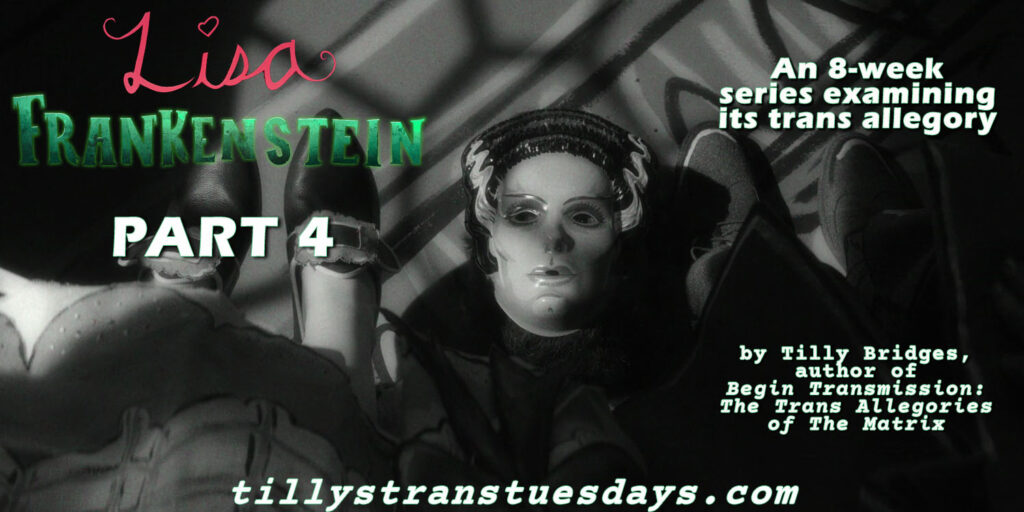
TRANS REPRESENTATION IN 2024 MEDIA part 3: TV part 2

Welcome to Trans Tuesday! Here we go with TILLY’S 2024 TRANS REP IN MEDIA, part 3: TV part 2! We finish our discussion on trans rep on complete seasons of tv that I saw last year, and then look at the overall numbers and see how they stack up my past two annual reports! Spoilers abound!

As we get to overall totals and comparisons this week, be sure you’ve read 2024 TRANS REP IN MEDIA, part 1: MOVIES and 2024 TRANS REP IN MEDIA, part 2: TV part 1!

My Adventures With Superman s2 – 1
In one episode there is a “Metropolis’ Most Eligible” contest, but note it doesn’t say “bachelor” or “bachelorette!” And one of the finalists is non-binary and has they/them pronouns! Even though they have no lines, it was nice to see.

Only Murders in the Building season 4 promo poster, showing Martin Short, Steve Martine, and Selena Gomez surrounded by movie film with photos of the season’s guest star cast in the frames.

Only Murders in the Building s4 – 0
Okay, this one got rough, which is really sad because this was my warm comfort show. This was the worst offender on trans jokes that I saw all year. Past seasons weren’t like this! Did something change behind the scenes and some transphobe got more power or something? I’m so baffled.

This season there are a set of sisters called the Brothers Sisters, which is supposed to be a joke, but why is that funny? Because they’re called brothers when they’re sisters, right? Which feels half a step from a misgendering joke. They also both kind of have deep voices. They make a point that one is really strong, they dress weird, nobody wants to be around them, and in flashbacks to college they’re both kind of wearing suit coats. And I’m just saying all of that sure is a big coincidence isn’t it? I’m counting their entire concept as a joke at our expense, and their portrayal as another joke that’s a dig at trans people.

For a while Oliver impersonates a midwestern grandma to spy on his girlfriend on Instagram, and he affects a voice for her, and they sure didn’t pick a midwestern grandpa for him to impersonate did they? More of “men acting like women is funny,” so this sweet show I adored is now up to three jokes at trans people’s expense.

Episode 5 has a very bad pronoun joke. Charles is telling a story about their mystery killer, and starts off saying “he or she” and then says “I’m just going to stick to male pronouns because it’s easier even if it’s not accurate,” which is what transphobes do to us all the time! The SAME episode has an Ace Ventura joke (with the movie mentioned by name, and if you’re not familiar that movie is HORRIBLY transphobic and makes a mockery of trans women and hits almost every bad trope about us). And the episode ALSO has a Harry Potter joke! Which is of course always awful because of its creator JK Rowling, who might be the world’s biggest transphobe and uses her billions to try and strip our rights away.

A horrid pronoun joke that’s in line with what transphobes say, an Ace Ventura reference, AND a Harry Potter joke, and all in one 22-minute episode is like a transphobic hat trick. What the fuck. 

In a brief scene Paul Rudd’s character, who has an outrageous fake Irish accent, calls another man “lassie” for… lulz i guess? Another misgendering joke.

I’m so, so mad and disappointed. But don’t go blaming the cast for this, they likely don’t even know that so much of the season was stealth transphobia right under the surface. You don’t see it until you see it, you know?

But this was a show that was so dear to me, and to have it repeatedly make a mockery of my existence hurts like hell. 

Orphan Black: Echoes s1 – 0
The show is set in the 2050s and a teen girl is bored by a “cishet” relationship, which isn’t really anything to talk about but it’s so rare to hear “cishet” in anything I thought it worth a mention!

In the finale a bad guy calls Kristen Ritter “dude,” but I don’t know why, not a joke and he’s being a dick at the time. Is that a deliberate misgendering of a cis woman? Or just the “words for men are okay to use for everyone” thing our society does creeping in again? I don’t know.

Quantum Leap s2 – 2
Ian is still in the main cast, a nonbinary character played by nonbinary actor Mason Alexander Park, who remains fantastic.

There’s an episode with a nonbinary character named Dean, played by nonbinary actor Wilder Yari, who wears a makeshift binder and comes out to their family, and it also includes discussion of what nonbinary means and they/them pronouns (it’s set in the 1950s so the characters didn’t have that terminology, but learn it from our time-traveling lead, Ben). 

This episode was written by Shakina, who wrote the super trans episode of this show back in season one, and it is again fabulously done. Be sure to check out the Trans Tuesday INTERVIEW WITH SHAKINA when I talked about it with her.

Along with Heartsopper, the Quantum Leap reboot was one of the bright spots of trans rep in television each year. It has sadly since been canceled, soooo trans rep may be taking another nosedive next year.

Resident Alien s3 – 0
There’s a lady alien with wings and feathers that keeps getting called a “bird lady” or “bird person” and she says “my noun is avian” which is just anoooooother recycled pronoun joke. 

Shrinking season 2 promo poster with Jason Segel and Harrison Ford sitting on adjacent benches in a park, Ford’s got one arm extended and his hand on Segel’s shoulder

Shrinking s2 – 0
In one episode the lead character Jimmy wakes up screaming from a nightmare and someone overhears and says they heard “an old lady screaming”. Yet another “anything feminine associated with a man is funny” joke.

Also a cis woman tells another cis woman she has to “sack up” and do a thing she doesn’t want to, but it’s not a joke or anything. Just another instance of the way our society says it’s cool for women to say and do stuff men do, whereas the opposite is to be derided and laughed at.

In another episode a cis woman says to a cis man friend, “such my dick you big dumb bitch,” and it’s played for laughs. It’s a joke. Ha ha women with penises are hilarious!

I’m so tired.

In another episode a gay man and his husband are thinking about adopting a kid and someone says “Jimmy’s having a baby!” And a guy responds “You’re not even showing.” Which I think is another “men being pregnant is hilarious” joke, because if that played out exactly the same but “Jimmy” was a woman it wouldn’t be a joke, would it? There was a show last year, UPLOAD, that did a whole terrible protracted scene around the joke of a man being pregnant, ignoring the reality of trans men entirely. I talked about that in 2023 TRANS REP IN MEDIA part 3: TV part 2.

When a cis woman hands a cis man a baby and he asks what to do if it gets hungry, she says “you’ve got nipples, whip out a titty.” A MAN with BREASTS and BREASTFEEDING, so hilarious, can you even imagine. Ugh.

And here’s the thing. This show is about mental health and forgiving ourselves (and others) and is generally positive and uplifting. But look at all those stealth transphobic jokes that worked their way into it.

I should mention this show is from the same folks who made Ted Lasso… which you can also hear me talk about in the 2023 TRANS REP IN MEDIA part 3: TV part 2 report, because that show was called “the kindest show on tv” and it ALSO had a LOT of stealth transphobic jokes. 

These folks keep making shows about being good and kind humans, but can’t see their own implicit transphobia and it keeps making me feel like their kindness is reserved only for cis people.

Silo s2 – 0
Is this show still a remarkable trans allegory? I believe so. Will I do another full write up on it, like THE UNINTENTIONAL TRANS ALLEGORY OF SILO Trans Tuesdays? I very well might. We shall see! There were some moments that felt allllllmost intentionally trans, as in season 1, so my gears are definitely turning.

No out trans or nonbinary people are involved with making it, however, as far as I know.

Skeleton Crew s1 – 0

Slow Horses promotional poster with Gary Oldman and the rest of the cast behind him.

Slow Horses s1 – 0
In one episode some right wing bigots are sitting in a house with someone they abducted, and one comes in and looks at a carton of milk by the tea (yes there’s tea even for bigots, it’s a very British show). He says “oh, you got milk,” and the cranky leader dude replies with “no, he lactated it.” Another joke about lactating men, and yeah these are literal bad guys, but it wasn’t making fun of them for being ignorant and bigoted, it was a joke about how funny it would be if a man lactated (and hey, some trans men do). Very very tired of this crap.

In another episode a character is about to show off his hacking progress and says, “ladies.” There are two women and a man with him. The man speaks up and says, “…And gentleman.” And the first guy looks at him and pointedly says, “LADIES.” Misgendering for humor! Because it’s just so funny, isn’t it?

COME ON.

Slow Horses s2 – 0
The boss at MI5 is a lady who everyone calls “ma’am”. One of the enforcers at MI5 is arguing with someone under her command, and she dismisses the enforcer and the guy under her command smiles and nods at the enforcer, and calls him “ma’am.” AUGH YOU DID IT AGAIN STOP IT STOP IT.

Slow Horses s3 – 0
In one episode a man knees another in the groin, and when the victim reacts in pain the attacker says something to the effect of “that didn’t hurt, you’ve got no balls” with the implication that you’re not a man without testicles. But hey, that’s a lot of trans men! Sigh.

In another episode a cis male character says to another cis male character, “hold on to your tits” when he’s about to drive fast. These jokes are insidious and everywhere.

Slow Horses s4 – 0
But no jokes about us this time, oho! How sad is it that that is progress.

I want to add I LOVE this show. A lot.

It also makes a lot of bad gender jokes that are implicitly transphobic.

Two things can be true.

Somebody Somewhere s3 – 1
Fred Rococo is back as a main supporting character, played by trans man Murray Hill. He’s so great, as always, but he felt a bit underutilized this season. 

Fred Rococo spinoff when?

Star Trek Discovery s5 – 3
Nonbinary character Adira is still a main cast member, played by nonbinary actor Blu del Barrio. 

Trans man character Gray returns for a couple episodes, and is still played by trans man Ian Alexander. 

Another character with “they” pronouns briefly talks to someone about drag racing. In another episode there’s an alien species that has three genders, and the third uses they/them pronouns.

This was the queerest (and least white) Star Trek show, but it’s done now and I’m sure going to miss it. It was the first to really live up to all of Trek’s inclusive ideals in terms of cast.

Star Trek Lower Decks s5 – 0

Star Trek Prodigy s2 – 1
Zero is still in the main cast and is nonbinary, but is played by a cis actor. But alllso Zero’s story this season is a trans allegory, and I can tell you it was definitely intentional because it’s what my wife Susan and I were brought in to help them with and consult on! We worked on a Star Trek! Hell yeah. 🖖

Superman and Lois s4 – 0

We Are Lady Parts s1 – 0
So this show is about an all Muslim woman punk band, which is amazing, but one of their songs is called “Voldemort under my head scarf”. Now listen, it’s not ABOUT Harry Potter shit, it’s about people who are afraid of a hijab like there’s something evil underneath it. Buuuuut they say his name like twenty times and drop Harry Potter house names too, and as a trans woman that’s just absolutely no fun to watch. Which is sad because I actually like the song!!

In the pilot a cis lady asks another cis lady “why are you such a boner-killer,” ha ha women with penises, that old hilarious chestnut. 

In episode 2 the same character calls her cis lady friend “bro,” but there is a LOT of this throughout the entire series. I suspect it’s true to the culture (it’s set in the UK), but there’s also just a ton of it. Saying things to each other like “nice one, man,” or multiple times they refer to each other as “lads.”

We Are Lady Parts s2 – 1
There’s yet ANOTHER song with a Harry Potter reference. And as this show is made in and set in the UK, they have to be even more aware of JK Rowling’s transphobia, right? If you know that and you’re still including Harry Potter references, that’s pretty bad. Of course I have no way to know if they’re actually aware of Rowling’s hatred or not.

Nonbinary actor Libby Mai is in one episode playing Chelle, though the character’s gender is never mentioned.

Now here’s something weird. In episode 3 of season 2, there’s a Martina Navratilova reference, when a millennial lesbian says she had posters of her on her bedroom wall as a kid. I’m not sure the timing there even lines up right for when millennials were kids and Navratilova was popular in the world of tennis, but Navratilova is also a known transphobe now.

Given this and the repeated Harry Potter references, it’s got me feeling wary and a little bit suspect. It could all still be coincidental, but there could also be someone behind the scenes who shares some views with some famous transphobes. 

What If s2 – 0

What if s3 – 0
One cis woman calls a group of three other cis women “guys.” And they’re all from alternate realities, so I guess dudes are just so good that words for them get applied to everyone in every universe. So that’s… cool.

What We Do in the Shadows s6 – 0
There’s one joke about a man with “a lady’s haircut,” ha ha funny right? C’mon c’mon, the show’s so much better than a joke that low.

There is also… a Harry Potter joke. COME ON. Like even if you don’t know about JK, it makes me wonder if you don’t know or if you do and you agree with her. Please stop referencing her, for the love of all that is good in the world.

The penultimate episode features Coney Island carnie vampires and one is a bearded lady. She has no lines but at least isn’t played for a joke. Though she does appear with a troupe of carnival sideshows, which is bad. We’re not freaks for your amusement.

That brings us to the end of my report! I mentioned way back in PART 1 of this 2024 trans rep in media report that some other folks sent in some of their own reports for inclusion, so I’m going to mention those here. Please note I have not personally seen these shows or movies, though I trust the people sending them in did their best to be accurate.

The lovely Duna sent in these:

Acapulco s3 – 0

Bodkin s1 – 0

Constellation s1 – 0 

House of the Dragon s2  – 2
Nonbinary actor Emma D’Arcy has a lead role, though the character uses she/her pronouns.

Abigail Thorn appears in this show as well, in the season finale, playing a character that seems quite likely to continue into season 3. She plays a woman pirate that’s respected, feared, and has many wives. There is mud wrestling. (I am suddenly interested in this show). Abigail’s character is not mentioned as trans, but the show sets expectations that her character is a man so that her reveal is a surprise… and that’s not great, and kinda feeds into the “surprise” “trap” aspect a bit. But again, as I’ve not seen this myself, I can’t really comment on if it fell into or deftly avoided that trope.

A Murder at the End of the World s1 – 1
Nonbinary actor Emma Corrin stars, but plays a cis woman.

Outer Range s1 – 0 

Outer Range s2 – 0
Duna said it seems like there’s some going out of the way to set up a couple transphobic lines. As an example, there’s a man named Trudy who seemingly exists just so someone can grumble “that’s a goddam woman’s name,” and then is rarely seen again. Well! That’s not great.

Palm Royale s1 – 0

The Power s1 – 2
Episode 3 introduces Sister Maria, a trans woman character played by trans actress Daniela Vega. Maria explains her coming out story and how their convent for wayward girls was formed by a group of nuns who were excommunicated from the church for standing up for justice during the AIDS epidemic. After this episode her character is still around but not featured as much.

Episode 6 reveals a character to be an intersex person who has the power. He explains that he identifies as a guy. Played by Nico Hiraga, who is not openly intersex as far as we know.

Presumed Innocent s1 – 0 

Time Bandits s1 – 0

Velma s2 – 1
There’s a nonbinary character, Amber, voiced by nonbinary actor Sara Ramirez. They/them pronouns are used. There’s a scene where men and women are being separated and Amber loudly asks where they should go if they aren’t either. 

There is a secret facility where one character puts people’s brains in a jar so they can figure out who they really are while they have no outside influences, then puts them back in their body. In the examples shown, clearly some of them come out of that experience happily queer. This is kinda glossed over, and Duna felt it deserved more attention! I would concur!

The Walking Dead: Daryl Dixon s1 – 0

And then I got one report from my fab friend Jenn Wallace, on X-men 97 s1 – 1
The character of Morph is nonbinary and uses they/them pronouns, and is played by genderqueer actor J. P. Karliak.

Jenn says that everyone knows the X-Men are a queer allegory, but she feels this season was an intentional trans allegory.

Okay, so where are we at with the totals?

Just for recent movies and seasons of television I, a trans woman screenwriter, saw 26 movies and 43 seasons of tv in 2024. And in our totals, we have:

23 trans or nonbinary actors
25 trans or nonbinary characters
30 jokes about trans people

And I counted four instances of bad representation, and ten good. (Keep in mind the joke total would have been much higher if I’d counted every instance of jokes about Ava’s “big hands” on Hacks).

When we add in the reports Duna and Jenn sent me, the new totals for 26 movies and 58 seasons of tv in 2024, we have

29 trans or nonbinary actors
29 trans or nonbinary characters
31 jokes about trans people

This shows representation as still not equal to the jokes made about us, even if most of those jokes were implicit. That’s terrible!

And the news is even worse, because in 2023, these were the numbers across 31 movies and 44 seasons of television, I found:

31 trans or nonbinary actors
20 trans or nonbinary characters
16 jokes about trans people

In 2022, the first year I did a trans rep report, across 22 movies and 62 seasons of television, I found:

22 trans people
15 jokes about trans people

And so what you see looking at these numbers is that actual trans people showing up, and actual trans characters in our media, hasn’t really changed, but the amount of jokes at our expense (even if implicit) has dramatically risen.

I wish I could say I was surprised, but given the propaganda war the Republicans have waged against us, and the Democratic party, as a whole, barely standing up for us if they even do at all… this is what you get.

It feels like gender norms are going back to being more rigid, “deviation” from those arbitrary, restrictive, and reductive norms is being further ridiculed and punished.

And while the trans rep numbers in what I’ve personally seen have remained somewhat steady, with the loss of Quantum Leap and Kaos (and rarities like I Saw the TV Glow and People’s Joker not happening that often), and the way trans and queer projects are routinely canceled, I fear next year’s numbers will be grim indeed. Also keep in mind that while the rep numbers were about the same, not all of that rep was good and some did active harm to us, on screen and off.

And then remember that Heartstopper alone makes up almost a quarter of all trans rep I saw last year.

Cis writers, producers, executives, publishers, and editors: YOU can help fix this. Art can change hearts and minds, and we NEED better and more trans rep across the board.

Hire us and help make it happen. We can fix this together.

I’m tech avail!

Tilly Bridges, end transmission.
tillysbridges@gmail.com


ADDENDUM 2/8/25

A reader let me know that Eva Everett Irving, in Orphan Black: Echoes, is a trans woman. The character is never mentioned as trans, and I missed her when looking up cast from so many shows.

I will add that there’s no reason her character couldn’t have been trans, tho, so why not just say in the show that she is and give us more of the representation we need? Otherwise even trans people watching, even trans women screenwriters specifically looking for trans representation, might miss it. And if we don’t know the representation is actually there, how can we feel represented?