Trans Life

THE 2022 US TRANS SURVEY RESULTS, part 4

Welcome to Trans Tuesday! This week we continue with more hard data on trans life in THE 2022 US TRANS SURVEY RESULTS, part 4! We’ve got satisfaction rates, numbers on detransitioners, and mental health!

A quick warning before we get into things: there will be some discussion of suicide rates and prevalence, and where that stems from in regards to trans people, as that’s one of the things the survey got a lot of data on. If that will be difficult for you, you may want to skip this essay.

All right, let’s dive in.

  • 60% of respondents reported undergoing some form of medical transition, including hormones or surgeries. 88% of respondents expressed a desire for gender-affirming hormone therapy, but only 56% reported ever receiving hormone therapy. Among those who have started hormone therapy, 90% were currently taking hormones, indicating a high prevalence of continuation.

Oh shit, almost like it really works well for its intended purpose huh?

  • 29% of respondents reported receipt of at least one gender-affirming surgery. 98% of respondents taking GAHT reported that taking GAHT made them more satisfied with their lives, and 97% of respondents who underwent gender-affirming surgery reported their surgery made them more satisfied with their lives.

NINETY-FUCKING-SEVEN PERCENT SATISFACTION RATE. Are you even kidding with these claims that it’s harmful? No other medical interventions or procedures have that high a satisfaction rate! Not even close.

Let this be your reminder that according to the World Journal of Surgery, the average regret rate for ALL surgeries for ALL people is 14.4%! For trans people the regret rate is less than one percent.

Gender affirming care fucking works.

But what about detransitioners? So glad you asked.

  • All respondents currently identified as trans and nonbinary, but 9% had gone back to living as their sex assigned at birth at least for a little while at some point in their lives due to challenges related to social acceptance.

Emphasis is mine there, but bigoted cis people are the reason for those 9% who detransitioned.

  • Respondents primarily reported social and structural reasons for living as their sex assigned at birth. For example, the most common reason was that it was “just too hard to be transgender in [their] community.” Other common reasons included pressure from a parent and experiencing too much harassment or discrimination.

Bigoted cis people making our lives miserable. The biggest hurdle we face.

But what about people who detransition because they’re not actually trans? Shouldn’t we worry about them and make transition care harder to access? For their safety, never mind the horrible impact putting more barriers between actual trans people and our transition care causes, I guess?

  • Of all respondents who had medically transitioned, only 0.36% went back to living in their sex assigned at birth at least for a while because gender transition was not for them.

Zero
Point
Three
Six
Percent
!

Not even half of one percent! Should detransitioners who are not actually trans, and are cis people who made a mistake, or are trans but discover transition isn’t right for them, be supported? Absolutely. Should their mistake be held against the 99.64% of people who are trans and need it?

AB-SO-LUTE-LY NOT.

For those trans and nonbinary people who needed access to abortion-related care:

  • 37% were unable to find abortion providers who knew about trans healthcare

And because they were trans:

  • I didn’t feel welcome in an abortion providers office/clinic – 79%
    Provider used harsh or abusive language – 38%
    I was verbally harassed by staff or others at the provider’s office – 32%
    Provider refused – 24%
    Provider was physically rough with me – 15%

I want to point out this wasn’t them seeking abortion-related care from places who won’t provide abortions for a multitude of bad reasons, this was them going to abortion-care providers who you’d think would be more accepting of trans people. But even there, we see transphobia is a huge issue that cannot be escaped.

Let’s take a look at some data about trans people and our mental health.

  • 44% of respondents met the criteria for serious psychological distress, compared to less than 4% of the general U.S. population. A majority (81%) of respondents indicated that they felt down, depressed or hopeless at least several days over the past two weeks (prior to taking the survey). Three-quarters (77%) reported little interest or pleasure in doing things at least several of the days over the past two weeks (prior to taking the survey).

Look at what societal transphobia does to us. We experience over TEN TIMES MORE PSYCHOLOGICAL DISTRESS than the general population!

I pale at the thought of where those numbers are in 2025.

  • In the year prior to the survey, 38% of respondents considered suicide. Of those who considered suicide, 41% made corresponding plans. These numbers are dramatically higher than the general population’s at 5% and 1% respectively. Victimization, such as being verbally harassed, denied equal treatment or service for any reason, such as at a place of business, government agency, or public place, or physically attacked, was associated with greater suicidality.
  • 31% of those who had no victimization considered suicide in the past year, compared to 50% for those who were verbally harassed, 53% for those who were denied equal treatment, and 63% for those who were physically assaulted. 78% of respondents considered suicide and 40% attempted suicide at some point in their lifetime. These statistics far exceed the 13.2% and 2.4% reported for the general population.

All of that, all of it, is due to transphobia and cisgender bigots. 

It’s not being trans that’s difficult, it’s the way cis society treats you when you’re trans that’s so hard to deal with. (GENDER DYSPHORIA is horrible, but if we’re supported and affirmed right away and aren’t forced to live with it for a lifetime, we can immediately do things to address it).

Really take that in and sit with it, cis folks, and let it inspire you to stand up for us when you know we need you to, because we need you to.

  • While 78% of respondents wanted counseling for gender identity or transition, only 48% received mental healthcare for it. Among respondents who discussed gender identity with a counselor, 12% reported that their mental healthcare provider tried to persuade them to identify only as their sex assigned at birth. Notably, this was much higher (50%) among those who consulted with religious counselors or therapists.
  • In [the survey’s] sample, 44% of respondents meet the criteria for Serious Psychological Distress. According to the National Health Interview Survey, less than 4% of the general U.S. adult population met the criteria for SPD.

I don’t even know what to say about this. I’m so mad. So mad.

It is important to note that SPD was more common in younger trans folks, and more common in AFAB nonbinary people and trans men than any other groups.

  • The [survey] sample had 6 times the prevalence of past-year suicidal ideation compared to the general population (38% vs. 5%) Further, 16% of [survey] respondents made a plan to attempt suicide, substantially higher than the 1% reported in the general population.

    Research suggests that structural factors like state- level discriminatory laws and policies, as well as stigma and hostile sociopolitical climates, contribute to the disproportionately high prevalence of suicidality seen among the trans and nonbinary community.

When trans people tell you that these transphobic laws stripping us of our rights, our healthcare, our ability to exist in public will result in dead trans people, that’s not hyperbole. It is legislative violence.

Living with that kind of oppression is too much for some people to handle, and more importantly no one should ever have to try to handle it.

  • Research focused on trans and nonbinary people have found that social support may be one of the most important factors in reducing suicidal thoughts and suicide attempts. Supportive families may play a crucial role in the wellbeing of USTS respondents. The survey asked respondents who were out to their family how supportive their immediate family was. Those with supportive families reported less suicidality compared to those with unsupportive families: 78% vs. 85% for ever considering suicide and 38% vs. 51% for ever attempting suicide.

Supporting us, standing up for us, standing with us? It’s literally life-saving. We need you.

  • 72% of medically transitioned and 71% of socially transitioned respondents were “Very to pretty happy” compared to 55% and 52% of those who had not medically or socially transitioned, respectively.
  • Medically and socially transitioned respondents were thriving more (37% and 36%, respectively) compared to those who had not transitioned (19% and 18%, respectively).
  • Respondents who had medically or socially transitioned reported substantially higher life satisfaction (43% and 43%, respectively), compared to 27% and 24% among those who had not medically or socially transitioned, respectively.

Medical transition (for those who want it) works.

Medical transition works!

IT WORKS!

  • Happiness levels varied substantially by social and medical transition status: nearly three-quarters of those who had medically transitioned reported being “Very to pretty happy” (72%) compared to over half of those who had not (55%); those who had socially transitioned also report higher happiness (71%) compared to roughly half of those who had not (52%).

Even socially transitioning shows a huge increase in quality of life and happiness!

These 2022 US Trans Survey results are so important, because it’s evidence of what trans people have been saying for… well, forever really.

We know who we are and transitioning, socially and medically, works.

And withholding it from us, legislating against it because it makes you uncomfortable, because it proves cishetero patriarchal white supremacy is founded on lies, is cruel and unconscionable.

Hopefully you already knew that. If you didn’t, now you do.

And we’ve got the data to back it up.

Tilly Bridges, end transmission.
tillysbridges@gmail.com
THE 2022 US TRANS SURVEY RESULTS, part 3

Welcome to Trans Tuesday! Some final results from the largest-ever survey of trans people have finally been tabulated and released, so let’s talk about THE 2022 US TRANS SURVEY RESULTS, part 3! This week is all about our experiences with healthcare providers. Spoilers: there’s problems!

I’ve previously covered this survey, and how important it was to have one not just on this scale, but run and administered by trans people. The survey was so large that we’re only now, midway through 2025, getting some final results from it, three years after it was conducted.

We first got a glimpse of the data contained in this survey in 2024, when the early insights were released. I covered those in detail, so you may want to check out THE 2022 US TRANS SURVEY RESULTS part 1 and part 2 before reading this essay.

The newly released data is titled “Health and Wellbeing,” which leads me to believe there will be further detailed results released in other categories later on. But there’s a wealth of info in here to talk about, so let’s get into it. It’s over a hundred pages long, so I can’t cover all of it, but I’ll try to highlight some of what I think is the most important.

If you want to read the results yourself, which includes detailed breakdowns of statistics by race and age and gender and transition status, you can do so here.

I’m just going to be talking about and trying to parse some of this data to make it more easily digestible, but do have a look if you’d like to read through it yourself.

There were over ninety-two thousand responses, and while they did include those from 16 and 17 year-olds, this particular report only includes data from those 18 and older. 

Let’s go!

  • US Trans Survey respondents reported worse overall health compared to the general population: 66% rated their health as “excellent,” “very good,” or “good,” compared to 81% in the general population. 34% reported “fair” or “poor” health, compared to 18% in the general population.

    Social and medical transition was associated with better health—67% of respondents who had socially transitioned reported good or better health compared to 61% of those who had not. Further, 70% of respondents who had medically transitioned rated their health as good or better, compared to 58% of respondents who had not medically transitioned.

What this pretty clearly shows is that access to transition care improves our health overall, which is likely partly due from the actual transition medical care, and partly due from transition making so many of us actually care about our bodies (and lives!) and wanting to take better care of ourselves. Which can be really hard to do when you feel trapped inside a waking death (see GENDER DYSPHORIA for more).

Just gonna reiterate not every trans person has dysphoria, and you don’t have to have it to be trans. Do not misconstrue a very difficult thing many of us deal with for a requirement of transness (that’s TRANSMEDICALISM babe).

But then there’s these barriers for many trans people who may want to see a doctor, but don’t:

  • 28% of respondents did not see a healthcare provider in the past year due to cost. … 24% of respondents avoided healthcare in the past year due to fear of being mistreated as a trans person.

Basically a quarter of us couldn’t afford it and a quarter of us were afraid of being mistreated because we’re trans. I don’t know what the overlap is there (people who both couldn’t afford it and were afraid to go anyway due to transphobia), but that’s a big, big chunk of us.

  • 50% of respondents said all their healthcare providers knew they were transgender… 24% of respondents said none of their providers knew that they were transgender.

Holy shit, a whole lot of us are hiding our transness from at least one (or all) of our healthcare providers. And the only reason to do that is the fear of mistreatment, or of having explicitly trans healthcare on your medical record (meaning it would then have to be stopped if laws outlawed it). For example, I only have access to HRT through my insurance because my doctor gave me a diagnosis of gender dysphoria.

I’ve asked them if they would change it to “unspecified hormone disorder” or what have you, like many good doctors will do, so that if trans HRT is outlawed, mine could continue. They said no. Yay.

  • Among respondents who visited a healthcare provider in the past year, nearly three-quarters (73%) said they had at least one healthcare provider that knew they were trans and treated them with respect… 

That’s great! 73% is huge! But-

  • …nearly half (47%) experienced at least one negative interaction with a healthcare provider.

Oooof. And note that negative interaction with a healthcare provider is because they were trans.

  • The most common negative interactions were that healthcare providers used the wrong names or pronouns (37%), respondents had to teach their healthcare provider about trans people to receive appropriate care (18%), and healthcare providers asked unnecessary or invasive questions about the individual’s trans status that were unrelated to the visit (11%).

I’ve personally dealt with the first two of those, and let me tell you… misgendering and deadnaming from your doctors is bad, but having to teach them about advances in trans care, or even basic trans care things, is even worse. Because it is their job. AND YET.

For so much more on this see COMPLETE TRANS HEALTHCARE (or lack thereof), ANECDOTAL TRANS HEALTHCARE, HORMONE REPLACEMENT THERAPY, and DISCRIMINATORY BUREAUCRACY.

And for a detailed instance of my own mistreatment at the hands of healthcare professionals, and how one good doctor who was a PROACTIVE ALLY turned it all around for me, see NO ESCAPE 2: SOME ESCAPE.

  • Among respondents that were refused transition-related care, the most common reason was that the provider was not familiar with treating trans people (41%).

But Republicans will tell you doctors are pushing trans care on people to make the big bucks. Never mind that almost half of the doctors we trans people tried to get care from said, “eh, sorry, I don’t know how.”

In the twelve months prior to the survey, for those respondents who had health insurance and experienced difficulty getting transition-related care from them, these were the reasons:

  • Only covered some of my transition-related surgical care – 45%
    Denied me other transition-related medical care – 23%
    Denied me transition-related surgery – 20%
    Covers surgery but didn’t have any in-network providers – 17%

    Wouldn’t change my records to list current gender – 16%
    Wouldn’t change my records to list my current name – 12%
    Denied me transition-related hormone therapy – 11%
    Denied me gender-specific healthcare because I am trans – 5%
    Denied me routine healthcare because I am trans – 3%

Yeah, transition healthcare is big bucks that’s why so many insurers won’t even cover all of it. And some of that is maddening, like… you cover transition surgeries but don’t have any in-network providers?

THEN YOU DO NOT ACTUALLY COVER IT, DO YOU?!

Augh.

The survey notes that these numbers are (generally) an improvement upon the previous survey, conducted in 2015, but that had a much smaller sample of respondents and a different cross-sectional sample of people who took it. 

But remember the 2022 survey’s numbers are for trans people’s experiences in 2021.

Where do you think they’re at now, in 2025, with ever more states banning transition care and hospitals and entire providers complying with fascism in advance and discontinuing trans care?

Yikes.

Be sure to come back next week as we get into transition satisfaction, detransitioners, and mental health!

There’s so much more important data to talk about. Don’t miss it.

Tilly Bridges, end transmission.
tillysbridges@gmail.com
Part 4 is here!

TRANS TOUCH 3: SEX AND BEING TOUCH-STARVED

Welcome to Trans Tuesday! Let’s wrap up our discussion on trans folks and physical contact (which means yeah, we’re gonna talk about sex some) in: TRANS TOUCH 3: SEX AND BEING TOUCH-STARVED.

Of course, you’ll want to know my own personal experiences with physical contact in TRANS TOUCH 1, and the first half of our survey results about platonic touch and hugging, in TRANS TOUCH 2.

Onward!

Pre-transition, what were your feelings about being touched in a (consensual) sexual manner and sex in general? 29.9% enjoyed it, 25.2% indifferent, 16.9% sought it out, 15.5% avoided it at all costs, 12.5% hated it

Almost half of all respondents, pre- (or no) transition, liked sex and sexual touch. But that also means more than half did not like it. This doesn’t mean those people didn’t have sexual desires (though some ace folks certainly fall into that category), but that even if they desired sex or sexual intimacy, they didn’t like actually participating in it.

This gets really interesting when you look at the during/post transition responses.

After/during transition, what were your feelings about being touched in a (consensual) sexual manner and sex in general? 36.3% sought it out, 26.9% enjoyed it, 14.1% indifferent, 18% avoided it all all costs, 14% hated it


Some of those in the indifferent/hated it/avoided it at all costs categories are ace folks from the pre-transition question, and some are people who newly discovered they were ace with transition… but even still, the numbers dropped drastically.

Because when you look at those who now like it, it went from a little under half to 63.2%! And that number is higher if you factor in only folks who’ve transitioned, because nearly 14% who responded to this had not transitioned.

As with platonic/friendly touch, we see the same huge shift that transition brings to our desire to be touched.

Let’s dive into some of your complex and difficult thoughts around sex.

  • I sought out sexual touch pre-transition because it contained a tiny drop of gender-feelings.

I think, pre-transition, I never realized any gender feelings during sex because I dissociated through so much of it. But if I had any, I suppose it would’ve made me feel like I was being seen, perceived, and appreciated for being a man, and that’s the last thing I ever wanted. Hence the dissociation.

  • One of my reasons for not transitioning has been a fear of losing desire for touch and sex.

That can definitely happen when you change the hormones in your body (if you medically transition, and utilize HRT (link) as part of it), but it can also go in the other direction! A good doc (easier said than found) can help you navigate that and hopefully help you find what’s right for you.

  • Pre transition, my body disgusted me to such an extent that I couldn’t bear any physical contact. The idea of someone having sex with me would have meant that they were attracted to me physically, which would have been misgendering and felt wrong.

That’s where I was, except my sex drive was so strong I couldn’t really ignore it. So again… just dissociated through all of it.

  • It wasn’t until *well* after HRT brought my body and cognitive patterns into alignment, and some pretty hefty therapy work, that a lot of the shame and stigma around seeking consensual sexual pleasure went away … That’s not to say everything is perfect, because it’s not, but the quantity and quality have increased greatly. It’s wild to think about how much societal norms encourage us to effectively cut off and hide a major facet of identity, and incredibly empowering to finally be in touch with that part, and be accepted not just “despite it”, but also because of it.
  • Pre-transition ALL touch made me confused. At the time I would have said that I liked sex, but learning about what sex is for other people, that pleasure and desire aren’t just words… about how forced I felt to engage in hetero style sex. I had to sexualize all touch to get past my discomfort, which meant I couldn’t touch men at all. It also made me not touch my own children. I felt confused and uncomfortable pre-transition. Now I don’t. Now I desire social and affectionate touch. I do not know what I think about sexual touch, since everything I thought about sex was wrong. Since trying to understand sex in a male body, in a male role, resulted in intense dissociation. I think that there is the possibility that I could learn to experience sex once I can accept myself and my body as feminine, but it’s so fucking scary.

Heartbreaking.

  • Sex in particular changed the most for me. I never hated it or anything but I just never liked it. I’d perform because my partner enjoyed it but it always felt like a service to them and never really something I got much out of other than enjoying their enjoyment. Now, it is pure fireworks with the same partner and solo.
  • I have…actually worse experiences with sex post-transition, which seems to be a rarity from what I’ve seen other trans women talk about. My problem is that the hormones pretty much completely disabled my penis, and I actually *liked* that part of me. I have no desire to have bottom surgery, but the same hormones that help me deal with the secondary sexual characteristics that cause me such gender dysphoria *also* suppress the primary sexual characteristic which I wanted to continue functioning, and that is just…a particular kind of frustration that I haven’t really seen anyone else struggling with.

Let me just say that I know a whole lot of trans people, and while it may not be super common, you’re also not alone in liking that part of your body and wanting it to remain functional. TRANSMEDICALISM and gender essentialism will tell you that’s wrong, but those things are full of shit. You can be however you want to be, however feels right for you.

A good doc (so much easier said than found) might be able to help you get to where you want to be. Don’t be afraid to look for as long as it’ll take to find one who will listen to you.

  • I’m transmasc and although I’ve always enjoyed sexual touch, I’ve been telling partners that my chest is off-limits for years (even since before I began thinking of myself as trans or even nonbinary). I did not have conscious thoughts about why I didn’t want that, just a frequent physical sensation like nausea when I was touched.
  • I haven’t had any kind of romantic or sexual anything with anybody, it feels wrong doing it before transitioning, like cheating on everybody involved.

Important to note the wording here, ”everybody” involved, including the person who wrote that comment. It was actually partly the same for me, because I wasn’t really who the world or my sexual partners thought I was, and I wasn’t even me… to myself.

And here’s a couple folks who had the opposite reaction to sex than the majority!

  • Sex was the only time I *didn’t* hate my body. Taking care of my spouse during sex was the only time I felt my body was doing something right. It didn’t matter that I hated the shell I was in, …During sex… that was when I could banish the gender dysphoria away from my head. I didn’t realize it was gender dysphoria for a long time, but sex was when I was able to quiet the trouble in my head. 
  • Before transition…I enjoyed sex when it was with someone I had an emotional connection to. There were some times where I engaged in sex activities with people I didn’t have that connection with, and often times was very difficult for me in ways I couldn’t explain. I think the emotional connection could bypass dysphoria, but when it wasn’t there, dysphoria was all I had.

Oh! These sound almost similar to dissociating, only rather than disconnecting from everything entirely you were simply disconnecting from physical parts of it to hone in on the emotional, or your partner, and that was enough to keep the bad stuff at bay. 

Pre-transition, would you describe yourself as “touch starved,” - longing for more physical contact than you were getting? 58.7% yes, 41.3% no.


This one is pretty straightforward, with more than half of trans and nonbinary folks who took the survey saying they weren’t getting as much touch as they wanted.

After/during transition, would you describe yourself as “touch starved,” - longing for more physical contact than you were getting? 53.7% yes, 32.4% no, 13.9% have not transitioned


These numbers look somewhat similar to the pre-transition numbers, but when you pull out those who haven’t transitioned, or will not be transitioning, you see a much bigger shift.

194 respondents said yes they were touch starved, to 117 who said no. That’s 311 respondents, which means 62% said yes they were touch starved, and 38% who said no.

The numbers are still similar, though we see a perhaps surprising upswing in trans and nonbinary folks saying they feel touch starved during/after transition.

My feeling on this is that it’s due to being so much more aware of ourselves now, and our needs, and all we’ve been missing, that more of us have realized all the touch we’ve wanted but haven’t gotten.

Let’s see what people had to say about being touch-starved.

  • I was extremely touch hungry pre-transition, but felt so uncomfortable in my skin that I projected that feeling onto others and assumed that they also were uncomfortable with me touching them, and so my exact feelings are hard to place on a loved it/hated it scale because frequently it would be both at the same time for different reasons.
  • When I started having sexual relationships with women (still pre-transition) it was… Always touch starved but sought out a lot of physical touching. Always wanting to cuddle and hold hands. Sometimes downplayed these feelings slightly, asked for less than I wanted so as to not seem weird. After transitioning, I still craved touch the same amount, but I was now less ashamed of seeking it out, cause it’s considered more socially appropriate to be a cuddly huggy girl than it is to be a cuddly huggy boy. I’m only slightly less touch starved now because I have a similarly touchy and cuddly girlfriend, who can’t get enough of me either, but every time she’s not around, most of all I miss her touch.

  • A few months before HRT, around the time I finally accepted myself as trans, I also got into a relationship. This basically solved the “touch starved” part. I don’t think it’s a coincidence the acceptance and the relationship happened around the same time (as in, acceptance allowed me to open up).

Here’s a couple on the pressing need to fill the void we lived with for so long:

  • Would still consider myself feeling touch starved, but only because, in transition, I want more — as if making up for lost opportunities?
  • Before, I could enjoy physical contact (mostly sex, less so non-sexual touch) but there was rarely any feeling of emotion behind it. I was too alienated from my own body to even FEEL touch starved. Having transitioned, I can feel so much more deeply, both physically and emotionally… I often feel extremely touch starved, like I’m trying in vain to make up for all the years of physical/emotional affection I missed out on before I came out. Like there’s an invisible barrier between me and the people I’m around.

Yeah, right on the money for me. I’m so much more aware now of all I missed out on, and I need to fill that well. But there might not be enough hugs in all the world.

So, there’s the data I collected and the fascinating and thought-provoking responses you all shared.

Thank you to everyone who took the survey, and was so open, honest, and vulnerable about a difficult topic to discuss.

Nothing will ever change for us, for any of us, if we don’t talk about these things. Over time I noticed a definite pattern in all the trans people I know, both online and in meatspace, and knew it was something I needed to discuss. So that maybe things will change for us, for the better.

I want to close with two more comments folks left me. Here’s the first:

  • I never imagined that being in touch with my body (rather than ignoring it and disassociating from it) could feel so good. It does. This questionnaire actually quite helped me process, solidify, and crystallize these thoughts. Thank you.

Well that’s just the greatest thing! It always moves me when people reach out to let me know these essays have helped you, whether personally in figuring things out, in explaining how you feel or what you’re dealing with to people in your life, or in any of a hundred different ways.

That the survey itself could do that never even crossed my mind. That alone makes running the survey and compiling and sifting through the replies worth it. And here’s the last one:

  • Thank you for the work that you do.

No stop you’re gonna make me cry (too late). All I ever wanted was to use what I have to do what I can to help, and if I’m doing that, then it’s a job well done.

I couldn’t have done it without all of your help, so truly, I thank you all again. 

Because what we’ve discovered is not only that trans folks are as widely varied as cis folks (like I’ve said a million times before), but that when you look at the macro level…

a whole lot of trans people need a whole lot more of people touching us, holding us, seeing us, and letting us know we’re loved for who we are.

Hug a trans person every chance you get (if they consent!).

We need them now more than ever.

Tilly Bridges, end transmission.
tillysbridges@gmail.com

TRANS TOUCH 2: PLATONIC TOUCH AND HUGS

(header art by Natalia Lavrinenko on Pixabay)

Welcome to Trans Tuesday! Time to dive into your survey responses and see how other trans and nonbinary folks feel about physical contact in: TRANS TOUCH 2: PLATONIC TOUCH AND HUGS.

For my own personal journey regarding physical contact and my transition, and understanding why the entire concept is so difficult for some trans folks, be sure you check out TRANS TOUCH 1 first.

Before we get to the results of the touch survey I ran, I want to mention a few things.

This is not a scientific survey, because I am not a psychologist or sociologist, nor do I have the knowledge or resources to pull off a fully scientific study. I’m just one lady trying to help.

As such, that means this is all anecdotal, but then so is a whole lot of stuff regarding trans people, because we’re such a small part of the population that it’s not profitable for people to do a lot of studies on us. See ANECDOTAL TRANS HEALTHCARE for more.

Also, to keep this survey manageable for everyone taking it, and for me in compiling and talking about the responses, it simply cannot account for every factor that may impact people’s feelings around touch and physical contact.

Yes, some people who took the survey said their feelings around touch may be affected by autism, and others said they may be affected by PTSD or other issues. And some people who answered the questions around consensual sexual touch said they were asexual, which of course factored into their responses. 

But that’s all well outside the purview of discussing transness, and would have made the survey unwieldy and inscrutable for one lone (but very smart and beautiful) woman to make any sense out of.

My goal was to get a sense of trans people’s feelings around touch at a more macro level, to look for commonalities or things that stand out. I simply cannot account for every variation humans experience with everything else that might factor in. As such, please note that there may be varying reasons for all of these answers, but all of these answers are from self-identified trans or nonbinary people

And that was the point.

Also, while we can easily look at the total number of responses to poll questions… I also included a freeform portion at the end, for any additional thoughts folks might have. 

I did not expect three hundred and sixty-one people to take the survey, much less for the vast majority of you to put additional thoughts in, which ranged from a sentence to nearly full essays!

As such I cannot include the additional thoughts of everyone, or even the full thoughts of most of the comments I will share. Comments from survey respondents are excerpts and have been edited for length only. I did not, and would not, change the content of any of them. And I do not know who they’re from, because the survey was intentionally anonymous.

Ready or not, here we go.

Have you transitioned (for whatever “Transition” means to you). 361 responses. 83.7% yes, 16.3% no


The first question, as our baseline for who’s responding, was “have you transitioned (for whatever transition means to you).” I cannot define someone else’s transition. Nobody can define someone else’s transition, because it means different things to all of us. You will find no TRANSMEDICALISM here.

There’s not a lot to discuss here, except to note that the vast, vast majority of respondents, 83.7%, consider themselves to have transitioned (or to presently be transitioning). 

Pre-transition, what were your feelings about being touched, non-sexually, by other people (hand holding, a hand on your shoulder, etc)? 31.9% indifferent, 28% hated it, 18.6% enjoyed it, 11.6% sought it out, 10% avoided it at all costs

What we see here, is that during “pre-transition” (which includes folks who don’t feel they have transitioned yet, or never will), the negative feelings around non-sexual touch are remarkably high. If you group “hated it” and “Avoided it at all costs”, they amount to 38%. That’s well over a third of respondents having a remarkably negative view of being touched.

Only 30.2%, just under a third, liked it (“enjoyed it” being you liked it when it happened, “sought it out” meaning it was something you actively tried to find).

Nearly 32% were indifferent to being touched, which isn’t necessarily a negative view of it, but certainly isn’t a positive one either. What’s interesting, though, is that if you define the results by those who liked touch (30.2%) and those who didn’t, you find sixty percent of pre-transition respondents didn’t like being touched. And that’s pretty huge.

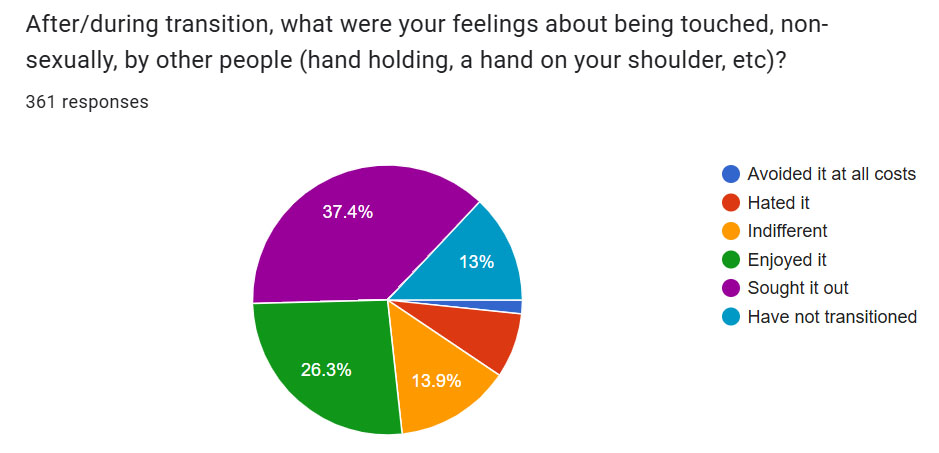
After/during transition, what were your feelings about being touched, non-sexually, by other people (hand holds, a hand on your shoulder, etc)? 37.4% sought it out, 26.3% enjoyed it, 13.9% indifferent, 13% have not transitioned, 7.8% hated it, 1.7% avoided at all costs

Holy shit look at that shift! Seeking it out went from 11.6% to 37.4%! Enjoyed it went from 18.6% to 26.3%! And those who were indifferent dropped from 31.9% to 13.9%! This is huge

Before, those who didn’t like being touched were the largest group, at 60% of respondents. Now it’s only 23.4%!

All of these numbers are a little higher if you reduce the pool of respondents to only those who’ve transitioned, as 13% of those who answered this question hadn’t.

But what you see here is an overwhelming positive shift to people liking or wanting platonic, friendly touch during or after transition.

Here’s some respondent thoughts around platonic touch, and how it may have shifted with transition.

Let’s start with some about the general change in body and mind that came with transition.

  • I enjoyed but was ashamed of, and uncomfortable with asking for, touch before HRT. I spent a very long time pre-HRT but out [as trans or nonbinary], and that persisted. Post-HRT I am still learning how to ask for touch, and there never feels like enough.

I had this too, where it felt like I didn’t “deserve” it. Because my body wasn’t mine, so anyone who wanted to touch it actually wanted to touch whoever it belonged to, and that wasn’t me.

  • I never could enjoy being in my headspace when I was touched pre-transition. I wanted to enjoy, but it felt uncomfortable. And I really regret giving off those vibes to my partner.
  • My feelings have changed in that I feel more protective and selective over my physical space. Idk if this comes from being less dissociated or what, but I’m much more aware of my body in a way that I like but that also has been a challenge to figure out.
  • Just the emotional and mental acceptance of being trans seems to have completely opened up a whole new world of touch sensitivity with my partner!
  • The thought of being touched sometimes makes me uncomfortable. Sometimes it’s sorta like repulsion, but without thinking “gross.” I just don’t want it. I’m pretty sure my dysphoria is part of this. The body I see is not the one I want and isn’t really me, makes it hard to find it enjoyable.

I absolutely went through that, too.

  • I didn’t realize how alone I felt, pre-transition. It was like existing in a void. Transitioning opened my eyes and revealed just how much I needed to touch, be touched, and be connected to the people around me.

Yes, yes, ten million thousand billion times yes.

  • Touch was something I needed to be careful with pre-transition, because touch is a short-cut to emotions, and emotions were dangerous. Now that I’m not trying to keep feelings bottled up all the time, there’s less need to avoid touch.

I also dealt with that, where if you opened yourself up to the feelings in that dark, cobwebby corner of your psyche that you knew you weren’t supposed to look into… you might find something you couldn’t put back in there. And then you’d have to deal with it.

  • Pre-transition I both enjoyed and avoided contact of all types, as in I craved physical contact but did not allow myself any.

Same. I was so alone, and scared, and all I wanted was that human connection. But I couldn’t get it, both because it might open up that dark, cobwebby corner, but also because my dysphoria made it impossible. See GENDER DYSPHORIA, where one example I give is like I was separated from everyone I cared about by a six foot thick invisible wall.

  • I never so much as held hands with a person romantically until after I had begun transition, at which point the affirmative desire for touch became more important for me.
  • After I got on [estrogen] and got more comfortable with my body, I started feeling like I needed [touch] more and feel increasingly frustrated by not getting it.

This absolutely happened for me too. Transition can help you realize all you’ve been missing, and then you want to fill that void as quickly as possible.

  • Before, it was more “someone is interacting with the body I wear.” Now, touch is “I am allowing access to an aspect of my vulnerability.”
  • Pre-transition, I *wanted* to have these forms of touch, but didn’t feel comfortable with actually accepting touch, and accepted that I probably just didn’t “deserve” it. Post-transition, I *still want* to have these forms of touch, but now I’m learning to be more comfortable with accepting touch, and how to communicate that with the people in my life.
  • Not having every interaction clouded with dysphoria is likely responsible for most of this, I feel like i was probably as affectionate a person as I am today I just didn’t let myself express it or understand why it felt so wrong to express.

This is common for a lot of us, where we find that transition didn’t change us so much as let us be more of who we already were.

Here’s a couple comments from folks on how just their egg cracking opened up new avenues.

  • I want casual touch with friends… I didn’t know this until half a year after cracking.
  • After my egg cracked I find touch of all kinds more palatable, despite not getting to do any transitioning yet.

Here’s some on the difficulties of touch that are compounded based on the gender society perceives you as. 

  • Before transition, I definitely felt less comfortable being touched, and felt weird about the concept of “being allowed” to enjoy touch, especially from women. Now that I’ve transitioned, I feel comfortable enough with myself and my body that I feel much freer to enjoy touch, and it turns out I really do want it after all.
  • As a trans woman, pre-transition me longed for touch and physical contact, but asking for it or even accepting it when offered felt awful, like I was being predatory. That feeling has faded dramatically as my transition has gone on and casual contact with other women is just good and normal and comfortable now.

I found this too, but also in ways beyond physical touch. See COMPLIMENTS and how the act of transition finally made me feel like I could compliment another woman on something as mundane as her shoes, and not have it be creepy.

  • I wonder how different the AMAB vs. AFAB experience is… as a trans guy, I personally feel very “starved” of physical contact. But back when I was still presenting as a cis female, it seemed like people wouldn’t keep their hands off of me. Do people avoid contact with me because I’m now trans? or because I’m now a man? It feels like a bit of both.

I feel like trans guys probably do get caught up in some folks’ aversion to being touched by cis men (for obvious and understandable reasons). Ask your trans guy friends if they want hugs!

And here’s a bunch on how feeling like we have BODILY AUTONOMY can drastically change things.

  • Touch has gotten much more comfortable for me, both post transition and with a better understanding of my own experiences, needs and boundaries. I enjoy being in my own body in ways I couldn’t before, including experiencing all kinds of sensations I used to hate — like exertion and the awareness of my own body that’s forced when I exercise. There’s plenty I’m still very uncomfortable with, but things are shifting in a good way. I also get a lot of joy and comfort from my cat, who is the reason I’m never touch starved. cats are amazing. and great at boundaries. my cat enforcing his own boundaries taught me so much, actually.

Yes. Cats are excellent at teaching people boundaries and bodily autonomy. They will accept your affection when they want it, and they won’t accept it when they don’t. That’s how it should be. (Cats are the best.)

  • Pre-transition, I sought touch as a kind of validation, despite the deep-seated internal sense that something was Wrong With Me. Post-transition, I’m much more able to enjoy touch for its own sake, as well as being an expression of love and affection. Simply put, my body feels like it’s *mine* now, so touch feels less like reassurance that I’m worthy of love, affection, and comfort, and more like an actual expression of those things.
  • I’ve been with my partner for years, and the biggest impact for her has been that “you don’t flinch when I touch you anymore”.

This one broke my heart a little, if only because I feel so much like that was me with everyone but my wife and kid, for all of my life.

  • Being touched in some ways felt like a violation of my body no matter what context pre-transition. Now that I understand my body there’s still plenty of dysmorphia/dysphoria, but it’s something I want to learn to navigate instead of just completely writing out of my life.

Just the desire to be open to touch changing is huge, truly. That’s where everything begins.

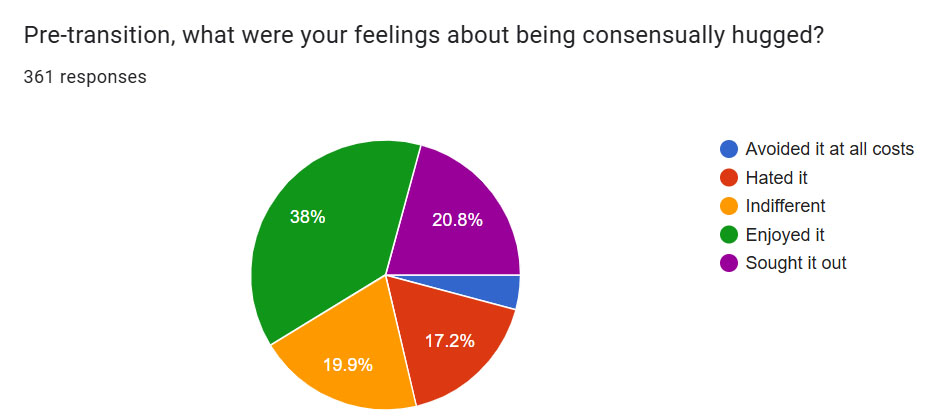
Pre-transition, what were your feelings about being consensually hugged? 38% enjoyed it, 20.8% sought it out, 19.9% indifferent, 17.2% hated it, 4.2% avoided it at all costs 

What you see here is over 50% of people pre-transition liking hugs, and much less on the negative side. Even when factoring in those who are indifferent, the majority still liked hugs.

I find this fascinating, because there seems to be a different view of hugs than of other non-sexual touch. I find hugs to be more intimate than holding hands, or a hand on the shoulder or arm, though maybe that’s just me.

Does this mean it’s more socially acceptable for people to hug, so we’re taught to do it more often and grow accustomed to it, even in spite of possible gender dysphoria? (not every trans person has dysphoria, of course, just to remind you)

I don’t know! But it’s incredibly interesting to me that there’s such a perception shift among these two kinds of platonic touch.

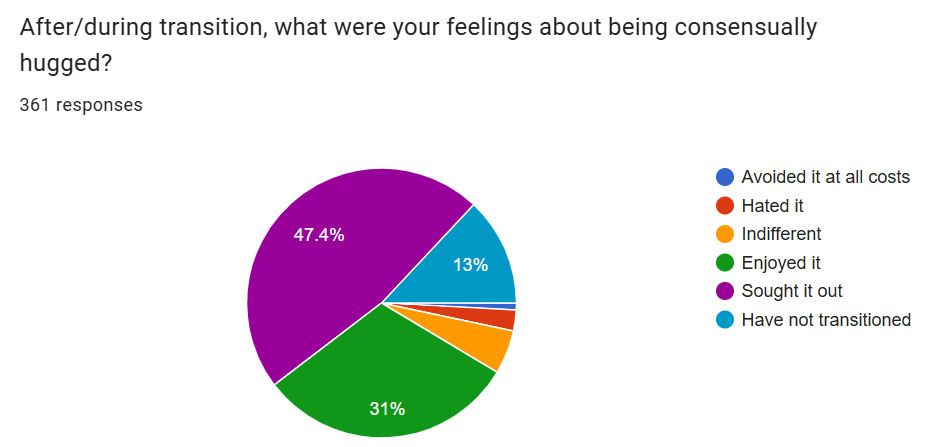
After/during transition, what were your feelings about being consensually hugged? 47.4% sought it out, 31% enjoyed it, 13% have not transitioned, 5.3% indifferent, 2.5% hated it, 0.8% avoided at all costs

Look at that huge shift again! Almost half of all respondents who’d transitioned (or are transitioning) now seek out hugs, and when you factor in those who also enjoy hugs, that’s well over 75% of those who’ve transitioned liking hugs.

I expected there’d be a positive shift in these things with transition… not just because it mirrors my own experiences, but because of what I’ve seen in all the trans and nonbinary people I know.

And yeah, again, this is anecdotal, but it also seems really clear that in terms of platonic touch (holding hands, a hand on an arm, hugs), transitioning does so much to make us more comfortable with them, and to like them.

It’s wild what feeling like your true self can do for you.

Let’s check out some of your comments around hugging.

  • Post-transition I feel like I have become a lot more sensitive to the social cues of others with respect to their intentions to make physical contact with me. I’m much less surprised now if someone hugs me, in part because I’m more comfortable, but also because I’m much better at noticing and understanding their intentions.

Yeah I relate to this a lot. It’s like you finally understand why someone would want a hug, to wrap someone in their arms and be wrapped up in return. It was legit hard to understand when everything about my body made me scream in horror.

  • I wish more people could be non-sexually physically affectionate (more hugs, holding hands, just being in contact) without making it weird or assuming there’s something more going on. I think that would be so so nice.

I think so too! I mean, with consent, of course. Normalizing closeness would go a long way to alleviating a lot of the isolation and loneliness that so many people face.

  • Pre-transition I feel like I was wanting more contact, but didn’t feel like I was allowed to, or I was worried that it might come off as creepy. Now, I’m more comfortable asking for hugs, but casual touch still seems kind of unfamiliar.

This one confirms what we saw in the survey responses above, in that hugs are easier (for some) than other forms of platonic or friendly touching. Fascinating.

  • Post-transition, I’m also much better at REFUSING unwanted touch. I still don’t like hugging strangers; it’s far too intimate an act. And modern corporate culture is very huggy, so in the past I felt I just had to endure it. Today I’m much better at gently deflecting proffered hugs from casual workplace acquaintances, although the bar for being willing to embrace somebody is also much lower, and I enjoy it more when I do.

Yes! Bodily autonomy returns for the win. The right to refuse unwanted touch is just as important as the right to ask for or seek out the consensual touch you need.

  • I still hate people that call themselves “huggers” and insist that means they should always be allowed to hug whoever they want, no matter whether that person is comfortable with it.

As a “hugger”… I completely agree with you. Again, this is why I ask people if they do hugs before I attempt to hug them. It’s not difficult to respect other people’s boundaries and needs! It’s no different than asking people their NAMES AND PRONOUNS… but then a whole lot of our society struggles with those, too.

I suspect they’re actually related, because a whole lot of people would just rather not have to think about how what they say or do affects others.

  • Pre transition, I enjoyed touch, but I was not willing to ask for it or seek it out. I’d be the one hanging back when people were giving hugs because it felt like even being there would be equivalent to asking for a hug, which would be an imposition. Post transition (or mid transition?), it was much easier to ask for and accept touch.
  • I’ve loved hugs ever since I was a kid, and while I don’t think I seek them out more now than I did before I got top surgery, I definitely enjoy them more now that I don’t have boobs.

Ooh that makes sense! I’m now always conscious of not smushing my boobs into people when I hug them, and that was something I had to adapt to after a lifetime of not having to worry about them. Happy it went the other way for you!

Come back next week as we wrap up with discussion of ess ee ex (gasp!), and just how touch-starved we might feel.

Let’s wrap up with one final survey comment, that felt like it was pulled directly from my own soul.

  • Hugging now feels like I can pull the person even closer to my heart than before.

Yes yes yes forever yes.

When I hug people now, it is pulling their heart to mine, and letting them know that I love them.

Yes, even people I just met. Yes, even you.

If strangers I’ve never met can hate me for who I am without even knowing or meeting me, I can love you for who you are, without even knowing or meeting you.

I love you, and the world needs to know it.

And, if you want, I’d be thrilled to hug you and show it.

Tilly Bridges, end transmission.
tillysbridges@gmail.com

PS – Part 3 is here!

TRANS TOUCH 1: PERSONAL EXPERIENCES

(header art by Natalia Lavrinenko on Pixabay)

Welcome to Trans Tuesday! This week we discuss a huge and complicated issue for so many trans and nonbinary folks… physical contact. Love it or hate it, here comes: TRANS TOUCH 1: PERSONAL EXPERIENCES.

There’s so much to talk about regarding touch, both friendly or platonic, and sexual, and I’ve seen so many trans and nonbinary people struggle with the topic. In fact, the podcast version of these essays were the most difficult episodes to schedule a guest for.

And that wasn’t because people didn’t want to talk about it, but a whole lot of people don’t even know how they feel about it and haven’t figured it out yet, and so didn’t feel they could add to the discussion (or, some were worried about their spouses hearing them record these episodes, because things are difficult around the topic at home). So an extra special thanks to Erin Rodriguez for being up for talking about this tough and complicated issue.

A while back I posted a survey about touch, asking folks how you felt about different kinds and if that changed with transition. And your responses were overwhelming. So much so that I can’t cover them in one essay. So you’ll find those in the next two essays following this one, because first I want to talk a little about my own experience, so you have an idea where I’m coming from. And what I, personally, was dealing with.

Pre-transition, touch was such a difficult thing for me. For reasons I talked about in the essay on GENDER DYSPHORIA, my life (such as it was) was lonely, isolated, terrifyingly empty. Even when I was happy. Even when I was being hugged by people I loved, even when kissing my wife, even during sex.

I hated being touched by anyone who wasn’t my wife, and I only acclimated to her touch after a long time. But I still wouldn’t say I sought out touch from her, it just eventually ceased to bother me. But at the same time, I wanted it so bad, because I felt so completely alone, trapped under an ocean of pain.

I never understood why. And I dissociated through most of my pre-transition life, so while I remember hating, hating, HATING being touched, and the feelings it gave me (which I’ll talk about shortly), I don’t remember many specific instances. But I do remember one.

It was somewhere in my teenage years, and my family and I were going… somewhere. I have no idea where. But as we approached this mystery building, a man was helping a senior lady toward the building, she walked with a cane. I held the door open so she could get in easier.

As she passed… she reached out to put a hand on my shoulder, and I instinctively flinched and pulled away. I only realized after the fact, after being yelled at by my mother, that she was doing it to help support herself as she went through the door, because it wasn’t a big enough opening for the man helping her to walk in beside her.

She made it through okay and didn’t fall or get hurt or anything, but I felt so awful about it afterward. The guilt that wells up inside me even as I write this hurts. A lot. I do everything I can, always, to help absolutely everyone I am able to. Not helping, if I have the ability to do so, just isn’t an option for me. It’s why Trans Tuesdays exist.

And here was a woman who needed help, and I denied it to her. For my own selfish reasons. At the time, I didn’t even know why I did it. I just knew I did not want her to touch me

That had nothing to do with her, and everything to do with me and my dysphoria, which I didn’t even know I had at the time. I just knew that being touched, by anyone, for any reason at all, was absolutely not good.

The one pseudo-exception to that was things of a sexual nature. Sex itself, sure, but not just that… even kissing a girlfriend, or holding hands as we walked through the halls of our high school. And if holding hands doesn’t seem sexual to you, that’s because it’s not. But when my body was a raging mass of hormones, the wrong hormones, and confusion, at that age? Even holding hands with my girlfriend sent sexy little jolts through me. 

Ah, to be a teen! If only I’d been able to be me in those years, how different might it have been? This is actually something I wrestled with for a long time, as discussed in the two-part essay on TRANS GRIEF.

My sex drive allowed me to get past my aversion to (sexual) touch, but only with people I’d grown emotionally close to and could trust. I’m not demisexual, by the way, I just needed to really feel comfortable with someone to get past my dysphoria enough to even think about sex. 

But even then… well, I didn’t know it at the time, but I dissociated through all of it. Even once I was married to my wife Susan, who I love and adore and is the sexiest, most beautiful woman I’ve ever seen.

I was not present for any of it, mentally or emotionally. I was entirely disconnected from my body through all of it. I could allow my body to do whatever it was that it did during sexy times, but I was not really there for any of it. If I got the urges out of me for a while, fine.

I still never wanted anyone to touch me. I’d shake hands if it was expected of me, I’d hug friends if they tried to hug me first, because I was taught you hug people who want hugs and you let them kiss you on the cheek if that’s what they want to do, even if you don’t want it.

When I look back at that, it seems so gross and unacceptable. It’s my body, why should anyone else get to do what they want to me, if I don’t want them to? In fact, even pre-transition, we told our kid he didn’t have to hug or accept kisses from any relative if he didn’t want to. It’s up to him. That’s how it should be. I actually haven’t so much as kissed his cheek in years now, because I asked him if he minded me doing it, and he said yes. So I stopped.

We hug, and that’s wonderful! And if that’s all he wants, that’s okay. I wish I could still give him little kisses on the cheek, but that’s my problem and not his. I respect him far too much to force him to accept something he’s stated he does not want.

What you’re hopefully seeing here is that this is inextricably linked to bodily autonomy, and not just in terms of who’s allowed to touch us when, and under what circumstances. 

In my BODILY AUTONOMY essay, you’ll see that discussion is mainly around my tattoo… tattoos which I never understood or could imagine anyone ever wanting pre-transition.

Because my body never felt like mine.

And that’s the crux of what the issue of touch revolves around for me. And based on the data from the survey so many of you filled out, for many other trans people as well.

Every time anyone touched my body, it hurt because it reminded me that my body was there, but it wasn’t my body. So it’d spike my dysphoria something awful, and instead of pulling me out of the depths so I could breathe, it shoved me even farther under the surface and away from any kind of relief.

During transition, and even post-transition (I don’t know that I consider myself “post-transition” yet because I’m not sure it’ll ever end, but it’s definitely at a point where it’s a gradual incline and not a rocket to the stars), that began to shift.

Because as I came more into myself, became more in touch with who I really am, came to feel as if my body was actually my body… touch electrified me.

Not in a sexual way (unless it was a sexual touch), but in a “holy shit this feels amazing” way, because now… shit, this is so hard to explain.

My dysphoria is mostly gone these days, even though it pops up here and there occasionally. But mostly I am out of those depths, and flying free in the skies above (see GENDER EUPHORIA for more). And touch?

It sends me into fucking orbit.

Because unlike before when it reminded me that my body wasn’t mine, now it reminds me that my body is mine. That whoever is touching me (hugging me, putting a hand on my arm, kissing me, whatever) sees me for who I really am, and wants some form of contact and intimacy with me.

And it wasn’t until this shift happened for me, that I realized how incredibly touch-starved I’ve been my whole life, and am even still.

I have this… deficit. Like someone who hasn’t eaten in ten years not being able to sate their hunger. Like someone who has known deep poverty (hi, this is also me) never, ever being able to feel financially secure regardless of your actual financial situation, because you know how quickly it can all disappear.

I want to be touched. Please see me, recognize me, accept me. Be close with me. I’ve been so alone for so long, and I can’t go back. Please please please reach out a hand and help ensure I never fall back under the ocean. I’ve asked my wife to touch me more. Put a hand on my hip as you walk past, touch my arm, my face, my back. Just… let me feel you close to me. I need it so much. So much.

But I still respect bodily autonomy.

I love hugging people so much. Friends, family, even people I’ve just met (Los Angeles is a very hug-forward city). But I don’t assume others want it, because I intimately know what it can do to someone who doesn’t. So I always ask. It’s so easy! “Do you do hugs?” is usually one of the first things I say when I meet people. And if yes, we hug! And if not we shake hands, or fist bump, or touch elbows, or simply smile and wave. Whatever they’re comfortable with! And it’s all great.

Sex has entirely changed for me, too. Not just because being on different hormones makes certain parts of your anatomy function differently, but it literally changes what feels good. It was one of the earliest things HRT changed for me… suddenly new parts of my body awakened to sexual touch in ways they never had before. 

It was so surprising and confusing. The first sex I had after those changes was legit world-altering. There’s not even any comparison. It’s like the difference between having the energy to run a hundred yard sprint, and having the energy to run a 26.2 mile marathon (and then some), y’know? Maybe you don’t. But holy dang, it’s amazing.

Over the next couple weeks we’re going to get into the results of the survey I ran, and the overwhelming amount of data you flooded me with, and see if we can find some commonalities.

For me, I feel like I’ll never, ever get enough touch and hugs for as long as I live. So if we meet, yes, know that I will gladly hug you… if you want. And I give amazing hugs, because I know the value of them to those who want them. 

It’s not just a greeting, or a goodbye. It’s pulling our hearts together, and holding each other in our arms, saying I see you, and I’ve got you.

And that’s magic.

Tilly Bridges, end transmission.
tillysbridges@gmail.com

PS – Part 2 is here!

FIVE YEARS OUT AND ON HRT CHECK-IN

Welcome to Trans Tuesday! Hey hey it’s July, and that means you’re gonna get my FIVE YEARS OUT AND ON HRT CHECK-IN! Let’s see where everything’s at, half a decade in!

If you’d like to chart my entire journey on hormone replacement therapy, and my entire journey being an out trans woman, check out my ONE YEAR, TWO YEARS, THREE YEARS, and FOUR YEARS OUT AND ON HRT RETROSPECTIVES.

As usual, I’m going to follow the same order of talking about things as my past retrospectives, simply because it helps me be sure I’m not forgetting to track anything.

So I’m gonna start with new things first, since there’s nothing to compare to for those.

In my fifth year, I realized I’d been wrong in estimating how long it’s been since I knew I was trans. I’ve mentioned so many times in so many of these essays how I had a hard date in 2020 that I knew I couldn’t transition before (for personal reasons), so I took my time figuring things out.

But I wasn’t writing essays or even journal entries back then, so I don’t know exactly when it was that I became sure of who I really was. I was estimating it at 2015, but this year I discovered a clue that made me realize it was even earlier.

Because I knew, I knew, when I made my character for Dragon Age Inquisition, which released in November of 2014. I downloaded it and began playing that day. And I always played women every chance I got (for reasons related to TRANS TABLETOP ROLEPLAYING GAMES). And the woman character I made for that game? Well it has very detailed sliders for facial customization. And… I gave her an Adam’s apple. 

So she’d be like me.

And I remember doing it at the time, and being like… well, there it is, huh? And I’m mad I didn’t realize the Inquisition connection sooner, because I could’ve celebrated ten years of knowing who I really am last year. Alas. So it’s been eleven years for me now, and ain’t that somethin’.

This past year I got my first pair of heels! For a while I avoided them because I’m already pretty tall, and I didn’t want the extra attention that being even taller would bring. But now… uh, I do actually? So as relates to CONFIDENCE and CONFIDENCE 2: INTO THE UNKNOWN (aka what is happening, aka whole new world), I guess my confidence has grown even further. Aw yeah.

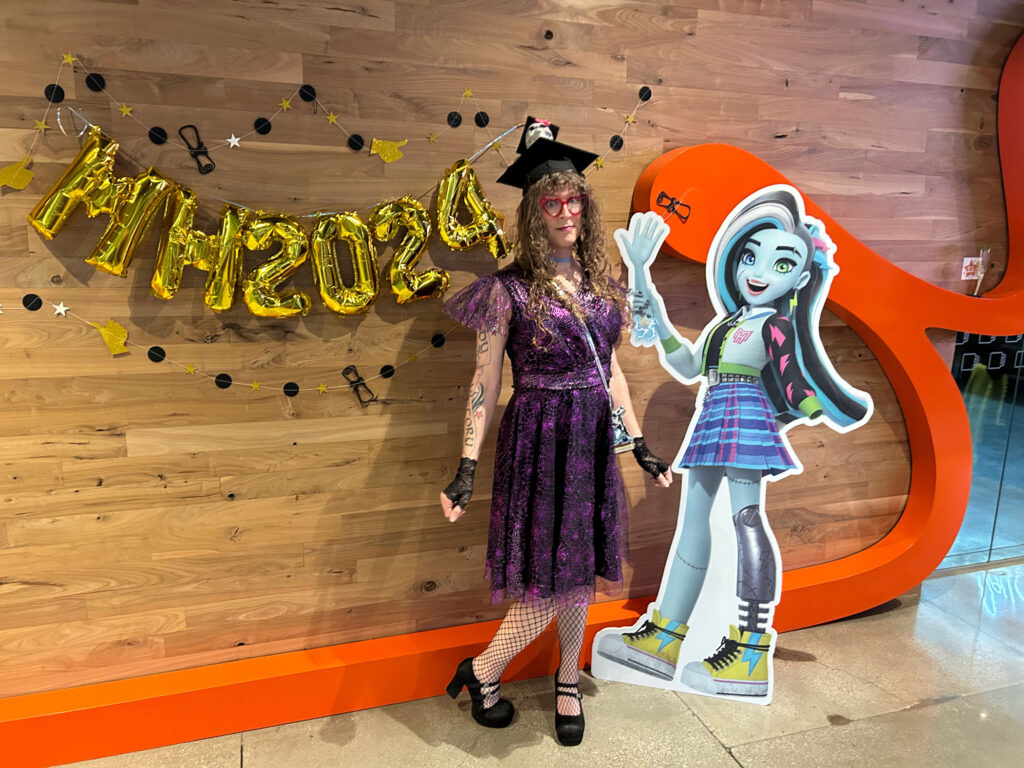
I got them for the Monster High “graduation party,” which was basically the season two cast and crew party, but themed around graduation because the show sadly hadn’t been picked up for a third season. My wife Susan and I wrote six episodes for season two of the show, including the four-part “Monster Fest” Halloween special that’s just so, so trans.

Anyway, they encouraged folks to dress up on theme, and so I did!

Me next to a Frankie cardboard standee, in front of balloons that say “MH2024”
Me trying to show off my new heels that have skull buckles but you can’t really tell.
Me in a purple spider dress with a black graduation cap… that has a skull wearing a pink bow (like the monster high logo) and a graduation cap of its own


I’m not super great in walking in them yet, but I think I did okay! I definitely need to practice more, but… I wore them outside, and now I can’t wear them around the apartment to get more used to them without grossing up the carpet. And I haven’t been able to afford another pair yet to practice walking in at home, so… I wait.

But I drove in them, spent two and a half hours hours standing and walking in them, which kinda killed my legs, and after taking them off the flat ground felt bumpy? That’s weird. It’s a work in progress.

I still think I’ll be mostly a super cute girly sneakers/stompy boots girl, but then again… until I can practice more, who can say.

I also got my first bikini last year! It’s the first time I felt comfortable enough with my body to not only get one, but then take photos of me in it… because wearing it felt absolutely amazing! I still haven’t had anywhere to wear it to, but I only got it right when it started cooling off last year, so we’ll see what this summer brings.

me in a blue bikini with hot pink trim and pink flamingos on it, my long brown curly hair is up in a pineapple and i have pink heart-shaped glasses
me in a blue bikini with hot pink trim and pink flamingos on it, my long brown curly hair is up in a pineapple and i have pink heart-shaped glasses, and I’m flexing to show off my kinda nice biceps and abs yay


Still shaving my face every morning, and my entire body once a week (see BODY HAIR for more). Still can’t get laser or electrolysis for my face for the same damned reasons I wrote about back in A PANDEMIC TRANSITION.

Not only am I furious that this last major source of addressing what dysphoria I still have remains inaccessible to me because our society collectively decided to abandon the disabled and immunocompromised (again), but that with the current administration’s anti-science anti-vax stances, things are likely to just get worse and not better on that front.

Kind of feels like I’ll be doomed to shaving my face for the rest of my life, and I’m fuckin’ salty about it.

PHOTOS remain great for me, and even video has held out as being okay, due to a combo of facial changes from HRT, my HAIR, and my VOICE. I was able to record the intro video for the crowdfunding campaign for the trans sci-fi short film that my wife and I wrote and directed without issue! That’s super cool.

Btw that film is an adaptation of a comic we wrote, which itself sprang out of my essay PARENTS WHO WILL NEVER KNOW THE REAL YOU (aka my dad), if you’re curious.

As a reminder tho, seeing ourselves in video can be a huge hurdle for many trans people, and certainly was for me for years. See PERFORMATIVE ALLYSHIP for what happens when cis folks refuse to make the very simple, easy accommodations we need.

Let’s talk BODY HACKING, which if you remember was about the very first thing I did to transition in a “socially acceptable” way: exercising to make my body look less like it did and more like I wanted it to.

You can kind of see where things were at for me last year in the bikini photo above (with more detailed pics in the FOUR YEAR RETROSPECTIVE).

Here’s where I’m at now:

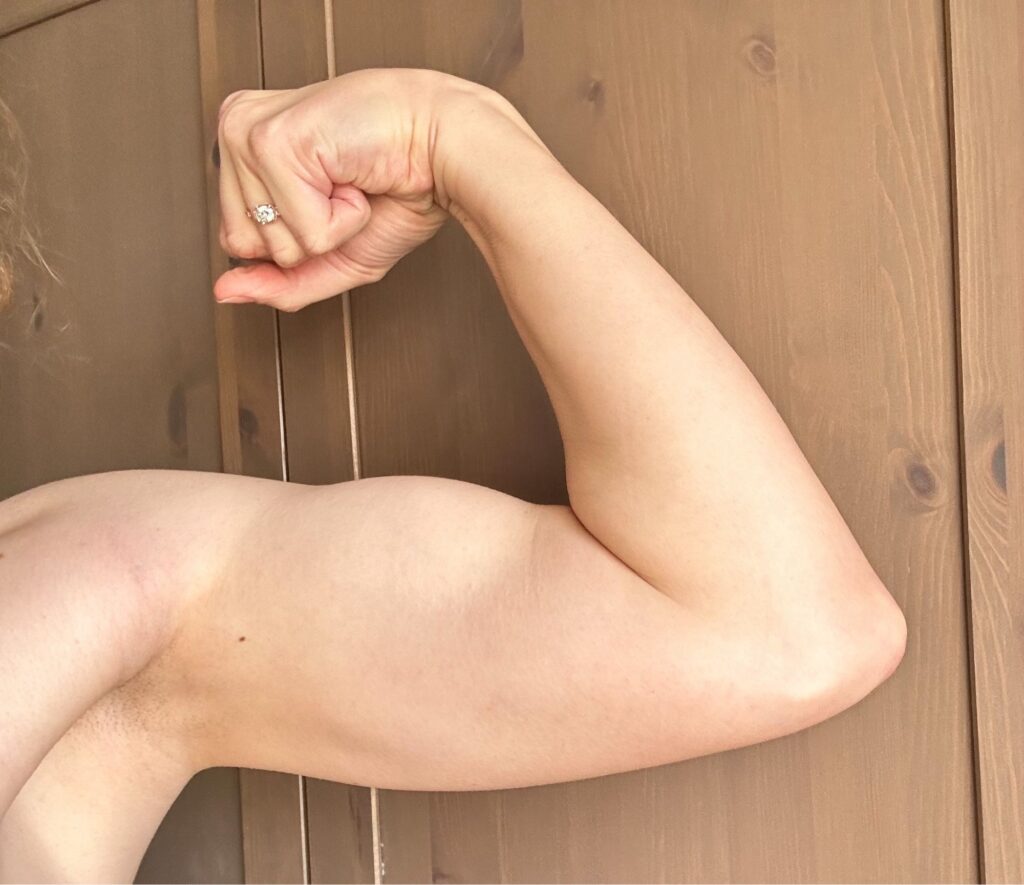
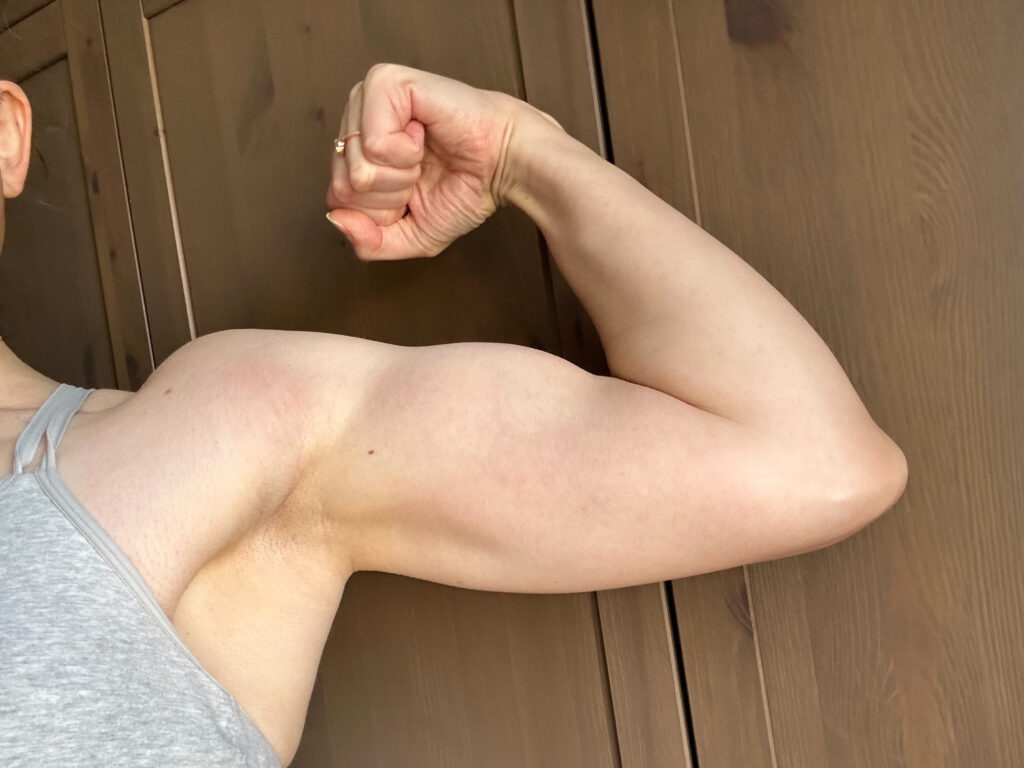
my poppin’ left bicep
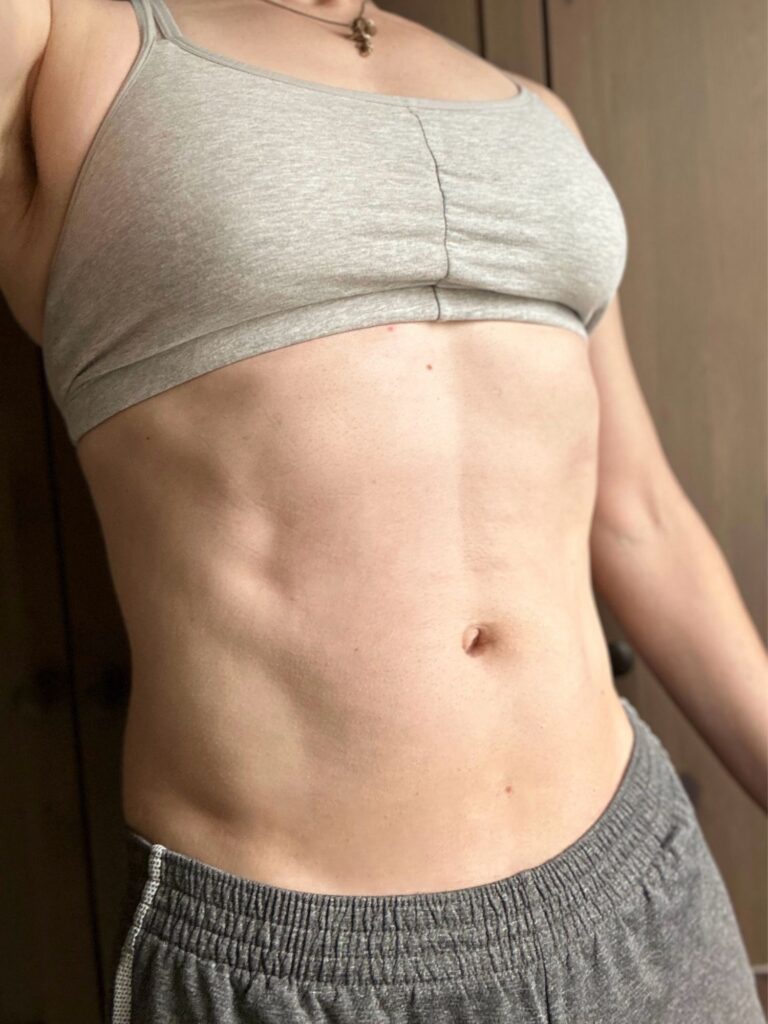
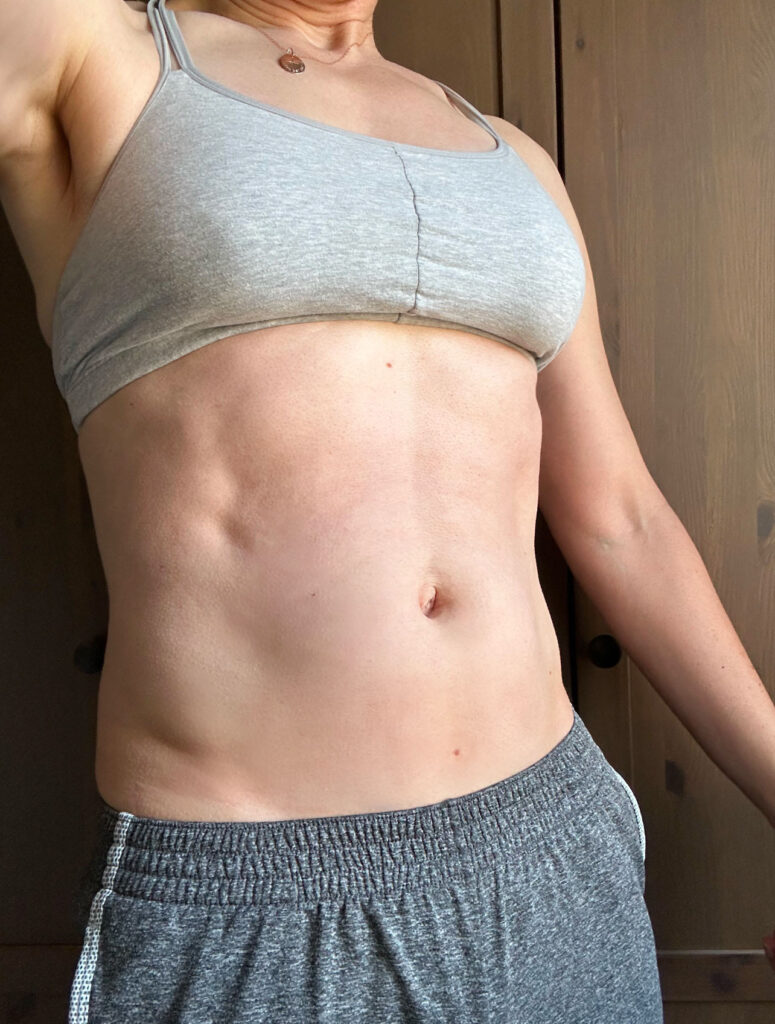
my abbbbbbbs!


I don’t know if it looks like I’ve made any gains to you, but it certainly does to me. I’ve mostly only had the time to struggle to maintain what I’ve had for years now, but I’ve recently eked out a little more time that’s allowed me to increase my workouts some. I feel stronger, and I think I look it a little too. But I’ve only had this tiny bit of extra time for about a month as of writing this, so there probably isn’t really a lot of visual difference yet. It’s likely all psychosomatic. But if I have to will them to get bigger, I will!

We’ll see where I’m at next year, if I have the time to keep up the increased intensity of my strength training.

I’m also biking regularly on a stationary bike, which is new, because  on the day of posting my four year retrospective last year… I have to give up running. And it was devastating. Not because I loved it (I hated it actually), but because I’d never not run since using exercise to start my transition. And without it, I felt like I was losing a vital part of what shaped me into who I am.

Again see BODY HACKING for more on how and why this was actually much more serious for me than you might think. 

Luckily the stationary bike has allowed me to keep things up, and is even in some ways better. But there were a few weeks when I was in emotional anguish over not knowing what I was going to do.

But biking indoor for my cardio means I don’t need to wear my hoodie anymore, my cape, my very first piece of women’s clothing that I ever owned, that gave me early hits of GENDER EUPHORIA and made me feel like I could fly. It sounds silly, but I miss it. I haven’t figured out what to do about that yet.

I plan to write more about the loss of running and what it did to me emotionally, but I just haven’t gotten to it yet. It’s on the list for someday.

My HAIR again remains vitally important to me and my identity and who I am, but I had a bit of a setback with that this year as well, which is also another essay for another day. 

But otherwise, all is well in that department and I love it with all my heart.

MY TATTOO remains amazing, and last year I mentioned I’d figured out what was making post-transition photos of me without it feel “wrong” and… I said I was gonna do an essay about it. Also haven’t gotten to that yet! Ha ha, good times.

The list of future essay topics just keeps getting longer.

VOICE remains good. I feel really secure in it most of the time, and though I still catch it slipping sometimes if I’m really tired or emotional, for the most part it’s been pretty great. And I even feel like resonance (the hardest part) is starting to come more naturally without my thinking about it. Slow and steady wins the race, sometimes. Especially in transition.

Let’s talk HRT! My estrogen injections are still going really well. Or rather, the results from them are. Sometimes I still struggle with giving myself a shot, and it’s been nearly two years of them now. And sometimes I mess them up and have to do over. That’s probably just the way it’s always gonna be, and that’s okay.

I did change up how I take my progesterone, however. Other trans women have long said that boofing it (taking it as a suppository) gets you better results, because it doesn’t get processed by the liver… which destroys most of it when the pills are swallowed. But boofing just didn’t work for me. (see ANECDOTAL TRANS HEALTHCARE for more)

But then I remembered that when I was on estrogen pills, before they entirely stopped working for me (see TRANSITION SETBACKS), that common knowledge among trans women was that taking those sublingually (letting them dissolve under the tongue) got more of the actual estrogen into your body, because the liver destroys most of that when you swallow it, too.

So… I tried taking progesterone sublingually. 

I’ve tried to explain the taste of it to people, and the best I’ve come up with is:

It’s like despair wiped through a dumpster, a medicinal peanut left in the sun for eighteen years.

And y’know… I stand by that.

But I cannot argue with the results.

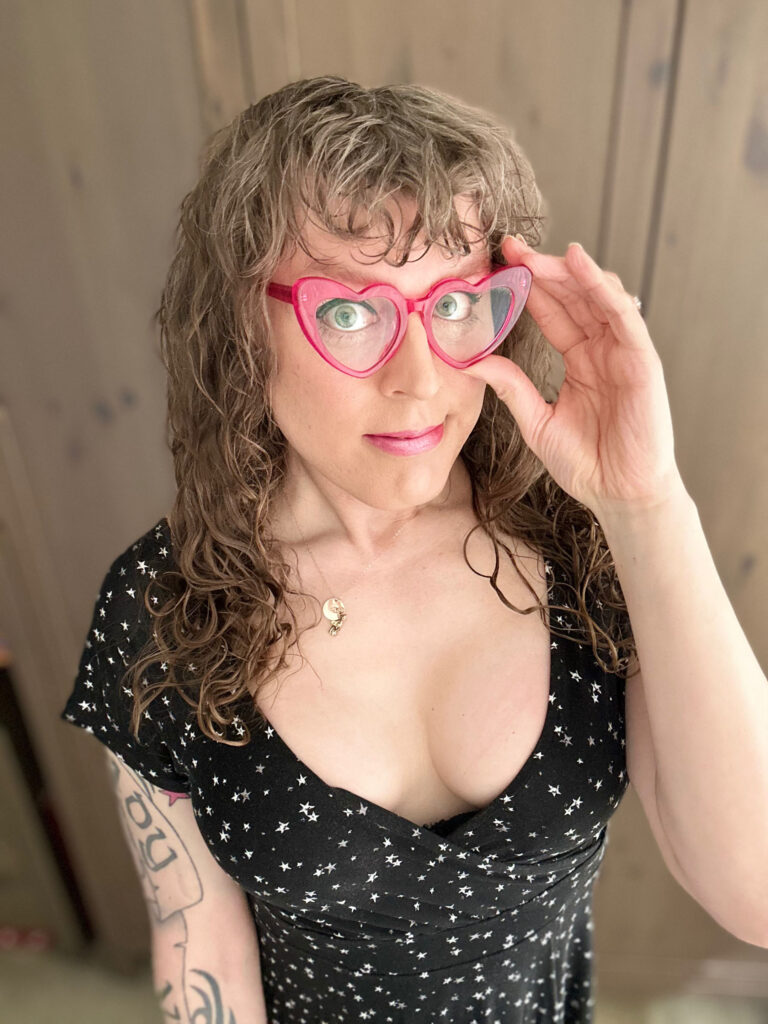
Me in a low cut black dress covered in white stars, and lo and behold: cleavage! aww yeah. and i am adjusting my pink heart shaped glasses just to be sure I’m seeing things correctly. ha.


I still wish they didn’t seem to be miles apart (I have a broad shoulders and chest thanks to the wrong puberty, hooray), and I certainly wouldn’t mind if they were bigger. I’m still at a C-cup, though a fuller one than I was before. I don’t think I need to go up a cup size again, but if they keep goin’ I am not gonna complain.

I’m 99.99% sure I don’t want top surgery. It was something I considered at the beginning, and while it could certainly make them bigger and potentially also get them to be closer together… they wouldn’t be the same as they are now (obvs).

But I’ve come to love how they are now, because they’re all mine. I grew them. Me. And all it took was the right hormone telling my genes to activate the info they’ve had in them all this time. These were always in there waiting for me, they just needed to be switched on. And I find that incredibly beautiful.

Which is not to make anyone who wants breast augmentation feel bad about it! We all have to do what’s right for us and what makes us happy. And right now? My boobs make me so exceedingly happy just the way they are, even if they live in different zip codes.

No other changes to my (tiny) butt or my (little) hips, sadly. 

ARGH C’MON GROW MORE DAMN YOU.

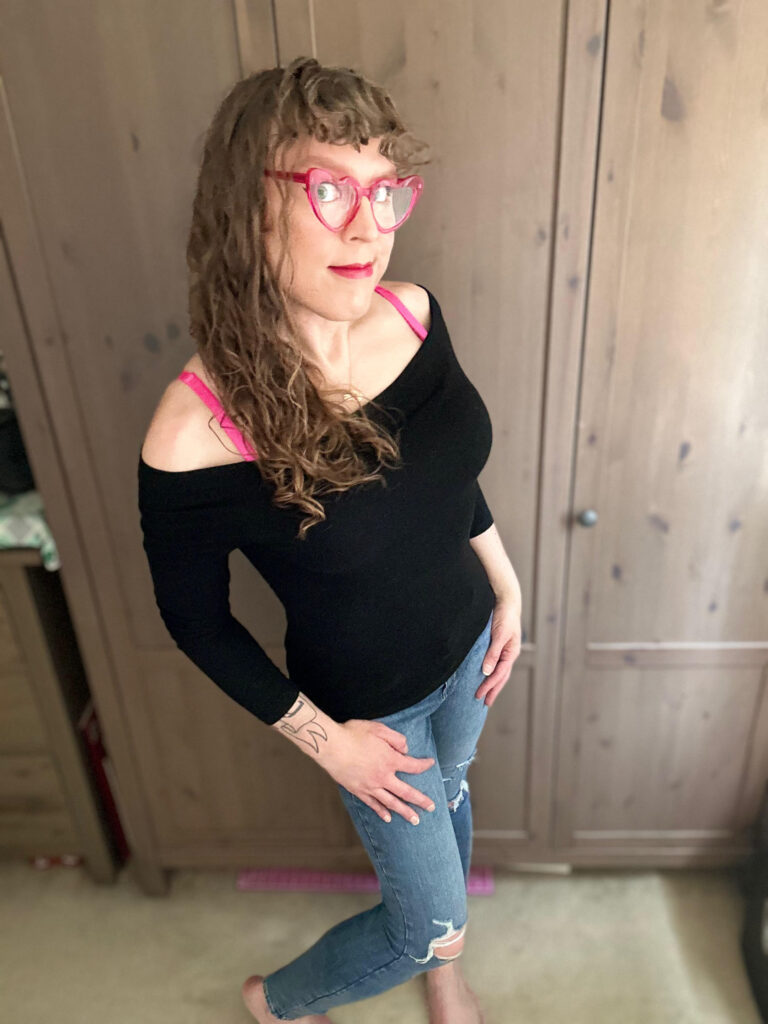
But! I recently got the first photo where you can actually see that my hips are there and hoooooo the GENDER EUPHORIA.

Me in an off the shoulder long sleeve black top with hot pink bra straps showing, hot pink lipstick and hot pink heart shaped glasses, and artfully ripped jeans, with long brown curly hair and curly bangs, and you can see the (tiny) curve of my hips!!


Weirdly the period symptoms I used to get have all but vanished over the past year. Why? Who knows. Will they return? Who knows! Why study trans people, nobody cares. Ugh.

I don’t really miss getting periods, though they were a little affirming in their own awful roundabout way. But it’s interesting they’ve hit the road… maybe they just went on vacation, and will come back with a vengeance to see I’ve been partying while they were out of town.

Still not overly thrilled with the backs of my hands or my fingers… I have  seen trans ladies that’ve gotten visual shifts in how their hands appear from HRT, but so far nothing like that has happened for me.

The mental changes HRT has brought remain just as good as the boobs and butt and hips and facial shape and other physical changes. I feel calm and at peace and delighted in myself inside my own head all the time, and it’s an absolute miracle. (the, uh, state of the world notwithstanding. Bigots will not take my joy.)

Feel like I’ve absolutely zeroed in on my style though, and it’s not really shifting. It fits me so perfectly and I’m so happy with it. (see FINDING OUR TRANS STYLE for more)

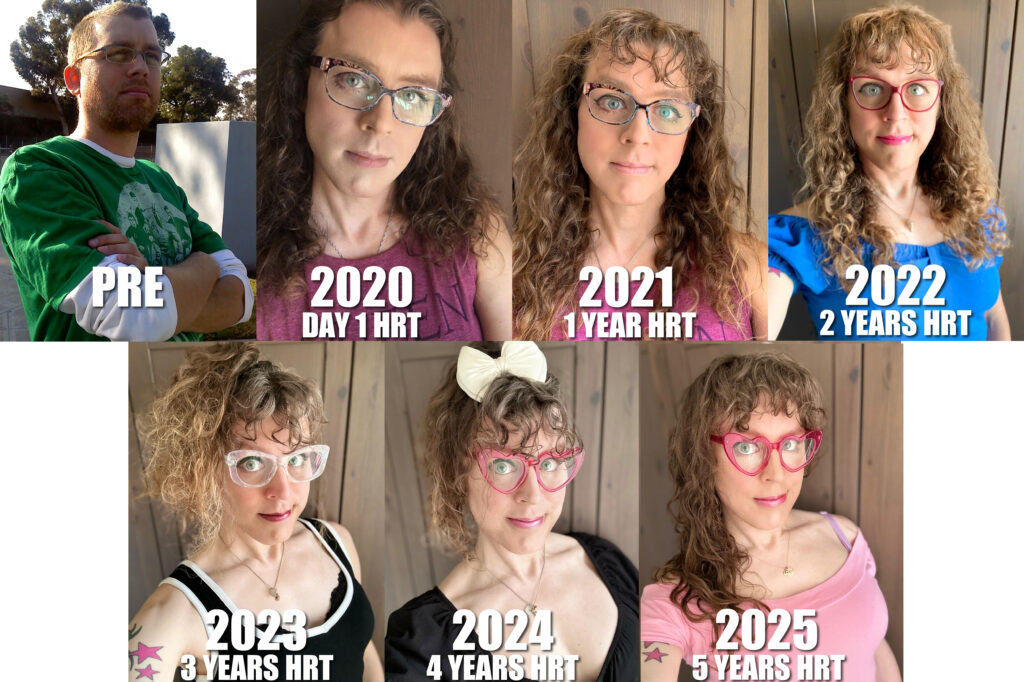
And so let’s close out with the traditional timeline photo, which continues to amaze me in so many ways. Look at me getting more me with every passing year. Gosh. 🩷

A timeline showing my transition progress from pre-transition, 2020 (when I came out and started HRT), 2021 (one year hrt), 2022 (two years hrt), 2023 (three years hrt), 2024 (four years hrt), 2025 (five years hrt). You can see my face changing drastically through them, becoming rounder and softer over time. Also the life in my eyes goes from dead, to huh, to yay, to hooray, to OH MY GOD to CAN YOU EVEN BELIEVE THIS WHAT IS HAPPENING.


One thing I only just recently noticed in looking at my timeline photo… look at my eye color change! They get greener every year! That’s wild (and yes, this can happen, there are estrogen receptors in the eyes… see HRT for more).

And that’s a wrap on year five of medical and social transition!

I never could’ve imagined the real me that was waiting on the other side, and how happy I’d be with her, and how delighted I’d be to see her in the mirror every day.

You owe it to yourself to find the real you that’s waiting for you, too.

Whatever it takes to get there.

Tilly Bridges, end transmission.
tillystranstuesdays.com 

TRANS TABLETOP ROLEPLAYING GAMES

Welcome to Trans Tuesday! This week we’re diving into what seems like a niche hobby, but it’s one way a whole lot of trans people, myself included, first got to explore our complicated feelings on gender. Let’s talk TRANS TABLETOP ROLEPLAYING GAMES.

First,  let me note that a version of this essay first appeared as part of VISIBILITY: An RPG Magazine from the Trans Community. A group of trans creatives made a gaming magazine for Trans Day of Visibility, to raise money for trans charities. It’s still available and well worth picking up. It supports important charities and includes multiple essays, a comic, and several ready to play complete games! So hit the link get great trans gaming stuff and support good causes!

If you’re not familiar, table-top roleplaying games (better known as TTRPGs) are things like the most well-known example, Dungeons & Dragons, where players make up characters to exist in a fictional world, and the person running the game (game master, better known as GM, or sometimes the dungeon master, aka DM) run players through the story and world they set up.

They’re sort of a combination of collaborative writing and acting, where you’re all getting together to tell a story about these characters in a certain world, and there are stats that represent your character’s abilities, and dice rolls thrown in for a randomization element, to determine whether your character succeeds or fails at what they’re trying to do.

All right so how exactly are TTRPGs trans? For me, as a kid pre-transition, it began with one sentence:

“Okay fine, I’ll be the girl.”

It was always said under fake duress, and I’m not what I’d call a good actor. Would my friends believe me? Or were insults and worse just around the corner? I mean I didn’t think they would assault me, but they were certainly homophobic and transphobic in that way everyone is when you’re raised in a society that teaches you to be exactly those things.

And with media reinforcing that at almost every turn, mixed with the blinding toxic masculinity that worms its way into young teen boys in the exact same way, you can just never be sure. Anytime I displayed any hint of femininity or girliness I was mocked and punished for it, sometimes physically. Sometimes by my own family.

But sometimes the implicit biases of society can work in our favor. Well, rarely. They’re very bad actually and should be flung into the sun (if one could fling an implicit bias, anyway… listen, someone should get on that. For science.). If you need more on what those are, see IMPLICIT QUEERPHOBIA.

The same society that told this group of young teen boys (I was never actually a boy, of course, but you know what I mean) that the only valid emotions were lust and anger, the same society that told this group of young teen boys that anything feminine was to be derided and mocked because who could ever want to be that way… also told them that you had to have “the girl.” 

The token, the one who’s not a boy, just to have someone to do what the boys couldn’t. Like flirting with or seducing a man as a distraction, for surely a man could never do that (btw that was categorically the worst part, because I am hopelessly gay for girls).

In those days of heady hormones and confusion, made extra unpleasant for me by the fact that I was going through the beginnings of the unimaginable body horror of the wrong puberty, when the darkness and the oppressive weight and silence and loneliness and abject misery and terror of my GENDER DYSPHORIA were growing worse by the day, there was the smallest bit of light, the tiniest hint of hope… in a little thing we discovered called Dungeons & Dragons.

The tabletop roleplaying world is so much more than just D&D. There are hundreds of different games, maybe thousands. My wife Susan and I actually officially write for two games, Star Trek Adventures (based on the Star Trek franchise) and Fallout (based on the videogames of the same name).

But the ubiquitousness of D&D means it’s a lot easier to find for kids who know nothing about TTRPGs. And I instantly fell in love, not just with D&D, but with the entire concept. You mean… I get to create a character, some weird variant or amalgam of myself and things I’d like to be or things I want to explore, and I get to basically live as them for an afternoon? 

To clarify, there was no live-action gameplay going on, this wasn’t LARPing (live-action roleplaying, where you dress and physically act as your character). This was dice and pencils and papers and mountains of D&D sourcebooks we all began acquiring, and entire Saturdays spent utterly buried in them, having the time of our lives.

But for a trans girl who didn’t know she was trans, and one that has hyperphantasia to boot (basically, my imagination is wildly overactive and I can see, smell, taste, feel, hear absolutely everything I think about, and it goes even further than that…), it’s not hyperbole to say that I lived those game sessions as my characters.

I didn’t actually know I had hyperphantasia, I thought this was just how every brain works. But then I saw the aphantasia meme about “what do you see when you picture an apple in your head” going around.

A diagram explaining aphantasia in terms of “picture an apple in your mind.” 1 looks like a photo-realistic apple, 2 looks like a cartoony and less defined apple, 3 is a black and white apple, 4 is an outline of an apple, and 5 is blank.

On that chart, I’m not a 1. I’d be a 0, because if you ask me to picture an apple I can instantly see, smell, feel, taste, and hear it all. And not only that, I can tell you that her name is Beatrice and she wields a thorny rose stem as a sword and is off on an adventure to save the orchard. 

And to be clear, I do not actively come up with that little story in my head, it just happens. All the time. It’s why I’m literally almost never bored, and why I say if I lived for a thousand years I could never write all the stories that are in my head. I thought everyone was like this! But no, turns out I’m just a weirdo (I embrace it, yay).

But given my hyperphantasia, our TTRPG sessions all played out like reality in my head. I could smell the leather of those magic boots I just found, I could feel the dust from the road caking their folds, I could hear that delicious leather rustle as my character put them on and became immune to sticky webs (those feel so gross, don’t even ask).

The first time I played “the girl” in the party, it was like sticking my fingers into an electrical socket (complimentary). My heart raced, I was sure my friends would notice and wonder what the hell was wrong with me, but they never did. They were always too busy consulting die tables in books and plotting strategy for how we were gonna take down this ogre and save the village.

And I didn’t sit those things out, but I did them… mentally feeling what my wizard’s robes felt like around her as she walked. Or as close as I could imagine, because I’d never worn a dress or a skirt and it would be more than a decade before I did, before I even knew that trans was something a human could be.

I almost always played wizards, because I love the creativity, that ingenuity you need to know which spell to cast when. But a wizard has to wear a robe, right? It’s just required, yes, that seems right. It’s not my fault wizard robes are basically a dress! Nobody could punch me for putting my wizard in a robe, that was just expected.

I’ve lost a lot of memories of my pre-transition life from all the dissociating I was unknowingly doing just to cope and get through living with my dysphoria, so I don’t remember my first character’s name. I don’t remember any of my character’s names from back then, they’re entirely lost to me.

But I remember the feelings they gave me. Inklings that something was there, some synapse in my brain was firing on overdrive, sending jolts through my body that I didn’t understand and wouldn’t comprehend until I’d more than doubled my time on earth. They were my very first hits of GENDER EUPHORIA.

So as I watched my body contort and warp from the wrong puberty, and become everything in the world that I hated and never wanted to be, I lived for these games, because they let me live. If only for half a day at a time, eight-to-twelve hour marathons fueled by way too much caffeine, because those were the only times I felt alive.

TTRPGs let trans people explore the seemingly impossible, even if we don’t yet know we’re trans. They’re the only way we can try out a new gender, a new pronoun, a new name, in an entirely “socially acceptable” setting, because society deems it “only a game.”

But that only goes so far. When our group found the first cis girl who was into D&D and wanted to join a game, to everyone’s credit she was welcomed in, but… ah, the implicit bias I’d found a loophole in loopholed me back. Now that we had a cis girl in the game, there was no need for me to play one. Because the token girl could be played by the (seemingly only) actual girl. You can’t have two girls in the same adventuring party, what is this, Themyscira?! (That’s where Wonder Woman’s from and where the Amazons live, listen, my nerdinesss is large-huge.)

And this lifeline I’d had, this secret joy and first doorway to my true self, was slamming shut in my face. So I rolled up a dude character, and my heart broke. In our first session, I was so disinterested and didn’t understand why I was no longer into this game that I loved. It didn’t make sense.

Until the loophole that loopholed me back… got loopholed again. Because toxic masculinity and implicit transphobia said a perceived boy doing something like, or being like, a perceived girl was hilarious… and so my friends thought it would be so funny if now that I “finally” got to play a man, my “real gender,” they conspired for the DM to have a magic belt come into my possession. (For more on just how much the idea of a perceived boy or man doing something feminine is a thing to be mocked, see my 2022, 2023, and 2024 TRANS REP IN MEDIA REPORTS).

None of us knew what this belt did, and I’m a very “throw caution to the wind” player, so I just put it on. You D&D heads know where this is going, I can see you nodding through space and time because it’s so obvious.

It was a Girdle of Femininity/Masculinity, a “cursed” item which changes the sex/gender of the character who puts it on. Suddenly, my dude was a lady again. Ha ha ha, surprise! Oh man we got you!! They laughed and they laughed. Even our new player, the “actual” girl, laughed. So funny! 

A smile crept across my face. They all thought I was a good sport and also found it funny, but inside…

That synapse was firing. A reprieve. An escape. A blessing! My lifeline returned. I could make it through the horrors of dysphoria through this tiny crack in the walls of reality. He was a she. Again. For real. He was always a she.

Our world isn’t full of magic and dragons, so it’s only a dream. I could never actually be a girl, could I? What I wouldn’t give. If only. So let’s enjoy it while we can.

I played that character until she was level 25, I think. She, uh, “just never got around to” removing the curse of that girdle. Listen, there were monsters to slay and innocent villagers to save! Adventuring is a busy life.

And I never let her go. Because she wasn’t the one who started as a girl, she was the one who the world thought was a man but then, suddenly, a woman! She was me. I wish I could remember what I named her.

So as my friends sat there laughing at what society told them to laugh at, I imagined the skirt of the wizard robe flowing around me again. I felt it on my legs. I wonder if it would spin if I twirled? I bet it would. Wouldn’t that feel cool? 

Let’s vanquish evil and make the world a better place, and if our skirt goes spinny in the process, well… all the better.

My smile grew.

“Okay fine, I’ll be the girl.”

Tilly Bridges, end transmission.
tillysbridges@gmail.com

PUSHBACK OVERKILL

Welcome to Trans Tuesday! I wasn’t quite sure what to call today’s topic, as it’s something awful that can happen in a lot of different contexts. But we need to talk about it and it needs a name, so here comes: PUSHBACK OVERKILL.

“Tilly! The hell is ‘pushback overkill?’” I hear you furiously screaming in your head, because I might be mildly telepathic (hey, I could be, you don’t know). And so I shall endeavor to explain.

There’s this… phenomena that happens a lot in the queer and trans community, where people who are so used to fighting for basic things that they need (and deserve!) continue fighting even when it’s not warranted or required, to sometimes terrible outcomes.

And if that seems vague, it’s because it kind of is! This is a tough concept to explain, but I’ve seen it crop up again and again and again, and there’s one specific way it’s hurt a lot of trans people. Which meant it was something I wanted to talk about, but it’s really difficult to talk about a concept that’s so hard to explain.

I can spot it, and I can recognize it, but I can’t really describe it better than I have above. So the best way is to give you some examples, and then I think you’ll get the gist of what I’m talking about.

Let’s start with a non-trans example (although it does brush right up against it in ways I’ll talk about): polyamory, which is having (or desiring) more than one romantic partner at a time. These other partners may also have a sexual relationship, but they also might not. But it’s mostly about romantically loving and being in a relationship with more than one person at a time. The Wikipedia article on it is actually pretty good.

Right up front: I’m not poly. I have no desire to be poly. That doesn’t mean I’m not attracted to people who are not my wife (because I sure am, ladies are just so good and I’m very gay for them). But I do not, and critically, do not want to, pursue having a relationship with them.

I’ve thought about it, explored it to see if I might be poly. I’m surely not! I am hopelessly monogamous and madly in love with my wife. She is the one for me, and by “the one for me” I mean “the ONE for me” because there is but one.

But I have a lot of friends who are poly, especially in the trans and nonbinary community. Does that seem odd to you? It doesn’t to me.

Because trans and nonbinary people have to operate outside the transphobic system we live in, right? We see through the lies of SOCIETAL GASLIGHTING, and find our truths.

And I’ve said this probably hundreds of times in these essays, but I need to say it again here: once you see that the false cis binary matrix of society is a lie, it opens you up to allllll the other lies society tells you. Trans people can see those, and prove them to be lies, better than anyone (and it’s part of what makes us such a threat to Republicans).

So when you’re already outside the system of lies and can see all the other lies society forces us into (like GENDERED CHILDHOODS and THE FALSE DICHOTOMY), things like compulsory cisgenderness and compulsory heterosexuality, you notice there are other things we are compelled to be… even if they’re not true to our personal nature.

And one of those is, without a doubt, compulsory monogamy. Our white supremacist patriarchal society has a vested interest in providing a good woman to every man to do all the unpaid and unacknowledged labor of keeping a house running (and often raising children), which is all wrapped up in it.

So we’re fed lies, by society and the news and our media, that monogamy is the only way humans experience romantic relationships. But that’s demonstrably not true. I know a lot of polyamorous folks, and all of it is consensual with all of their partners. It’s not about cheating or wild sexual encounters (though I suspect some of those happen anyway!), it’s about being a person who falls in love with, and then continues loving and being in a relationship with, multiple people at a time in an ethical, loving way.

And so I get really angry when people try and force monogamy on them, because it’s not who they are. It’s not even a choice they made, it’s just how they experience love and if that’s different from me or you, that’s fine and good and lovely and wonderful. 

But.

Ah, here comes the turn.

I have seen some poly folks in the trans community (here’s where it brushes up against transness) say things akin to everyone is polyamorous, being monogamous is just your choice and don’t force it on me!

Please tell me you see the problem.

Because if being polyamorous isn’t a choice, and being aromantic isn’t a choice…

why on earth would being monogamous be a choice?!

This isn’t even about if I’d choose being monogamous if I could, because I could literally no more choose that than I chose to be trans. It’s just who I am.

Sure lots of other mammals may have multiple sexual or romantic partners (if you can call love between two animals that… and I dunno, maybe you can), but many of them also pick a single other member of their species and mate for life. There are examples of all of this in nature.

And if polyamory isn’t a choice, and being aromantic isn’t a choice, if they’re just who you are, how how how how how can you claim monogamy is a choice?

Are there poly people who choose to have a mono relationship for whatever reason? Sure. But just because they’re in a mono relationship doesn’t change that they’re actually a poly person, right? Just like a bi person in a straight marriage doesn’t make them any less bi.

Do poly people experience discrimination from people who want to force mono relationships on society? Yes. But that doesn’t make mono people nonexistent.

Trans people experience discrimination from people who want to force cisness on society, but that doesn’t mean cis people don’t exist.

Estimates from studies in that Wikipedia link put the poly population at probably around 4-5%, not that much higher than the trans population in terms of percentages. And they’ve been discriminated against and can’t legally marry multiple partners (if that’s a thing they wanted to do), and have had to fight to be seen and recognized and treated equally.

And they’re so used to having to fight for those things that they deserve that sometimes some of them go too far, and right into… pushback overkill.

You’re so used to pushing back so, so hard and having to fight for every single inch, that the need to constantly push back to take up the rightful space you deserve spills over, and you end up doing to innocent people what was just done to you.

I, as a person who is monogamous with it most assuredly not being a choice, who has supported poly people in being treated as equally as mono people are, don’t deserve to be told that my state of being that I had no say in is a “choice” while their way of being is the one true natural one.

Do you see how that’s the exact same thing transphobes do to trans people? That homophobes do to gay people? You pushed back too far, and it went right into overkill.

See what I mean how it’s difficult to explain? In the example I think you can see it clearly, but summing it up succinctly is tough.

But here’s how it’s damaged part of the trans community, and why I wanted to talk about it.

You’ve seen me also say this a hundred times (especially in THIS IS NOT FOR YOU (YES YOU ARE TRANS ENOUGH)), you do not have to medically or socially transition to be trans.

Transitioning is what we do to make ourselves and our lives better, if we can, are able, and want to. But they are not what make us trans.

And we have had to fight so, so, so hard against TRANSMEDICALISM to get that thought into people’s heads. And even still (even still!) today it gets perpetuated in movies (see BAD REPRESENTATION: EMILIA PEREZ) and media, and even carried along by trans people who were taught that medical transition, full and all the way with HRT (and every surgery, was the only way to transition and was what made you trans.

Honestly I’m not even sure if we’re winning the fight against transmedicalism. Some days I think we are, some days I wonder if we ever will. But it is a long, hard fight that good trans people are involved in all the time, because there is no one right way to be trans. None of us without all of us (see TRANS INTERSECTIONALITY).

So what’s the problem?

Perhaps, I imagine, you have seen the threat that trans gender affirming care is presently under in the United States and other countries. Conservative bigots are doing their damndest to erase us from history and public life, and make our care illegal.

This has, rightly, caused a lot of trans folks to worry about the future and the loss of their care. Because for those of us on hormone replacement therapy, losing access to it would forcibly medically detransition us.

And this has caused some within the community, who are seemingly trying to help, to say, “Even if that happens, you don’t have to detransition. You’re still trans!”

Like, yeah, I’m still trans, and it wouldn’t force me to socially detransition… but it would one hundred percent medically detransition me.

Some trans or nonbinary folks are on HRT by choice, as a nice thing to have, but are okay without it. And that’s great! But as I mentioned in the Trans Tuesday on HRT, I (and many others) actually, legitimately need it.

We don’t need it to be trans, we need it to be us. To survive, to feel like we can exist in this world. To hold on to who we are, because without it, the physical and (for me especially) mental changes are key components of making us who we are. It’s a necessary part of our lives, of our bodies, of our very identities.

But some trans folks have taken “you don’t have to be on HRT to be trans” right into pushback overkill, and turned it into “if you lose your HRT it’s not a big deal” and holy shit that could not be more wrong for so many of us.

And the last thing any trans person needs, especially right now, is other trans people telling us that losing the very thing that makes us who we are isn’t a big deal or worth fighting to protect.

What I’m getting at, and it’s something I’ve said a whole lot of times (listen, I gotta repeat the important shit, you understand)… please lead with kindness and compassion. 

Remember there is no one right way to be trans. 

Remember there is no one right way to love other humans

Remember that every marginalized community is worth fighting for, and must be fought for.

And remember they must be fought for up until true equality, but not so far beyond that it spills over into hurting innocent people.

None of us without all of us.

Tilly Bridges, end transmission.
tillysbridges@gmail.com
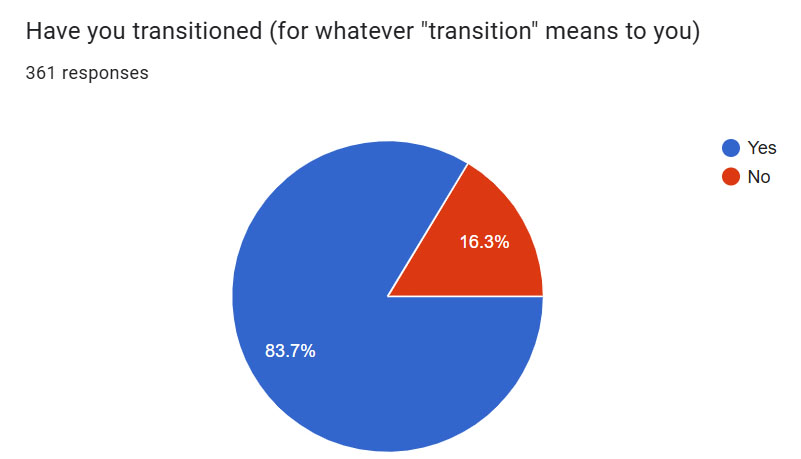
THE PAST 5 aka THE NEW PAST 4: RECOVERING TRANS CHILDHOODS

Welcome to Trans Tuesday! This week we dive into a topic that’s come up often before, but it’s finally getting an essay of its own. It’s something that can plague those of us who transition as adults all our lives… THE PAST 5: RECOVERING TRANS CHILDHOODS.

This obviously deals a lot with how difficult the past can be for those of us who transition as adults. 

For the full picture of what I’m talking about, see THE PAST AND WHY IT HAUNTS US, about about why a past lived not as our true selves can be a lifelong problem to deal with.

See THE PAST 2: THE NEW PAST for how a tv show, of all things, gave me a little piece of the childhood I never got to have.

And then see THE PAST 3 and 4, aka THE NEW PAST 2 and 3, better known as TRANS GRIEF 1 and TRANS GRIEF 2 for the time I confronted that missing childhood, and found a way to maybe vicariously experience it for a brief time.

Also kinda related is TRANS BIRTHDAYS, and how difficult they can be when it feels like you didn’t actually get to live most of your own life. That includes a short letter I wrote to little Tilly which you might want to check out.

Given all of that, I think you can see this is something that I, personally, have struggled to come to terms with. I mean it’s better than it used to be, due to those small pieces of little Tilly that I was able to sort of, maybe, experience, even if I didn’t get to really live those moments.

So when you’re an adult who transitioned well after your childhood, you end up feeling kind of… like you don’t have an anchor. You see people talking about happy childhood memories, and you don’t have those. You see folks posting photos of themselves from high school, and you don’t have those, because the real you didn’t get to exist then.

Which can very much make it feel like you don’t have any connection to your past. I do have my childhood red bow, as talked about in the first essay on THE PAST, but I don’t (and can’t) wear it every day, nor do I carry it around with me everywhere as a tangible connection to this world, to life… saying that I was always here.

And part of my life being stolen from me are all those childhood memories I missed out on. I didn’t get to have a sleepover with all my friends who were girls, or get to do each other’s hair in braids or paint each other’s nails.

This actually even carries over into my teen and adult years, because I don’t know what it’s like to date or be pursued by a woman as the woman I really am. I mean I love my wife more than the universe itself, don’t get me wrong. But I’m hopelessly monogamous, so I’ll also never know what it’s like to date a lesbian as a lesbian, y’know what I mean? And I wonder what that’s like.

And this wonder leads your mind in all kinds of different directions, and you can get a little lost in the “what ifs” if you’re not careful. You don’t want to fall down that path, because it’s a steep drop off and I imagine it’s pretty easy to get stuck down there.

So I think what we need are handholds to keep us from falling all the way in. We need an anchor to our past that says… we were actually always here, even if we were buried in pain and misery by being forced to pretend to be someone we’re not. See the essay on GENDER DYSPHORIA if you need more on that.

One of the things that surprised me was a gift I received not long after coming out. I talked about this in UNEXPECTED BONUSES OF TRANSITION, where it had never even occurred to me that after transition, people might give me “girly” gifts.

And a very dear friend, after seeing me talk about my lost childhood, sent me a big stuffed My Little Pony. (Quick aside to say yes, boys and nonbinary kids can like those too, but often aren’t allowed thanks to a little thing we call GENDERED CHILDHOODS.)

I wasn’t allowed anything remotely “girly” as a kid, and so I was absolutely touched by that gift. But I was surprised by how much I loved it, even though I’m not overly into horses or ponies or anything.

It sits right next to our bed, and I see it every morning when I get up and every night when I go to sleep, and it’s a sweet reminder that even though my family and society forced me to be someone I wasn’t, the real me was always in there, even as a kid.

And what brought this essay about was yet another thing that maybe little Tilly would’ve had and loved to death, but I didn’t even realize that when I got it.

Unless this is your first Trans Tuesday (and if it is, OMG hi! Thank you for reading!), I am kind of a girly girl. I mean I am also buff, and also sporty, because we can all be more than one thing and we do not subscribe to THE FALSE DICHOTOMY around these parts.

But I love girly things, and they make me really happy. I also love science and space and sci-fi, and my wife and I are sci-fi and fantasy writers!

So when I saw this amazing backpack that kind of marries all of that together, I got so excited and it became imperative that I get one. And then I saw I could get it personalized with my name! In pink! So very exciting.

a purple and pink backpack with a girly-colored outer space print slung over one of my shoulders. Some of the planets and comets are replaced with hearts, and the straps are kind of pastel-colored rainbows.

Cute as all heck? Oh yeah. But also practical, because when we go to comic conventions (which we often frequent, as I’m doing book signings and/or am a panelist) I need something to keep copies of my book in, a water bottle, snacks, etc. It’s more than any purse can hold, really. And we have bags, but none of them were girly. Or cute. Or me. It even has a matching thermos/water bottle, also with my name on it!

I didn’t at all anticipate my reaction after it arrived. Because… I love it. I mean, I love it. My reaction was so much more emotional than I thought it would be (to be fair, I anticipated zero emotional reaction, I thought it’d just be a fun thing to have).

But seeing it, holding it… putting it on made my heart swell. I teared up?! What the hell?

I am always always always trying to understand myself better as a person, probably because I spent a lifetime having that person intentionally suppressed and crushed and hidden from me. You can learn how that manifested in my childhood in SEARCHING FOR MEANING (when you’re trans and don’t know it).

So I sat there holding it, looking at it, wondering. Thinking. Pondering. Feeling.

And you’ve probably already figured it out because I obviously decided to write this essay about it. It was another tangible, real, physical connection to my lost childhood. Because this is one hundo percent something little Tilly would have screamed in joy to have, and used every year and loved dearly, so much that it’d get dirty and beat up and wear out, a strap would break and there’d be a hole in a corner on the bottom from where it always scraped the floor as she tossed it under her desk in class every day.

And she would’ve begged to get another, exactly like it, to replace it. Because she would’ve loved it that much.

But now big Tilly has it. 

And she loves it that much.

Trans and nonbinary friends, it’s okay and even good to nurture that true little you that you didn’t get to be. It’s good to find what ways you can experience so much of what you might’ve missed out on. It might just help heal some old wounds.

And cis folks, if you see trans people getting toys or dolls or “kid stuff,” try to understand where we’re coming from. It’s not a refusal to live in the present, or to “grow up,” it’s trying to form a connection to a past that we’re otherwise disconnected from. (“Growing up” is overrated anyway.)

I can feel my inner child dancing in glee and just so excited about it, unable to wait to show it off to all her friends.

I can’t wait to show it off to all my friends. 

So here I am, showing it off, feeling things I thought might be lost to me forever.

And you deserve to feel those things too. 

Tilly Bridges, end transmission.
tillysbridges@gmail.com
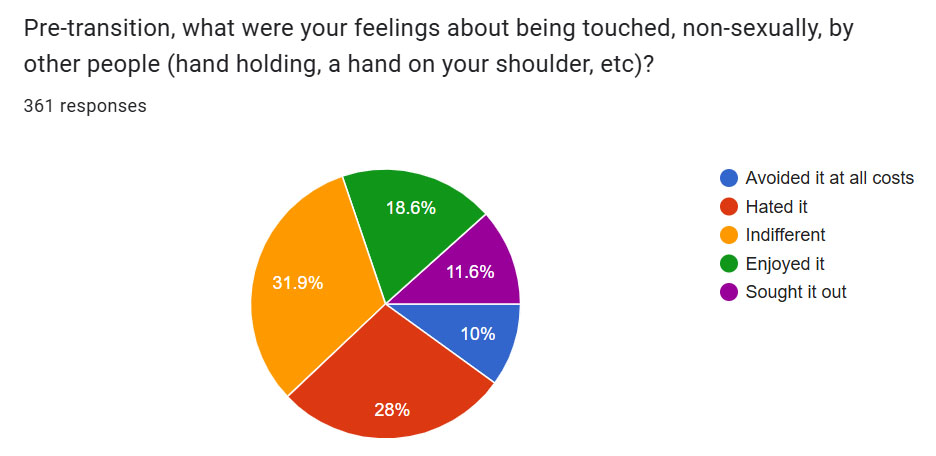
Me hugging my girly space backpack in front of me, smiling.

ASK TILLY ANYTHING, part 5

Welcome to Trans Tuesday! This week we wrap up our 100th episode celebration in episode 102, because I’m mad with power and do what I want! So here comes ASK TILLY ANYTHING! …part 5!

Do see ASK TILLY ANYTHING part 1 and part 2 from years ago, and then the new part 3 and part 4 first, if you know what’s good for you. You do know what’s good for you, don’t you?

On with your questions!

Hey Tilly. I have a question from a cis perspective. We have a new starter at work who (I am pretty sure) is trans, but she is introduced (as it should be) without any reference to that. I want to show solidarity, but unsure how.

Oh I am SO glad you asked. Okay, so, first:

You can’t tell if someone is trans just by looking at them. You can’t tell if someone is trans just by looking at them. You can’t tell if someone is trans just by looking at them. 

That’s the stuff all those bullshit “transvestigators” do and they universally seem to be trying to prove that any cis woman who doesn’t conform to the “gender ideal”, either in presentation or physically, is trans. It’s an awful way of policing gender conformity.

I don’t think that’s what the person asking this question was doing, but I wanted to make that bit clear to everyone else out there first. Just do not make assumptions about people’s gender and the world will be a kinder, better place for us all.

And definitely, absolutely, unequivocally do not ask someone if they’re trans. That could put us in incredible danger, and it’s also asking us to out ourselves to you (or anyone else who may be listening). It is, frankly, none of anyone else’s business if someone is trans or cis.

BUT, if you think this new coworker might be trans and you want to show solidarity and support… wear a trans pride pin. Not only when you talk to them, just… wear it. Always. When something comes up in meetings or whatever that might affect trans people, stand up for us. It is, of course, the right thing to do and SO much safer for cis people to do. You also then spare the person who may be the only trans person present from having to do it and out themselves if they’re not ready to and risk reprisals from transphobes.

In short, just be an accomplice. Stand close enough so that the bricks thrown at us hit you too, and use your privilege as a cis person to stand up for her and all of us. Which is, ideally, what you’re doing even when you think all of your coworkers are cis, right?

Check if your health insurance plan covers trans healthcare. If it doesn’t, fight to ensure that it changes and does.

These are the things we need. We don’t need people to ask if we’re trans and then tell us you support us, we need you to support us with all of the things I just mentioned.

Just keep doing those things. That is the support and solidarity we need.

Am I a chaser? I just think my trans friend is so cool and like maybe we could be more than friends. But like I don’t want to fetishise her.

My friend, my person, my fellow human, I kind of love you for asking this. Because if you’re worried you might be a chaser, that is the first step to not being an actual chaser.

Chasers, for those unaware, are (almost universally) cis men who fetishize trans women and literally chase us around trying to have sex with us. For more on them and how awful that all is, see CHASERS AND THE FETISHIZATION OF TRANS WOMEN. (Warning: it includes screenshots of chasers in my DMs and some of the content is incredibly awful)

See the thing about chasers is that they never think about the feelings of the women they fetishize. That’s literally what fetishizing us is, right? Thinking of us only as objects you can use to get your rocks off.

Chasers don’t support trans rights, they turn on you the second you don’t fawn over their attention, they’re very often bigots who think we’re “naughty” or some “safe” way to explore their own feelings about their sexuality.

It is okay to be attracted to trans women! We’re great! Trans women are hot (just ask me). What’s not okay is to treat us as if we’re not human beings with feelings, wants, and needs of our own.

If you think you’d like to approach her about being more than friends… just do that the way you would with a cis woman. It’s literally no different. We’re just women!

As long as you respect us and don’t hound our DMs, as long as you’re not preying on the newly-out looking for someone to finally see them as the women they are, as long as you’re treating us like human beings, you’re not a chaser.

Just don’t be a creep! Not being a chaser is the easiest thing in the world to do (which makes it remarkable that so very many cis men entirely fail at it).

Can you discuss how cross dressers fit into the trans umbrella? Some cross dressers identify as trans but also as their assigned at birth gender or nonbinary, and some of the trans community seems unaccepting.

Yeah this one is really complicated, because cross-dressing isn’t the same as being trans. But some cross dressers are absolutely trans! But some also aren’t.

I think the important thing to remember here is that it’s not cross dressing that makes someone trans, because a whole lot of cis people do it. If you’re trans or nonbinary and a cross dresser, that’s cool, you’re trans. Cross dressing doesn’t negate your transness.

But cis people who are cross dressers do not get to call themselves trans, because by the very definition they’re cis. Or… presumably.

Because invariably some of those cis cross dressers discover they’re actually trans through cross dressing.

So I think we need to be inclusive of the cross dressing community, but I think the cross dressers who know they’re cis need to not take advantage of that. And I think that’s where the hesitance comes in, because there are so few places for trans people that don’t get invaded and taken over by cis people.

I mean I can’t speak for the trans people you mentioned who aren’t accepting of cross dressers, but my gut says that’s where it comes from. Fear over another potential cis invasion of space and privacy.

I think it’s on cis cross dressers to know that things for trans people, that are inclusive for cross dressers, are inclusive of trans cross dressers and are not intended for cis folks.

I mean drag queens technically fall under the cross dressing umbrella, but they’re almost all cis men. And conflating drag queens with trans women is a big problem, because it perpetuates seeing trans women as “men in dresses,” which we are not. 

I love drag queens! But outside of the few that are trans, the vast majority are not trans people. They’re cis men dressing up as (often heightened versions of) a different gender.

Do you cross dress for sexual gratification? Not trans. Do you cross dress for fun? Or work? Not trans. Do you want to be/feel or believe you are a different gender than the one assigned at birth? Trans.

It’s not the clothes you wear that make you trans, it’s about who you are.

I haven’t fully examined my thoughts on the topic before, so I’m not sure how well I’m explaining it and these might not be my final thoughts on it. Maybe it needs an essay of its own one day, I dunno. But that’s where I’m at right now.

Cis cross dressers gotta know what is and is not for them, and trans cross dressers are trans.

What languages do you speak? Of the languages you do not speak, what languages do you understand without needed a translation hearing them, and then seeing them on paper?

Well this is a, sadly, very short answer. I can only read and speak English, and that’s it. I had two years of French in high school, and my first teacher was great but the second absolutely killed my desire to continue learning it. So I never went any further beyond that, and I don’t remember much of it, and I haven’t had the time to try and pick up another one.

What is your artistic/creative dream?

At its most basic, to just be able to make a living writing and telling stories. For my wife and I to get staffed on a tv show, move up, and become showrunners that get to run shows we created someday. And to work on as much Star Trek as possible.

And if you wanna get really wild, if we somehow ever got incredibly successful financially, I’d love to start a studio specifically to produce movies and tv shows written and created by trans people.

From the wayback machine: how would you describe the character of the advertisement announcer on the Dixie Stenberg and Brassy Battalion Adventure Theater?

Oh shit. This is going to require some explanation.

So of the aforementioned podcast production company my wife and I run, our first show (that I created) was Umket Industries Presents: The Dixie Stenberg and Brassy Battalion Adventure Theater.

It’s an homage/spoof of old time radio audio drama, about a group of pilots with sci-fi planes and rayguns fighting nazis in WWII. It’s very silly, a nazi gets punched for comedic value in nearly every episode, and there’s a robot that goes through a “Servo reassignment surgery” ah ha ha ha there were no signs.

Anyway, as part of the show there were entirely fake commercials in the middle, all for products from the show’s fictional sponsor, that were also spoof of old radio commercials from the 30s and 40s (they. Were. a. TRIP.). And I played the commercial announcer in all fifty episodes of the show, in what can only be described as an ill-suited, warbling voice of discombobulated bewilderment. I honestly don’t think I could even do it anymore, after speech therapy!

And so to answer your question: I would describe that guy as perpetually confused but happy to read whatever is in front of him and support the employer who signed his paychecks.

Do you take any supplements in regards to your weightlifting and fitness regimen? And how has working out affected your mindset about transitioning?

So first, no, I don’t take any supplements or anything. I just eat a lot of protein and a lot of fiber (and let’s be honest, a lot of carbs). I do keep protein bars on hand for when I get snackish though, because you need a lot of protein to build muscle. My faves are TruBar, because they actually almost taste like candy bars. Best tasting ones I’ve had. I’m particularly fond of their Daydreaming About Donuts, Whipped for Key Lime, and Saltylicious Almond Love varieties. They’re also really high in fiber, which helps because when you eat a lot of protein, uh, you need that extra fiber. I am not paid to say any of this! I just legit love them.

But what supplements you take or don’t take, and what you eat or don’t eat, is going to vary for everyone because every body is different. I eat a PB&J for lunch every day with (rotating flavors of) a sugar-free and high fiber jelly and high-fiber bread, along with a pound of grapes and like three to four bananas. And every other day for dinner I have a salad so big we had to buy an extra big bowl for it, and it’s got an entire head of romaine lettuce and a ton of tomatoes and almost a pound of deli meat in it.

a mega sized green bowl full of lettuce, chopped grape tomatoes, and about a pound of diced deli turkey

And whatever meals are left I eat “normally”, except for my Friday cheat lunches (see FREEING UP MY BRAIN (lunch with Tilly).

And, like… that is not gonna work for most people. But it works great for me! I talked about that in PARENTS WHO WILL NEVER KNOW THE REAL YOU, I have an unreal alien metabolism, one of the things my dad gifted me with.

Also working out didn’t affect my transition mindset, it was actually the other way around! All the exercise I do was the first thing I ever did to start my transition, years before I could medically or socially transition. I talked all about that in BODY HACKING.

Also also, if you wanna see the latest of where all my exercise is at, check out my FOUR YEAR RETROSPECTIVE as it includes the most recent photo of where I’m at physically with my workouts.

Your hottest Star Trek takes. The ones you’ll lose followers over. I dare you to post them.

Dr. Pulaski is no more cranky or racist than Bones, and in fact learns and grows beyond her bigotry in her one and only season of The Next Generation. Yet she’s universally derided for it, while Bones is celebrated for it (he’s really unrepentantly racist toward Spock through all of The Original Series, and it’s always played for laughs). That’s some sexism at work.

Chris Pine is a far better Kirk than William Shatner was. Pine’s Kirk is overconfident and compassionate and charismatic. Shatner’s Kirk is smarmy and compassionate and charismatic. And the flip from smarmy to overconfident makes all the difference for me. I can love an overconfident character, but I find myself extra repulsed by smarmy cis white men these days. To be clear I don’t hate Shatner’s Kirk, he’s still compassionate. But sometimes the smarm is too much and it icks me out, and I don’t get that from Pine at all, so I’ll take Pine first every time. (I feel like I haven’t seen enough of Paul Wesley’s Kirk on Strange New Worlds yet to make a determination about where he falls in the Kirk hierarchy.)

Also there is no bad Star Trek. There are some highly problematic episodes, and movies and series that succeeded at what they were trying to do more than others, but… there is no bad Star Trek.

Best and worst things about the Star Trek franchise.

The best thing is how it’s founded on the ideals of inclusion and equality, of hope and wonder.

The worst thing is that it’s made by fallible humans and is always a product of its time. So it’s had sexist episodes, and racist episodes, and homophobic episodes, and transphobic episodes. It, and the people who work on it, are not exempt from the implicit biases of our society.

But it posits a world that is exempt from those, because we’ve recognized and addressed them, and over time it grows more and more into being as inclusive as its ideals have always been. And there’s no other mass media franchise you can really say that about, and that is a huge reason why I love it as much as I do.

It says we can be better if we choose to be better, and look at the wonders we can accomplish together when that happens.

And that’s fucking beautiful.

How do you think people should get over internalized transphobia? Is it the same for trans people as it is for the cis?

Oof, there’s no easy answer to that. Internalized and implicit biases are nightmares to root out and get rid of.

For INTERNALIZED TRANSPHOBIA, the most important thing is, again, community. We can often see it in others when we can’t see it in ourselves. So we need other trans people to be like, hey babe…. That thing you just said about yourself? That’s internalized transphobia. We have to recognize it before we can fight it. And fighting it is about realizing that it’s transphobic society that wants us to feel that way, and they do NOT get to tell us how to feel about ourselves (especially when society wants us to feel embarrassed, or ashamed, or like we’re not enough, or like we’re freaks, or like there’s something wrong with us, or-). Nobody gets to tell us how to feel about ourselves.

For cis folks with implicit transphobia (see IMPLICIT QUEERPHOBIA for more), it’s the same as it is with other implicit biases. You have to recognize that they’re there and that society put those biases in you, and you have to actively work to change your way of thinking about it. And that can best happen by listening to and believing and learning from the people you want to change your biases about.

Because biases and phobias can crumble when the unknown is replaced with knowledge, because then you’ve no longer got anything to be scared of.

This is why representation in media is so fucking important, by the way. It’s the way most of the people in our country first learn about people who are different from them. And so if marginalized communities like trans people aren’t getting that rep (see 2024 TRANS REP IN MEDIA), or worse, have all the propaganda about us confirmed for them (see BAD REPRESENTATION: EMILIA PEREZ), that has real world consequences for us and the way we’re treated, thought about, and think about ourselves.

What advice would you give to people whose partners are trans or newly hatched as trans?

First I’d say you absolutely need to check out CIS SPOUSAL AND PARTNER SUPPORT for how very, very badly we need you to support us when we come out, and what can happen when you don’t.

Second, I’d say that you may have complicated feelings about it (even if you’re fully supportive!) and that’s okay, because you’re human. But what you cannot do is make your complicated feelings your trans spouse or partner’s problem. Our coming out isn’t about YOU, it’s about us, and it’s already such a complicated and complex and often difficult thing to do. 

The last thing we need is you trying to work through your weird feelings about “losing a version of us” or what have you, because that’s not what’s actually happening. This doesn’t mean you don’t have real feelings to work through! It just means your own internalized confusion over it, and possible internalized transphobia and/or homophobia) cannot be our problem, not then. See CIS GRIEF (over trans people when we come out) for more.

So my advice to you is, whatever it is you’re feeling, know that your spouse wasn’t lying to you about who they were. It doesn’t mean your marriage is a lie, it doesn’t mean staying married to them after transition is somehow breaking your vow because you vowed you were “marrying a man” and not a trans woman, or whatever other nonsense.

Your spouse was trying to be the person that society and all of their friends and family and possibly even you told them they were and had to be. And that hurt them, and it wounded them, and they want to be free of trying to be someone they’re not.

You care about them, you love them, you should want them to be happy and to be whoever they truly are. So when they’re on the path to doing that, and they trust you enough to tell you, you have got to support them all the way through it. You’re their spouse, that’s the job. It’s what you signed up for. That’s love, baby.

If you don’t know what they need, ask. If they don’t yet know, that’s okay. Tell them whenever they do, you’re there to help. It’s a scary as fuck time to come out, so just make it unequivocally clear you love them and support them and will be with them every step of the way.

Learn what you need to support them (there are lots of resources… like Tilly’s Trans Tuesdays, oh what?!). Learn as they learn. Follow where they lead. Just as you would with literally anything else in their life, because they’re your spouse, right?

You’re partners. So just… be a partner. Be a spouse. And love them.

What are some of the more memorable progesterone dreams you’ve had?

Y’know, I’ve never really gotten to have my Progesterone Dream Theater as part of Tilly’s Trans Tuesdays, so it’s about time to change that! Let’s get some immortalized in digital ink.

I should add, for those not in the know, progesterone is a hormone some trans women on HRT take, and it’s got some wild side effects, like increased sex drive, making you sleep really well (I’ve never slept better)… AND WILD-ASS DREAMS. 

I never had dreams like these before being on progesterone. And the benefit of posting them to social media for hilarity, is that I now have them all gathered together here. For you.

And now I present to you…. 

Tilly’s Progesterone Dream Theater! 


PROGESTERONE DREAM 1

so Guns N Roses was putting on a concert inside a deli
and Slash told me he couldn’t play for reasons, and so I had to play with the band instead
but… I don’t know how!
he doesn’t care, it has to be me
so he takes me to a case with his guitar, and I open it
and inside
is a tiny guitar half the size of normal
made out of rubber
and I pick it up and it bends all over, it’s very noodley 
and I say “but the strings are so tiny!”
and they are, even tinier than the rest of this mini bendy rubber guitar 
cut to the end of Welcome to the Jungle and I’m somehow playing it and things are going okay, but I’m struggling with the tiny strings and it keeps wobbling and bending and is hard to hold
and I can’t believe I am somehow holding it and plucking the right strings and somehow playing the song when I KNOW NOTHING ABOUT MUSIC (this is a true fact)
and then it cuts right into the intro to Sweet Child O’ Mine 
and I don’t just manage it, I NAIL it
and I look to the crowd, and Slash is there in his hat, and he smiles and gives me a thumbs up


PROGESTERONE DREAM 2

things were REALLY weird and i KNEW they were weird but not that i was dreaming
so i kept asking every person in my dream why things were so weird and they all got mad at me for not knowing i was dreaming 


PROGESTERONE DREAM 3

I was in an infinite white void
running through it was a hallway with no ceiling
the walls were covered in Lego plates, so you could build on them
there was a bearded burly lumberjack guy in a harness dangling from a rope between the walls, swinging back and forth between them rapidly, sticking legos on to build stuff
and there was a flying drone with a bucket attached that had to zoom around and catch any legos he dropped
because if any hit the floor
WE WOULD ALL DIE


PROGESTERONE DREAM 4

a woman was talking to me, pointed a finger at me and said: “Well I can tell you one weird thing, you’re going to wake up right now.”
AND OUR ALARM IMMEDIATELY WENT OFF 


PROGESTERONE DREAM 5

I’m on the Walking Dead set and discover over 12 seasons only 240 hours passed for the characters (I was SO mad about it), and then Tom Petty had squirrel teeth and couldn’t sing and demanded I fix them for him


PROGESTERONE DREAM 6

I was being chased by a bundle of dry spaghetti, running through a grid in which, at every intersection, there was a singe dried spaghetti noodle that rose up to the infinite sky. I escaped my pursuer by… climbing a mountain made of one pound bags of baby carrots.


PROGESTERONE DREAM 7

We got a brand new apartment for the first time, and it was big and wonderful, but it was also a huge building up on stilts and the only way down was to ride an invisible cloth hammock conveyor UP 20 STORIES to a tower a couple miles across town and take its elevator down.

Also we had a tiny multicolored translucent gelatin cat with a moose head (complete with antlers) that followed us everywhere and liked to play inside sink drains

A very crude drawing attempting to show what was just described above, which I cannot describe any better than has already been described


PROGESTERONE DREAM 8

real me and a cartoon version of Timothy Olyphant are private detectives
tracking down a real rabbit who worked at an ice cream shop,
and the rabbit wore a shirt that said “are you a creamer?” 
(creamers were anyone who likes ice cream)


PROGESTERONE DREAM 9

Woke up with the phrase “uh oh, dinosaurs!” in my head


PROGESTERONE DREAM 10

Dreamed I had a heart attack and instead of calling the hospital, people called the Soulful Wellness Center. A van from there arrived five minutes later, and a woman got out and said I was now booked for a six night stay in June. But I’m having a heart attack NOW, I told her.
She shrugged and then misgendered me, so I forced the heart attack away, picked her up and threw her all the way across the street.


PROGESTERONE DREAM 11

I was helping Hayley Atwell learn ballroom dancing (to Total Eclipse of the Heart)
and she wasn’t sure if she should keep doing MCU movies
I said yes “because they’re running out of bankable stars” 
she was tooootally into me but respected that I was married and we would just be friends
then she asked me to put the eggs (that were on the floor in the corner of the room) away…
but only the brown ones


And now, for the installment of Progesterone Dream Theater that I think exemplifies them all:


PROGESTERONE DREAM 12

I know I had three dreams one night, and while I didn’t remember the first two dreams, I did remember everything faded to white between
and I was like what is this am I in a void?
no
there was a TITLE CARD between each of my dreams, and it looked just like this

Golden scripty text on a white background that reads “your brain’s scrambled!”

Thank you all for coming along with me on this ride of, now, two hundred nineteen Trans Tuesdays and one hundred and two podcast episodes.

I do these for you, and I hope I hope I hope they’ve been of some help to you.

Okay, I’m gonna vamoose. My cryotube needs maintenance, but my brain’s too scrambled to do it.

Somebody help a chick out?

Love you, babes.🩷

Tilly Bridges, end transmission.
tillysbridges@gmail.com