THE UNINTENTIONALLY INTENTIONAL TRANS ALLEGORY OF LISA FRANKENSTEIN, part 4

Lisa Frankenstein part 4, an 8-week series examining its trans allegory. by tilly bridges, author of begin transmission: the trans allegories of the matrix, at tillystranstuesdays.com, over a black and white image of someone in a bride of frankenstein mask looking up between two sets of feet

Welcome to Trans Tuesday! Tillyvision speeds down the slopes in THE UNINTENTIONALLY INTENTIONAL TRANS ALLEGORY OF LISA FRANKENSTEIN, part 4! This week we discuss Lisa’s super trans dream, and how hate and bigotry can come in passive-aggressive forms!

Like a good student of the art of cinema, you’ll have read PART 1, PART 2, and PART 3 first, so you have some idea what’s going on, yes? Yes.

Good, because I’m not waiting any longer. Lessgo!

16:22 – “Strange” by Galaxie 500 plays. The lyrics sure read to me like someone just going through the motions, doing the cis things everyone expects of them, and wondering why they ever agreed to it.

Why’s everybody actin’ funny?
Why’s everybody look so strange?
Why’s everybody look so nasty?
What do I want with all these things?

16:40 – We cut to black and white, a world run by the FALSE DICHOTOMY, the false cis binary matrix, and the tears on her face. She’s still in bed but in a fancy dress with bows on it. Ultra femininity.

17:06 – She sits up, and a Pabst Blue Ribbon beer blanket falls off of her. It, and the Doug it represents (I fucking hate Doug), was holding her down and confining her to that box.

She looks at a photo of her mom, who tells her to wash her hands and calls her “kiddo,” infantilizing her. Remember just a few minutes (of screentime) ago, Doug called her the same thing. It’s no coincidence it happens again here, from her mom. Neither of them respect her.

And the “wash your hands,” well… where did Lisa have her hands when she was assaulted? Note that her mom also winks at her after saying it. It all reads as very “boys will be boys” and “you were probably asking for it, Lisa” and “if he says you led him on, you must have” so just be a good girl and clean up afterward.

A doll looks at her and calls her “Mama.” Being a mother is also a box society wants to force her (and all perceived women) into, and that can be dysphoric when you’re not the gender that word’s associated with. Getting called “dad” was always painful for me, even though I love being a parent, and I never knew why, until I figured out I was trans. See TRANS PARENTS (Mother’s Day) to learn more about that.

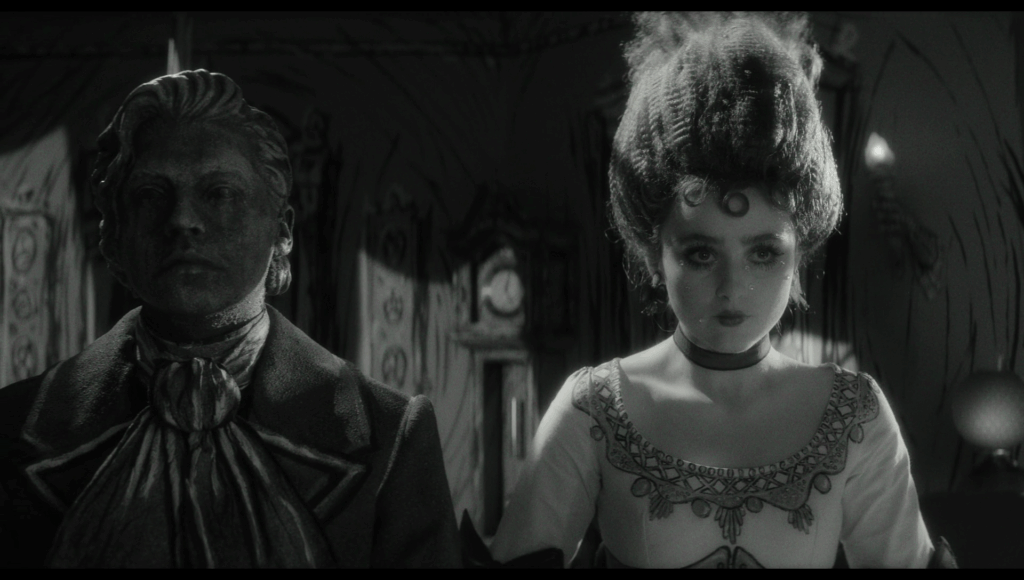
Black and white still of Frank, looking like a statue, sitting next to Lisa, looking like the Bride of Frankenstein.

17:30 – She sits up further, and Frank, as the statue from his grave, sits next to her. You can see her hair really well here, and what’s it look like? The Bride of Frankenstein. Frank’s not fully alive, she’s not fully his bride, so they’re not together aka a self-accepted and transitioned person, but they’re closer than they’ve ever been, despite the world seeing in only black and white, cis boy or cis girl.

They turn to look at each other, but she’s not scared. He opens his hands to reveal a package of Freshen-up gum. They clasp hands over the gum, squishing it, causing goop to run out and drip down. You don’t need to “wash your hands” and “freshen up” after a sexual assault, you need to squash the entire concept.

They both lean forward and look down, in sync, as a masked person comes out from under the bed and grabs their feet. That person is wearing the same Bride of Frankenstein mask that Lisa’s mom’s “murderer” wore!

A person wearing the same Bride of Frankenstein mask that the man who “killed” Lisa’s mom wore in the flashback, lying on the floor looking up between Lisa’s and Frank’s feet.

 The person in the mask then grabs both their feet, at the same time. These two are one. As in the flashback when the man in this mask was representative of Lisa’s transness, here it represents the same thing. Trying to get her to see the truth.

This man may look “dead,” may seem to be nothing more than a statue, an unreal representation of a person, but you can make him real, Lisa. All you had to do is let him out.

And you just did.

18:05 – They lean back and slowly put their heads together, as they look at old footage of the man in the moon from A Trip to the Moon, a silent film from 1902 (see Doug! (I fucking hate Doug!), Lisa’s a real fan), as a rocket hits the moon in the eye.

When they put their heads together, the man in the moon rests between them.

Black and white still of Lisa and Frank sitting side by side, heads bent to rest on each other, with the man in the moon footage (from A Trip to the Moon) in the space between their heads and shoulders.

This is them looking, together, at the place they want to be. Shoot for the moon. Aim for the stars. Flight. Joy. Freedom. GENDER EUPHORIA. A second after their heads touch, the rocket hits the moon right in the eye. Arrival at the destination. Will they ever make it there?

18:16 – Taffy wakes her up, and we see Lisa’s pajamas are in trans colors… Cathy from the comic strip of the same name, on a beach, with the words “unattached and cordless.” Unattached = unmarried = a not whole trans person, cordless = without a, uh… ahem. “Cord”. Supertext?

And her hand’s in her shorts. Implying masturbation maybe, sure, but that wasn’t a sexy dream in any regard, was it?

If you’re dreaming out the trans man you really are inside, one of your most likely sources of dysphoria is what you find, or don’t find, in your pants. And maybe you try to imagine what it’d be like if that was… different. (Standard reminder: you don’t need to have gender dysphoria or want or need bottom surgery to be trans, but many trans people do and this is metaphor.)

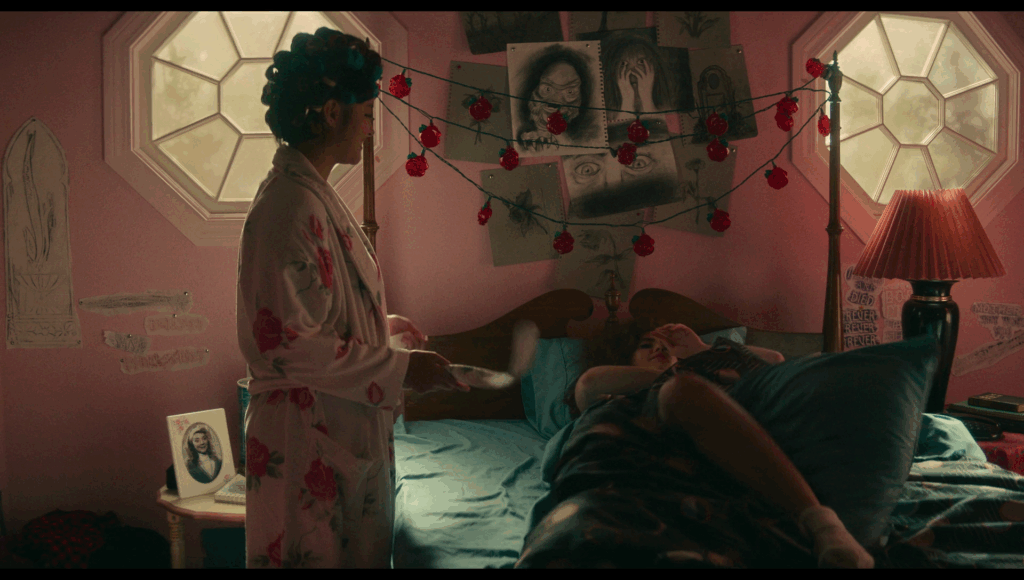
Lisa laying in bed, Taffy stands next ot the bed. Above the bed are two octagonal windows that look like eyes, and dysphoric black and white drawings that include a close up of terrified eyes, someone covering their face, and the creature from the black lagoon. On the far left is a drawing of… what looks like a penis.

18:28 – Remember when I said Lisa’s bedroom was her subconscious? Look at the windows above her bed, they literally look like lies. We’re inside her head, and it’s gender conformity pink and green-blue dysphoria everywhere. Her sheets were very blue prior to the dream, but now seem to more closely match that signature dysphoria color. That could’ve been done by switching the sheets, or even slightly tweaking the coloring when editing the film.

And there’s those dysphoric black and white drawings jailed behind red danger lights. Eyes that look scared, and someone covering their face as if they’re horrified by it. And there’s…The Creature from the Black Lagoon? From the old horror movie of the same name. Whaddaya think that means?

There’s actually a poster from that film on the walls of Lisa’s bedroom that you can see in other shots, so they’re really hoping you pick up on it.

Despite the fact that I’m calling him Frank, the movie calls him “the creature.” Remember I mentioned that in this film, black and Lisa together are a signifier of change and transition (and this is a great place for a reminder, because this is where all the black really starts appearing). Lagoon = water.

Frank, transition, water.

You can interpret the water as dysphoria, and the ways it drowns us, but I think this is actually more about foreshadowing where Lisa will transition to Frank…

Next to Lisa’s bed is a black and white photo of her mom, who only saw things in FALSE DICHOTOMIES, and her photo is bordered by the pink flowers of gender conformity.

And we still aren’t done talking about this, because look at the far left… and how that suuuuure does look like a penis drawing on the wall. The thing Lisa doesn’t have but was maybe just dreaming about having, to alleviate her dysphoria.

There’s so much going on in this one shot!

18:54 – Lisa goes down to talk to Janet about the destroyed bathroom mirror, and look at her. Remember how Barbie in BARBIE woke up the day after her egg cracked? Yeaaaah. Remember how Neo in THE MATRIX woke up after his egg cracked? Yeaaaaaaaaaaah. Metaphor, surely, but drastic changes to physical appearance clue you in to what’s going on with the character internally, and mean a lot when the story’s about transition.

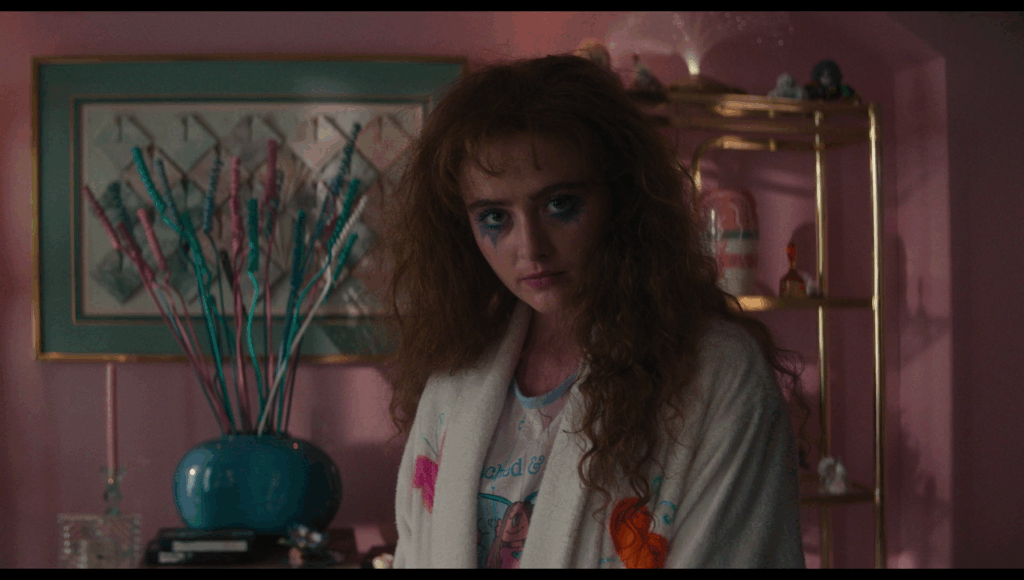
And look at the mascara under her eyes, even more pronounced than before. The black/change/transition is growing.

19:15 – Look at all the pink and green-blue between Lisa and Janet. This whole house is a nightmare for Lisa.

20:39 – Notice how none of them ask if Lisa’s okay, or how she’s feeling, they’re only concerned about how what she’s going through affects them. This is CIS GRIEF in action.

Janet: “Lisa, do you know what happens to people who act out? They wind up in the looney bin.” They literally used to do this to trans people, mind you, and certain people would love to again. It’s not a mental illness! It’s just how we are! But display any more signs of that, Lisa, and we’ll lock you up. How you affect us is more important than anything you feel, or the hell we’ve put you through.

And Janet’s a psych nurse, so that’s an extra big threat, saying she’ll have Lisa committed if she doesn’t drop this trans stuff. Taffy calls her out on how she shouldn’t be calling it a “looney bin,” but Janet doesn’t care at all (including not caring about her patients, as she feels they’re all nonconformos who “deserve” to be there).

21:19 – Lisa sees the news report that the statue and grave of Frank was struck by lightning, which “reignited neighborhood concerns”. The trans man she buried deep inside is coming back to life due to Lisa’s egg fully cracking, even if she hasn’t realized it just yet. And the cis sure have “concerns” about that.

Lisa with her ruined mascara running down beneath her eyes

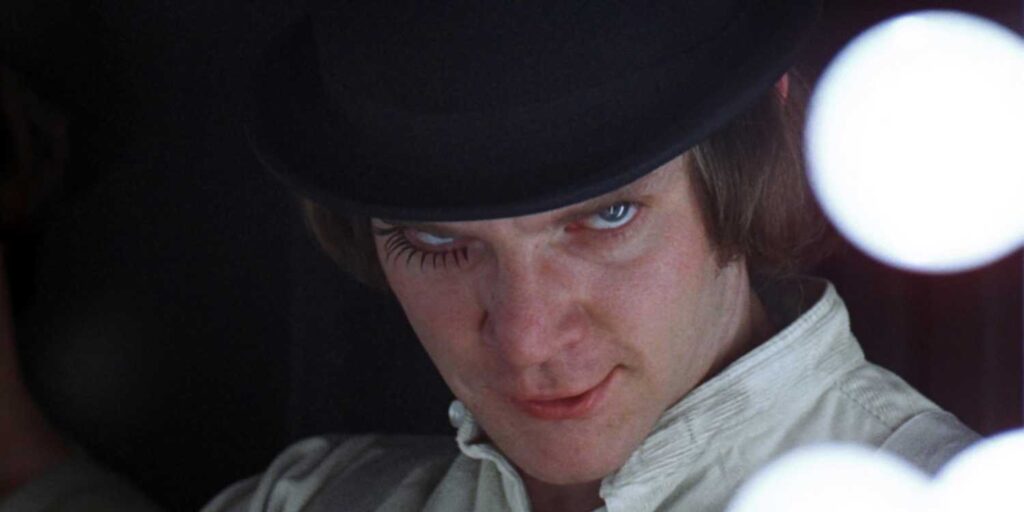
Throughout the scene, Lisa’s incredibly visually evocative of that striking, idiocyncratic look of Malcom McDowell in A Clockwork Orange. The entire scene she keeps her head down even while looking up, as if to drive the reference home even further.

A young Macolm McDowell in A Clockwork Orange, with one false eyelash on the bottom of his right eye, head down but eyes up.

So in A Clockwork Orange, the character Lisa’s drawing allusions to, Alex, is a violent criminal and sexual predator. Lisa Frankenstein isn’t saying here that Lisa is those things, but that Janet sees her that way.

But the most important part is that Alex is used as a tool by those in power, who try to brainwash his “undesirable” qualities out of him, and in so doing use him as a political pawn.

Given we know that Janet will soon make further references to having Lisa committed for her “deviant” behavior, and actually has the power to make that happen (and puts those plans into motion), and the way society weaponizes transphobia as a political wedge issue, this reference absolutely tracks.

21:19 – Lisa’s back at work like a good contributing cis member of society, but look how she’s walled in by the pink. And behind her, by the door when Michael Trent walks in, there’s a poster (in the iconic Patrick Nagel style so popular in the 80s) of overly sexualized Elvira, in a pink Frame.

Who is Elvira? An overtly sexualized performance of a woman, created and performed by Cassandra Petersen. These are the messages Lisa (and everyone) are bombarded with about who and what women are supposed to be.

This is not the fault of Elvira mind you, she’s great and that’s a performance where how overtly sexualized she is is part of the joke. The point is just that despite her overtly sexualized nature being part of the joke, many miss the “joke” part and just overtly sexualize her because that is what society tells us to do to women. And that can be extra dysphoria-inducing for trans men.

And look at Lisa’s magnifying glasses, they’re blue. All she can see in here is despair. She’s even dressed in blue.

21:53 – There’s another similar ultra sexualized, ultra fem art piece behind Lisa, framed with pink gender conformity and green-blue dysphoria.

Though just seeing Michael, who’s closer to the kind of man she wants to be, the kind of man she is, has helped her see things more as they are. Or, rather, as she wants them to be. She’s no longer looking through the magnifying glasses.

22:05 – Michael apologizes for the spiked drink (that was weird how you got gender feelings, we definitely didn’t mean to do that) and jokingly calls her an “experienced psychonaut… an astronaut of the psyche.”

But like… guess what looking inward and examining your heart and subconscious, which all trans people do, is? It’s exactly that.

Lisa says she’s the “Sally Ride of drugs.” Funny, yes, but also Sally Ride is… famously queer, though she was forced to pretend to be straight for a very long time because it’s what society required of her for her to be an astronaut.

Doooo you see any parallels there?

Do you?

22:36 – Lisa’s boss acts like she has no friends (what a dysphoric loner!) and she can’t get a date. When he says it and claps her on the back, the despair goggles fall to cloud her vision again.

He then says… he then says, “it’s probably because she’s so flat-chested.” Which is inappropriate on multiple levels, but also this white cis man with power has noticed Lisa is not as sexy as she should be. Maybe like she’s even… doing something… to make her breasts appear smaller? HUH. See TUCKING AND BINDING if you need more info on that.

23:13 – Lisa smells the jacket that Michael left to get cleaned and smiles, because she likes him… or maybe wants to be him (or both!). Again see SEXUALITY IS NOT GENDER. What would it be like to smell like a boy?

23:22 – Lisa comes home to Taffy telling a story about a teacher at school, seemingly about his being sexually inappropriate, and she and her parents all laugh. So funny! Boys will be boys.

Ugh and ew, and how extra difficult does that make it for trans guys who internalize that their whole lives but, y’know, actually respect women?

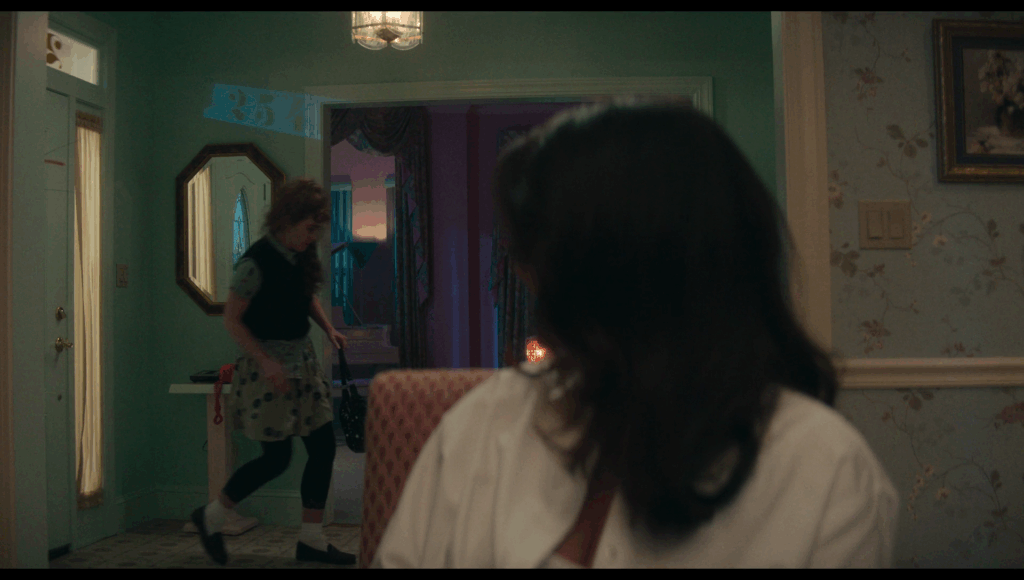
When Lisa comes in, we never see her face reflected in the mirror by the door.

Lisa entering the house in the background as Taffy turns back to look at her from the foreground. Above Lisa in blue lights, from light shining through a window with the house’s address above the door, is the number 254.

It also seems clear that they want us to see the “254” from the house’s address in blue light on the wall. Meanings on this vary, but when you look at numerology and astrology, there’s some rough consensus that it stands for self-sacrifice, balance, positive change and… transformation.

Welp! Supertext.

23:35 – Taffy invites Lisa to go with them to the late showing of Look Who’s Talking.

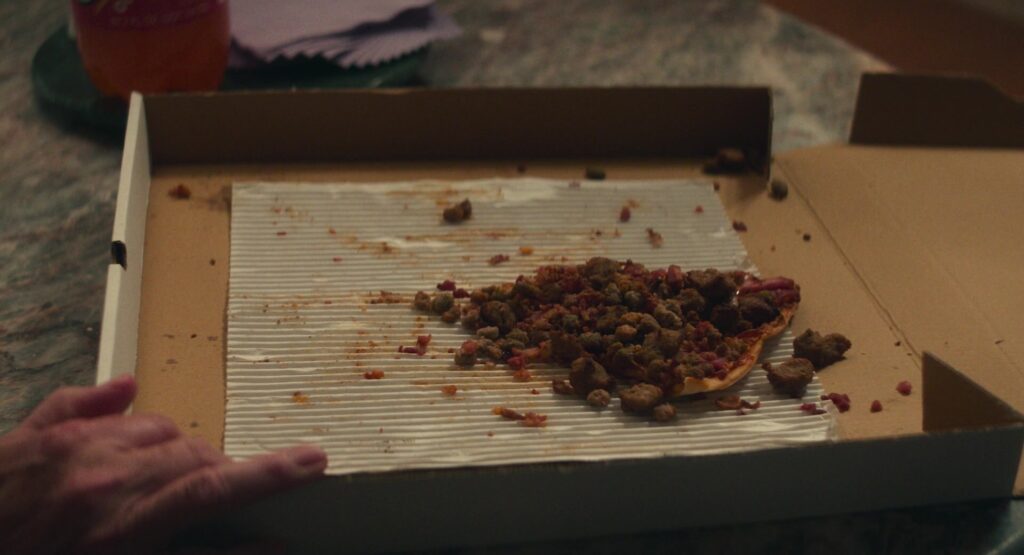
Lisa asks if there’s pizza left… the saved her one slice, but her dad says: “Looks like it’s got a little meat on it.”

One slice of pizza in a pizza box, comically completely covered in meat.

And it’s of course entirely covered with meat. This is a genius little moment that tells you so much.

Vegetarianism is a choice some people make for various reasons, and a lot of people disrespect vegetarians for that choice. For the way they live.

Being trans isn’t a choice (though you can be trans if you decide want to be, because you’re trans if you say you are (YOU ARE TRANS ENOUGH), but transitioning is a choice. Talking about your complicated gender feelings is a choice.

And her family does not respect that choice.

Janet: “Oh she can pick it off.” Never mind there would literally be almost no pizza left. Never mind it would all be contaminated from having meat on it. “We will not accommodate your choices, and if you don’t like it, you can have the nothing scraps (of society) that are left over for you.”

The disrespect is painful. And all too familiar.

Taffy wanted to get Lisa a veggie lovers pizza, but Janet wouldn’t allow it. Even though Taffy is gender conforming and clearly doesn’t get or understand what Lisa’s going through, and has done things to harm her (like spreading rumors about her), she doesn’t want to actively exclude her. She’s kind of trying, in her backwards way, to be supportive.

Janet also has no respect for Lisa’s job doing alterations, but Taffy’s cheerleading (a very gender-conforming physical sport) gets all the respect in the world. And though it’s funny, the line about Taffy spending hours screaming with her legs spread against the walls is pretty dark. Because Taffy says “it doesn’t even hurt anymore,” implying those are not screams of pleasure.

Highly conforming to gendered stereotypes hurts cis people, too.

Taffy thinks Lisa’s fingers probably hurt from sewing, and Lisa says: “Eventually a callus just forms.” But she’s so dejected and dead when she delivers that line.

She’s talking about her heart, because of the way her family treats her, for being different.

24:41 – Lisa’s watching Dawn of the Dead, and they make a point to show us Bub.

If you’ve not seen the film, Bub is a smart zombie who’s capable of learning. He screams and thrashes in chains. When you learn how society wants us all to be chained like zombies, all you want to do is break free. And he’s undead. Brought back to life.

Huh.

Lisa, in yellow, pink, and green pajamas, surrounded by yellow lights, smiles. This pain and discomfort is familiar to her. Light from outside the windows? That green-blue. She’s interrupted by loud banging and groaning from outside.

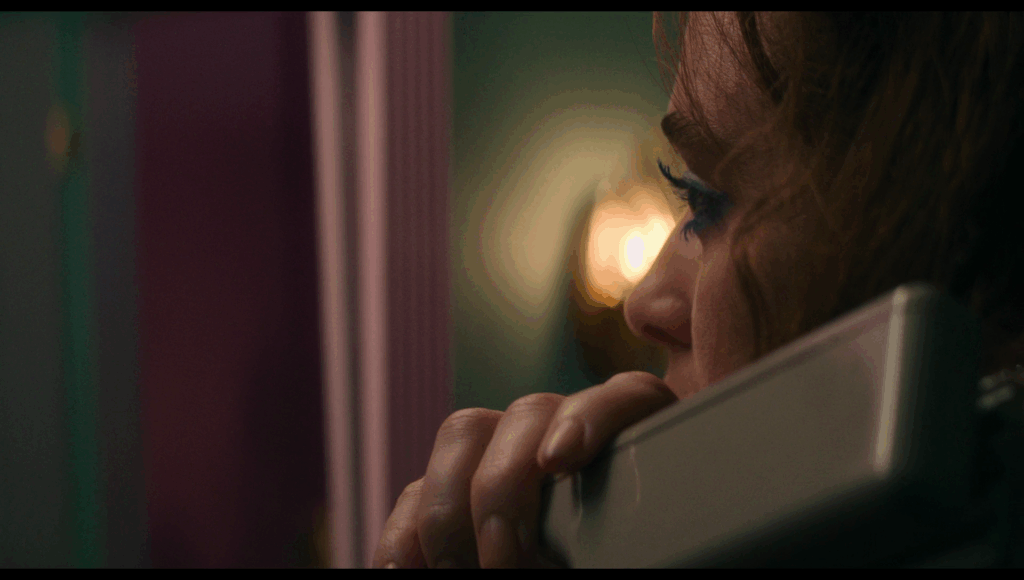
25:04 – Lisa sneaks toward the door and grabs the red phone, but she does not cross in front of the mirror.

25:10 – Too late, that egg you duct-taped closed has re-cracked, babe. Frank smashes in through the dysphoria window. She screams and runs as he zombie walks after her. You are Bub, bub.

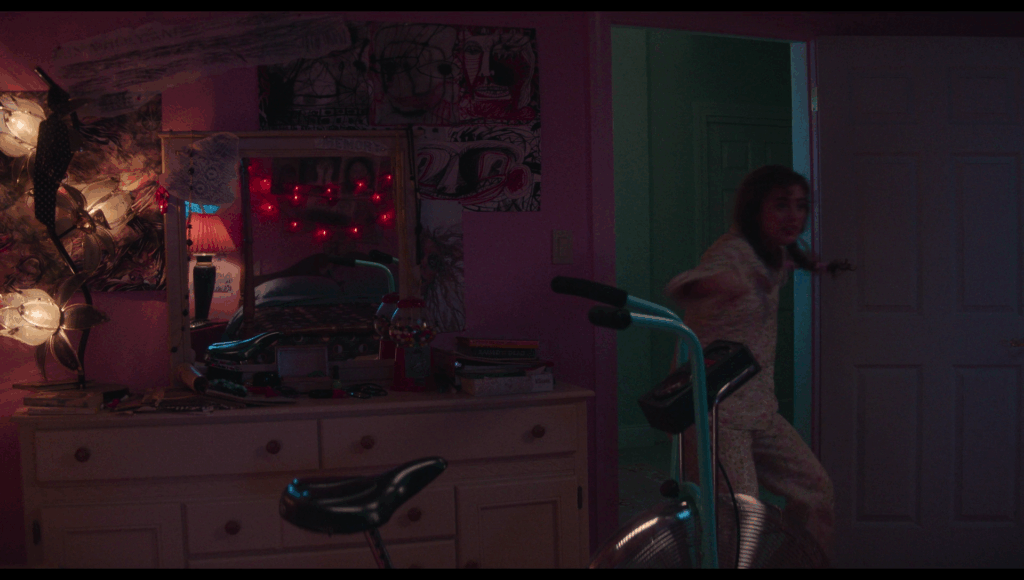
Lisa running into her pink bedroom from the green-blue hallway.

25:40 – She runs to her room, and look at the dysphoria hallway, the pink gender conforming walls, the yellow light, the red danger lights reflected in the mirror that she sprints past. More danger and change (red and black) art on the walls, and on the frame of the mirror, a rubbing that says “memory.” Remember how you figured this out a long time ago, Lisa, and it could have led you to your true reflection? Time to remember again.

Next week, we’ll see if we can escape this part of ourselves we thought was long dead, and finally get a clear picture of the prison we’ve been trapped in!

Tilly Bridges, end transmission.
tillysbridges@gmail.com

Part 5 is here!

THE UNINTENTIONALLY INTENTIONAL TRANS ALLEGORY OF LISA FRANKENSTEIN, part 3

lisa frankenstein part 3, and 8-week series examining its trans allegory, by tilly bridges, author of begin transmission: the trans allegories of the matrix, at tillystranstuesdays.com, over a still from the film of pink, white, and blue lightning

Welcome to Trans Tuesday! Tillyvision can’t be stopped as we dive into THE UNINTENTIONALLY INTENTIONAL TRANS ALLEGORY OF LISA FRANKENSTEIN, part 3! This week we see what loved ones not being accepting can do to us, and see if a little trans energy can wake us up!

You’ll want to read PART 1 and PART 2 first, because that just makes good sense.

Let’s go!

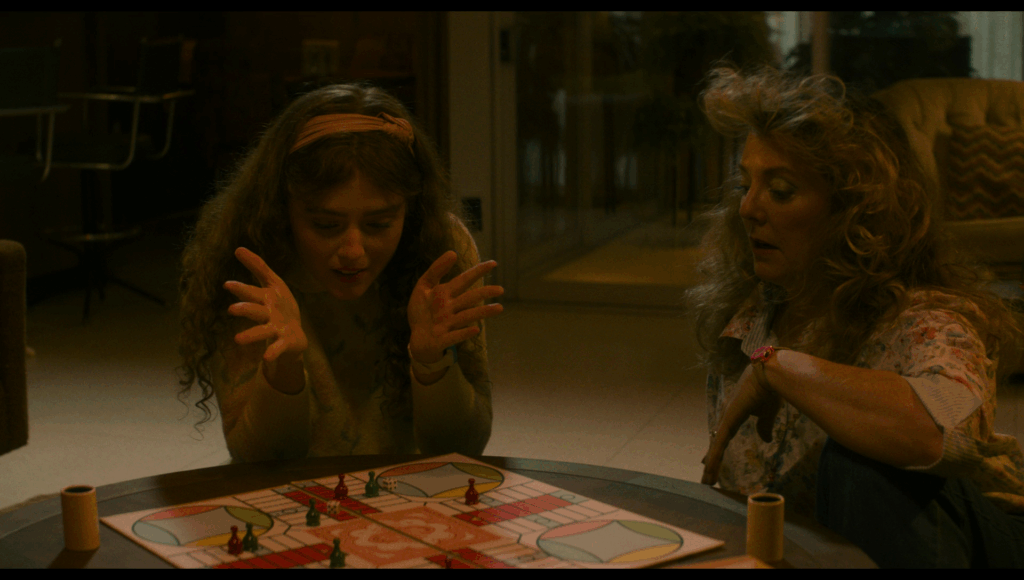
Lisa, in a white sweatshirt with pink flowers on it and a pink headband, sits on the floor playing a board game with her mom. The spaces on the board are pink and blue, green and yellow, red, and the pieces are red and blue.

9:21 – Flashback to Lisa and her mom playing a board game, and look at the board and pieces. Blue and pink! Red. Yellow. Transness, with fear and danger. Lisa’s got pink flowers on her shirt and a pink band in her hair, all gender conformity. Whaddaya think that all means?

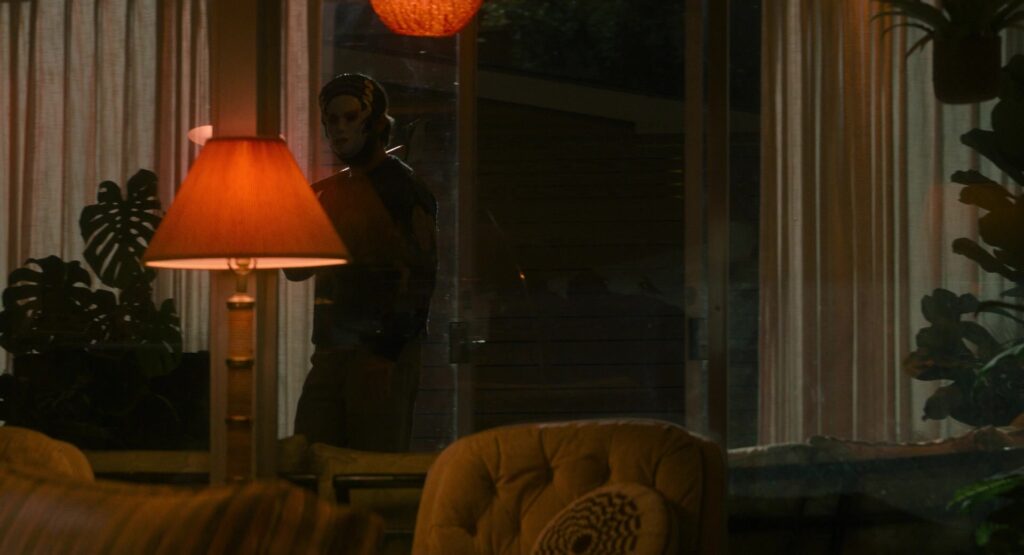
Taffy: “Like two years ago, Lisa was home alone with her mom, and this psycho broke in.” A man with an axe enters the house. He… he’s carrying an axe and wearing a Bride of Frankenstein mask!

A man in a bride of Frankenstein mask enters a house behind a red lamp, he’s mostly in darkness.

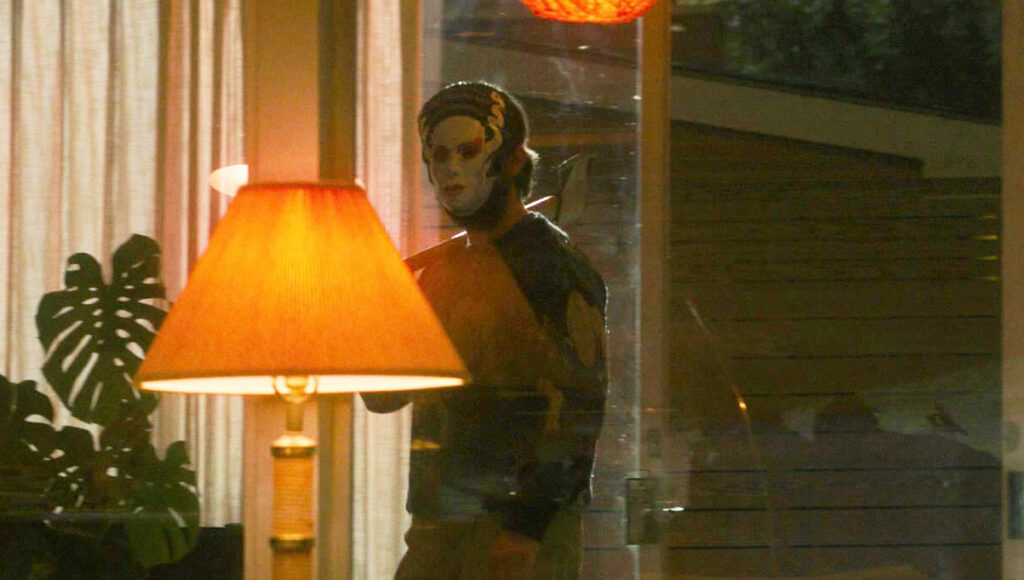
No, really. Let me lighten it up for you.

A man in a bride of Frankenstein mask enters a house behind a red lamp, he’s mostly in darkness, with the image lightened so you can see the man in shadow better.

There’s so much going on here.

You’ve already seen the movie, right? Right?

What is Frank? A man.

What does Frank kill people/reject the idea of being those people with? An axe.

If a man and woman pair are this movie’s symbol of a trans person accepting themselves, and they are (as established in the opening credit animation), who is the “bride” of Frank?

LISA.

This is Lisa “breaking in” to the happy home to tell her mom that

she
is
a
trans
man!

Listen, this mask alone makes me want to remove the “unintentional” part of calling this an Unintentionally Intentional Trans Allegory. Because why else would you put a Bride of Frankenstein on this guy who has an axe?!

I’M JUST SAYIN’.

Lisa’s mom freaks out, sure that she’s defending her child in doing so, because transness is bad and evil. And what does Lisa do?

9:37 – She runs to hide in the closet.

This is metaphor for Lisa previously feeling safe and comfortable with her mom, and telling her she was a trans guy, and it basically killing her mother (or making her mother feel dead to her, or made her mother treat her like Lisa was dead, etc), and sending her back into the metaphoric closet, “killing” the man she truly is.

This is why Lisa left her mother’s rosary, full of her mother’s fear, despair, and danger, at Frank’s grave. Those are what caused her to bury her true self.

9:42 – Now another person is sitting next to Laurie and hearing the story. The rumors of Lisa’s transness spread.

9:51 – The guy “escaped,” and “by the time [Lisa] came out, it was too late.” Lisa came out, but her mother couldn’t accept it, and the guy disappeared. I tolllld youuuu.

9:59 – Yet another girl is now next to Laurie, listening. Rumors spread fast. Laurie: “I’d be screwed up if I were her, too.” Can you imagine thinking you’re really a man? Can you imagine being a weird tranny?! That’s so fucked up! (those girls can go to hell)

10:07 – After that, Lisa “kind of just wandered around like a zombie.” Suppressing yourself makes you dead inside. In a lot of these essays I’ve even described it as “a waking death.” Y’know… like a zombie.

10:28 – Yet another girl is listening to the story. Taffy explains how Lisa’s dad met Taffy’s mom six months later and got married and Lisa “had a new mom right asway.” You can’t not have femininity in your life, Lisa! You need it to conform and be a good “girl!”

10:52 – Tamara asks if Lisa wants a sip from her green-blue cup. Michael says he does, and Tamara says “why would I assume [Lisa] parties?” Look at that weirdo who’s not fem like me, I’ve heard the trans rumors, why would I think she’d conform to the “cool thing” teens are “supposed” to do?

11:02 – Pressured, not wanting to be further ostracized and othered, Lisa drinks from the dysphoria cup. She coughs and gags, while Tamara laughs. Michael takes a sip and spits it out, the liquid is the same color as the cup. Michael: “What is this?” Tamara: “I’m not really sure.”

Michael got a taste of dysphoria (maybe from seeing Lisa’s reaction to it) and found it gross, maybe even drugged. Tamara can’t even identify it. Cis people have no idea what dysphoria even is, and cannot imagine anyone having it.

11:28 – Taffy runs to check on Lisa. Lisa’s vision is blurry, her hearing distorted. Taffy asks if they gave her something, and Lisa nods (yes, dysphoria). Taffy is upset… with Lisa. “This isn’t what I expected from you. You have so much potential.” Lisa’s face is awash in yellow even though she’s nowhere near the firelight.

How could you feel all dysphoric because of what other people did to you? This is your fault for being trans, and not the fault of the world that treats you like shit because you’re trans.

Sad tale as old as time.

11:52 – One of the kids, dressed in clothes with pink and that dysphoria green, plays a ukelele and sings part of the chorus of “I Can See Clearly Now” by Johnny Nash. This song’s pretty well known, but again look at the full lyrics:

I can see clearly now, the rain is gone
I can see all obstacles in my way
Gone are the dark clouds that had me blind


I think I can make it now, the pain is gone
All of the bad feelings have disappeared
Here is the rainbow I’ve been prayin’ for

It’s gonna be a bright, bright
Sunshiny day

Sure sounds like coming out of a dysphoric funk to accept the truth, doesn’t it? Guess what’s about to happen for Lisa?

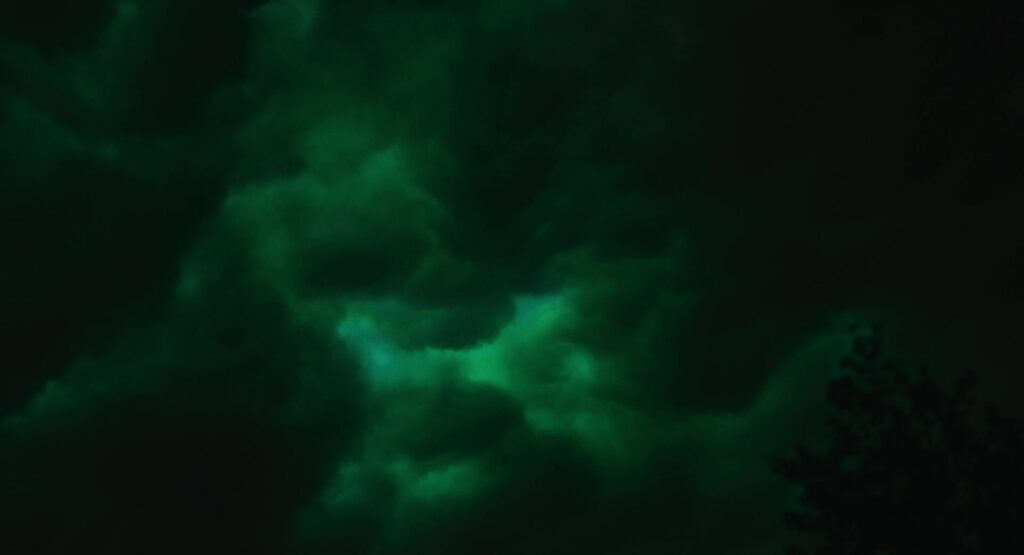
Green-blue dysphoria light in storm clouds

12:00 – Lisa stumbles into a girl who says she’s psychic and she thinks it’s going to rain. Lisa looks up at the storm clouds… and all that dysphoria green-blue.

12:07 – Outside and inside this house, the lights are all fear, the dysphoria fairy lights border the room.

12:25 – A dude comes to check on Lisa, asks if she’s okay. She touches and squeezes his face. This… how do I get… how do I become… this?

She asks who he is, he says he’s Doug (I fuckin’ hate Doug). “Doug” comes from “Douglas” which means, no shit, “dark river.” More darkness in the water, dysphoria dysphoria dysphoria.

He’s her lab partner, in is in a red, yellow, green-blue, and blue shirt. All the bad things, wrapped up into one. (I fuckin’ hate Doug).

He says he’ll find somewhere for her to sit and she takes his hand, he leads her past yellow light streaming down on a boy and girl making out on the couch. Lisa looks at them with wide eyes. Doug says he’d rather watch movies. What kind of movies, Doug??

There’s nothing wrong with adult entertainment, mind you, as long as it’s consensual and everyone’s treated fairly and not exploited, but bringing it up when talking to someone who’s not your partner is a weird and bad thing to do.

13:04 – Doug leads her down a hallway with yellow lights, and yellow wallpaper, still pretending he wants to talk about movies. He asks her favorite director, and she says “Pabst.” Doug thinks she just read his beer can, asks what kind of movies he made. Lisa says: “Silents.” Which Doug takes as “silence” and is a great gag, but also Lisa is right and knows more about movies than slimy skeezeball Doug (I fuckin’ hate Doug). G.W. Pabst was a director of silent films!

Anyway, remember Pabst for next week’s installment.

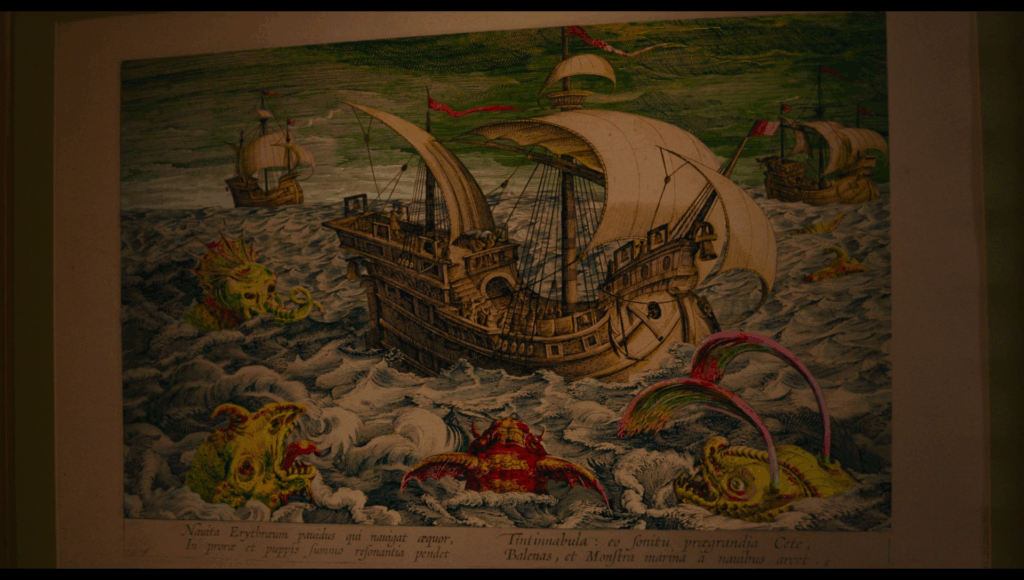
A framed painting of a yellow ship sailing on blue seas with red sea monsters all around, under a green-blue sky

13:21 – Lisa looks at a painting on the wall that seems to be moving, of a ship (with large bells fore and aft) sailing turbulent blue seas, red and yellow, sea monsters lurking, under a green-blue dysphoria sky.

This is a real piece of art (as in, it was not created specifically for this movie), but it’s actually an engraving that exists only in black and white. Meaning the color was added just for the film, so think about why they’d make certain things those colors and what that’s telling you.

The text on the bottom Is Latin:

Navita Erythraeum pavidus qui navigat aequor,
In prorae et puppis ummon resonantia pendet
Tintinnabula: eo sonitu praegrandia Cete,
Ballenas, et Monstra marina a navibus arcet.

Via Google translate, it reads:

The sailor who sails the Erythraean waters, afraid of the wind, On the prow and stern hangs the echoing bells: with that sound he keeps away the enormous whales, and sea monsters from the ships.

I’ve asked a few people who know some Latin to translate it for me as well, because translation is an art and humans can much better discern intent and meaning, and they came up with these:

(credit to AB):
A sailor sailed the fearful Erythraeum/Red Sea – In the bow and highest stern hangs a small bell/windchime, ringing: I go to make a noise to ward off colossal Dolphins, Whales, and Monsters of the sea from the ships.

(credit to Mo Ryan):
From the bow and stern, the frightened Eritrean sailor navigating the sea hangs the loudest of bells
With that sound, he drives from the ships the enormous whales and sea monsters

“Navitae” means sailor, that much is clear. So this could be about an Erythraean sailor, or a sailor on Erythraean seas.

But get this:

The Red Sea appears red due to a bacteria in the water, Trichodesmium erythraeum. “Erythraeum” is derived from the Greek “Eruthraî” or the related Latin term “Erythraeus”…

Which means “red.”

So maaaaaybe what we have is a red sailor.

If the sailor (a man, “navitae” is gendered male I think?) is red, they are wearing red, meaning they have love for themselves. So what you’d have is a self-actualized Lisa-as-Frank, sailing through despair, with fear and danger all around, dysphoria looming overhead… and only the bells, a loud proclamation (of her existence), can keep those things at bay.

You gotta transition, man! It will help you!

Look at what’s staring you in the face, Lisa.

I was sure the Latin on it was something added for the film, but it’s part of the original.

Dang, that piece of art was a find.

13:23 – The room Doug’s leading her toward is red inside, blue light on the door. Lisa barfs into the trash, as he holds her hair and says it feels like easter grass (what color is that, usually? A… greeny-blue maybe? Mmhm.)

Doug reacts to the smell. Sure, it smells bad. But maybe there’s more to it… I wonder if smells ever come up again?

13:38 – Doug calls her “kiddo,” infantilizing her. Not only is she 18 and an adult, we learn later that she’s older than he is. But because he’s a cis white man, society tells him he has authority over everyone. “Kiddo” is a recurring theme in this movie, watch for it.

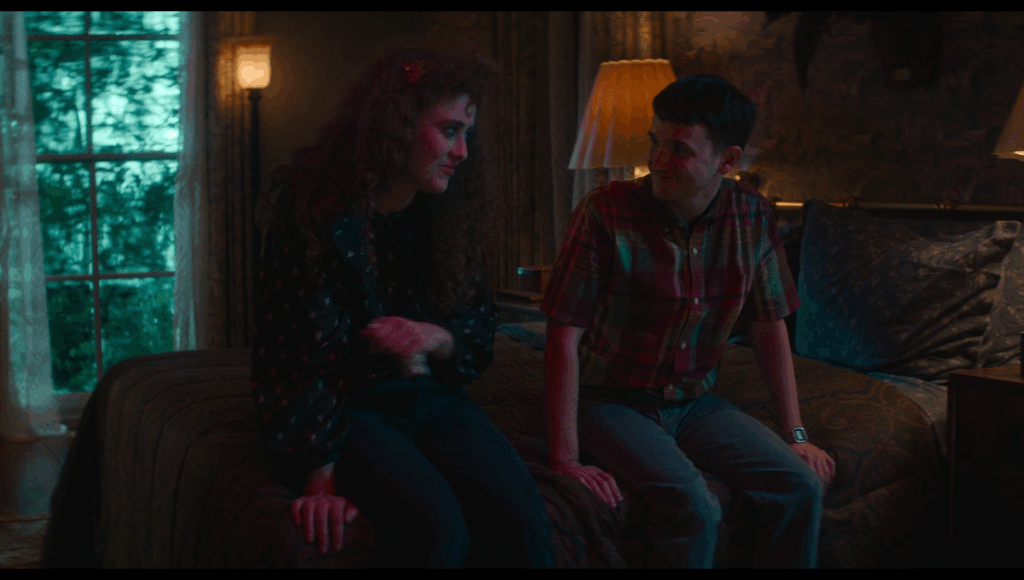
13:50 – The lights in the room are yellow, but the light on Lisa’s face is blue, as she tries to steady herself. Doug sits next to her on the bed.

Lisa and Doug (I fuckin’ hate Doug) sit on a bed with yellow lights behind them, blue light shining on them, and a green-blue flash from lightning can be seen outside the window behind them.

14:00 – Thunder and lightning outside the window behind them, the light that green-blue color that lightning actually isn’t (its color is very intentional, is what I’m saying).

14:11 – Doug says the thunder is “the angels bowling,” and Lisa says her mom used to say that. Doug is reminding her of her mom, which means this guy who offered to help is not going to be actual help… and so here comes the turn.

14:21 – Doug has his hand on one of her breasts and asks if that feels good. Takes her other hand and puts it right on his crotch. “Come on, you can’t stop once you’ve started. It’s the rules.” Never mind that he instigated this, and didn’t ask if it was okay, and she’s done nothing to make him think it was okay, and in fact is in an altered and vulnerable state. Since he started the rules are she owes him sex.

Doug’s even more toxic than the jocks were. (I fuckin’ hate Doug).

14:26 – Lisa’s horrified, there’s blue light on her face, and suddenly red light outside the window… for no reason whatsoever? But she is in danger, isn’t she. And there’s your reason.

14:30 – A haunting cover of “I can see clearly now” plays as Lisa’s mind reels. She doesn’t want to be a bro jock, she doesn’t want to assault women, why can’t she just be a guy like Michael? (Michael is also shit, but we’ll get there eventually).

Lisa gets off the bed and says no, as Doug pleads with her. There’s more red outside the window, but also blue, the yellow lamp, the very green wallpaper with hints of yellow. This is a torture chamber for Lisa.

Doug: “You know it’s not nice to lead people on, Lisa.” You’re supposed to let me sexually assault you, I’m a man.

And if you were a man, this is the kind of thing you’d do, too. It’s what society says we do.

14:50 – Lisa stumbles through the hallway and into more danger, look at the bright red angel behind her, a reminder of the dangers of coming out and how it means death (change), and possibly losing those you love.

14:57 – She stumbles through the dark, only the now-blue light from the lamp surrounding her.

15:05 – Look at the way the footage here gets choppy, like it’s sped up to be unnatural, it seems like there’s frames missing. Everything is surreal and inscrutable.

Lisa, hands in the air, looks up, bathed in a mixture of blue and pink light.

Lisa looks up, face awash in pink and blue, awash in her own transness, as the green-blue dysphoria lightning strikes through the clouds.

15:16 – She’s in the forest, heading toward Bachelor’s Grove. As she walks beneath the gate and turns around to look at it, the sides of her face that are pink and blue switch. They flip opposite of how they seemed before. Multiple times. They change. They transition.

15:24 – The green-blue lighting flashes inside the cemetery, leading the way to Frank’s tomb, which stands apart and above the others.

15:29 – Lisa: “It’s you.” Look at the lighting on the statue, still holding her mother’s rosary, he’s been chained by her mother’s transphobia, where she left him. She touches the statue’s face. “I wish I was with you.” Supertext. There’s a bright flash of white, and then:

15:55 – Lisa stumbles into her house, but it’s allll blue. There’s a mirror on the wall by the door, as she enters and steps forward, the reflection fractures around the mirror’s border. More continued problems with mirrors for her, but also foreshadowing what’s to come shortly.

16:07 – In the bathroom, all these girly things are now all blue. Despair. She sees her reflection clearly in the bathroom mirror.

16:09 – We flash between Lisa and Frankenstein’s statue, pinks and blues all over Frank, we flash back and forth, until there’s another electric zap (remember Lisa in the tanning bed?).

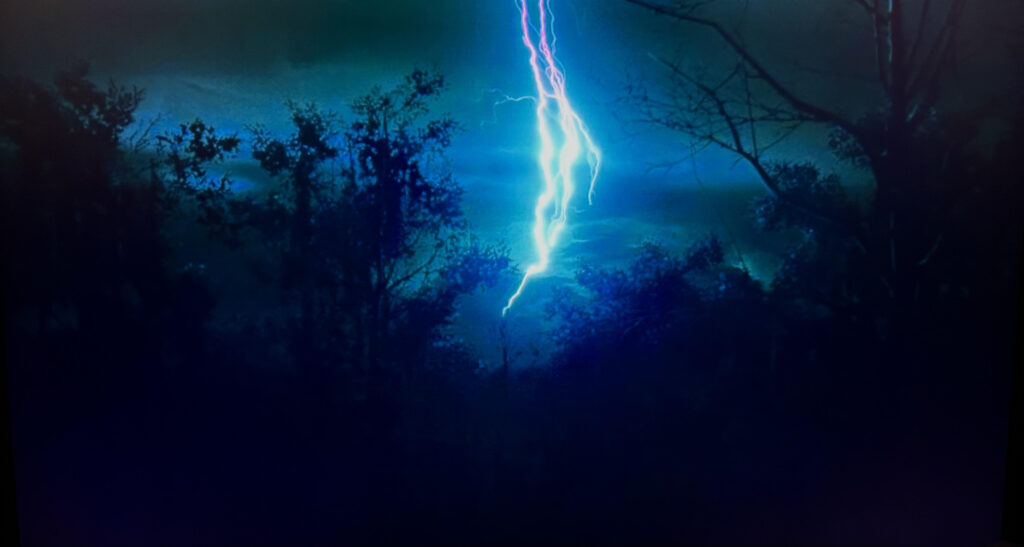
Pink, white, and blue lightning strikes in the forest, in front of a green-blue sky

16:10 – Lightning strikes, but it’s not that unique blue/green of dysphoria. It’s blue, and white, and there’s pink in it too. It’s pink, white, and blue! Have you… ever seen lightning like that? That was a choice that was made by the filmmakers. Hmmmm.

Lisa screams and smashes the mirror. Why is my REFLECTION so wrong?! Supertext.

16:11 – The instant the mirror shatters, the shot switches to the statue of Frank, specifically his face. And then the light radiates out from behind him in the same circular pattern the mirror glass fractured in. This is the face she wishes she saw in the mirror.

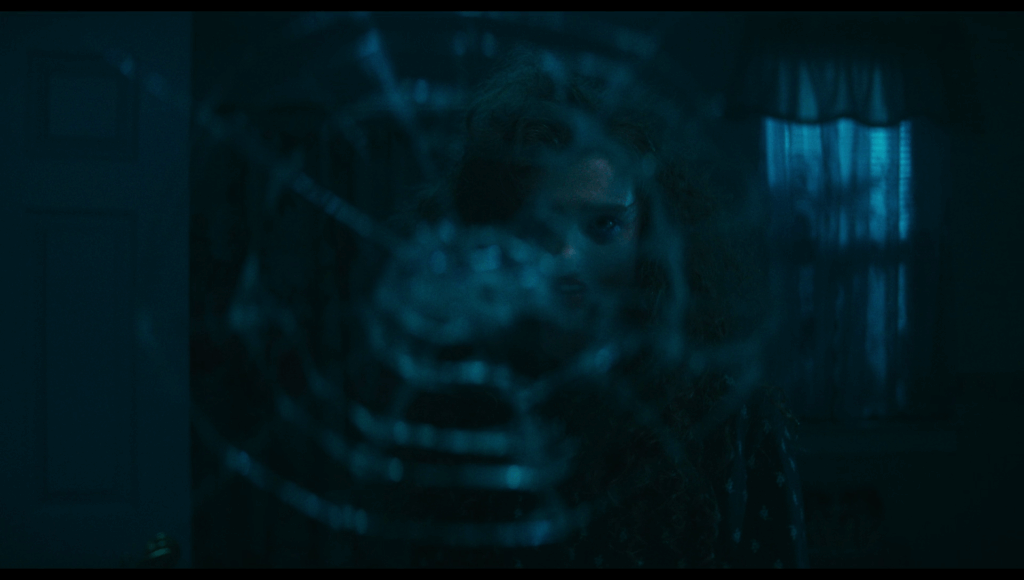
16:15 – We cut back to Lisa, looking in the mirror, her face entirely fractured.

Lisa looks into the mirror she just smashed, her reflection is cracked and fractured.

16:20 – That green-blue dysphoria fills the sky as groaning is heard from the cemetery at Bachelor’s Grove. Signs of life of someone long thought dead! From within her heart!

16:22 – This is the first time we’re in Lisa’s bedroom, which remember represents her subconscious. There’s lots more to talk about here, but we’ll get there when we can see more of it.

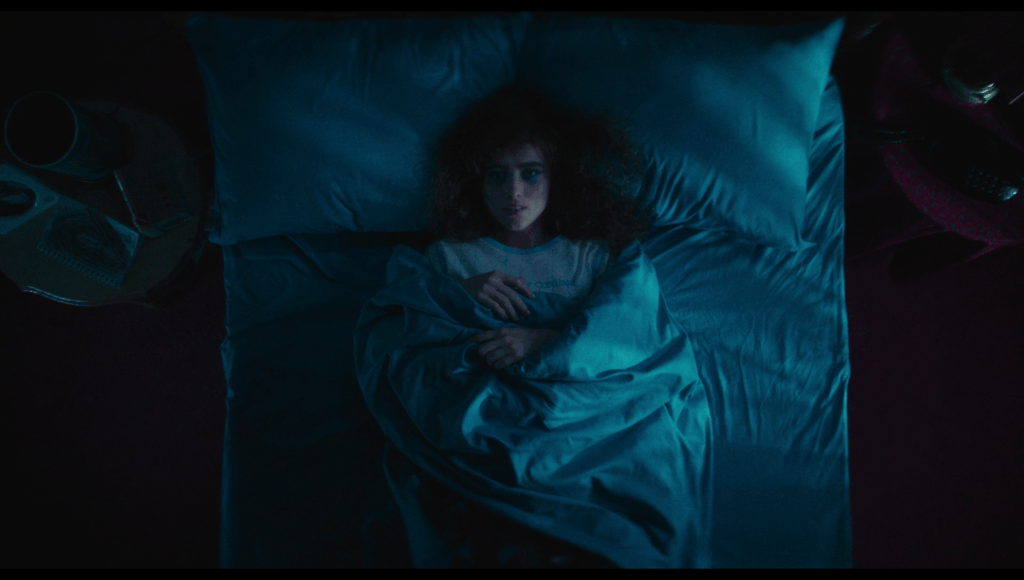
Lisa, wrapped up in her blue blankets in her blue bed, shadows from vertical blinds at the window casting shadows across her bed like prison bars.

Lisa wraps herself in blankets, all blue, the light from the window forming bars across the bed, she’s jailed and boxed in by trying to be the woman society says she is. Her eyes have blue eye shadow, her lips are extra pink. White light flashes across her face. Transness, babe!

From her makeup we can tell she’s been crying, and her mascara runs down beneath her eyes. The mascara is black. The first bit of black we’ve seen her in so far. Remember that in this film, black equals death, death equals change, and change equals transition. She’s begun the journey!

Why is Lisa all wrapped up in her blankets here. It’s foreshadowing of where this journey of change will take her! We’ll refer back to this later.

And you want to get to later, right? Yeah you do. So come back next week as Lisa dreams of a better future, and we see if her step-mom follows the same path Lisa’s mom did.

Tilly Bridges, end transmission.
tillysbridges@gmail.com

PS – Part 4 is here!

THE UNINTENTIONALLY INTENTIONAL TRANS ALLEGORY OF LISA FRANKENSTEIN, part 2

Lisa Frankenstein, part 2. an 8-week series examining its trans allegory, by tilly bridges, author of Begin Transmission: The Trans Allegories of The Matrix, at tillystranstuesdays.com, over a screenshot of Lisa leaning against Frank's grave in a forest, reading.

Welcome to Trans Tuesday! Tillyvision rolls on in THE UNINTENTIONALLY INTENTIONAL TRANS ALLEGORY OF LISA FRANKENSTEIN, part 2! This week we get into what chains our hearts, and how awful it is to be seen when you aren’t the real you.

Be sure you’ve read PART 1 before this, it came first for a reason and has context you need! On we go.

2:50 – The Promise by When in Rome plays, almost the entire song, until 5:00. Look at those lyrics telling you allllll you need to know about Lisa’s coming journey. That it starts when we see her love and infatuation with the “dead boy” says a lot. Read them as Frank, her true self, talking to Lisa, letting her know he’ll be there when she’s ready.

If you need a friend
Don’t look to a stranger
You know in the end
I’ll always be there
And when you’re in doubt
And when you’re in danger
Take a look all around
And I’ll be there


I’m sorry but I’m just thinking of the right words to say
I know they don’t sound the way I planned them to be
But if you wait around a while I’ll make you fall for me
I promise, I promise you, I will

Yyyyep yep yep.

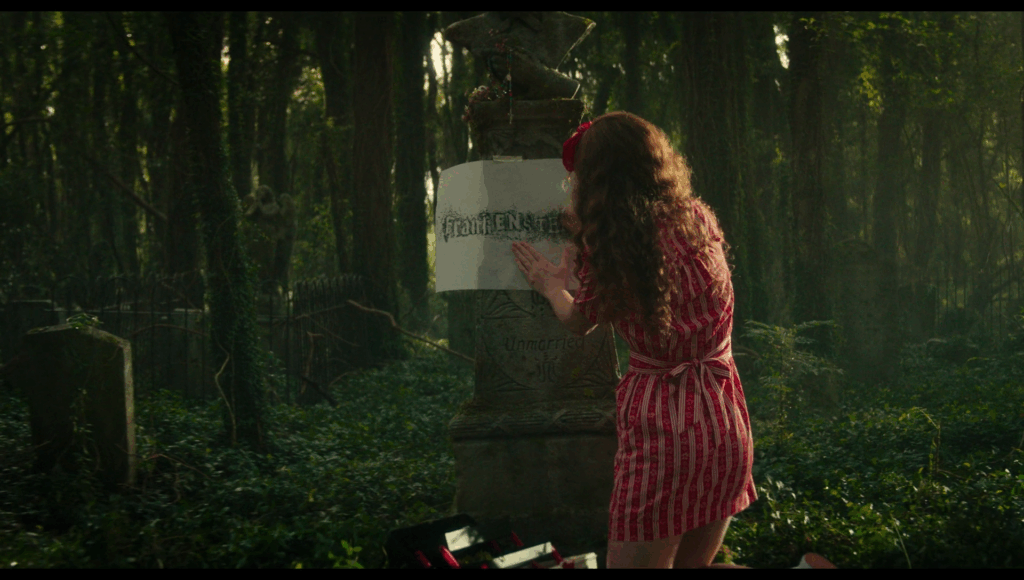
Lisa, dressed all in red, does a rubbing of Frank’s gravestone, in a cemetery inside a forest

2:53 – Lisa does a rubbing of the gravestone, to copy and remember him. She doesn’t want to forget him.

3:02 – She adds “Lisa”, with a heart over the I, in red lipstick above it. She’s infatuated with this dead (to her) man (inside), has feelings of love about him.

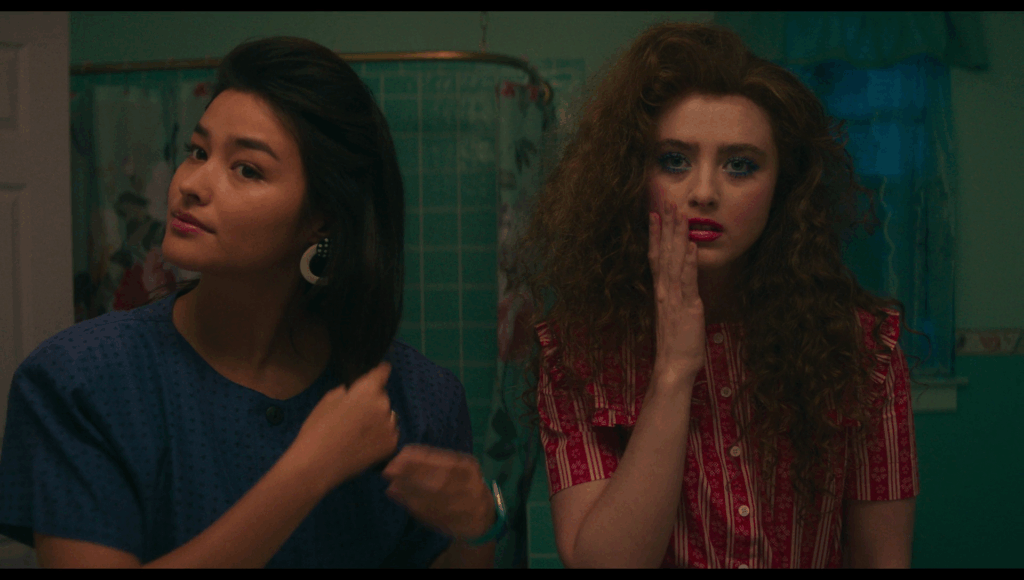
3:15 – Look at everything on this bathroom counter, makeup and hair products, a curling iron… things society tells us women and girls need to conform to the rigid gender binary, many of them the dysphoria green-blue. Things Lisa feels forced to use to be the person everyone tells her she has to be.

By the way, liking these things doesn’t make you a girl or a woman, and not liking them doesn’t mean you’re not… regardless of our feelings about them, they’re what society says we’re supposed to like as women.

Side closeup of Lisa crimping her hair, a yellow light on the wall in the background, on a green-blue wall, right in front of her eyes as she looks into a mirror with a pink frame.

3:20 – As she crimps her hair, look at all the green-blue around her, the yellow light right by her eyes (these things send warning signals through her, these are not for you), the pink framing the mirror. Bathrooms are a source of dysphoria and gender conformity. She sees herself in the mirror and averts her eyes, she doesn’t want to look at that.

3:23 – In this shot there’s even more green-blue around her, she’s surrounded by dysphoria when doing these things society says she should do, and liking the things society says she should like, because they told her she’s a girl.

3:35 – She spares little glances in the mirror just to try to do the girly things right, but the crimping didn’t work right, the makeup makes her miserable, none of it brings her any joy. She drops the makeup brush and averts her eyes from the mirror again, hides her eyes from it. See PHOTOS AND REFLECTIONS to learn how difficult those can be for trans people.

Taffy fixing her hair as she looks in a mirror. Lisa stands next to her, looking into the mirror, gently touching her face, looking miserable.

3:43 – Despite the misery, Lisa’s trying to girl correctly again, when Taffy, her step-sister, enters. Taffy’s dressed in blue, being a girly-girl holds only sadness (in Lisa’s eyes). Taffy: “I don’t think that blush is your shade, Lisa.” A girl who does like those things tells her she’s “doing girl” wrong. Lisa looks at herself in the mirror, still miserable, touches her face like something’s wrong with it. Is it the blush Taffy mentioned… or it is that that’s not her face?

Is that the face someone makes if they put their makeup on wrong? Does her makeup even look wrong to you? She can do it however she wants. But dang, that hollowed-out despair stare is something you see in so many trans people’s photos from pre-transition.

3:48 – Lisa says she’ll probably just stay home. There is a gathering, a party, an event, and she’s not thrilled about going and being perceived. We see this same thing in THE MATRIX and REAL GENIUS, a thing that speaks truth about trans people pre-transition. Even if we want to be at a gathering or around people we like, it means being seen as someone we’re not and having to put on the act of who everyone says we have to be, and that hurts.

Watch in here how rarely Lisa looks at the mirror. She mostly keeps her eyes down, and when she does look up… she tries to look absolutely anywhere else.

3:53 – Taffy tells her this party is critical and “compulsory”! Like the compulsory cisgender heterosexuality our society foists on us all! See GENDERED CHILDHOODS for more on that.

3:55 – Taffy: “You know what your doctor said. You need socialization.” Lisa has seen a doctor for a problem she’s having, and a medical professional basically said “use more makeup, wear a dress, conform to who we say you should be and you’ll feel better! You only feel bad because you don’t conform!”

Like, medical transition care is real and needed for a lot of us, but allllso it’s basically treated as a “last resort” option they try to keep from us. They’ll try absolutely anything else first, even when we directly tell them what we need.

4:13 – Taffy wants Lisa to use her tanning bed. What is a tanning bed? A thing you use to fake a real thing you might otherwise have. It’s a way to conform to a visual aesthetic that society says is pleasing.

My friends, that’s gender-affirming care. Fine for the cis! Just not for us nonconformo transes. Check out CIS PEOPLE GET GENDER AFFIRMING HEALTHCARE TOO to learn more.

BUT—

Remember that the tanning bed is gender affirming care in metaphor, and watch what happens…

4:22 – Taffy turns Lisa’s head, forces her to look at herself in the mirror. Look at Lisa’s miserable face, again. Taffy: “You’re in need, babe.” Lisa is in need, but not of the lies society offers. Look at the difference on their faces. Lisa is not a person who likes what she’s hearing.

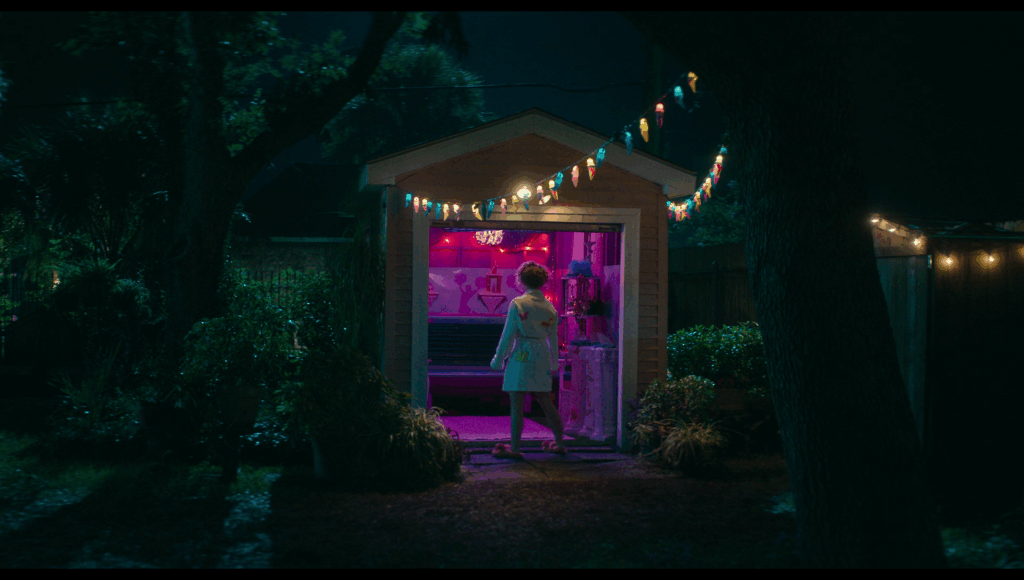
4:29 – Lisa opens the shed and is bathed in pink light. Using this will only force gender conformity on her (or so she thinks).

Lisa stands in a bathrobe in front of the shed with the tanning bed in it, the interior all pink and blue. Strings of yellow, red, and blue lights lead toward the shed.

4:32 – The shed is awash in pink light, but there’s a lot of blue inside. Remember what the two together means? Yar, there be transness here!

The lights leading to the shed are yellow, red, and that same green-blue. The fear and danger of dysphoria have led her to this point. When you examine why you have those feelings, they can lead you to a solution… transition (here, in handy shed form).

More specifically, I believe this transition shed represents HORMONE REPLACEMENT THERAPY. I’ll explain why toward the end of the film.

4:35 – Look at her bathing suit, clashing in colors and patterns. Her love of self, all the warnings she’s picked up on, her sadness, and her dysphoria, have brought her to this point.

Behind her, the blue wall with silhouettes of pink cheerleaders. Transness.

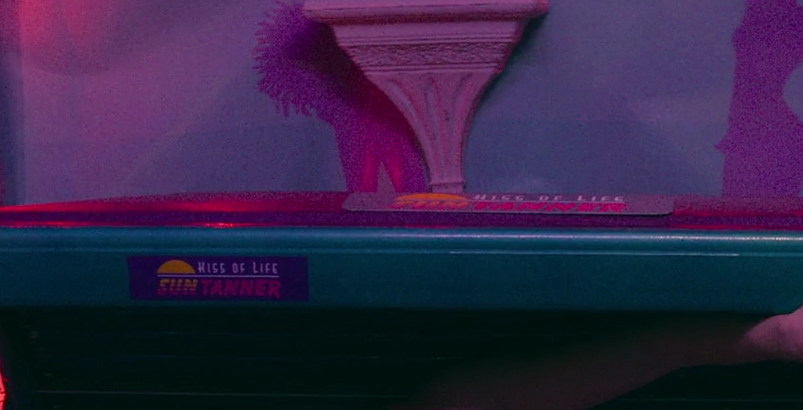
The tanning bed is blue and pink. Transness.

The tanning bed label says “Kiss of Life sun tanner”.

The tanning bed brand is Kiss of Life. Kisses equal love, and they bring true life. Loving yourself carries you to living your truth.

4:46 – When the tanning bed closes, looking much like a coffin, it lights up with the dysphoria green-blue. It zaps her and she screams! It didn’t work, because it was, in effect, set to the wrong hormones.“The Promise” stops playing with the zap. But that zap is important. It’s her realizing that trying to conform to this woman she’s told she has to be really is wrong for her.

4:52 – As they drive to the party, Taffy apologizes for her tanning bed electrocuting Lisa, who replies, “I’m fine.” Is she? Look at her face! She’s miserable! And no wonder, look at her top. The pattern on it is in the dysphoria green-blue.

Trying to be a woman (again) only covered her in even more dysphoria.

5:00 – Taffy asks how Lisa likes Brookview so far. Not for nothing, but I described my own GENDER DYSPHORIA as being “like drowning,” and other trans folks have likened it to similar things. In view of a brook means you can see the water, ie I have not escaped dysphoria even though I moved to a new place.

In the same dead monotone as before, Lisa again says, “It’s fine. It’s the same as my old school.” Running from your dysphoria doesn’t make it go away, it follows you everywhere. And it makes you feel dead inside.

5:17 – Taffy asks if Lisa’s hot for anyone, and Lisa whispers “Michael Trent.” Remember that Michael means “like god,” and “god is love.” Lisa’s attracted to him because she loves him… or is it because she loves the kind of man she thinks he is?

I don’t know how to tell you this, cis folks, but for a good number of gay/bi/non-straight trans people, part of the difficulty in figuring out we’re trans is in wondering if we’re into someone because we’re attracted to them… or because we want to be them? It can be both! See SEXUALITY IS NOT GENDER for more.

Lisa’s going to struggle to figure out that very thing for most of the movie.

Lisa says Michael’s the editor of the school literary magazine. Do you remember what we saw Frank doing in the opening animation, besides playing the piano? Reading. Lisa sees in Michael something she recognizes from the man she has inside.

5:56 – Taffy talks about how great the party will be, and Lisa says it’s just off of Bluff Road (bluffs are lies, supertext), and they could have walked. Taffy says that’s too far to walk in jellies (they’re wacko shoes from the 80s kids, look ‘em up) and it would have hurt her feet. Taffy’s more concerned with appearances than functionality. Which, by the way, is what society forces on women all the time, with things like corsets and high heels, and makeup that makes it so you can’t hardly touch your own face without ruining it.

Again again again, it’s fine to like those things if you’re a woman! I do. But it’s wrong for society to make it a requirement for being the “right” kind of woman.”

Lisa says there’s a shortcut through the forest… through Bachelor’s Grove. Taffy says that’s the “haunted cemetery,” a place for dead things and tormented souls.

Lisa: “It’s not haunted. It’s just… abandoned.” Hey, that’s her heart, remember? Supertext. Then she smiles as she says, “Desecrated.” Is that a thing to smile about? She clearly likes something about whatever’s in there…

6:20 – Taffy says she heard the Heshers did witchcraft there, and that Gina Marzak dedicated her unborn child to satan there. “Gina” can be derived from several different names, but one of those is Virginia, which means virgin. Given that Taffy references the name in relation to an unborn child, it feels like a safe bet.

The cis view of the place where they force us to lock our true selves away from the world? Where people have autonomy (listen, people can do whatever they want with their own bodies even if you don’t agree with it)? It’s evil and no one should go there. According to much of our society, bodily autonomy is for (cis white) men only, whether you’re talking about abortion rights or trans rights (they are the same fight, see BODILY AUTONOMY.)

Lisa says she’s never seen anybody else there. Being trans and dysphoric is lonely, you might think you’re the only one who has these feelings, if you’ve not be taught that we exist. Which is why Republicans are fighting so hard to erase us from history and public life again.

There’s a long history of trans people being erased from, well, history. Learn more in TRANS HISTORY 1: HOW AND WHY WE NAME TRANS PEOPLE IN HISTORY.

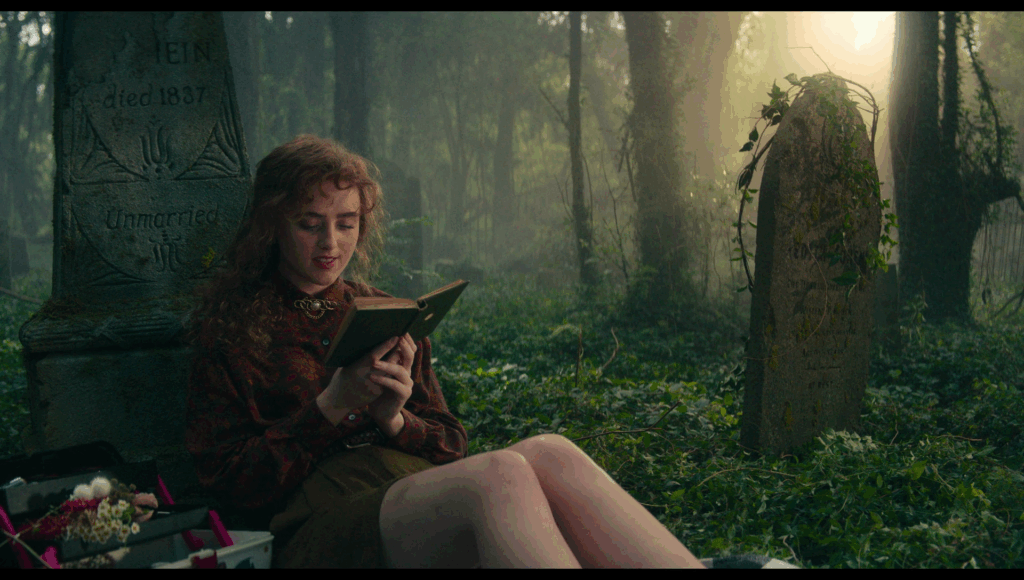
6:30 – In a flashback, Lisa is reading at the base of Frankenstein’s grave, dressed in red, deep in her heart she knows she still has love for her true self.

Lisa, in a red top, leans against Frank’s grave in the forest, reading a book. Next to her is a small bundle of red and white daisies.

Do note the flowers next to her, the small bundle of red and white daisies. I’ll remind you about them near the end of the movie.

She says she does wax rubbings of all the tombstones… Frank’s is her favorite. She does rubbings to remember him. She doesn’t want to forget him.

But pay attention to how his name is broken on the tombstone, so you can’t read it (and neither can Lisa). She doesn’t know his name, and won’t, until she becomes him and chooses one.

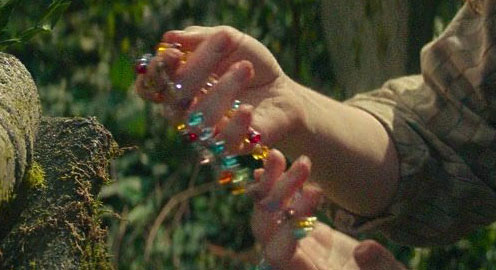
Lisa’s hands holding a rosary with red, yellow, and blue beads.

6:59 – In another flashback, Lisa now wearing green, she brings him a rosary with a crucifix that was her (dead) mom’s. Why would she bring that to the grave of a strange man, do you think?

Look at the beads… danger, fear, despair. There’s a crucifix attached, emblematic of sacrifice. That’s why it’s her mom’s rosary, and why she leaves it at Frank’s grave. This is when Lisa sacrificed her true self because of the fear, danger, and dysphoria her mother caused.

This gets confirmed in a bit!

And notice her top is green like the forest. By sacrificing her true self, she’s going to blend in to her surroundings. She’s gonna go GIRLMODE even if it kills her inside to do so.

Also, the book she was reading, and that she leaves him is titled, “Shelley’s Poems.” This is not just a nod to Frankenstein author Mary Shelley, it will also be relevant again at the end of the film. Just remember she left it with the man in her heart.

7:13 – Taffy: “That’s really weird, Lisa.” Cis people think us even talking about the smallest hint of our complicated gender feelings is “weird.” Lisa: “I just don’t think anyone should be forgotten.” That includes our true selves, buried deep inside.

7:22 – Taffy’s car is bright red. Danger, Lisa. Maybe not now, but beware. Head Over Heels by Blue Peter plays. Let’s have a look at those lyrics:

Swept away, I think I′m gonna fall
Late last night, when I got your call
Round and round my head, I still hear your voice
You said “Stay”, I guess I’ve got no choice


Just like a favourite song or a pretty face
When you’re gone, I’m still hungry for the taste
Building up the walls to keep the world outside
Out on the streets, we′ll take the world for a ride


The city’s on fire, we live for the smoke
I feel the heat when you get this close
Across the table, I light your cigarette
Just another story I could never forget


Head over heels
I′m falling fast
Head over heels
Will this romance last?

If we continue to interpret the “romance” as loving yourself enough to transition, you get a song wondering if there’s any hope for self-actualization in the future, and closing off from the world because being yourself out there is dangerous. Hmmmmm.

7:28 – Look at the lights at the party… they’re all green-blue. Dysphoria awaits you here. Taffy goes right over to other girls, they talk about hair and girly things. Lisa rolls her eyes and hangs back. Alone. Uncomfortable. THE MATRIX (see my book Begin Transmission: The Trans Allegories of The Matrix) and REAL GENIUS both feature this exact same event.

7:52 – Lisa walks past some boisterous jocks in red. Danger. She flinches at their stereotypical displays of tough man masculinity. But also those are often the types of people who punish us most for not conforming. There’s a boy in a pink and blue shirt just standing there, looking at them, following them around silently.

We already know she’s not into those kinds of guys. That’s not the kind of man she wants to be, or is. But she’s worried that she’d have to follow in those footsteps. For what it’s worth, BARBIE deals with that sort of bullshit on a macro level… if society says a woman (or man) is X, and I’m not X, does that mean I’m not “really” a woman (or man)?

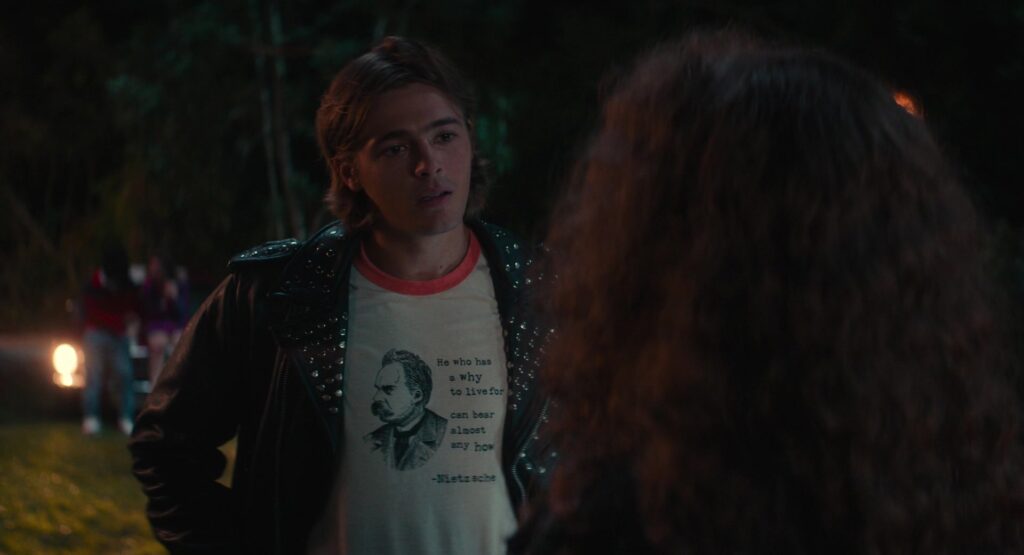
8:23 – Look at Lisa’s reaction when she meets the kind of guy she thinks she does want to be, the famed Michael Trent. She’s panting! Excitement! An encounter with, seemingly, the kind of person she always wished she was.


Michael wears a white tee with an orange collar under a black studded leather jacket. The shirt has a picture of Nietzsche on it, and says “he who has a why to live for can bear almost any how”

Look at his shirt! A picture of Friedrich Nietzsche with the quote, “He who has a why to live for can bear almost any how.”

As in… living for the he you want to be, Lisa, can help you do things you never thought possible (see TRANS MOTIVATION).

Nietzsche was a philosopher and complicated person (to put it mildly). Among many things, he was known for claiming “…the Christian faith as practised was not a proper representation of Jesus’ teachings, as it forced people merely to believe in the way of Jesus but not to act as Jesus did…”

Remember Taffy saying things in Bachelor’s Grove/Lisa’s heart were satanic? Remember Lisa had her mom’s rosary? These women who claimed to believe in “goodness” were themselves anything but (the bit about Lisa’s mom we’ll get to in a minute).

Nietzsche also “became increasingly preoccupied with the creative powers of the individual to overcome cultural and moral mores in pursuit of new values and aesthetic health.”

Okay listen. There’s trans things, and then there’s transy things. Supertext.

8:36 – Michael tells her she submitted good poems, even though they’re “pitch black.” Things are dark indeed from deep inside dysphoria. But remember Lisa and the color black is about change and transition. She was writing about her complicated gender feelings!

9:00 – Laurie, bathed in yellow firelight, asks Taffy what “happened” to Lisa because she’s “heard stuff.” Rumors that she’s, y’know… transy. Taffy says she can’t talk about it because she promised not to… but then does anyway. Gotta give that hot goss on us transes and not respect our privacy. Already we see the betrayal and why Taffy’s car is red. This foreshadows her later, much more severe betrayal.

That does it for this week! Next week we get into how horribly things can go wrong when we trust the wrong person to come out to, and how figuring out who we don’t want to be can lead us to who we do.

Tilly Bridges, end transmission.
tillysbridges@gmail.com

Part 3 is here!

THE UNINTENTIONALLY INTENTIONAL TRANS ALLEGORY OF LISA FRANKENSTEIN, part 1

Lisa Frankenstein, part 1. an 8-week series examining its trans allegory, by tilly bridges, author of Begin Transmission: The Trans Allegories of The Matrix, at tillystranstuesdays.com, over an animation cell of green lightning striking bare trees

Welcome to Trans Tuesday! Tillyvision is back again to talk about the first explicitly transmasc allegory I’ve seen! Let’s dive into the delightful, the weird, the wonderful UNINTENTIONALLY INTENTIONAL TRANS ALLEGORY OF LISA FRANKENSTEIN, part 1! This week: context, color, names, and more!

I’ve done a lot of trans allegory in media writeups, and they’ve kind of become what I’m most known for, thanks to the series on The Matrix films that became my book, Begin Transmission: The Trans Allegories of The Matrix. If you’d like to check out alllll the others I’ve done, head to the TRANS MEDIA section of this site and have a browse!

These are easily the most popular essays and podcast episodes I do, you all seem to love experiencing them as much as I truly love doing them. But as a reminder, they’re exponentially more work than my usual essays.

Between watching the film and taking notes, turning those notes into this write up, sourcing screenshots, research, editing and revising, and recording the podcast version, I’ve put approximately thirty hours of work into this. And this is why I can only do them every so often. But hey, the next one’s here! Hooray.

When I first saw Lisa Frankenstein, I not only loved its heart and its humor and its delightful weirdness, but so much transness leapt out at me that it immediately went on my list of films to do a trans allegory deep dive on.

Especially since it’s the first transmasc allegory I’ve found! Some, like SILO (which as far as I know is entirely unintentional) and STAR TREK: STRANGE NEW WORLDS’ “AD ASTRA PER ASPERA,” speak generally about transness, others like THE MATRIX and BARBIE and I SAW THE TV GLOW speak even more specifically to transfems. So I was really excited to dive into one for all the trans men and nonbinary masc folks out there. Especially given THE ERASURE OF TRANS MEN is a real thing that happens.

But I do want to say Lisa Frankenstein, like The Matrix and Barbie and I Saw the TV Glow, still speaks to the entire trans community in so many ways.

So what the hell is an unintentionally intentional trans allegory, Tilly? Well I’m so glad you asked, this is perfect timing because I was just about to tell you.

As far as I’m aware, no out trans people worked on this film. But in an interview with intomore.com, Lisa Frankenstein writer and producer Diablo Cody had this to say about the film’s queerness:

…the object of Lisa’s affection is literally in a closet for a lot of the film. …I grew up not just in the 80s, but Catholic in the 80s, at a time when people around me were encouraged to repress any queer feelings that they had. And this relationship in this movie is hidden, so I think you can read some subtext into that. And, you know, even though it is somewhat of a heterosexual love story… they’re definitely an offbeat pair… it’s not a relationship that would be fully accepted by society in any era…

From that alone, you know that there’s an inherent queerness to the film, in spite of its seeming cishet romance.

But here’s something super interesting, if slightly problematic:

The film’s director, Zelda Williams… played a trans man in a television show, Dead of Summer, in 2016. Here’s some quotes from her in an interview with etonline.com:

The thing I’m most terrified about is the transgender community being insulted by [Drew]. It’s great that [the public] will get to learn about a male-identifying transgender character as a lead in an ensemble show, but really, more than anything, he is for the transgender community, because they don’t ever get to see him. I hope that they’re happy with him, because I’m proud of him.

Although she was a bit nervous to take on her first-ever leading role, Williams reveals that in a lot of ways, she felt like she could connect with Drew. “Drew isn’t necessarily a far stretch from who I am,” she explains. “I’m not a girly girl. I never have been. I had a shaved head for six years.”

While a seeming cis woman playing a trans man isn’t great (see TRANS ROLES AND STORIES for more on why that is), she clearly got to experience some of what trans men go through in her prep and performance of a role. And that’s not to say playing a trans man and being a trans man are equivocal, but actors get inside the heads and hearts of their characters. That’s the job. They think about them and explore them in deep and intimate ways.

So while portraying a trans man is not living as a trans man, it does give her a perspective that most cis people don’t have. Especially when she was so concerned about not doing harm and getting it right. A cis person playing a trans character does do harm (again see TRANS ROLES AND STORIES for why), but I doubt anyone involved even realized that. It’s part of a long trend of cis actors playing trans characters, even though there are many out trans actors available, especially now in 2025.

And from those quotes, she’s maybe somewhat gender nonconforming, or at least lived that way for a while. And that also gives her some personal experience with the way society treats you when you don’t fit into the very narrow boxes they like to categorize us into (see THE FALSE DICHOTOMY for more).

So I think, when you combine a writer who’s trying to speak to queerness subtextually, and a director who’s intimately familiar with some of what trans people, especially trans men, go through… when you mix those things together, you get them intentionally making a very trans movie even if they might not have realized it.

I’ve mentioned in many of these allegory writeups how that’s absolutely a thing that happens. Writers (and directors, and musicians, and and and…) can often be exploring something subtextually in their work and not even realize that’s what they’re doing.

For years before I understood, could name, and accepted my transness, I was exploring gender themes in my own writing. There were always perceived men becoming or turning into women. Why would that happen? Nobody knows, it’s a mystery!

In fact, Jane Shoenbrun, who wrote and directed I SAW THE TV GLOW which I did one of these deep-dives on, said it was the process of making their first film, We’re All Going to the World’s Fair that cracked their egg (made them realize they were trans).

We’re All Going to the World’s Fair is also a deep trans allegory, which Jane admits was intentional, because they were unpacking all their complicated gender feelings in exploring the theme of the film. But they didn’t know that’s what they were actually exploring through most of the process, even though they were intentionally exploring it. (I was on the Progressively Horrified podcast, with other fabulous guests, to talk about this film and all the ways it speaks to dealing with gender dysphoria, if that’s a thing you’re interested in).

This is what creating art is, we tell stories about people exploring feelings and themes that we want to talk about, sometimes without even being able to name or identify what those feelings and themes are.

And thus we arrive at Lisa Frankenstein, an unintentionally intentional trans allegory.

However… there’s some compelling evidence that it might not have been unintentionally intentional at all. Once we get to the end, and you have all the evidence, that’s something you can ponder. 😊

Just remember everything in a movie is a choice made by the filmmakers. Even when coincidences or happy accidents happen, it’s a choice whether to include those in the final cut of the movie or not. There is artistic intent behind it.

So let’s get to talking about the film itself! On the surface, it’s a Frankenstein retelling about a teen girl who’s a bit of an outcast bringing a dead body to life, making him whole with pieces from other humans, and falling in love with him.

But just like with The Matrix and Barbie, Lisa and the creature (this is how he’s referred to in the film’s subtitles, and is how the monster is referred to in the original Frankenstein) represent the same person at two different points of transition.

Before we go any further, I don’t like referring to someone who is, in effect, a trans man as “the creature,” so for the rest of these deep dives, I’ll call him Frank.

Lisa is a trans man who has denied their truth, like society instructs us to do in so many ways (see GENDERED CHILDHOODS and TRANS TRAUMA 2: SOCIETAL GASLIGHTING). Over the course of the film, she self-actualizes and becomes who she truly is, Frank the trans man.

It’s important to note this movie is not about her egg cracking (realizing she’s trans), this is about someone who did realize, but the world reacted so poorly that she suppressed and denied her own truth. And then coming to realize they cannot deny that truth no matter how hard they try, and finally accepting it.

So Frank represents her self-actualization, exactly the way Trinity represented that for Neo in The Matrix. And just like in the Matrix films, the “romance” between the two apparently cishet lead characters is actually about someone loving themself enough to do what they need to do in order to be happy… transition, even in spite of society working so hard to stop that.

“Lisa” derives from “Elizabeth,” which is the Greek form of the Hebrew name “Elisheva” which means, “my god is an oath.” An oath is a promise, and though I’m not Jewish, if “god is love” holds true then Lisa becomes “love is a promise.” A promise to yourself, to love yourself. To be your true self.

Lisa’s last name is “Swallows.” Those birds are symbolic of homecoming (very supertexty for someone who rejected their truth but then comes back around to accepting it), but also of the protection and blessing of the divine (and if god is love, the love she has for herself is protected and blessed here in her heart). Swallows can also represent those who know the truth but refuse to accept it! So now it’s just SUPERsupertext.

“Supertext” is a term I coined  to mean the opposite of subtext, basically yelling the truth right in your face.

Lisa’s step-sister is “Taffy,” which in terms of names is the Anglicized form of “Dafydd,” which itself is the Welsh form of “David”… which comes from the Hebrew name “Dawid,” which means “beloved” or “uncle.”

So what the heck’s going on here?! Is the seeming gender-swap of the name important? I submit to you that no, it is not, and in fact I think the Taffy in Lisa Frankenstein has nothing to do with the origins of the name, and is instead there because of the candy. Because what is taffy? Soft, stretchy. Malleable. It can take whatever shape you mold it into.

And Taffy, the character, is everything society tells you girls should be. Pretty, overly concerned with her appearance, kind of obsessed with boys, ultra-fem. She’s everything Lisa doesn’t want to be. Though the fact that she’s someone who should, and seemingly does, actually care about Lisa (well, until she doesn’t) is also important.

Lisa’s dad is “Dale,” which literally just means a dale or valley. But what’s a valley? A low point that prevents you from seeing what’s around you. Dale is perpetually unaware of his surroundings, what’s going on, or even how to describe his own wife’s appearance. He’s kind of clueless, in the way so many cis people are about anything related to transness.

“Janet” comes from “Jane” which comes from “John,” which… okay, here we go… it’s the English form of Iohannes, which is the Latin form of the Greek name Ioannes, which comes from the Hebrew name Yohanan. And that means “god is gracious.”

But if god is love, why was this name given to Janet, the most cruel and evil person in the entire movie? Because Janet is a hypocrite in every way, which makes her name deeply ironic.

“Michael” is from the Hebrew name Miḵaʾel, meaning “who is like god?” or “like god.” Again, if god is love, then Michael is like love, but maybe actually isn’t love, which is important. Not just in what happens with him in the movie, but in what he represents for Lisa. We’ll talk more about that when he first appears.

As with The Matrix, and Barbie, and I Saw the TV Glow, all linked above, colors are used metaphorically to help tell the story.

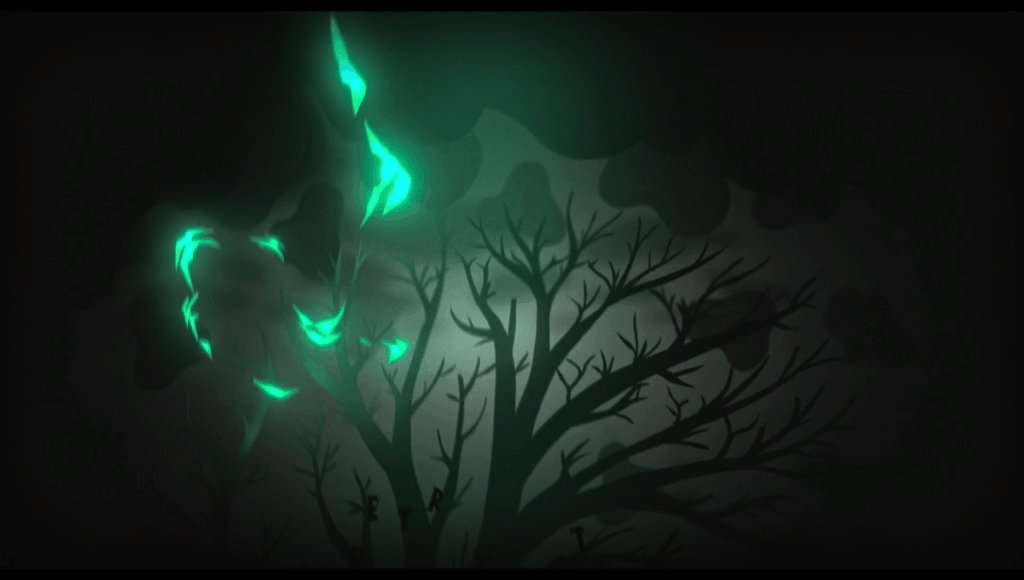
The single most important color in the entire film is the very specific green-blue in the lightning bolt in the opening credits animation.

A bolt of green-blue lightning striking a tree in a simple animated style

It’s the first color you see, it’s horribly destructive, and it shows up everywhere in the movie in very specific ways (which I think has to be very intentional for such a wildly specific color). This color is representative of GENDER DYSPHORIA, of everything wrong with the world when you’re not the gender you’re assigned at birth.

I tried to find a name for this color, and there are several that get close, but also because things like lighting and paints and fabrics are all colored in different ways, the color doesn’t always exactly match. So you’re looking for anything close to what you see in the screencap above. Trust it will be very obvious most of the time, and difficult to miss.

Pink is the color of gender conformity, which makes a lot of sense in a transmasc allegory. It’s the color the world forces on girls. And of course you can be nonbinary and like pink, you can be a girl and like pink just because you like it (like me), and you can be a boy who likes pink. But society says “pink is for girls” (see that GENDERED CHILDHOODS essay), and so in Lisa Frankenstein it’s representative of everything society forces on girls, and everything that transmasc folks may want to get away from.

Yellow is fear and caution.

Blue is sadness, despair, and depression.

Except for when you see pink and blue together, which is, you guessed it, indicative of transness.

Red is more complex, and has a double meaning. In the world, it’s a sign of danger.

But when Lisa is wearing red, it’s a metaphor for love. The colors Lisa wears conveys a lot about what’s going on with her.

When Lisa’s in black and going all gothy, well that kind of garb usually signifies death, or honoring death, respecting those we’ve lost. But as in tarot, many cultural beliefs, and many allegories, death is symbolic of change. The more black she wears, the closer she gets to the change of transition. And conversely, the more human Frank looks, the closer he is to being the fully realized man Lisa has always been inside.

I believe Lisa’s bedroom is indicative of her subconscious, and Bachelor’s Grove is a metaphor for her heart (which, yes, has a dude in it).

It’s important to note that all of the murders in this movie happen at the hands of Frank, and not Lisa, but more important is that each kill is a metaphoric rejection of what that person represents.

And just to be clear, though Lisa is a trans man, for clarity I will use she/her pronouns for her, and he/him for her true self, Frank.

Time for timestamps! Let’s. Gooooooooooooooooo!

0:58 – In our opening animation, we see Frank wake with a sigh, and the photo on the wall shows he’s alone. His parents disappeared from the photo after he looked at it. Maybe they died… or maybe they’re dead to him, and he to them, because they couldn’t accept his truth. It’s actually that second one, when you remember that Frank is Lisa’s final form, and what happened with Lisa’s mom.

1:04 – The food falls from the spoon, there’s no joy. Frank is reading, always reading or playing the piano. He’s artistic, inquisitive, soft. Not the stereotype of the manly-man, devoid of emotions except lust and anger, that the world tries to tell men they have to be.

1:18 – The woman blows a kiss at him, giving up her femininity and accepting him. This was Lisa’s egg cracking, realizing the soft, artistic guy that she really was.

Still from a black and white animation of a man and a woman sitting on a bench in a park. The man is on the left, the woman on the right. The man has put aa flower in the woman’s hair.

1:27 – The pair are together on the bench in black and white, him on the left, her on the right, happy. Frank puts a flower in her hair, and she accepts it. This is her accepting his gift (his existence). And look how similar the silhouette of their hair is. Is that because they’re the same person? Yeah you betcha.

1:36 – The woman leaves Frank, when society still treats her like a woman, and you see the flower in her hair has been lost. She’s given Frank up, and it devastates her true self inside.

1:49 – The horse kicks a man off the balcony, and metal beams fall and crush a man (with a gun) on a boat. Masculinity is rejected and cannot fight for itself.

Note that Frank here is always walking from left to right. He was on the left of the bench, the woman on the right. He is moving from his true self back to the woman society said he was and had to be.

2:00 – He sits on the bench alone, forgotten, not whole, as a man and woman pair (representative of a trans person who’s accepted and reconciled who they really are) are blown away. Gone.

2:05 – And here our green-blue lightning of dysphoria strikes and kills him, the true man inside is dead (for now).

2:12 – On his gravestone it says “unmarried.” If the metaphor for a self-accepted trans person in this film is a man and woman being together (just like in The Matrix, and opposite of Barbie), then being unmarried means unactualized.

2:15 – The dirt falls into the grave, and the man inside is covered up and hidden from the world. Her true inner man has been buried deep in her heart… Bachelor’s Grove.

2:19 – The woman places the flower on his grave, she is sad to lose him, even though she gave him up to pretend to be who society said she had to be.

2:33 – Much later in the future, in the same graveyard, we’re in Bachelor’s Grove (it’s for the dudes!). And there’s Lisa, the woman, at his gravestone. In red. She still loves her true self, even if she rejected him.

2:39 – A closeup shows a gravestone reads “Frances Owens.” “Frances” means French. How are French men seen culturally in the United States? As “weak” or “effeminate,” artistic, not “real” men. Owen traces back to two different names in English and Irish, and both mean “born of.”

Here in her heart, where she has love for the man she truly is, her true self will be born! This is foreshadowing her entire arc, and the entire movie, right in front of you. Supertext!

We’ll wrap it there for this week, even though we’ve only just begun. Come back next week as we discuss what we’ve buried deep inside our hearts, and the horror of being perceived!

Tilly Bridges, end transmission.
tillysbridges@gmail.com

Part 2 is here!

Interview with Cicada Queen V about her game “When Summer is Over”

You can play When Summer is Over… right in your web browser window. Please read and heed content warnings.

NOTE: This week’s update is a transcription of a live interview done as part of the Tilly’s Trans Tuesdays podcast. Special thanks to Kate Rascali for the transcription!

Tilly Bridges: Welcome to Tilly’s Trans Tuesdays! This week, we’ve got an interview with Cicada Queen V about her video game, When Summer is Over, an indie free-to-play game that’s so, so trans, right down to its core.

Tilly: Hi, I’m Tilly Bridges, your host, and I’m joined by my writing partner, my best friend, my wife, our token cis representation, the star that makes my summers last forever, Susan Bridges.

Susan Bridges: Hello!

Tilly: Our guest this week, you may have guessed from the episode intro, is Cicada Queen V, the developer of Cold Call and When Summer is Over. Originally from Florida, now living in New England, she turns her experiences of growing up in an increasingly hostile state and living situation into art to make others who went through similar experiences feel less alone. Welcome, V!

V: Hello, thanks for having me! I really, I really like that. Endless Summer, huh? That’s pretty cool.

Tilly: Okay, so we generally like to start this show off with a few questions so our listeners can get to know our guests. I wanted to sort of get started by asking how you got into making video games.

V: I’ve always liked playing video games. There was a point in my, I would say probably, later teen years, which I guess you could call my childhood still, that I kind of realized that video games could be art, and not just entertainment.

Tilly: Right.

V: And that got me even more interested, and for the longest time, I always thought I wanted to make them, but I just never…(you know, undiagnosed ADHD and all these problems) I could never focus to get far enough into. And then enough stuff happened in my life, I just had all this, almost want to say fuel, I guess. And finally this dam burst. I’ve tried writing, I’ve tried art, I’ve tried drawing, I’ve tried making music, and, like, nothing ever felt quite enough. So I thought maybe combining all of it together, try to do this thing that I’ve always wanted to do. I just found myself in the perfect situation this year, and I just decided, let’s do it, let’s finally try it. So I’ve been doing it, and it’s reached more people than I expected.

Tilly: Yeah, it’s really cool when you find the medium that fits your creativity the best, and you’re like, hey, this is home, this is the best thing that I can express myself through, yeah.

V: Definitely, yeah.

Tilly: Okay, well, before we get into talking about the game specifically, I wanted to ask, for you, what has been the best thing about transitioning?

V: That feels like a loaded question. No, it’s a good question. I actually really like that, because I think it helps to slow down and try to think about the good things sometimes, because sometimes it feels like there’s so many harsh and bad things.

Tilly: For sure.

V: It’s been hard, I’m not sure. I feel like my transition has been a little bit different than a lot of other people I’ve interacted with, but to me, just getting to get closer to who I really am, to my true self, you know? Even though I look in the mirror and I’m still a little uncomfortable sometimes.

Tilly: Sure.

V: I don’t have these episodes where I disassociate anymore, I don’t have these episodes where I look in the mirror and I don’t recognize the person looking back at me. I feel more like me. And to me, whatever that shape is, whatever form you take. It’s always nice to be closer to that, and to me, that’s the nicest thing about transitioning.

Tilly: Yeah, and you know, one of the things that I’ve learned, especially from doing this show and from all the trans people I know, is that every transition is unique, and it’s different for all of us.

V: Absolutely. True, very true.

Tilly: Yeah, yeah, but that moment when you don’t see a stranger in the mirror anymore, even if it’s not fully you. You can feel it getting better, it’s so huge.

V: Yeah, definitely.

Tilly: Well, then let me ask, what do you think has been the most surprising part of your transition? Is there something that you totally didn’t expect?

V: Hmm… Surprising. I mean, there were a lot of things I didn’t expect. The hormones, when I started them, hit me pretty fast, and within 6 months, I was already kind of, like, very different. So I didn’t really have the option of trying to go undercover and stuff. So, I kinda had to come out a lot. And some of the things that surprised me were some of the reactions from some people that were… they either just didn’t care, which was nice, like nothing changed…

Tilly: Right.

V: But there were some people I didn’t expect to react the way they did. And, you know, people who would talk about things like “‘”being yourself” and, you know, “going against the grain” and all this stuff, and then when that happens, they’re like, “oh, you’re shoving yourself in a box for others.” Not the nicest thing to be surprised by, but.

Tilly: Yeah.

V: I suppose the way people have reacted, but to leave that on a positive note, my mother, things were a little bit rough at first, but she has since come into her own, and she’s been very supportive of all of it.

Tilly: Oh, that’s amazing, I’m so glad.

V: I’m grateful for that, yeah.

Tilly: Yeah, it’s weird, there’s this thing in our society, where our whole life, we’re bombarded with messages of, “be yourself,” and “break out of the box,” and “do things your own way,” and then when you’re like, okay, I’m trans, that’s what I’m gonna do. And they’re all like, “no, not like that.”

V: “No, you have to do it the way we tell you!”

Tilly: Exactly. “Break out of the box in the way that’s still inside the box that makes us comfortable.”

V: Don’t destroy the box!

Susan: There’s a whole series of boxes, and you have to fit into one of them, and when you don’t…

Tilly: Yeah, yeah, it’s terrible. All right, well, let’s get into talking about your game, When Summer is Over. You sent me a link to this game, and I played through it, and it hit me so hard that I had to have you on to talk about it. So, I guess to start off, do you want to tell folks a little bit about what the game is and why you made it?

V: Yeah, It’s funny, because everyone I’ve shared it with has had that same reaction, like, “this hit way harder than I expected.”

Tilly: Yeah!

V: And I made a joke with my friends about, like, I finally found my niche in art and games. I make the kind of games that people play, and then it makes them want to ask me, “are you okay?” But to start with the reason I made it… the game itself, the story, revolves around a trans woman’s last day in the only home she’s ever known, particularly in Florida. I grew up in Florida. I was born and raised there. There were a few years of my childhood I spent growing up in other places, but it was a very small portion of my childhood, and for the most part, I was born and raised in Florida.

I always had a sort of… it’’s hard to even call it a love-hate relationship with Florida. But things were always different and strange and complicated for me. A lot of people around me loved Florida for either reasons I didn’t agree with, which might sound weird, or they didn’t love Florida, and they hated it, and they wanted to leave, and I could never understand either of those. And then I realized I was trans, I started coming out, my time sort of came, and I started to realize this state is increasingly getting worse and worse. I don’t like this idea that I’m gonna be forced to leave, but I think I need to leave so that I can feel at least a little bit safer, a little bit more comfortable with myself, not worrying as much about things.

So I eventually left. It was not under the best terms, it was not the way that I wanted to leave. And, the first year that I arrived at the new place, as you mentioned, I moved up to New England, Vermont specifically. It’s been a hell of a ride. I’ve been very happy up here, but it’s been tough getting used to things. That first year, there was a lot of change, a lot of growth, whether I wanted it or not, and I sort of had the idea for this game. I wrote a lot of things down, I wanted to try to start working on it. I started to work on it that year, but I just was not in a good position for it.

Tilly: Understandable, yeah.

V: Yeah, so it got shelved for a little while, and then this year, I made my first game, which is Cold Call, which is a visual novel. It’s something really short compared to When Summer is Over. I did all the art, it’s not, like, pixel art. I did everything mostly black and white and stuff, and I made this thing, and I put it out into the world, and I was like, wow, I finally did the thing I’ve wanted to for my whole life! And I was like, okay, I’m gonna take a break. Then a friend told me about a game jam going on. And for folks who may not know what that is, basically the idea is, a community or a group of people set up a little thing where you have a time limit, and sometimes you might have something like a theme or, like, structure. And you basically go out and you develop a game in this time limit, and then you release it, and then a bunch of people play it, and they rate it, and they judge it. Some game jams will have ratings where they try to say, like, oh, this game got first place, this game got second place. Some of them will just be for the glory of making games and sharing it around.

And the theme, it was for an RPG Maker horror game jam, and the theme was “House of Remembrance.” And I read the description for the theme, and I was like, this is exactly When Summer is Over. I have to do this. So I kind of just dove in, and I made it. And, I surprised myself, because I made the game… I already joined the jam late, and I made the game in, like, about 25 days?

Tilly: Wow.

V: From the ground up, I pretty much didn’t use any of the assets that I had previously made besides just references and concept art stuff. And so I made it, and then I put some finishing touches on it, and it broke me in a lot of ways. But yeah, I put it out in the world, and then all of a sudden, a bunch of people started playing it and reacting to it in ways that I did not expect. Now I’m here.

Tilly: Yeah, I think it was this really genius way of putting the audience in your shoes, because a game is so much more active than reading or even watching something, right? The player is moving and causing things to happen, and so it’s more like those experiences are happening to them. And I think that’s a really brilliant way to get cis people, especially, to maybe understand a little better some of what we go through. Was that part of the hope with making it, or was it more just about getting out all of these thoughts and feelings that you were working through?

V: First and foremost, when I make something, I genuinely care more about art than anything. And to me, art is a conversation between two minds? And so it’s very possible that subconsciously I did have these ideas, because when I work, I never know all of what I’m feeling. I can get so lost in what I’m doing. And I sort of just make it, I get to the end of this tunnel, I share it with people, and then people say, “wow, that was really interesting, I got this out of it.”

I never intended for someone to get that out of it, but I really like that you saw it in your own way. So, to me, it was always just being honest about my own experiences, my thoughts and feelings, and hoping that in whatever way that that could reach people, if it reached cis people who wanted to try to understand more, or who could learn, they could try to understand more. Or maybe some of them, maybe it even changed some of their minds. That would be amazing. That wasn’t the initial goal by any means, but that would definitely not shy away from that.

Tilly: Yeah, I think all art is really like that. Like, we put so much of ourselves into it. Susan and I here, we write scripts, comics, movies, TV, and it’s always the same way. You never know how someone’s gonna interpret your art once you put it out in the world. It’s gonna change. Every single person will view it differently, because they all bring their own baggage and experiences and feelings to it. And so, I think that’s one of the most beautiful things about art, is that you never know what somebody else is gonna get out of it. And that’s kinda cool.

V: Yeah, I think it’s beautiful, honestly. That’s one of my favorite things about art.

Tilly: I wanted to ask you, Susan, because you played through it as well.

Susan: I did.

Tilly: As a cis person.

Susan: Yes.

Tilly: What was it like for you to play through something that was so, like, deeply trans?

Susan: I thought the plants were a great metaphor, kind of. Because, like, I feel like you’re a plant nerd.

V: What? Me? No…[laughs] Just a little bit.

Susan: So there’s, like, oh, these plants, and I love the plants, and then later, like, the poisonous sort of plants are in the house and everywhere, and it adds an interesting thing about the mixed feelings about loving and hating and all together. I thought that was cool.

Tilly: But did you feel the transness of it, the bits that sort of relate to, like, dysphoria and things? Like, how did that feel for you?

Susan: Yeah. Definitely, yeah, yeah. I mean, it was clear to me, but I’m married to you.

Tilly: You are.

V: Actually, I think one of my favorite things about it, is that some of the cis people I know, some of my friends, who are very supportive, they may not understand as much about things, but they do understand the state of the world, this country and some of the sad things going on, and they’re very supportive.

It was really interesting to see how they could relate to those trans struggles, and in their own ways, the things that they go through. You know, being uncomfortable looking in a mirror, it tends to be something trans people talk a lot about, but it’s something that anyone can experience, and having issues with family, or feeling unsafe somewhere, or not feeling comfortable, no matter what clothes you wear. Like, you know, these are all first and foremost, as I know them, trans issues. But a lot of people experience them in different ways that aren’t trans. I think to relate on that level, to realize, like, oh, yeah, we do go through similar things, you know? We’re all human. It’s really nice to see that.

Tilly: Yeah, like, cis people may not know what it’s like to not feel like you are the gender that the whole world has told you that you are, but there’s so many things… because we’re all just humans, you know, struggling through this world. And there’s so many things that I think cis people can relate to. You may not know exactly what it is like to have gender dysphoria, but you know what it’s like to have expectations laid on you by society or your family about who you’re supposed to be, and feeling like that’s not you.

I think that’s one of the most beautiful things about making art like this, is that it helps the whole world understand better, and that’s really cool.

Susan: I guess, yeah, also, parental garbage. I mean, we both have a lot of experience with that.

Tilly: We do!

V: That was something that struck the chord with a lot of people, yes.

Susan: Yeah, because my mother, growing up, was very unpredictable. So everything was trying to figure out what her mood was and when she was going to explode, and there was no real way to always be able to figure that out. And not being able to have an opinion about anything because it was just gonna be turned against you, or… conditional love, and all of those things. Which I definitely grew up with.

Tilly: I wanted to ask, was there a reason that you chose to go with the older 8-bit style of Game Boy-type graphics?

V: I’ve always really liked surrealism as an art movement. I’ve also been weirdly attracted to absurdism and certain philosophical ideals and things, and how they translate to art. And one of my favorite things, obviously, is how those art movements might translate to things like video games.

Tilly: Sure.

V: I wanted to pick something limited because I wanted it to feel nostalgic for a lot of people, even people who may not have played Game Boy games back in the day. I actually did get the chance to play a few Game Boy games on an old-school dot matrix Game Boy. There’s just something about the older, more limited styles that tend to breed this nostalgic feeling, for bad or good.

I wanted to do that because the whole idea of this game is looking back on this hazy memory, and this was another reason I really wanted to make this game relatively soon after I moved. Which was February of 2024. So I wanted to make it before I forgot. It’s hard to imagine myself forgetting, but I found the more and more I live in life, the more I forget things that I later am surprised that I forgot about them. I wanted to do it while they were still relatively fresh. And to me, this idea that it had to be this memory. And the best way to do that was something limited.

The other thing about limited art, colors and palettes… my previous game was mostly black and white. I’m still working on my art style and my art, and I find it much easier to work in a limited color palette. Which is very interesting, because I’ve had other artists tell me, like, “I don’t understand how you do it, my brain breaks when I look at it,” and to me, it makes much more sense, I feel less held down by the art I’m making, when I specifically choose a limited amount of colors.

Tilly: Yeah, I thought it was an excellent choice for the game, not just because of the nostalgic reason that you mentioned, but I feel like those older-style graphics, 8-bit style, they’re not trying to be realistic, like our present-day Xbox and PlayStation games.

I think that they cause us to use our imaginations more. We’re filling in the blanks that the graphics don’t give us. And in a game like this, that is so intimate and personal. And it’s a horror game. To me, that made it even spookier, because I’m seeing your representation of the tree, but my mind is filling in the rest of what that tree looks like, and what’s going on, and what’s happening on the ground at the base of that tree. And your graphics were great, but then my mind is like, oh, but I bet… it’s filling in all these tiny little details that the graphics don’t have, and so, to me, that made it even more of a personal experience.

V: Yeah, That’s actually really interesting. I never thought about it, but I do think that’s one of my favorite things about games like this. I played a lot before making this game. And I like reading, but I have a hard time with novels and books, though. But if you put me into a game, and you give me a ton of stuff to read, I’m all about it. I’m gonna read as much as I can. And I always loved games that gave you just enough art to sort of form the basis of the image, but then the rest of it is sort of obscured, and you have to think about it. I agree, one of my favorite things about horror is when you don’t fully understand the horrors that you’re experiencing?

Tilly: Yes, exactly.

V: There’s a mystery behind it.

Tilly: Yep.

V: So, definitely, that makes a lot of sense.

Tilly: Yeah, it’s like in the, like, original Alien movies, you know, where you never get a really good look at that alien and so your mind is filling in what it must look like, what it must be like, and that makes it even scarier, because everything we’re imagining… they couldn’t make anything that freaky on screen, you know? Our imaginations run wild with them.

Susan: I think the art style, like, gives it a little bit of a childlike quality, which very much plays into how we deal with our parents. Like, we never stop being treated like the child we were versus who we are now. We might as well live on Mars. My parents just can’t fathom the people we are. Like, it’s just beyond their understanding. But it feels very much like when you’re suddenly faced with things from your childhood, or interactions with parents, like, it puts you back in that place.

V: I very much tried to do that. So to hear that people did feel that way is a really nice feeling. Making this game was very hard. There were times I was very uncomfortable as I was writing things, and I thought, should I change something? Should I change this? But, I really wanted it to be raw, and the only way I could really elicit and put people in those feelings was to just, you know, be as transparent as possible is a good way to say it.

Tilly: Sure.

V: Yeah, within the confines of this type of game, of course. There were things that I couldn’t do that I wish I could have done. But with the time limit, and with the idea of just wanting to finally make this thing that I’ve been thinking about for a year, I definitely did everything I could to try to give a sense of, one, that powerlessness that you feel when you’re a child, and even if you’re an adult, if you interact with a parent that still doesn’t acknowledge who you are or accept who you are, which, for a time, my mother was like that when I was older. And it just puts you right back there. The yelling and screaming, or the- there’s no sense of identity, or this idea that you can’t choose for yourself. You can’t make your own decisions, you can’t be your own person, you have to be this person that they know you are, or they say they know you are, or whatever.

Tilly: Was it hard, then, to sort of relive all of the things that you were talking about? Or did you get a catharsis from it? Or was it just mostly, “hey, I’m reliving my trauma, this sucks.”

V: This is a great question, because one of the reasons I wanted to make this game was this idea of catharsis. And then once I finished it and put it out into the world, and saw all these people reacting to it, and playing it, and streaming it, and making videos, and making comments… and I’d watch the videos, and sometimes I’d sit in on some streams and I’d realize, this isn’t really doing anything! So, I do think it was, in a way, a type of catharsis, but it’s something that didn’t feel cathartic, if that makes sense? It was something I needed to do and I’m glad I did it, and I don’t regret doing it. But a lot of it has been reliving, in an unpleasant way, those things, which might be a little bit complicated. I don’t think that’s a horrible thing. But I wouldn’t want to get lost in that.

Tilly: Sure.

V: I think I got a little bit depressed near the end when I finished it, and put it out into the world, but lately I think I’ve been doing a little bit better.

Tilly: That’s good. Yeah, it can be so tough when we’re getting so personal. We’ve written scripts or whatever where we pull bits from our lives or from our past, and we’re sort of reliving those emotions, and sometimes it can help you process them, and sometimes it’s just like, “I’m just going through it all again.” And, yeah, it can be really tough.

I have to tell you that the movie theater level kind of ruined me, in a good way. It was so good at capturing the actual feeling of what it depicts. I’m not gonna spoil it, but, I wanted to ask how you approached the horrors that we experience in this real world, and translating them into the fictional horror of your game. Were you worried they would come across the way you hoped? Because you put these artistic liberties on them, which is great, but that’s what you have to do. But were you worried about how people would interpret those?

V: I actually wouldn’t necessarily call it an artistic liberty.

Tilly: Okay.

V: I know that might sound a little bit strange, but to me, the way that we experience the world, I’ve been in some weird situations, and sometimes it feels like the offenders in those situations don’t feel like humans. And maybe that’s what I wanted to portray. So, in that way, I wouldn’t use that term, but that doesn’t make it incorrect, and now I’m being a little bit nitpicky.

Tilly: It’s your game, nitpick all you want!

V: Still, I don’t want to be too much. Actually, just to clarify, and not to spoiler anything, I just want to make sure I 100% understand… you’re referring to the bathroom segment, correct?

Tilly: Yes.

V: Okay, and I won’t say more than that. What happened in that segment is not something I have experienced directly. Which I’m grateful for, but it is something that I was constantly terrified of, living in the state that I was.

Tilly: Sure.

V: And I knew people who experienced it, and I read stories about people who experienced it. And I actually remember, a couple of my friends were playing the game and they had this reaction to it during that sequence, that they were laughing. I realized that they were laughing because it’s so ridiculous that this is actually happening in the real world, these kinds of things.

It was kind of a weird catharsis, in a way, to be able to have someone there to laugh with me. Like just how insane and ridiculous that these things are happening and so, to me, that’s what they are. It’s one of the most insane things that could happen. So, I wanted to portray it that way, as just this senseless, nonsensical, like… what even is this thing?

Tilly: Which you did very well.

V: Thank you. When I was writing, the dialogue was probably the hardest part for that sequence. What’s difficult for me is that I know some people and some artists who are very good at obscuring and translating things into metaphor and poetry and this beautiful art, where it doesn’t come out and say what this thing is, but it is able to portray it. I don’t think I’m really that good at that kind of thing, and I also realized in the moment as I was writing it, that I don’t want to obscure it and risk it sounding like anything else other than what it is.

So to me, there was a moment of… this is something that’s really important to me. And actually, funny that you mentioned the bathroom scene, that was not originally going to be in the game, in any shape or form. It was actually near the last week as I was developing the game, that I had the idea for that scene. And I realized, with everything going on and the stories I was reading about the ridiculous things happening, what this game is and what it represented, it was a very necessary thing to put in.

Tilly: Yeah.

V: So when I was writing the dialogue, I actually became less worried that people wouldn’t be able to pick up on what it was. I became more worried that people might think it came off as… how do I describe it? Preachy? But then I kind of realized if people think that, then they are not the ones who know what’s going on, and maybe they need to see something like this and think a little bit more about what’s going on, because it is.

Tilly: Absolutely. I think there’s this danger sometimes when we’re making very trans art, where if you don’t explicitly say sometimes exactly what’s happening, so many people are going to miss it.

V: Yeah, absolutely.

Tilly: When we made our short film, there’s a line in there from one of the characters that says the lead character’s mother was transphobic. And that word is said, and we had this big discussion with our assistant director and our producer over… should that line stay in there? Is it too blatant? Is it saying, “look, everybody, what’s going on?”

But then, without it… right? That was the only thing that was 100% confirming, right, that this was a trans story. The rest is there. They’re talking about this trans woman, and her father refers to her as a boy as a child, but it’s like… people are going to miss it, and we need to be sure that it is said and seen and heard and understood. Because so many times, even in work that we’ve done, we’ve had it stripped out, where it can be nothing more than metaphor. Executives get scared, or what have you, and they keep pulling it back, and then people miss it.

So many people that need to see that, to know that they’re being represented on screen, or in a game, or wherever, or they’re going to miss it. And so I like that not only did you make it very clear, but there’s even a spot somewhere in the game where the character talks about her transition. And I love that it was just right there, because it’s a normal thing that some people do, right? And it’s a thing we can talk about.

V: I’ll get this thought out, just because I’m bad at holding onto my thoughts. I’m really glad you brought that up, because when I was initially developing the game and writing the dialogue, there was no mention of the word “transition.” It was, like you said, sort of obscured, and sort of metaphorical. And I looked at it from the top, and I realized, “I can hand this to a trans person.” And I handed it to many of my trans friends, and they read it, and they were like, that was so deep, that was so powerful, I really felt that. But then the more I thought about it, I realized, like, I think this is gonna go over a lot of cis people’s heads.

Tilly: Yep.

V: And I realized something, you mentioned Alien earlier. I tried to do a little bit of digging when I heard about this a while ago, and I think it might be true, I never actually confirmed it. You might know, you might have more information, but I believe in the second movie, Aliens… there’s a very blink-and-you-miss-it reference to one of the previous characters in Alien that is trans in the movie?

Tilly: Yes! There is.

V: I remember finding that out, and I loved Alien and Aliens. I loved both of them for two very different reasons, like Aliens are obviously not much of a horror

Tilly: They’re very different movies.

V: It’s more of a sci-fi action, but I love sci-fi action, and Alien is just such a great horror movie.

Tilly: Right.

V: And when I found out that there was that kind of blink-and-you-miss representation… I found out about that when I was early on in my transition, and there was something about it that was very comforting to me at the time. But as I got more and more into my transition, I kind of started to get a little bit upset. And I realized, you know, there’s plenty of that kind of stuff out there, and I think we need more blatant representation.

Tilly: Yeah.

V: That word that you use, blatant, and the whole execs problem, I kind of realized making this game I don’t think being blatant about things is that much of a problem, and I think we should actually not shy away from doing it more. I think maybe when it comes to art, there are times it could be very helpful to others. And to ourselves, especially in these times that we’re dealing with.

So, I deliberately, as I was starting to actually make the story, put things together, work on the art, touch up the dialogue, I started to deliberately make it so that there were many things that made it very obvious that she was trans. And at first, I always get this little fear in me about, like, oh, is someone gonna see it, and someone’s gonna misgender my character and be mean to her, or whatever. And I was like, you know what? No. I wanna be true to it. If someone’s gonna be that mean, that’s their own problem, that’s not on me. This is about portraying this in art, and that’s what I wanted to do. And, I’m very happy I actually went that route, because I wanted to try to be more poetic in obscuring everything at first, but I realized it just wasn’t right for this story.

Tilly: There are so many times when we aren’t allowed to be blatant. Like, when you’re making an indie game and you’re controlling everything, that’s the time when we can, right? Because we have been told on projects, we can’t say the word “trans,” that’s a bad word. We’re like, “No, that’s just what we’re called.” It’s not a bad word. We can and we should say it.

And so, I think especially in these times that we’re living in, when so many times we only can get our stories told through publishers, or past executives, where it has to be allegorical. On those times when it doesn’t have to be, when we can actually say it, we need to. Because there’s not enough of that, and we need to be sure that it is obvious representation for the people who need to see that, “No, you can be the lead character in a really cool video game. You can be the lead character in a TV show, or a movie, or a comic. You belong. We belong.” You know, we’re just human beings, and we can be those people, too. So, I love that you did that. It was a wonderfully bold choice, and we needed it really bad.

V: Yeah, absolutely, that whole thing about indie- indie art specifically, that gets the chance to do the things that the big exec arts don’t. I think subconsciously, something inside me knew that. And that’s one of the reasons I’ve always loved indie art, experiencing it and making it, because it’s not held back by, “oh, well, we need to be prim and proper, and we can’t use this word,” or whatever else. It’s like, it’s a raw experience from the heart.

Tilly: You talked a little bit about this before, but I just wanted to ask, have you heard from more people who’ve played it? What has the response been like? And have you noticed any differences between trans people and cis people who have played it in their responses or the things that they’ve thought or said about it?

V: Yeah, I have seen a lot of people play it, and see it, and one particular thing that comes to mind is that trans people, or as sometimes I like to call some people, “trans-adjacent” people… I have a couple of cis friends that have trans partners, they’re very supportive, they’re very deep in this stuff. They work on these things with us, they’re the kind of people and support that we really need at this time. Trans and trans-adjacent people can tell right away that it’s a very personal, raw story. They can tell that it’s something from the heart, and these kinds of people will often be the ones writing comments, like, “if an ounce of this is true and it happened to you, I’m so sorry for what you went through.”

And I’ve noticed that cis people, some of the cis people who’ve played it, have… they’re not quite as quick on the uptake about it. So some of them don’t realize right away. They can appreciate it, they can realize the visceral, raw, real story, but they don’t realize how analogous to real-life situations, it might be.

There was one particular streamer who played it, and then messaged me afterward about it. I think he saw a comment about how I had mentioned that I was originally from Florida, and he sort of made the eye-squinting gif reaction kind of thing. He messaged me, and it was like, “so, did any of that stuff…” I don’t remember all the details, but paraphrasing, “did any of this stuff actually happen to you, or is it…” And I’m like, I will be real with you, it is almost a one-to-one analog telling of things that I’ve been through.

There are plenty of things in there that I didn’t go through, and plenty of things that I exaggerated, plenty of things that I know other people went through that I discussed with them, but a lot of it is very personal. And he was like, “wow, I feel so bad for all the jokes I made while I played it! Sorry.” And I told him, please don’t be sorry, because to me, humor is one of the ways that we cope with things. And that’s incredibly important to me for people to be able to make jokes and laugh about things. I would never want to silence something like that, even if they made a really dumb joke that I didn’t like. So, that has been an interesting reaction.

Overall, you know, comments-wise, from what I’ve seen from the comments and the people who have played it, they’ve been so surprising that people were like, “it’s beautiful. It’s beautiful art, it’s a beautiful piece of this visceral story, it’s so personal.” Let me see if I can find this comment real quick… it said, “yes, I love this!” This person commented on the game on the itch.io page. “It feels like a direct glimpse into someone else’s mind. Deeply uncomfortable inner debates about identity and what to let go of made real, and then brutal recounts of abuse.” So, I’m really grateful that people have really seen and felt what it is, what I meant for it to be.

Tilly: Yeah.

V: And I’ve been surprised by some of the ways that people reacted, some people pointing out things that I didn’t notice or didn’t think of at the time when I was developing it. Almost everyone I’ve seen who’s made a comment or posted about it or talked about it had a positive thing to say about it, usually a very positive, personal, thing to say about it.

Tilly: That’s amazing, and well deserved. So, what is next for you? Do you have, like, a new project that you want to tease or talk about or anything?

V: I am… I’m working on a lot in my personal life, in my work life, because I make these games and projects for free, and it was very important to me that they are completely free, I care very much about the accessibility of art. Unfortunately, I have a day job that I have to go to.

Tilly: We still need money to live.

V: Yeah, exactly. There have been some stressful, difficult situations I’m trying to work out. I’m trying to see if I can get to a better place where I can be more comfortable about things and work on things. But even now that I’m done, and I’ve been taking time to rest, the ideas are still just assaulting my brain.

Tilly: Yeah, that’s how they are.

V: I very much have plans to work on more things. I will say that in the future, there will be a sequel to this game, and it’s going to be something that’s going to be very different and important. And I can hint that the girl has finally chosen a name for herself, so we’ll actually have a name for her in that game.

But, in the meantime, I’m planning on working on a few more, I want to say, smaller projects. They may be larger than When Summer is Over, but still smaller than for what my goals are for the sequel. And it’s funny you ask, because a couple of friends of mine pointed out now I can try to make something cute, a palate cleanser, something like that. I was like, yeah! But as I thought about it more, I’m afraid deeply personal and dark is all I know, so all the next ideas I have are for more things that will revolve around that kind of stuff.

At the moment, I’m mostly trying to just rest and recover a bit, because this game took a lot out of me. But once I find my bearings again, I’ll be working on a couple of smaller projects. I wanted to make another visual novel type game, similar to what Cold Call is, with a bit more interactivity to it, some point-and-click aspects, and some branching, narrative story lines. That game will particularly be pertaining to women’s issues with stalking and some other things, which I want to try to portray carefully. I am familiar with some of those issues, and I know that they can be very frightening to deal with.

The other game I wanted to make will be another similar game, like When Summer is Over, another RPG Maker game where I want to actually explore some more RPG map aspects. I want to make it more gameplay heavy, I want to have some more puzzles and some combat sequences and things to kind of prepare. I can’t say too much about those yet. I have overall ideas for the storyline and stuff, but, you know, things change as you write and work on them. But, yeah, I will definitely be working on more projects.

Tilly: Excellent. Please keep me informed, I would love to see them. And don’t feel bad that personal dark horror games feel like your wheelhouse. We all have our wheelhouse, and the thing that we feel best writing, and that’s where our creativity lies, and where we want to work. So, it’s cool that you have found what that is for you. Don’t let anybody pressure you to make a cutesy game if you don’t want to.

V: I really appreciate it. I do like that some of the people pointed out how cute the art in When Summer is Over is with the sprites and stuff. I do like the overworld when you’re moving around, and the little old-school, kind of almost 8-bit style sprites.

And I actually did feel bad at first, but I’m really glad you said that, because the more I’ve thought about it, the more I’ve realized there are so many different kinds of games I like. And I kind of had this hard thing in my brain for a while that told me, like, if I like something, that means I have to also want to try to make things like that. And I kind of just realized that’s not how it works. Within the last two games that I’ve developed, I have found my wheelhouse, and I’m happy with that. And that doesn’t mean that I can’t also continue to like and enjoy the other kinds of games that I do like, that are more entertainment, or silly, or cute, or whatever. So, yeah, absolutely.

Tilly: Well, thank you so much for being here, and for making When Summer is Over, and turning something that was so personal into this, like, amazing piece of art that speaks so well to trans people.

V: Thank you so much for having me, I really appreciate the time, and I really appreciate talking about it.

Tilly: Of course. And to the folks listening, you can play When Summer is Over at the link in the show notes, but please do read and heed its content warnings. It is a horror game, but it’s also a really beautiful piece of art that you should experience if you can.

Tilly Bridges, end transmission.
tillysbridges@gmail.com

Transcribed by Kate Rascali – summerknights.bsky.social
COMING OUT AS TRANS

Welcome to Trans Tuesday! National Coming Out Day is approaching, so let’s get into what can be a difficult and complicated issue for so many of us: COMING OUT AS TRANS.

When people hear the words “coming out,” I think so many default to seeing it as a celebration, a joyous occasion, a party. And it definitely can be those things, but it’s also much more complicated than that.

And I want to be sure you realize right up front that while all queer people who choose to come out as their true selves share similarities, it’s very different for trans folks than it is for other varieties of queer people. Especially right now, in this political climate we’re in.

I didn’t have the word to describe my transness for most of my life, or a childhood where I could have come out and lived as my true self, but if I had had those things, I definitely could have come out at a really young age.

But in the real world that didn’t happen, and I finally realized and accepted the truth that I was trans in 2014. As I’ve mentioned many times in these essays, I had a hard date I knew I could not transition until, in 2020. It’s personal, and unless we are good friends I’m just not going to tell you for reasons that are my own. But it was nothing nefarious, no person was terrible to me about it and forced me to wait.

Those six years were some of the hardest in my entire life, doing what little I could to start my transition in “socially acceptable” ways (see BODY HACKING for more).

And I remember when a certain person was elected in 2016 thinking… well shit, how the hell do I come out in 2020 now, when he’ll still be president? And he and his administration are so horribly transphobic? 

Given where we’re at now in 2025, with him back in office and the onslaught of anti-trans laws ramping up even higher than his first term… I look back at the me of 2016 and feel like yeah, she was right, but she had no idea how bad it was really going to get.

But as the time when I could fully begin my social and medical transition drew nearer, I knew I couldn’t not transition. I also knew I couldn’t not come out. I’d spent a lifetime hiding and suppressing who I really was, and the pain of that was so great that I couldn’t bear it a second longer than I had to. Even knowing the extra danger it would put me in, given the way anti-trans rhetoric was ramping up.
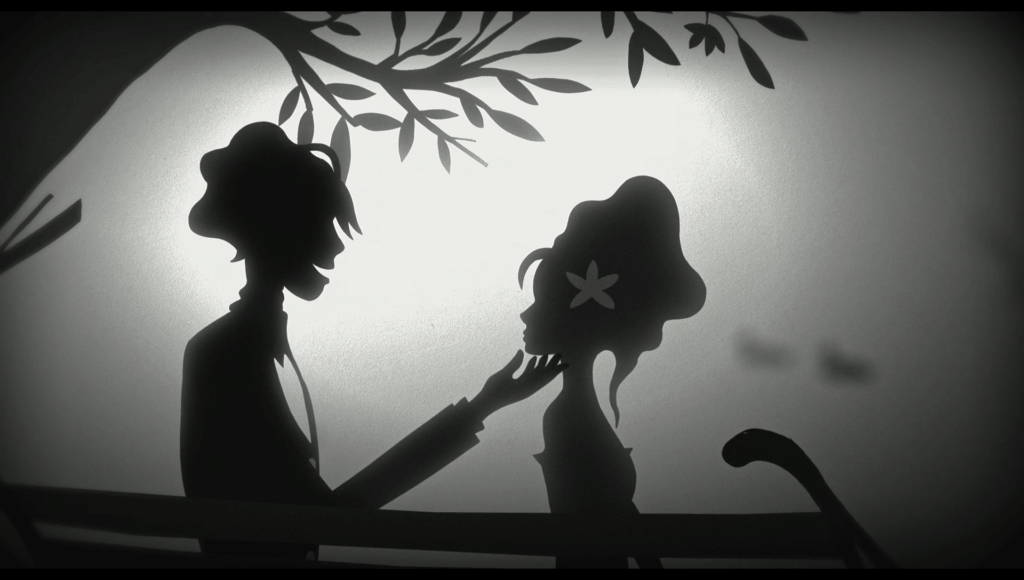
Just after midnight on January 1, 2020, I “came out” to my wife Susan. And that’s not really true, because she’d known about (and helped me deal with!) my feelings that I was trans all along. We have superb communication and tell each other everything, I highly recommend it.

But that was when I told her I felt like had to transition, for sure. I felt like I was drowning (see GENDER DYSPHORIA), and told her so. And even then, BOYMODING was hurting me more and more every day, and would only get worse and worse, until I finally stopped doing it altogether.

In early March of that year, I went to a Hollywood makeup artist who did makeovers for trans women, and it changed everything. This social media post I made that day shows up in multiple Trans Tuesdays, because it was such a monumental shift in my life. (Do not let the avatar or username on the post fool you, at the time I looked nothing like that and my handle was still my deadname, but I grabbed this screenshot of it a couple years after coming out).

Today I did something I’d been terrified to do for most of my life (I can’t tell you what it is, but it’s not dangerous so do not worry). And all I can tell you is that we only live once and if you’re wondering if you should do that thing that scares you? Fuck yes. Go do it. [purple heart emoji]

That was the first time I ever caught a glimpse of the real me in a mirror. It wasn’t even close to the real me, mind you. I have photos from that day. A lot of them. I can’t really stand to look at them, they’re perhaps the most dysphoria-inducing photos I have.

Because it’s that guy who was never me, but with the tiniest, most infinitesimal bits of the real me, buried under so much pain. But it was enough. It was enough to know I had to do it, for real. I was one hundred percent going to transition.

We were in the tail end of a certain cretin’s first term as president, and I had no idea if he’d be elected again. I had no idea how the next years would play out. 

I wouldn’t let that stop me.

Covid hit, and things were so bad, and I had no idea what the world would be going forward. See A PANDEMIC TRANSITION for more.

I wouldn’t let that stop me.

See TRANS MOTIVATION for more on the ways the need to be our true selves can drive us to do things we never thought we could.

On July 7, 2020, I came out to the world (I’d come out to close friends and family throughout the week prior). And yes, that was a Tuesday. I’d already planned to do Trans Tuesdays from the start (see WHAT IS TRANS TUESDAY? for more on how it’s inextricably linked to my transition and my coming out).

This has never been posted to this site in the entire time I’ve been doing Trans Tuesdays, but here’s what I said to the world on that day:

So! Doing this in the time of covid was… something. I dunno what your pandemic project of choice was, but maybe not like mine. I’m still married to Susan. But as you won’t recognize the handle change, you knew me as [deadname]. Hi! I’m transgender, and my name is Tilly. 🙂

There’s so much I want to say. So much I have to say. Rejecting the white male society saw me as, and told me I was, means giving up so much of my privilege. Believe me, I know. But I’m still white. I’m 6’2”. I’m not ripped, but I have obvious musculature.

And I live in a safe neighborhood, in the most liberal and accepting state in the country. The amazing friends in my life I’ve already told have been nothing but kind, compassionate, and supportive of me. Every single one of them!

I still have so much more privilege than many trans people, especially trans women of color, especially Black trans women. No trans person, no trans woman, owes the world any more information than they want to provide.

They’re hesitant to be open about things, and for good goddamned reason. But I’m going to use my privilege. I’m going to be as open and honest as I can. I’ll be making weekly posts with #TransTuesday to talk about transitioning…

To talk about things in society you might not notice if you’re not transitioning yourself. I don’t claim to speak for all trans people, and certainly not even all white trans women. All I can offer are my own thoughts and experiences.

But I hope I can increase understanding, at least a little bit. If it helps one other trans person in any way, or if it helps one other person understand someone in their life who’s transitioning, it’ll be worth it. I want to help. If I can.

And I’d like to take a second to mention some people who’ve helped me, many who maybe didn’t even realize it. I’m terrified I’m going to forget people, but there are people I absolutely have to thank.

To the trans ladies who inspired me with their courage and heart, you made me feel as though I could be me. Lilah Sturges, Magdalene Visaggio, Jamie Clayton, Nicole Maines, Dana Levinson, Laverne Cox, Kristine Chester and Lana and Lilly Wachowski.

To the writers/producers who made me feel that my being trans would never exclude Susan and me from working in the industry we love, your visible support of trans people made me feel like this wasn’t career suicide:

Jon Rogers, Jennifer Court, Geoff Thorne, Tze Chun, Amy Berg, Bo Yeon Kim, Javi Grillo-Marxuach, Jeff Lieber, David Slack, Jose Molina.

To animation writer/producers, and comics editors and publishers, whose visible support made me feel like being trans would never exclude us from being hired: Mairghread Scott, Ellen Tremiti Waltke, Aaron Waltke, Dafna Pleban, Heather Antos, Andrea Shea, Barbra Dillon, Bryant Dillon, Damian Wassel.

There were so, so many things that went into me figuring this out, which I’ll go into over time with #TransTuesday, but one very real corollary fear was if discrimination would prevent Susan and me from being writers. It’s what we want most (and are pretty fucking good at tbh).

Your support matters. All of my friends and their private support, and all the people mentioned in this thread helped me believe it was okay to be me in this world. Please keep supporting LGBTQ+ folks. You have no idea the lives you’re changing. It honestly means the world.

Look how long this thread is. See? I’m still me. 🙂 Anyway, right, yeah, okay, I think I’m done? Who knows. IT’S ALL A PROCESS OKAY? Come along on the journey with me. Maybe we’ll all learn something.

Oh, and if you’re looking for writers of kickass hopeful sci-fi with blue sky imagination, from what might be the only married cis woman/trans woman writing team around (are there others? Tell us! I want to know them!!), Susan and I would love to talk to you. 💜

Tilly Bridges, end transmission. (I didn’t plan to end my coming out this way, it just happened as I wrote it, and I liked it so much it stuck)

I tagged as many people mentioned in that post as had accounts, and then this happened:

Lilly Wachowski and Jamie Clayton liking the tweet about them inspiring me

Lilly and I have talked several times since then, by the way. She’s one of the loveliest, kindest people on the planet. She even gave us this lovely blurb when we were crowdfunding our short film, Long Away! (you can learn more about that film in the essay on PARENTS WHO WILL NEVER KNOW THE REAL YOU (aka my dad).)

“Long Away is a soothing balm. Art that heals cracks in our hearts is vital now more than ever. More please!” - Lilly Wachowski. LONG AWAY. Support this film at Seed & Spark.

When your heroes turn out to be wonderful people? Yeah that’s the best thing ever.

And I regret to inform you that you don’t just come out once. As I mentioned, I came out privately to some family and friends before I came out publicly. But then I also had to come out to the DMV, and the bank, and our AAA car service, and our auto insurance, and and and and and. There’s a million services and websites you need to change your name on, and for some of those you can’t do it without contacting someone at the company, and having to come out to them, too, just to get them to change your name in their system. It’s a long and exhausting process. I had to take them one or two at a time, so I didn’t get overwhelmed. But I did it.

For more on how wrong that can go, see DISCRIMINATORY BUREAUCRACY, and for more on how right it can go, see INCLUSIVE BUREAUCRACY.

I’ve also said this a million times, and aha, now I have an essay to point to when I say it again: coming out and being ourselves, showing our joy living as our true selves, inspires others to do it too. I thanked the trans ladies who inspired me. Others who came before inspired them. I’ve inspired others since I came out (I’m not self-aggrandizing, people have directly told me… especially due to these essays and Begin Transmission).

So if we can come out, if it’s safe for us to do so, it’s vital, not just for us, but for every trans and nonbinary person down the line who will see us and believe they can do it too.

This is one of the key questions Matrix Reloaded explores in its trans allegory. If we knew how truly difficult cis people would make our lives when we come out, would we still come out and transition? And the answer is yes, but why? Why?

We do it for ourselves, because we deserve to live authentic and happy lives. But just as important is that we do it for them, for those who come after. For the one person who sees us smiling and joyous and thinks they can do it, too. We can save ourselves, and we can save each other (look, just read Begin Transmission: The Trans Allegories of The Matrix already, willya? Ok thx).

But then it’s not that easy, is it? Because for so many of us it’s not safe to come out, due to geographic location, political and legislative and physical violence, the possibility we’ll lose our homes and jobs (which happens a lot, see THE 2022 US TRANS SURVEY REPORT part 4 for more).

Even when we know, even when we know, people will accept us… there’s still a chance they won’t. I was terrified the first time I told my wife Susan I thought I might be trans. I was terrified on January 1, 2020, when I told her I felt like I had to transition to survive. I was terrified after my makeover when I told her I knew I was going to transition for sure.

She’s been nothing but wonderful, loving, and supportive the entire way! She’s never been bigoted or hateful towards anyone, including trans people.

But so many times, for so many of us, even those with spouses or family who are entirely supportive of trans people, we see that “entirely supportive” isn’t true as soon as it’s someone in their lives. Suddenly they’d have to be seen with us and that changes how they’re seen, and now they absolutely cannot have that (guess what, friends? That’s transphobia. See CIS SPOUSAL AND PARTNER SUPPORT for more).

Suddenly their CIS GRIEF is more important than us no longer living a torturous lie and being in pain for our entire lives.

AND THAT IS BULLSHIT.

None of us should have to deal with that! But the reality is that we do.

And that makes coming out an incredibly complex and difficult thing.

Despite the fact that in my coming out post I said all my friends and family accepted me without question, that’s not entirely true.

After that post, I had some people who I thought were friends get mad that I didn’t tell them privately. They were upset that they had to find out with the rest of the world.

My mother in law has been especially terrible since that post, and was routinely deadnaming and misgendering me, to the point where even our kid stood up to her and told her to stop it. Now she just doesn’t mention me at all, it’s like I died, or never existed. I’m not sure if that’s better or worse, but either way it’s terrible.

But nobody gets to tell you how to come out! Nobody gets to tell you when to come out, or if you have to come out at all.

I believe in the depths of my heart that we owe it to ourselves, and to each other, to be out and living as our true selves… but only if it is safe and the right time for us to do so. The sad reality is that, for some people, it will never be safe or the right time due to outside factors in their lives.

We should not be angry at those people. Imagine how difficult that must be, and the suffering they’re going through. I know several people stuck in that situation, who can only be themselves online or anonymously. I know the pain they’re in.

So let me wrap it up with this:

I want all of us to be able to come out and be our true selves. I want you to be able to come out and be your true self. I hope with my whole being that you’re able to, when the time is right and it’s safe for you to do so. Whenever that may be.

If you can’t come out, I see you. You are no less trans. You’re trans if you say you are (see YES YOU ARE TRANS ENOUGH), whether you can come out or not. Whether you can or want to transition or not.

Nobody gets to tell you how, when, or if you should come out. It’s all up to you, and that’s how it should be.

And I hope, I hope, I hope with everything I am, that one day soon you’ll get to join us in the sun.

When you’re ready, I’ll be waiting for you with open arms.

Tilly Bridges, end transmission.
tillysbridges@gmail.com

TRANS KIDS 2: THE INTAKE EXAM AND TRANS FLIGHT

Welcome to Trans Tuesday! We conclude our talk on trans kids by learning what most go through just to access that care, and what their parents will do to protect them, in THE INTAKE EXAM AND TRANS FLIGHT.

Be sure you’ve read TRANS KIDS 1: FACTS AND DANGERS, so you know what is actually involved in transition care for youth, and the dangers of withholding it from them.

And here’s where we get into the intake exam, which most cis folks have literally no idea about. Now there are places in this country that have informed consent for trans people… you go in, certify that you consent to the treatment, and you get treated. These places are vanishing quickly with the legislative assault on trans care, however.

In the rare places that might have informed consent for trans kids, what does that look like? It’s something the entire medical establishment has rules for, to deal with everything related to kids and their medical care, gender-affirming care or not. Doctors know how to handle all these medical issues with kids! Trans care is no different!

What if a medical provider does not have informed consent for gender-affirming healthcare? Well let me tell you about what it was like, and how difficult it was for me, as an adult. I could have found an informed consent provider, there are several here in Los Angeles.

But they would not have been covered by my insurance. Gender affirming care paid for out of pocket is just not feasible for many trans folks, who are often financially unstable due to the employment and housing discrimination we face. One in five trans people has been discriminated against when seeking housing, one in ten has been evicted due to anti-trans discrimination.

Thirty percent have experienced homelessness, more than one-third have experienced poverty, and the unemployment rate is at 18%.

For a whole lot of us paying out of pocket for transition care just is not feasible. So for those of us lucky enough to even have insurance, we have little choice other than to do what our healthcare insurance and provider require.

The first thing that happened when I told my doctor I was trans and wanted to transition was her referring me to a psychologist. Not because she thought being transgender is a mental illness, but because it’s their policy.

Some of the reason is that mental illness can often be worsened by (and even caused by) gender dysphoria, so of course they want to check for that and be sure you get whatever help you may need on that front. Which is good and I absolutely understand and appreciate that.

But… they also want to “make sure” you’re trans, again showing they’re more concerned about not letting a cis person make a mistake than they are about helping actual trans people get the care we need. 

They wouldn’t even consider referring me to an endocrinologist to begin HRT until I had my intake exam with the psychologist.

This psychologist was a specialist in gender and transitioning. She’s my go-to for any other referrals I need for other services related to transitioning. Voice therapy, laser/electrolysis hair removal, gender confirmation surgeries, etc.

So how did this lady determine I was trans? We had a very long talk, and she had a billion questions to ask me.

And. 
I. 
Had. 
To. 
Justify. 
My. 
Existence. 
As. 
A. 
Woman.

Please sit with that for a minute.

Have you ever had to convince someone you’re a man or a woman? How would you do that? Especially when you can’t reduce it to your secondary sexual characteristics.

I mean even outside of being trans, the entire point of feminism is that women (or anyone) cannot be reduced to nothing but their reproductive organs. All of us are more than the sex junk we were born with, despite what right wing bigots want us to think, because they see cis women as nothing more than babymaking machines.

I had to dig up every memory I could find, in the course of my years of self-examination, where looking back I could see signs of my dysphoria, of my longing to be the girl I knew I was. I had to prove to a total stranger that I am who I say I am.

And if I failed? 

Too bad, Tilly.

You don’t get the medical care you need to make your life worth living.

Does that scare you? It should. It fucking scared me. 

Because what if I didn’t say the right thing? What if because my dysphoria revolved mostly around my face, chest, and my body hair, and not my crotch, she decided I wasn’t “trans enough” to transition? By the way, YES YOU ARE TRANS ENOUGH no matter how much or how little medical or social transition you do or want. 

It’s just terrifying and awful. It’s a nightmare. I don’t know how to tell you what it’s like. 

I’m a writer, and I can’t find the words for it. 

And what you have to understand is the trans kids who want puberty blockers, all of those kids who are already on puberty blockers… the vast majority don’t have informed consent. They go through varying versions of this.

And a doctor, a psychologist trained in gender and transitioning, has listened to them and made the medical determination that it’s in the patient’s best interest to be on those puberty blockers. Especially given, again, they make no permanent changes to the body!

So what right does any government have to interfere in a matter between patients and their doctors? If you’re seeing stark parallels between trans folks and their transition care, and cis women and trans men and nonbinary people with uteruses and their right to choice… yeah, weird huh? Maybe think about why that is.

It’s all connected. See BODILY AUTONOMY (and my tattoo) and TRANS RAGE (stop forgetting about us) to learn how it’s all the same fight and cis people, as a whole, need to wake the hell up to that already.

Every trans kid has already done more self-examination than a whole lot of cis adults ever do in their entire lives. And I’m so thankful some of them have safe home environments in which to do that, but I know also that many do not. I certainly didn’t.

And don’t give me bullshit about supportive environments, or being exposed to the very idea of trans people, as being “brainwashing” or whatever the fuck you want to call it. Hey cis folks, how much trans acceptance would make you suddenly not feel like a man or woman?

Is it zero? Of course it’s fucking zero. No amount of exposure to trans people is going to make cis people suddenly trans, just as no amount of exposure to cis people is going to suddenly make trans people cisgender.

Where the fear comes in is that learning about trans people, seeing us, may make you think you might be trans too. Might make your kids wonder. And some of you might discover that you are. And that scares the shit out of them.

Because it means everyone you know, and all of society, has been lying to you. It means the very foundation of our society’s patriarchal white supremacy, that men are manly men fighters who feel only lust and anger, that women are demure subservient babymakers, is a fucking lie. And then you see all the other lies our society is founded on in terms of racism, ableism, xenophobia, fatphobia, ageism, and on and on.

It means admitting you got conned about who you are, and choosing to make it right because you know yourself better than anyone else, and you don’t have to be who anyone else tells you to be.

Even if you’re not trans, just thinking about whether or not you are (which may just reconfirm your cisness!) means waking up to the lies you’ve been force fed for your entire life.

And sadly, when people learn they’ve been scammed, most can’t admit to themselves that they got took, so they double-down on the scam… rather than change and chase actual, real happiness. It’s the sunk cost fallacy. They’ve invested so much in believing the lie, they can’t risk it all now, especially when society rewards you for conforming.

See my trans allegory deep-dives on The Matrix, BARBIE, I SAW THE TV GLOW, STAR TREK: STRANGE NEW WORLDS’ “AD ASTRA PER ASPERA”, SILO s1, REAL GENIUS, and THE TWILIGHT ZONE’S “NERVOUS MAN IN A FOUR DOLLAR ROOM” for more, because all of them deal with that!)

Let’s end on an up note. Please read these, from the parents of a trans child, about what it’s like for them… and what a difference acceptance makes.

What I Wish I Knew Before My Child Came Out As Transgender

What I Wish People Knew About Raising A Trans Child

I’m raising a transgender son. My child is not a threat

Gender affirming care for trans kids is so important, many parents will uproot their entire lives to move to states who still have it and better protect it, because it’s what their kids need to survive. This has been going on for years.

There are tons more stories like these that you can find if you do ten seconds of looking. Some families are even leaving the country.

There are even guides on how to do it, and organizations whose sole purpose is to help families move to where their trans kids will be safer!

After all you’ve seen over these two essays, you’re going to tell me these kids are faking it? Their parents don’t know how vital that care is for them? That you think those kids should be forced through unimaginable suffering that many won’t survive?

If so, please fling yourself into the sun immediately.

Cis friends, this fight is yours too. It has to be, or these kids are going to suffer and many will never make it to adulthood. There aren’t enough trans people to change things on our own. See TRANS POLITICS 1: STOP TOLERATING TRANSPHOBIA and TRANS POLITICS 2: YOU MUST VOTE TO PROTECT US for a whoooole lot more on that.

See PERFORMATIVE ALLYSHIP and FALSE ALLYSHIP, and don’t let that be you. And PROACTIVE ALLYSHIP and NO ESCAPE 2: SOME ESCAPE (due to cis allyship) for what it looks like when you get it right.

And if you still, still, still can’t believe this is true, look…

Lawmakers in Utah, commissioned a study on gender affirming care for trans kids, thinking it would justify the ways they were already banning that care. Guess what? THE STUDY FOUND THAT THE CARE WORKS AND IS GOOD and the lawmakers just decided to throw it out and ignore it.

Why would they do that?

Excellent question!

It’s because RIGHT WING BIGOTS HAVE ACTUALLY ADMITTED THAT THE ENTIRE “ISSUE” OF TRANS KIDS ISN’T ACTUALLY ABOUT PROTECTING KIDS FOR ANY REASON, IT’S JUST AN OPENING TO ELIMINATE ALL TRANS RIGHTS.

It’s so hard for trans people right now, even more so for trans kids. I need you to let them know you support them. You’re there for them. You’re going to fight for them and defend them with everything you’ve got.

I don’t remember who started it or why it disappeared, but let’s bring it back… #Letters4TransKids was a hashtag going around from adults writing letters of support to trans kids. And they need to see them now more than ever. Write it, photograph it, post it to your social media accounts. Here’s mine:

Hi trans kids! I’m trans just like you. I was a trans kid, too, but I didn’t figure that out until I was an adult. You’re already so far ahead of the game! I’m so happy you’ve found your true self, and please know the people who disagree are wrong. Don’t EVER listen to anyone who thinks they know who you are better than you do. Things are scary right now, but you are not alone. You are loved, and we will never stop fighting for you. <3 Tilly Bridges <3 PS - I bet your handwriting is better than mine! I should practice more, huh? But nobody can make me! This is the fun of being an adult. I can’t wait for you to be an adult too. Then we can not practice handwriting together. Also let’s have ice cream for dinner. :)

Your support of trans kids is literally life-saving. If I’d had that, it would have changed my entire life.

SUPPORT AND FIGHT FOR TRANS KIDS.

They need us.

They need you.

Tilly Bridges, end transmission.
tillysbridges@gmail.com


PS – Here’s a list of BOOKS FOR TRANS KIDS! Thanks to Karla, mom of a trans kid and the guest on the podcast version of these episodes, for providing this!

It Feels Good to be Yourself
My Shadow is Pink
Call Me Max
Me and My Dysphoria Monster
Pink , Blue or Rainbow… It’s Okay to Be you!
Being You
Pink, Blue and You!  Questions for Kids About Gender Stereotypes
Fred Gets Dressed
Who Are You? The Kid’s Guide to Gender Identity

TRANS SPORTS 2: SCIENCE AND BIGOTRY

Welcome to Trans Tuesday! Let’s get to the bottom of this huge, discriminatory issue that is not actually a real issue at all: TRANS PEOPLE IN SPORTS 2: SCIENCE AND BIGOTRY!

Be sure you’ve read TRANS SPORTS 1: ORIGINS AND “ADVANTAGES” first!

Okay, so republicans would have you believe trans women are “taking over” women’s sports, but we’re barely even competing in sports as it is.

There are 510,000 NCAA athletes in the U.S., as NCAA president Charlie Baker explained to a Senate panel in December, and he’s aware of “less than 10” athletes who identify as transgender. But if you believe many right-wing voices, you’d think it was far more than 0.001961 percent of college athletes.

0.001961 FUCKING PERCENT OF ALL NCAA ATHLETES ARE TRANS. One hundredth of one percent. That’s what we need laws to ban???

It’s sexist patriarchal bullshit. Trans women have competed with women, and if we were dominating in any sport you’d know it already!

Until the recent bans, trans women were allowed to openly compete in the Olympics since 2004. How many of them have medaled? 

Z E R O.

In fact, prior to banning trans people from competing with our gender, the Olympics commissioned a study.

A groundbreaking study that was sponsored by the International Olympic Committee …sought to compare a range of athletic abilities between trans athletes and their cisgender counterparts. The finding that trans women athletes are at a relative disadvantage in many key physical areas relating to athletic ability and perform worse on cardiovascular tests than their cisgender counterparts could be the first step in fighting back against the conventional wisdom conservatives have spread that trans women’s participation is inherently unfair.

It showed trans women are at a DISADVANTAGE compared to cis women. Then they ignored the findings and banned us anyway.

This policy targeted trans women, and there is currently no scientific consensus—rooted in systematic, independent research—that justifies the exclusion of trans athletes. It’s just a vibes thing.

And if that’s not enough for you, here’s another study that says the same thing.

And another!

Here’s a study of volleyball players that showed trans women performed worse than cis men and about equal with cis women.

Also, it’s important to note that the very idea that trans women have an advantage over cis women is because those who peddle that nonsense see us as men. And that’s important because it means they believe men are better than women by default.

Cis ladies, do you see what that’s saying about you, too?

Also also? That’s bullshit!

In baseball, a cis woman pitcher even struck out Babe Ruth and Lou Gehrig.

I’m personally not sure that sports should be segregated by gender, but there is value in having sports where people of marginalized genders (cis women and every trans and nonbinary person) can compete away from cis men who often harass us.

But allllllso there’s pretty compelling evidence that women’s sports were created because cis men were losing to cis women and they couldn’t handle how that hurt their feelings.

Women’s figure skating became an Olympic sport because in 1902 a cis woman got the silver medal when competing against cis men!

The very next Olympics women had their own separate event.

In Olympic skeet shooting, which is far less physical than other events, why can’t women and men compete together? 

They did.

Until 1992 when a cis woman won the gold medal.

The next Olympics women were not allowed to compete! And in the Olympics after that, they had their own separate event.

You’ve probably seen the images of Kathrine Switzer, who was the first woman to run the Boston marathon in 1962.

black and white photos of Katherine Switzer running in the Boston marathon as cis men competitors shove her and try to rip her number off

The other runners, all cis men, assaulted her, and tried to rip her number off (and thus disqualify her from the event). After the race, women were banned from competing in marathons until they got their own separate event in 1972.

HMMMMMMMMM.

Take all of that in context within the “issue” of trans women competing with women, and where does that take you? It’s the same discriminatory nonsense repackaged for trans women. Everything old is new again.

But let’s see what an elite cis woman athlete has to say about all this. Megan Rapinoe, what are your thoughts?

Here’s the salient bits:

Show me the evidence that trans women are taking everyone’s scholarships, are dominating in every sport, are winning every title. I’m sorry, it’s just not happening.

So we need to start from inclusion, period. And as things arise, I have confidence that we can figure it out. But we can’t start at the opposite. That is cruel. And frankly, it’s just disgusting.

So, we need to really kind of take a step back and get a grip on what we’re really talking about here because people’s lives are at risk. Kids’ lives are at risk with the rates of suicide, the rates of depression and negative mental health and drug abuse.

We’re putting everything through ‘God forbid a trans person be successful in sports.’ Get a grip on reality and take a step back.

Okay so what’s the reason for all this? Well friends you know as well as I do that it’s transphobia, because it literally can’t be anything else! For every reason I’ve already laid out for you. 

They’re not making it a secret who’s behind this, and the bigotry is pretty clear. The wildest part is them using the “our bodies, our sports” tagline, when some of the very organizations who sponsor this shit are the ones taking away cis women’s right to bodily autonomy.

Erin Reed, @erininthemorning tweeted, on June 21, 2022: Looks like the TERFs are having a rally in DC. I always love when they pair up with Alliance Defending Freedom and The Heritage Foundation, two of the leading anti-abortion organizations in America. You know, just in case you thought they were actually "feminists." There’s then an ad with a photo of girl athletes hugging, and the text “Our bodies, our sports. On the 50th Anniversary of Title IX, let’s keep women’s sports FEMALE. Rally + press conference June 23, 2022, 11:00 am EDT, Washington, DC.” two of the listed sponsors are THE FAMILY RESEARCH COUNCIL and THE HERITAGE FOUNDATION.

If you’re somehow not familiar with the “Family Research Council” or The Heritage Foundation, do some reading, especially as the latter of which is largely responsible for Project 2025 and the state our country is presently in (see TRANS POLITICS for more).

This is like the nazis originating the idea of sex testing in sports. If you find yourself on the same side of an issue as a nazi, you need to reexamine where you stand.

If you are a woman’s group, if you support women’s sports, if you support women’s rights, and you find yourself on the same side of an issue as The Family Research Council and The Heritage Foundation, it’s time to reexamine where you effing stand. They do not support women as anything other than tradwife babymakers, and that really ought to make you question why you agree with them on trans women in sports. That should tell you something important, in fact!

And if you’d like an even clearer picture of where things stand, note that sexual predators were allowed to continue playing sports while trans people were not. Talk about having your priorities backward.

A convicted rapist played in the very Olympics that said trans women are a “threat.” They don’t really care about threats, do they? White cis men can do anything and still play, but we can’t let an innocent trans woman who is likely at a disadvantage compete with her fellow women!

This is just another in a long line of new rules and regulations and legislation trying to eliminate trans people from public life. Can’t play if you transitioned as an adult, state won’t allow you to transition as a kid, then you’re legally barred from public bathrooms and your healthcare.

And if, even fucking if, adult trans women who went through male puberty have an advantage (we don’t!), why would you ban pre-pubescent trans girls from competing with pre-pubescent cis girls?! 

AAAAAAGGGGH do you see how transparent this all is? Please tell me you see it.

PLEASE TELL ME YOU SEE IT.

So why do these bigots only focus on trans women? Because trans men disprove their entire “theory” and all their talking points. Trans men on HRT are taking testosterone, which cis men use to cheat, and still do not dominate against cis men! See THE ERASURE OF TRANS MEN for more.

The ENTIRE “issue” of banning trans women from competing with cis women is simply to set a legal precedent that we are, in fact, “not women.” If trans women can’t compete with cis women, the bigots will say, it’s because we’re not “actually” women. 

If we’re not actually women in the eyes of sports, I mean, how could we be considered women anywhere else? It’s a wedge issue they made to establish that we’re not really women, and use that to take all the rest of our fucking rights away.

And they’ve been successful because too many people fell for the propaganda.

THEY HAVE EVEN ADMITTED IT’S NOT ABOUT SPORTS, IT’S JUST PRECEDENT TO DISMANTLING ALL TRANS RIGHTS!!!

‘The gender ideology movement is a house of cards, Gaines told the Times this week, using a euphemism frequently deployed by the Trump administration. Gaines added that she believes sports participation will be the card that makes all of it crumble,’ opening the door to convince the general public that trans women are not truly women and gender-affirming medical care for trans youth should be restricted.

And thus this two-part essay, for you who are confused, for you who want to know the truth, for you who want people in your lives who “have doubts” to understand.

We and our doctors know who we are better than you do. And none of us would choose to go through the unending bullshit the world continually throws at us just so we can beat you in a fucking sport. 

Recognize this for the hatred it is, and understand that there’s literally nothing more to keeping trans people out of sports than unrepenting, unending bigotry for people who are different and throw the FALSE DICHOTOMY of the entire false cis binary status quo into question.

If you believe in equal rights, you have got to fight for trans people to be treated equally.

Everywhere. 

Including in sports.

Anything else is just repackaged bigotry.

Tilly Bridges, end transmission.
tillysbridges@gmail.com

ADDENDUM 1/16/26

As further proof this entire issue is nothing but naked bigotry, Republicans are trying to ban trans girls… from a co-ed cheerleading team, already open to all cis girls and boys.

It was never about fairness. Quite the opposite, actually!


ADDENDUM 2/6/26

Yet another scientific study confirms that trans women possess no physical advantages over cis women.

Body composition and physical fitness in transgender versus cisgender individuals: a systematic review with meta-analysis.

Conclusion – While transgender women exhibited higher lean mass than cisgender women, their physical fitness was comparable. Current evidence is mostly low certainty and has heterogenous quality but does not support theories of inherent athletic advantages for transgender women over cisgender.

THE 2022 US TRANS SURVEY RESULTS, part 4

Welcome to Trans Tuesday! This week we continue with more hard data on trans life in THE 2022 US TRANS SURVEY RESULTS, part 4! We’ve got satisfaction rates, numbers on detransitioners, and mental health!

A quick warning before we get into things: there will be some discussion of suicide rates and prevalence, and where that stems from in regards to trans people, as that’s one of the things the survey got a lot of data on. If that will be difficult for you, you may want to skip this essay.

All right, let’s dive in.

  • 60% of respondents reported undergoing some form of medical transition, including hormones or surgeries. 88% of respondents expressed a desire for gender-affirming hormone therapy, but only 56% reported ever receiving hormone therapy. Among those who have started hormone therapy, 90% were currently taking hormones, indicating a high prevalence of continuation.

Oh shit, almost like it really works well for its intended purpose huh?

  • 29% of respondents reported receipt of at least one gender-affirming surgery. 98% of respondents taking GAHT reported that taking GAHT made them more satisfied with their lives, and 97% of respondents who underwent gender-affirming surgery reported their surgery made them more satisfied with their lives.

NINETY-FUCKING-SEVEN PERCENT SATISFACTION RATE. Are you even kidding with these claims that it’s harmful? No other medical interventions or procedures have that high a satisfaction rate! Not even close.

Let this be your reminder that according to the World Journal of Surgery, the average regret rate for ALL surgeries for ALL people is 14.4%! For trans people the regret rate is less than one percent.

Gender affirming care fucking works.

But what about detransitioners? So glad you asked.

  • All respondents currently identified as trans and nonbinary, but 9% had gone back to living as their sex assigned at birth at least for a little while at some point in their lives due to challenges related to social acceptance.

Emphasis is mine there, but bigoted cis people are the reason for those 9% who detransitioned.

  • Respondents primarily reported social and structural reasons for living as their sex assigned at birth. For example, the most common reason was that it was “just too hard to be transgender in [their] community.” Other common reasons included pressure from a parent and experiencing too much harassment or discrimination.

Bigoted cis people making our lives miserable. The biggest hurdle we face.

But what about people who detransition because they’re not actually trans? Shouldn’t we worry about them and make transition care harder to access? For their safety, never mind the horrible impact putting more barriers between actual trans people and our transition care causes, I guess?

  • Of all respondents who had medically transitioned, only 0.36% went back to living in their sex assigned at birth at least for a while because gender transition was not for them.

Zero
Point
Three
Six
Percent
!

Not even half of one percent! Should detransitioners who are not actually trans, and are cis people who made a mistake, or are trans but discover transition isn’t right for them, be supported? Absolutely. Should their mistake be held against the 99.64% of people who are trans and need it?

AB-SO-LUTE-LY NOT.

For those trans and nonbinary people who needed access to abortion-related care:

  • 37% were unable to find abortion providers who knew about trans healthcare

And because they were trans:

  • I didn’t feel welcome in an abortion providers office/clinic – 79%
    Provider used harsh or abusive language – 38%
    I was verbally harassed by staff or others at the provider’s office – 32%
    Provider refused – 24%
    Provider was physically rough with me – 15%

I want to point out this wasn’t them seeking abortion-related care from places who won’t provide abortions for a multitude of bad reasons, this was them going to abortion-care providers who you’d think would be more accepting of trans people. But even there, we see transphobia is a huge issue that cannot be escaped.

Let’s take a look at some data about trans people and our mental health.

  • 44% of respondents met the criteria for serious psychological distress, compared to less than 4% of the general U.S. population. A majority (81%) of respondents indicated that they felt down, depressed or hopeless at least several days over the past two weeks (prior to taking the survey). Three-quarters (77%) reported little interest or pleasure in doing things at least several of the days over the past two weeks (prior to taking the survey).

Look at what societal transphobia does to us. We experience over TEN TIMES MORE PSYCHOLOGICAL DISTRESS than the general population!

I pale at the thought of where those numbers are in 2025.

  • In the year prior to the survey, 38% of respondents considered suicide. Of those who considered suicide, 41% made corresponding plans. These numbers are dramatically higher than the general population’s at 5% and 1% respectively. Victimization, such as being verbally harassed, denied equal treatment or service for any reason, such as at a place of business, government agency, or public place, or physically attacked, was associated with greater suicidality.
  • 31% of those who had no victimization considered suicide in the past year, compared to 50% for those who were verbally harassed, 53% for those who were denied equal treatment, and 63% for those who were physically assaulted. 78% of respondents considered suicide and 40% attempted suicide at some point in their lifetime. These statistics far exceed the 13.2% and 2.4% reported for the general population.

All of that, all of it, is due to transphobia and cisgender bigots. 

It’s not being trans that’s difficult, it’s the way cis society treats you when you’re trans that’s so hard to deal with. (GENDER DYSPHORIA is horrible, but if we’re supported and affirmed right away and aren’t forced to live with it for a lifetime, we can immediately do things to address it).

Really take that in and sit with it, cis folks, and let it inspire you to stand up for us when you know we need you to, because we need you to.

  • While 78% of respondents wanted counseling for gender identity or transition, only 48% received mental healthcare for it. Among respondents who discussed gender identity with a counselor, 12% reported that their mental healthcare provider tried to persuade them to identify only as their sex assigned at birth. Notably, this was much higher (50%) among those who consulted with religious counselors or therapists.
  • In [the survey’s] sample, 44% of respondents meet the criteria for Serious Psychological Distress. According to the National Health Interview Survey, less than 4% of the general U.S. adult population met the criteria for SPD.

I don’t even know what to say about this. I’m so mad. So mad.

It is important to note that SPD was more common in younger trans folks, and more common in AFAB nonbinary people and trans men than any other groups.

  • The [survey] sample had 6 times the prevalence of past-year suicidal ideation compared to the general population (38% vs. 5%) Further, 16% of [survey] respondents made a plan to attempt suicide, substantially higher than the 1% reported in the general population.

    Research suggests that structural factors like state- level discriminatory laws and policies, as well as stigma and hostile sociopolitical climates, contribute to the disproportionately high prevalence of suicidality seen among the trans and nonbinary community.

When trans people tell you that these transphobic laws stripping us of our rights, our healthcare, our ability to exist in public will result in dead trans people, that’s not hyperbole. It is legislative violence.

Living with that kind of oppression is too much for some people to handle, and more importantly no one should ever have to try to handle it.

  • Research focused on trans and nonbinary people have found that social support may be one of the most important factors in reducing suicidal thoughts and suicide attempts. Supportive families may play a crucial role in the wellbeing of USTS respondents. The survey asked respondents who were out to their family how supportive their immediate family was. Those with supportive families reported less suicidality compared to those with unsupportive families: 78% vs. 85% for ever considering suicide and 38% vs. 51% for ever attempting suicide.

Supporting us, standing up for us, standing with us? It’s literally life-saving. We need you.

  • 72% of medically transitioned and 71% of socially transitioned respondents were “Very to pretty happy” compared to 55% and 52% of those who had not medically or socially transitioned, respectively.
  • Medically and socially transitioned respondents were thriving more (37% and 36%, respectively) compared to those who had not transitioned (19% and 18%, respectively).
  • Respondents who had medically or socially transitioned reported substantially higher life satisfaction (43% and 43%, respectively), compared to 27% and 24% among those who had not medically or socially transitioned, respectively.

Medical transition (for those who want it) works.

Medical transition works!

IT WORKS!

  • Happiness levels varied substantially by social and medical transition status: nearly three-quarters of those who had medically transitioned reported being “Very to pretty happy” (72%) compared to over half of those who had not (55%); those who had socially transitioned also report higher happiness (71%) compared to roughly half of those who had not (52%).

Even socially transitioning shows a huge increase in quality of life and happiness!

These 2022 US Trans Survey results are so important, because it’s evidence of what trans people have been saying for… well, forever really.

We know who we are and transitioning, socially and medically, works.

And withholding it from us, legislating against it because it makes you uncomfortable, because it proves cishetero patriarchal white supremacy is founded on lies, is cruel and unconscionable.

Hopefully you already knew that. If you didn’t, now you do.

And we’ve got the data to back it up.

Tilly Bridges, end transmission.
tillysbridges@gmail.com

THE 2022 US TRANS SURVEY RESULTS, part 3

Welcome to Trans Tuesday! Some final results from the largest-ever survey of trans people have finally been tabulated and released, so let’s talk about THE 2022 US TRANS SURVEY RESULTS, part 3! This week is all about our experiences with healthcare providers. Spoilers: there’s problems!

I’ve previously covered this survey, and how important it was to have one not just on this scale, but run and administered by trans people. The survey was so large that we’re only now, midway through 2025, getting some final results from it, three years after it was conducted.

We first got a glimpse of the data contained in this survey in 2024, when the early insights were released. I covered those in detail, so you may want to check out THE 2022 US TRANS SURVEY RESULTS part 1 and part 2 before reading this essay.

The newly released data is titled “Health and Wellbeing,” which leads me to believe there will be further detailed results released in other categories later on. But there’s a wealth of info in here to talk about, so let’s get into it. It’s over a hundred pages long, so I can’t cover all of it, but I’ll try to highlight some of what I think is the most important.

If you want to read the results yourself, which includes detailed breakdowns of statistics by race and age and gender and transition status, you can do so here.

I’m just going to be talking about and trying to parse some of this data to make it more easily digestible, but do have a look if you’d like to read through it yourself.

There were over ninety-two thousand responses, and while they did include those from 16 and 17 year-olds, this particular report only includes data from those 18 and older. 

Let’s go!

  • US Trans Survey respondents reported worse overall health compared to the general population: 66% rated their health as “excellent,” “very good,” or “good,” compared to 81% in the general population. 34% reported “fair” or “poor” health, compared to 18% in the general population.

    Social and medical transition was associated with better health—67% of respondents who had socially transitioned reported good or better health compared to 61% of those who had not. Further, 70% of respondents who had medically transitioned rated their health as good or better, compared to 58% of respondents who had not medically transitioned.

What this pretty clearly shows is that access to transition care improves our health overall, which is likely partly due from the actual transition medical care, and partly due from transition making so many of us actually care about our bodies (and lives!) and wanting to take better care of ourselves. Which can be really hard to do when you feel trapped inside a waking death (see GENDER DYSPHORIA for more).

Just gonna reiterate not every trans person has dysphoria, and you don’t have to have it to be trans. Do not misconstrue a very difficult thing many of us deal with for a requirement of transness (that’s TRANSMEDICALISM babe).

But then there’s these barriers for many trans people who may want to see a doctor, but don’t:

  • 28% of respondents did not see a healthcare provider in the past year due to cost. … 24% of respondents avoided healthcare in the past year due to fear of being mistreated as a trans person.

Basically a quarter of us couldn’t afford it and a quarter of us were afraid of being mistreated because we’re trans. I don’t know what the overlap is there (people who both couldn’t afford it and were afraid to go anyway due to transphobia), but that’s a big, big chunk of us.

  • 50% of respondents said all their healthcare providers knew they were transgender… 24% of respondents said none of their providers knew that they were transgender.

Holy shit, a whole lot of us are hiding our transness from at least one (or all) of our healthcare providers. And the only reason to do that is the fear of mistreatment, or of having explicitly trans healthcare on your medical record (meaning it would then have to be stopped if laws outlawed it). For example, I only have access to HRT through my insurance because my doctor gave me a diagnosis of gender dysphoria.

I’ve asked them if they would change it to “unspecified hormone disorder” or what have you, like many good doctors will do, so that if trans HRT is outlawed, mine could continue. They said no. Yay.

  • Among respondents who visited a healthcare provider in the past year, nearly three-quarters (73%) said they had at least one healthcare provider that knew they were trans and treated them with respect… 

That’s great! 73% is huge! But-

  • …nearly half (47%) experienced at least one negative interaction with a healthcare provider.

Oooof. And note that negative interaction with a healthcare provider is because they were trans.

  • The most common negative interactions were that healthcare providers used the wrong names or pronouns (37%), respondents had to teach their healthcare provider about trans people to receive appropriate care (18%), and healthcare providers asked unnecessary or invasive questions about the individual’s trans status that were unrelated to the visit (11%).

I’ve personally dealt with the first two of those, and let me tell you… misgendering and deadnaming from your doctors is bad, but having to teach them about advances in trans care, or even basic trans care things, is even worse. Because it is their job. AND YET.

For so much more on this see COMPLETE TRANS HEALTHCARE (or lack thereof), ANECDOTAL TRANS HEALTHCARE, HORMONE REPLACEMENT THERAPY, and DISCRIMINATORY BUREAUCRACY.

And for a detailed instance of my own mistreatment at the hands of healthcare professionals, and how one good doctor who was a PROACTIVE ALLY turned it all around for me, see NO ESCAPE 2: SOME ESCAPE.

  • Among respondents that were refused transition-related care, the most common reason was that the provider was not familiar with treating trans people (41%).

But Republicans will tell you doctors are pushing trans care on people to make the big bucks. Never mind that almost half of the doctors we trans people tried to get care from said, “eh, sorry, I don’t know how.”

In the twelve months prior to the survey, for those respondents who had health insurance and experienced difficulty getting transition-related care from them, these were the reasons:

  • Only covered some of my transition-related surgical care – 45%
    Denied me other transition-related medical care – 23%
    Denied me transition-related surgery – 20%
    Covers surgery but didn’t have any in-network providers – 17%

    Wouldn’t change my records to list current gender – 16%
    Wouldn’t change my records to list my current name – 12%
    Denied me transition-related hormone therapy – 11%
    Denied me gender-specific healthcare because I am trans – 5%
    Denied me routine healthcare because I am trans – 3%

Yeah, transition healthcare is big bucks that’s why so many insurers won’t even cover all of it. And some of that is maddening, like… you cover transition surgeries but don’t have any in-network providers?

THEN YOU DO NOT ACTUALLY COVER IT, DO YOU?!

Augh.

The survey notes that these numbers are (generally) an improvement upon the previous survey, conducted in 2015, but that had a much smaller sample of respondents and a different cross-sectional sample of people who took it. 

But remember the 2022 survey’s numbers are for trans people’s experiences in 2021.

Where do you think they’re at now, in 2025, with ever more states banning transition care and hospitals and entire providers complying with fascism in advance and discontinuing trans care?

Yikes.

Be sure to come back next week as we get into transition satisfaction, detransitioners, and mental health!

There’s so much more important data to talk about. Don’t miss it.

Tilly Bridges, end transmission.
tillysbridges@gmail.com

Part 4 is here!